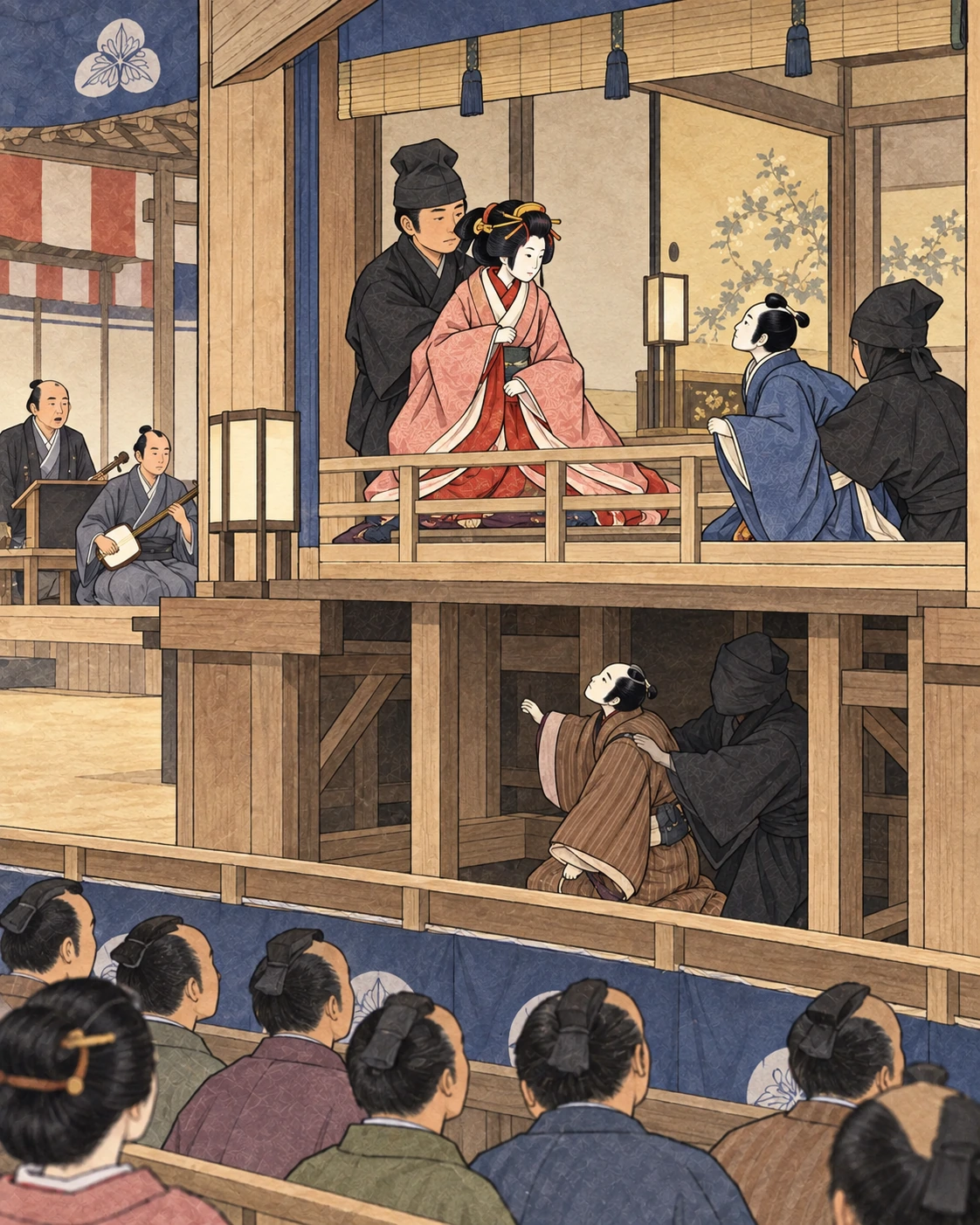
In the fourth month of 1703, the courtesan Ohatsu and merchant’s clerk Tokubei died together in the grove at Sonezaki. A month later, Osaka’s Takemoto-za staged Chikamatsu Monzaemon’s three-part Sonezaki shinjū. A recent incident supplied the play’s people and setting; Chikamatsu built the scenes through which audiences followed their deaths.
In 1683 Nobumori wrote Yotsugi Soga for Uji Kaga-no-jō. The play returned to the familiar world of the Soga brothers’ revenge and its aftermath. Takemoto Gidayū used it when opening Takemoto-za in Osaka in 1684. A year later, Chikamatsu’s Shusse Kagekiyo, about a defeated warrior, helped establish Gidayū’s reputation. The writer now had work carried by a new company as well as by an established chanter.
In 1686 the printed text of Sasaki Senjin, also known as Sasaki Ōkagami, displayed the name Chikamatsu Monzaemon as author. That is the first surviving signed example usually identified in his career. A signature was not yet routine. A 1687 book of theater commentary recorded both objection to the practice and acceptance of it as a writer’s commitment to the stage. The dispute shows that visible authorship was becoming a claim a theater audience could recognize.
The work remained shared. The tayū, or principal narrator, voiced every character as well as the narration. A shamisen player accompanied him on a three-stringed plucked instrument, shaping pauses and movement. Puppeteers gave the narrated people bodies. During Chikamatsu’s career an important puppet was normally handled by one operator; the three-person arrangement familiar today was introduced at Takemoto-za in 1734, after his death.
That earlier division of labor matters when imagining a scene. One voice could pass rapidly from an accusation to a frightened reply, while an operator held or changed a pose. Chikamatsu supplied language and action for that arrangement. His name gave successive texts a recognizable continuity, but neither print nor a signature preserved the whole performance. The modern name Bunraku became attached to the puppet-theater tradition later. Here, ningyō jōruri means the narrated puppet theater for which he actually wrote.
In the play, Tokubei is cheated of money by Kuheiji and publicly disgraced. Ohatsu conceals him beneath the veranda of her workplace. While responding to Kuheiji’s accusations above, she asks whether Tokubei is resolved to die; he answers by pressing her ankle to his throat. The concealed gesture lets spectators understand what the other characters cannot see.
Gidayū-style chanting and Tatsumatsu Hachirōbei’s handling of Ohatsu’s puppet helped the production succeed. He performed visibly, using the one-person puppet technique of the period. The hit helped spread sewamono, dramas about contemporary life. The fraud, gesture and dialogue belong to Chikamatsu’s staging of the incident; they do not supply independent testimony of what the historical couple said or experienced.
While developing his puppet-theater work, Chikamatsu also wrote for kabuki, performed by human actors. From the 1690s his plays were closely associated with Sakata Tōjūrō I, a celebrated Kyoto actor. Their collaboration belonged to Kamigata, the Kyoto–Osaka region, during the Genroku era of 1688–1704. Tōjūrō was known for wagoto, a softer acting style that made an elegant or vulnerable lover compelling onstage.
The relationship was practical and ongoing. The actor Kaneko Kichizaemon’s diary, quoted by the Hyōgo Prefectural Museum, records discussion of a new play with Chikamatsu in 1698. The entry places the dramatist in company with working actors rather than alone above them. A role had to suit the person who would speak it and the expectations spectators brought to that performer.
In Keisei Hotoke no Hara, first staged in 1699, a young lord appears in a townsman’s disguise and falls in love with a courtesan. The household’s succession troubles and the lover’s altered appearance gave Tōjūrō room to display both refinement and vulnerability. Chikamatsu could make rank and money act through the same character instead of explaining them in separate arguments.
An actor’s voice and body carried such a role together. In puppet theater, narration and movement were divided between performers, so the same kind of scene required a different arrangement. Chikamatsu worked in both forms for years, and surviving catalogs include more than thirty kabuki plays associated with him. The number does not recover every revision made during rehearsal.
Tōjūrō’s later career also complicates a familiar explanation of Chikamatsu’s turn toward Takemoto-za. Some accounts describe an early retirement as the decisive cause, but performance chronologies record appearances through 1708; he died in 1709. Chikamatsu’s closer attachment to the puppet company around 1705 overlapped that late acting career. The change was a gradual concentration of work, not the discovery of puppets after a human actor abruptly disappeared.
Much of Chikamatsu’s repertory was jidaimono: drama set in a historical or legendary world. The Soga revenge stories and Kagekiyo’s warrior legend already offered recognizable characters. A dramatist could bring a new conflict into such a world, or sekai, without recounting every event that earlier stories had established.
These plays freely rearranged inherited material. Relationships, motives and the order of events could change to give a scene a clear confrontation. A long struggle might become a dispute within one household. Audiences were watching a new treatment of a known world, not a documentary reconstruction. This helps explain how Chikamatsu could use history to examine loyalty while inventing the actions through which that loyalty was tested.
Tokugawa rule also affected what theaters could show. The shogunate was Japan’s warrior government, and licensed urban playhouses answered to local officials as well as to customers. Direct treatment of ruling houses or recent scandals could carry risks. Older settings and altered names gave companies room to approach sensitive questions at a distance.
An old setting, however, does not identify one concealed contemporary target. Such settings were useful conventions even without a particular political allusion. Nor is there evidence of one central censor reading every Chikamatsu line before performance. A manager’s judgment, a local order or a publisher’s caution could shape what reached the public. Assigning every change to government intervention would erase the writer’s and performers’ own theatrical decisions.
The commercial attraction worked in the other direction. A recent incident was something spectators might already be discussing, and a company could draw customers by staging it quickly. Familiar history and topical domestic drama offered different ways to secure attention. Both passed through a company that had to judge whether a subject could be performed, whether people would attend, and whether official intervention might interrupt the run. The more specific love-suicide restrictions came near the end of Chikamatsu’s career.
Chikamatsu helped establish a durable repertoire across kabuki and narrated puppet theater. Domestic tragedies such as The Love Suicides at Sonezaki made debt, employment and contractual dependence act through recognizable characters. His historical plays brought familiar legends and distant dynastic struggles into large theatrical worlds. These were distinct strengths within the same commercial career, not the invention of either form by one man.
The achievement was inseparable from performers and managers. Gidayū and his successors gave the words their voice; musicians and puppeteers shaped their pace and movement. Printed scripts then enabled works to circulate and to be adapted for different stages. Late-Meiji revivals and Tsubouchi Shōyō’s comparisons with European dramatists helped make Chikamatsu a national literary author, sometimes obscuring the collective theater for which he had written.
In Kyoto, Nobumori served court-noble households. Later accounts name Ichijō Ekan among his patrons, but the order and duration of these employments remain uncertain. Service brought him into a culture of classical stories and poetic exchange. In 1671 one of his verses appeared in Takaragura, a haikai collection that also included contributions from his family. Haikai was a collaborative poetic practice, often playful, in which writers answered one another through linked verses and allusion.