Read the article below. Interactive reading tools are available when scripts load.
Classic
Attendance at a ruler’s seat already existed under Hideyoshi and the first Tokugawa shoguns. Lords traveled for service and ceremony, and important households maintained residences near the governing center. Keeping relatives there could provide a guarantee of obedience.
The 1615 Laws for the Military Houses regulated the conduct and size of attending retinues. They also required reports on castle repairs and prohibited private marriages. Attendance thus formed part of a broader relationship between the shogun and territorial lords before Iemitsu’s revision.
In 1635 the revised laws explicitly prescribed alternating attendance in Edo. Their wording addressed both large and smaller lords. The institution developed across successive requirements, with hereditary and outside houses, official appointments and distance affecting its practical schedule.
Edo became a recurring place of service for men who still governed territories elsewhere. The rule required their presence at the shogun’s center without replacing each domain’s government. Family residence and restrictions on lordly conduct operated alongside the journey itself.
The categories reflected earlier political relationships. Hereditary houses had served the Tokugawa before unification; outside houses had entered the order from other allegiances. Their attendance schedules were not initially identical. A study of Nakasendō transport records describes the 1642 arrangement as fixing outside lords' attendance in the fourth lunar month and hereditary lords' in the sixth or eighth. Service in shogunal office could require a different pattern again. This was an expanding set of obligations, rather than a single journey invented in 1635 and imposed unchanged on every house.
The separate rules reinforced one another. A lord needed authorization for a castle's reconstruction and for a marriage that might create a powerful alliance, while attendance made his movements and household visible at Edo. These controls reduced the scope for independent action without abolishing territorial governments. Expense was a consequence to be managed: the attendance clause expressly criticized burdens on inhabitants, so the claim that its sole stated purpose was to bankrupt every lord cannot stand.
The attendance clause named the fourth lunar month as the time for arrival. Later timetables and exemptions altered this pattern. The general alternation between Edo and home therefore describes a governing arrangement rather than an identical calendar for every house.
The same clause criticized excessive followers as a burden on territories and inhabitants and required appropriate reductions. Lords traveled with attendants and equipment, but the law limited the size of that display. Rank and public service could still affect the retinue required.
Travel depended on a chain of roads, stations, horses, ferries and bridges. The 1635 laws expressly required these to remain available and prohibited private checkpoints and new restrictions on passage. A lord’s journey therefore relied on obligations imposed beyond his own retainers.
Principal wives and heirs occupied Edo residences during the lord’s absence. These residence requirements had developed separately from the attendance clause. They kept members of the ruling household within reach of the shogunate while the lord returned to his territory.
At Hakone, inspectors controlled women’s departure along the Tōkaidō. Women needed a checkpoint pass, including those who lived nearby. The checkpoint enforced the restriction on lordly women’s flight from Edo through a practice that also affected travelers outside daimyō households.
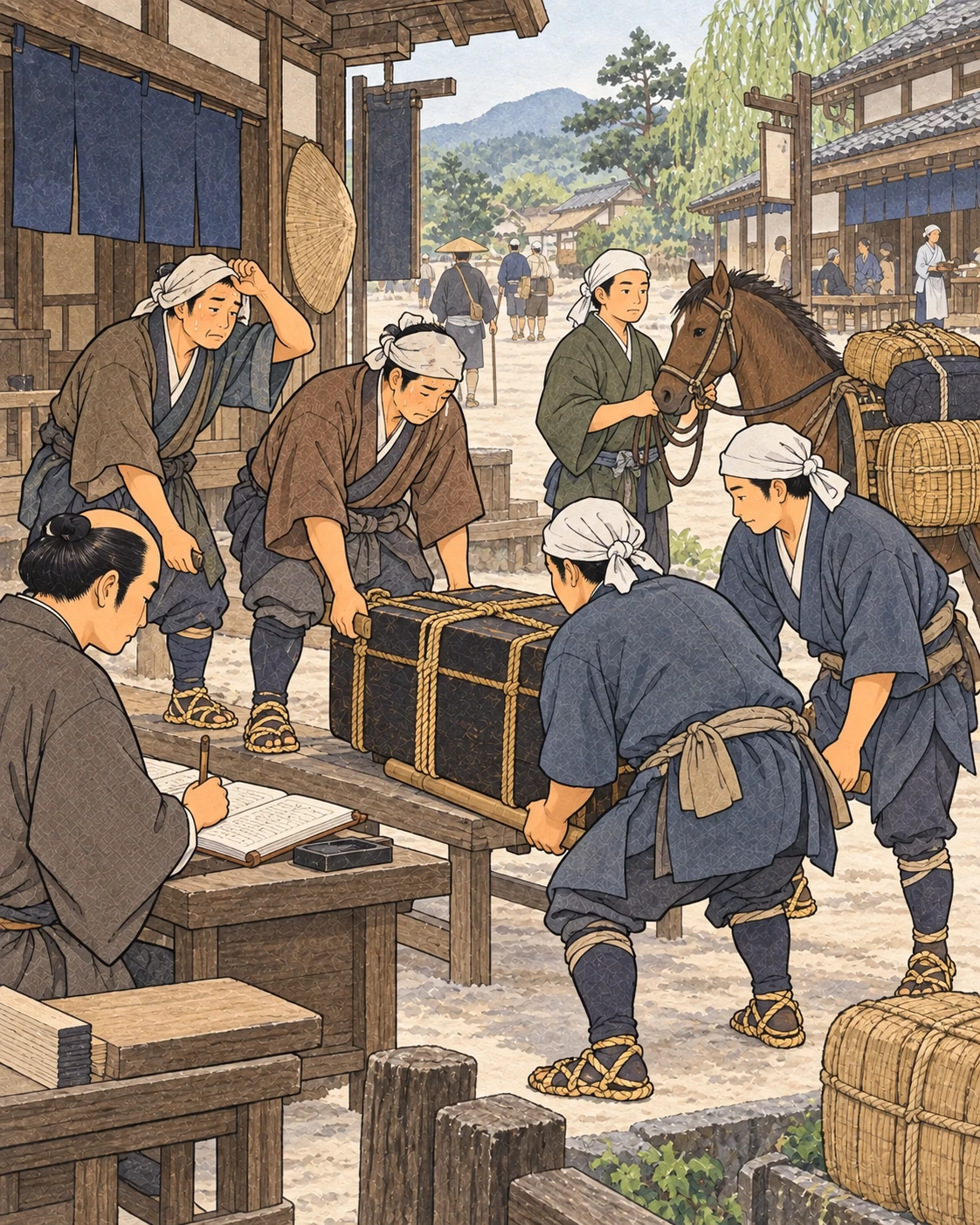
The journey’s transport work continued at successive stations. Supporting villages could be called upon to provide additional porters and horses. Innkeepers, carriers and suppliers also worked around the traffic. The lord’s scheduled movement brought recurrent demands to people whose homes stood along the route.
A later Kaga retainer's diary follows the preparation behind a procession. In 1855 Ogawa Sennosuke, ordered to accompany Maeda Nariyasu, submitted a list of his servants, arranged allowances and obtained permission to use a mountain palanquin because of illness. Instructions prescribed cotton clothes and prohibited gold or silver decoration on his swords. The party left Kanazawa on March 13; high waves near Oyashirazu delayed the main procession, which reached Edo on March 27. Arrival then required attendants to prepare furnishings and receive the lord and visitors. An orderly public appearance rested on paperwork, supplies and work before and after the road journey.
The women in Edo performed household work within restricted residence. In the Ii family, wives helped raise the heir and corresponded with the shogunal family and the women's establishment at Edo Castle, maintaining connections essential to the house. Letters and gifts also sustained family relationships across the separation. The rule placed them under constraint; it did not prevent them from conducting relationships or acquiring influence. A Saga example makes that activity explicit: Nabeshima Naomasa's wife Morihime, a shogun's daughter, wrote of her pleasure when he was rewarded for his work guarding Nagasaki. Marriage and correspondence joined the two ruling houses, without giving her free movement between them.
Alternating attendance made the serving lord repeatedly present in Edo. Ceremonial attendance and regulated movements sustained the shogun’s relationship with territorial households, while those houses continued to administer their domains through retainers.
The lord’s household operated across Edo and home. Wives and heirs remaining in Edo furnished a guarantee distinct from the lord’s periodic attendance. Their residence constrained family movement even when the lord had permission to return.
The costs included travel and the maintenance of an Edo establishment. The law’s complaint about oversized retinues shows official concern with expense and the labor drawn from inhabitants. Its prescribed reductions do not support treating unlimited expenditure as the stated purpose of the clause.
Road stations bore repeated transport demands. Wada’s records for 1832 list 17,759 porter services and 7,744 horse services over the year, heavily concentrated in spring. These later totals reveal the scale and seasonality of one station’s work; they cannot measure all routes or the burden in 1635.
The division was maintained by staff and correspondence. Before his 1855 departure, Nariyasu discussed arrangements for government during his absence. At the Edo residence, offices, family apartments and retainers' quarters occupied distinct spaces. Most Kaga retainers serving there came from Kanazawa on assignments rather than being recruited locally. Their allowances, rooms and periods of service required administration while the domain continued operating at home.
The smaller Takagi houses offer a documented comparison, not a model for every daimyō. They were direct Tokugawa retainers allowed to reside in their Mino territory and required to attend Edo by turns. Their Edo agents' diaries record shogunal notices, contacts with agents of other houses, and letters exchanged with the home household. Such records show how separate offices kept government in contact; the lord's departure did not suspend administration.
Transport obligations could clash directly with farm work. The Nakasendō study distinguishes free relay service from service paid at official rates. It places heavy demand in spring and the harvest season, when villagers also needed their own labor and horses. Some villages petitioned for exemption because the assigned station was distant, and assignments were revised. Wada's annual totals therefore need to be read alongside timing, payment rules and which villages supplied the work, rather than as a uniform charge borne equally along every road.
The recurring journeys supported demand for accommodation, transport and provisions along the major roads. Businesses supplied a regular lordly clientele, while stations and supporting villages furnished relay labor. Commercial earnings and service burdens reached different participants.
The institution lasted through changing schedules and requirements. In 1862 shogunal reforms shortened daimyō attendance and freed wives and heirs to live in Edo or at home. This altered both the journey requirement and the family guarantee that had accompanied it.
Hakone’s inspections made restrictions on women’s movement visible at a particular road barrier. The practice affected local women as well as elite households. Its history therefore extends beyond the lord and his ceremonial procession.
The buildings now shown at Hakone Sekisho were reconstructed after archaeological and documentary study. Excavation took place in 1999–2001; part opened in 2004, and the project was completed in 2007. They represent the former checkpoint’s working spaces through modern reconstruction, rather than surviving untouched from the seventeenth century.
The traffic carried family letters and gifts as well as ceremonial equipment. Retainers encountered metropolitan entertainments and fashions while living in Edo, where their employers sought to control spending and conduct. Kaga orders complained of elaborate clothing and singing in residence quarters; in 1780 the domain simplified procession equipment while changing the duration of Edo assignments. These examples put cultural contact and attempts at economy inside the continuing institution. They do not prove that every regional custom originated in Edo or that all cultural exchange followed a single direction.
The 1862 relaxation changed domestic lives too. Nabeshima Naomasa's later wife Fudehime and his successor's wife Komahime lived at Saga Castle after requirements eased. Fudehime found the new surroundings unfamiliar; Naomasa arranged a boat outing with her sister, who had married into the nearby Tachibana house. The change thus affected residence, kinship and daily activity alongside road traffic.
Procession equipment and reconstructed checkpoints make selected parts of this history visible. Banners, clothing and the order of attendants displayed rank, but the arrangements also depended on passes, wage and allowance rules, station labor and the upkeep of two establishments. Hakone's modern buildings recover working spaces through study and reconstruction. Reading them together with those obligations restores the people and administration behind later ceremonial pageantry.