Read the article below. Interactive reading tools are available when scripts load.
Quick
The Shimazu sought access to the Ryūkyū Kingdom’s China trade and pressed demands for recognition within the new Tokugawa order. When the kingdom did not send the requested mission, Shimazu Iehisa obtained authorization for an invasion. He appointed Kabayama Hisataka and Hirata Masumune to command the expedition in 1609.
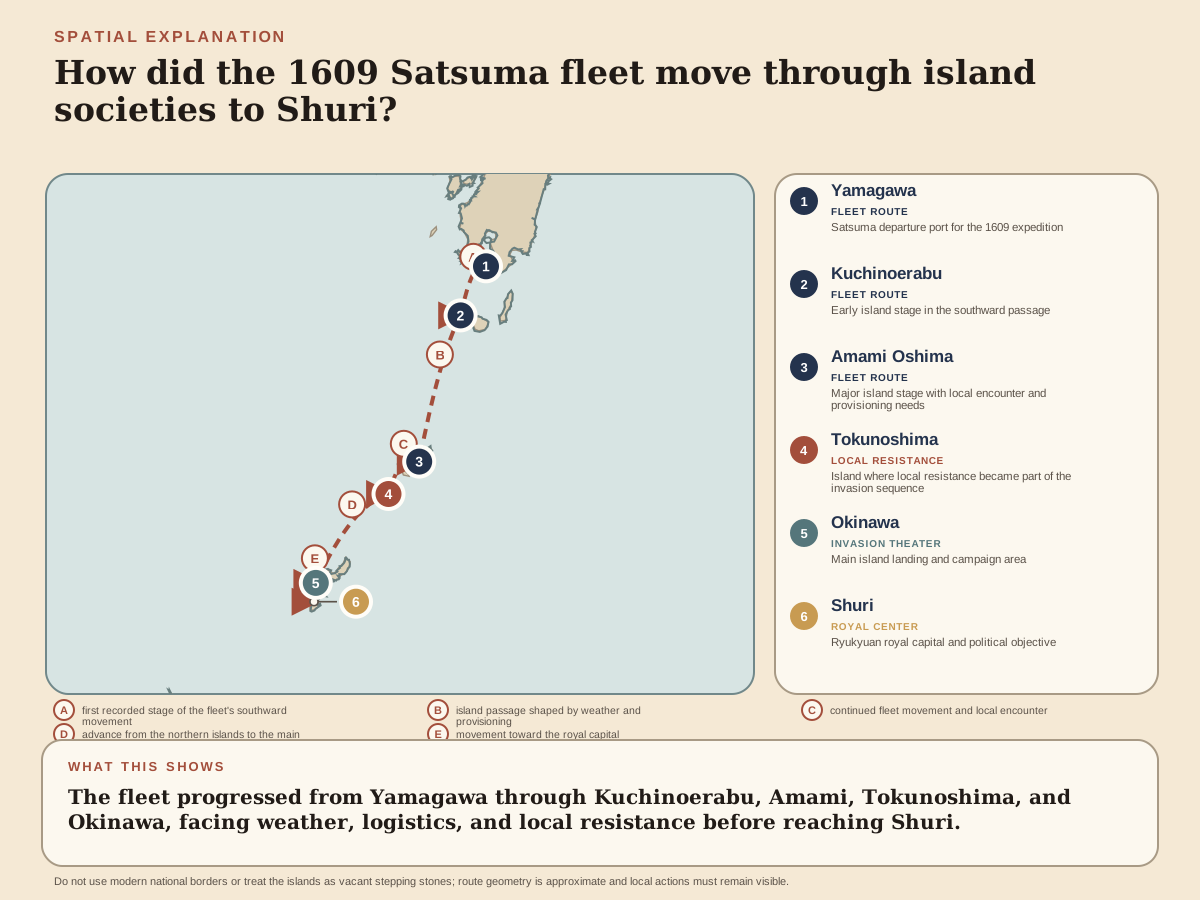
Ships assembled at Yamagawa. The surviving campaign log follows them past Kuchinoerabu to ports on Ōshima, then through Tokunoshima toward northern Okinawa. Waiting for wind, returning to a harbor and entering a different anchorage were part of the recorded advance. Fighting occurred in Amami before the force reached the capital region. The expedition attacked Shuri by land and sea, overcame the kingdom’s resistance and carried Shō Nei away to Satsuma.
In 1610 Iehisa took the captive king to Sunpu to meet the retired Ieyasu and then to Edo to meet Hidetada. The presentations of gifts and recognition of Shimazu service placed the conquest within Tokugawa authority. Shō Nei returned in 1611, accompanied by members of the party who had shared his captivity.
The settlement preserved the government at Shuri under Satsuma control. Land measurement and annual payments were introduced, the Fifteen Injunctions were issued in 1611, and officials continued to be sent to Satsuma as hostages. A territorial list left Kikai, Ōshima, Tokunoshima, Okinoerabu and Yoron outside the territory retained by the kingdom.
Ryūkyū’s relations with China continued through its royal government and envoys. Satsuma used that channel for trade while imposing obligations on the kingdom. The conquest therefore changed both the kingdom’s freedom of action and the administration of the northern islands. The later abolition of the kingdom by the Meiji government was a separate event.
Classic
The Ryūkyū Kingdom’s tribute and commercial relations connected it to China and wider maritime networks. These links made the kingdom valuable to the Shimazu, whose own territory lay at the southern end of Japan. Access to Chinese commerce was a substantial interest in their pressure on Ryūkyū.
Shimazu claims of earlier jurisdiction also appeared in demands for missions and recognition. Following the establishment of Tokugawa rule, the Shimazu requested that the king acknowledge the new ruler. Later Japanese accounts used the absence of that mission to justify military action.
Iehisa obtained Tokugawa permission and sent commanders Kabayama Hisataka and Hirata Masumune. The decision converted the Shimazu demands into an expedition against a separate kingdom. The king’s relations with China continued to give his government a role that the invaders wanted to control.
The court chronicle later blamed a royal adviser for the failed exchange and represented surrender through the language of submission. That explanation was written after conquest under constrained royal government. It supplies evidence of how the court recorded its defeat, alongside the Japanese accounts that defended Shimazu claims.
A mission to acknowledge the Tokugawa could establish a political precedent without a territorial transfer. Satsuma treated its demands as grounds for enforcement, but a disputed exchange did not itself launch ships. Iehisa chose to assemble the expedition and obtained permission within the new Japanese government. The kingdom's established links with China made it valuable precisely because its court, envoys and trading arrangements supplied a channel the Shimazu did not possess in the same form. Preserving those institutions under domination was a subsequent arrangement, rather than proof of a fully specified prewar plan.
The expedition assembled ships at Yamagawa in 1609. The campaign log records a wait for a favorable wind before departure, then a stop at Kuchinoerabu. The advance depended on a succession of sailings and anchorages rather than a single uninterrupted crossing.
On Ōshima the ships moved among Fukae-ura, Yamato-hama and Nishikomi. An attempted departure from Nishikomi ended in a return when the wind failed. At Tokunoshima, a calm brought the ships into Kametsu after a departure from Akitoku; they subsequently sailed south past Okinoerabu toward Kōri off northern Okinawa.
Japanese accounts record resistance and killings in Amami. The fleets entered inhabited islands associated with the Ryūkyū government before approaching Shuri. These communities encountered the expedition first, and the territorial settlement later placed several northern islands under direct Shimazu administration.
The invaders then approached the capital region by land and sea. Royal forces resisted, but the Shimazu expedition prevailed and Shuri surrendered. Kabayama and Hirata’s campaign ended with the king in the victors’ custody.
Shō Nei and accompanying officials were taken to Satsuma in 1609. Their absence removed the ruler and senior members of the court from the kingdom. Kian, who had served the king as a tea master, accompanied him and later recorded the journey in his account of the invasion and captivity.
The party’s movement continued beyond Satsuma. In 1610 Iehisa brought the king to Ieyasu at Sunpu and Hidetada at Edo. Japanese accounts list the gifts presented, the audiences and honors given to the Shimazu. They made the conquest and the captive ruler visible to the Tokugawa governing centers.
The island communities did more than watch the ships pass. At Te-kebu on Ōshima, residents defended the shore behind barriers. On Tokunoshima, islanders opposed the landings but faced Japanese firearms, including fire associated with the expedition's ships. These defenses could not stop the concentrated force. Their defeat was a result of unequal military capacity, not evidence that Ryūkyū had an inherently nonviolent culture or no experience of armed defense.
The campaign records' killings and the removal of the royal party identify direct human losses without supplying a census of all affected communities. The islanders encountered ships, armed landings and the loss of existing jurisdiction; at Shuri, the king and senior officials were taken away. The records name some leaders and companions much more readily than ordinary families. Exact casualty totals or a uniform account of every farmer's requisition and flight would exceed what these sources establish.
The return to Satsuma also requires care. The expedition's log and Kian's account give different stops and arrival dates for the 1609 northward journey. A comparison of their routes therefore cannot turn one ship's itinerary into a single schedule shared by the entire captured party. Both belong to the record of conquest and removal, while their particular stages remain distinct.
The king returned to Ryūkyū in 1611. Shuri again had its ruler and continuing royal institutions, while the Shimazu retained authority over the imposed settlement. Kian’s account follows the return voyage and places it within the same period of captivity and release.
The territorial list recorded by the court in 1611 excluded Kikai, Ōshima, Tokunoshima, Okinoerabu and Yoron. These islands had previously belonged to the kingdom’s jurisdiction. Their transfer produced a different governing position from that of the territory left under the king.
The court chronicle records land measurement, boundaries and annual payments to Satsuma. These operations converted conquest into continuing fiscal obligations. The Fifteen Injunctions and a catalogued oath dated to 1611 belong to the documents of the postwar settlement.
Officials were subsequently sent to reside in Satsuma as hostages, with others replacing them after illness or the end of a term. The court’s lists preserve names and successive assignments. The king’s return was thus followed by continuing demands on his officials and household, as well as on the kingdom’s revenues.
The king's title did not make the Sunpu and Edo visits exchanges between free and equal rulers. He traveled in Iehisa's custody and was presented to the retired Ieyasu and serving shogun Hidetada. Neither was an emperor. Japanese accounts listed offerings and rewards to the Shimazu as evidence of service to the Tokugawa; the king's subsequent return left that hierarchy in force. The catalogued oath and injunctions show formalization of the settlement, while surveys, payments and hostage rotations show its continuing operation.
The hostage lists also bring the pressure inside households. The court records that when Mabuni Ankō became ill, his son remained in Satsuma in his place. Return or replacement of one official did not end the requirement. Royal government at Shuri survived, but revenues and the availability of its officials now answered imposed demands.
The royal government continued sending envoys to China. The court chronicle records a mission after the invasion and later reporting through Satsuma. Japanese compilations also preserve requests to use Ryūkyū’s contacts to restore or enlarge commercial exchanges with Ming China.
These relations required the kingdom’s envoys and court to work across unequal demands. Chinese recognition of the royal line continued, while Satsuma claimed authority over its government and benefited from the trading channel. Diplomatic continuity existed alongside the new fiscal and political restrictions.
Northern island communities lived under the different administration created by territorial separation. The court noted their earlier connection to the kingdom and continuing similarities in appearance and clothing. Their exclusion from the king’s grant changed jurisdiction across an island chain with established social ties.
The invasion was remembered through records with different positions and dates. Kian’s account contains observations associated with the captive party but was composed retrospectively and survives in later copies. Court chronicles and Japanese compilations explain the conquest within their own institutions. Together they document force, captivity and imposed government, while their speeches and justifications require separate evaluation.
Administration gave the separation of the northern islands practical form. On Ōshima, older magiri districts continued, but they were divided into smaller administrative units and supplied with changed local offices. Institutional continuity thus coexisted with direct Shimazu supervision. The exchange of social and diplomatic forms across the islands did not undo the loss of jurisdiction recorded in the king's territorial grant.
The royal chronicle records advice to preserve a China mission because disclosure of Satsuma subordination might obstruct tribute. Japanese compilations describe commercial requests made through the king. Such passages reveal demands imposed on the same envoys from different sides; they do not establish that China accepted every Japanese proposal or remained wholly unaware of the conquest.
The separate nineteenth-century sequence altered this arrangement again. The Meiji government established Ryūkyū-han in 1872 and imposed Okinawa Prefecture in 1879, bringing the kingdom's institutions to an end. That later annexation cannot supply a national destiny for the invasion of 1609. The earlier event was conquest followed by a constrained, continuing kingdom, with the northern islands under a different form of control.