American shipping gave President Millard Fillmore’s mission concrete aims. His letter described vessels crossing the Pacific and whalers operating near Japan. Wrecked crews needed protection, while steamships needed coal and water. He requested access to a port where those supplies could be purchased, as well as commercial relations.
Japan already maintained regulated overseas contacts. Nagasaki handled Chinese and Dutch trade, and Japanese officials possessed records of earlier approaches by foreign missions. In 1850 the shogunate commissioned the compilation of Tsūkō ichiran, a collection of diplomatic precedents completed in 1853. Information existed; the difficulty was deciding how to use it when an armed mission refused the established channel.
Coastal preparations also predated Perry. By 1847, Kawagoe, Oshi, Hikone and Aizu had been assigned guard responsibilities on the Sagami and Bōsō coasts. The arrival therefore confronted an existing administration of magistrates, interpreters and domain guards. It exposed the distance between maintaining that system and possessing ships and defenses adequate for a confrontation near Edo.
Fillmore suggested suspending restrictions on commerce for five or ten years as an experiment. Perry’s accompanying letter supplied English, Dutch and Chinese copies and offered assurances of peaceful intentions, but also warned that he could return with a larger force. Four warships, including two steamers, backed the request. Negotiation concerned castaways and supplies as well as trade, and accepting the papers would not itself concede all those demands.
The response fell to the shogunate’s senior officials, headed by Abe Masahiro. Coastal domains would help guard the approaches to Edo and bear the work of preparation. A decision on the American request consequently required more than an interpreter’s answer at Uraga: officials had to decide what they could concede, what they could defend and whose advice they needed.
Perry appeared off Uraga on July 8, 1853. Officials including Nakajima Saburosuke dealt with the mission and directed it toward Nagasaki. Perry rejected that instruction and pressed to present the presidential document through a higher-level reception.
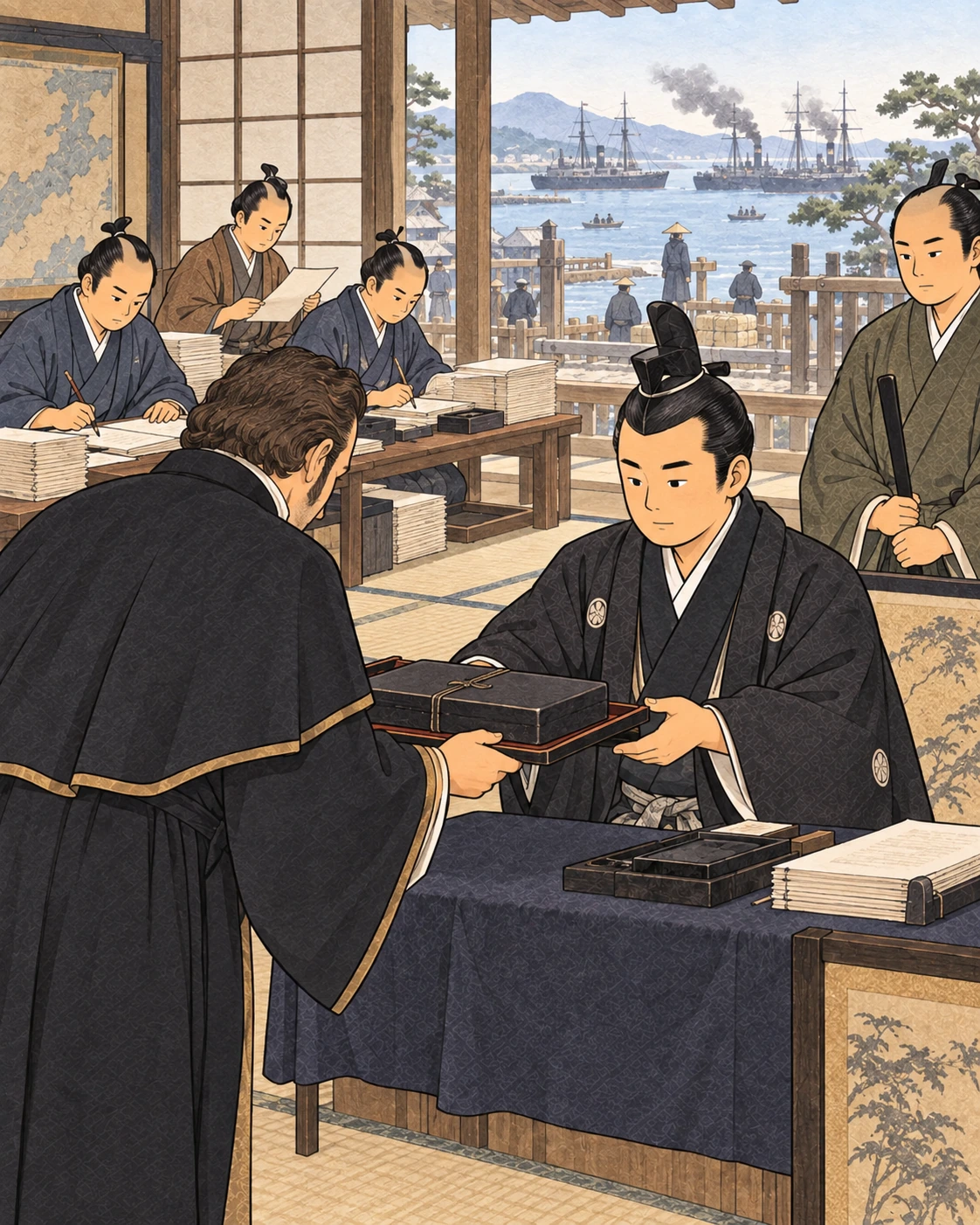
The fleet advanced farther into Edo Bay while demanding that the letter be received. The shogunate agreed to a meeting at Kurihama, where a temporary reception site was prepared. On July 14, Uraga magistrates Toda Ujiyoshi and Ido Hiromichi accepted the documents. The exchange gave Japanese officials a request to consider; it did not produce the commercial agreement Fillmore wanted.
After the fleet withdrew, Abe Masahiro had Japanese translations of the American documents prepared and shown to the lords, requesting their opinions. This enlarged consultation beyond the senior officials who normally directed the response. The documents made the demands available for argument within domains, whose lords could submit proposals through the government’s own procedure.
The advice did not converge on a single policy. Tokugawa Nariaki, the former Mito lord, pressed for rejecting the opening demands and strengthening coastal defense. Military preparation could accompany resistance to concessions. Hikone lord Ii Naosuke proposed a different sequence: avoid immediate war, permit trade, study navigation and train naval forces. His second memorandum also allowed for restoring restrictions later. Agreement that Japan needed stronger defenses did not settle whether commerce should begin while those defenses were being built.
Ii’s advice drew on work within Hikone. His Confucian adviser Nakagawa Rokurō prepared Chūhen kanken, advocating restricted opening and commerce to avert immediate fighting and strengthen resources. Ii submitted two opinions; the surviving second draft belongs to the eighth month of the Japanese calendar in 1853. It records a domain proposal, rather than a cabinet decision implementing every part of that proposal.
Abe’s request gathered alternatives while negotiation remained the shogunate’s responsibility. The lords had been invited to judge the terms and the country’s capacity to resist them. Receiving their answers could help officials consider a response, but it neither gave the domains a binding vote nor removed Perry’s threatened return.
The first visit ended without battle or a final treaty. The letter had been received and the fleet had withdrawn. Perry’s warning of a larger return meant that the interval for discussion was also an interval for preparation under continuing pressure.
The government expanded guard assignments around Edo Bay and began offshore battery construction near Shinagawa. Egawa Tarōzaemon’s plan called for eleven batteries. None was ready when Perry returned in 1854; the first three were completed in that year’s seventh month in the Japanese calendar. Funding difficulties reduced the completed program to six. A construction order could set work in motion, but it could not make the whole planned defensive line available before the next negotiation.
Consultation left written proposals rather than a consensus. Ii’s surviving draft and Nakagawa’s advice preserve one approach to strengthening naval capacity through limited commerce. Nariaki’s opposition shows why preparation alone did not resolve the policy dispute. No submitted memorandum entitled its author to claim that the eventual settlement followed his plan in full.
The negotiations resumed in 1854. The Kanagawa convention opened Shimoda and Hakodate to American ships for supplies and castaway assistance. Its rules required supplies and permitted purchases to pass through appointed Japanese officers, and restricted ordinary American access to those two ports. Those provisions explain the immediate compromise more precisely than saying that the first arrival brought unrestricted trade.
The 1853 reception and the 1854 agreement were separate steps. The first secured time to consider demands; the second established defined port access. Defenses were still being completed after the agreement, while later commercial negotiations would raise terms beyond the first convention.
Abe’s consultation gave lords a government-sanctioned occasion to argue about foreign policy. It did not establish a permanent representative assembly. It did, however, leave specific demands and written judgments outside the senior council, so later concessions could be compared with advice that the government itself had requested.
The subsequent commercial treaty dispute made the question of authority sharper. Hotta Masayoshi’s government sought imperial sanction after lords argued that it was required, but failed to obtain it. In 1858, after Ii Naosuke became tairō, Japanese negotiators signed the commercial treaty under his authorization without that sanction. The dispute involved later decisions and a different agreement; it cannot be treated as an outcome already determined at Kurihama in 1853.
Preparation also developed through institutions and personnel. Katsu Kaishū submitted a coastal-defense opinion in 1853 and went to the Nagasaki naval training establishment in 1855. His subsequent training illustrates how proposals for navigation required instruction and practical work. The naval program was not completed by circulating a memorandum or building a battery.
The finished batteries were assigned to guarding domains. Plans for the third battery distinguish powder storage, gun positions and guard quarters; coastal-defense prints recorded domains and their assigned areas for readers in Edo. These objects show the administrative and material work behind the familiar image of the black ships.
American naval pressure remained decisive to the encounter, but Japanese officials translated, negotiated, consulted and organized defenses under that pressure. The surviving American letters state the mission’s demands; the Hikone draft records one answer among competing proposals. Neither document supplies a complete transcript of government deliberation. Together with the defense records, they explain why the first visit became both an armed diplomatic crisis and an enlargement of political consultation.
The shock of Perry’s arrival strengthened reform programs already being argued inside domains and teaching networks. Sakuma Shōzan linked coastal defense to the study of Western military knowledge, while Shimazu Nariakira used Satsuma resources to pursue shipbuilding and industrial experiments. Neither caused Perry’s mission, but both helped shape the Japanese response.
Shōzan's schools changed with his interests, from Confucian study to coastal defense and Western gunnery. Yoshida Shōin became a pupil whose search for overseas knowledge would directly affect his teacher's life. Katsu Kaishū, another man associated with his teaching, also entered Shōzan's family network: Shōzan married Katsu's sister Junko. Kinship and intellectual exchange connected the households without making their careers identical.
After taking office, Nariakira established an experimental laboratory within Kagoshima castle. Its work ranged across chemical processes, casting, glass, alcohol and other materials. The laboratory gave experiments a place within domain administration; promising methods could then be considered for larger production. This connection between testing and manufacture was central to the programme.