HO Guides
Sagara Castle: Taking Possession
A castle changed hands, and its plan survived in another domain. The receiving party's records help explain what happened between a lord's dismissal and the disappearance of his walls.
Quick · About 2 min
The story in five points
A short route through the argument. Follow a point into Classic for its context and sources.
Confiscation needed a receiving party
The shogunate ordered Kishiwada lord Okabe Nagatomo to receive Tanuma Okitsugu's Sagara Castle in 1787. He acted for the taking authority, rather than inheriting the property or becoming its ordinary successor as territorial lord.
Read in contextThe castle depended on permission
Tanuma's territorial seat developed separately from his Edo government work. Permission preceded a long construction campaign. Enclosures, palace and approaches formed an establishment whose possession could later be withdrawn by the authority that had authorized it.
Read in contextA map explains what was taken
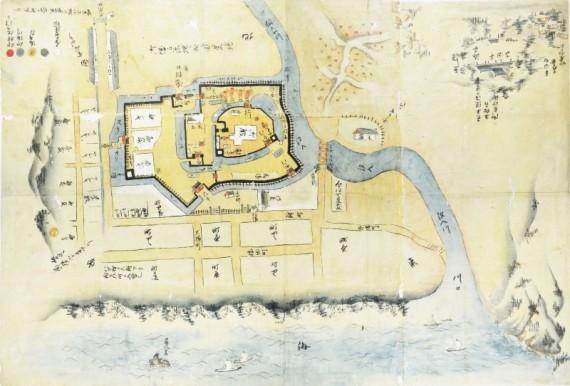
A colored plan distinguishes river, moats, enclosures, town streets and outward routes. It locates a fortified residence within a coastal settlement, supplying the receiving assignment with a concrete spatial setting beyond a sentence about political downfall.
Read in contextVillage papers widened the record
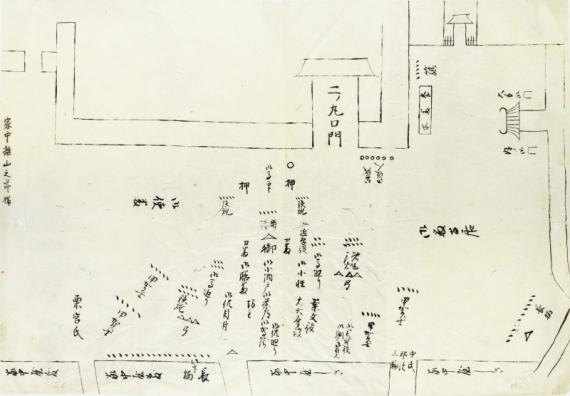
Senior headmen from Kishiwada traveled to greet their lord, and drawings survived in a headman's family archive. A second sheet arranged the departing household and separately identified shogunal officials; its weapons indicate an armed following, not demonstrated combat.
Read in contextDismantling scattered different survivals
The castle was dismantled in 1788 after possession changed. A bank remains on site, attributed palace panels survive elsewhere, and distant drawings recover broader relationships. The modern museum brings evidence together without recreating an uninterrupted castle interior.
Read in context
Opening
A colored plan of Sagara Castle survives among the papers of a village headman's family far from Sagara. The family lived at Hatakenaka, in the domain of Kishiwada near Osaka. Their drawing depicts another lord's residence on the Pacific coast: its enclosures, waterways, streets, and exits. Related documents place it around 1787, when the shogunate confiscated the castle from Tanuma Okitsugu.[1]
The distance is the clue. Kishiwada's lord had been ordered to receive Sagara Castle on the shogunate's behalf. Senior village headmen from his domain traveled there to greet him. Their connection to Sagara was neither ownership of its land nor service to Tanuma. It arose from the assignment given to their own lord.[2]
The castle was dismantled the following year. Following the transfer before that destruction reveals a process hidden by the familiar description of Tanuma's fall: a decision made at the center had to become a change of possession at a particular defended place. Sagara's plan and a second drawing of the receiving party preserve different parts of that passage.
1. Permission before the Palace
Tanuma became lord of Sagara in 1758. His career was based at Edo, the city now called Tokyo, where he served the Tokugawa shogunal government. Sagara gave him a territorial seat elsewhere. The distinction between those positions is essential: the provincial castle was connected to his standing at the center, but it was not the building in which he conducted all his work for the shogunate.[3]
Permission to build a castle came in 1767, and construction began in 1768. Makinohara City's chronology dates completion to 1780 and records a visit by Tanuma that year lasting about ten days.[3] The works thus occupied a much longer interval than that particular stay. A residence could organize a domain's establishment without requiring its lord to remain there continuously.
The completed arrangement had a Honmaru, the principal enclosure, with a palace; a Ninomaru, or second enclosure; and an outer Sannomaru. These names identify parts of a connected fortified seat. They are more useful than imagining the castle as one large house, because taking possession involved the spaces and approaches around the palace as well as the palace itself.[4]
The prior permission is equally important. Tanuma's position as a territorial lord did not make the decision to establish this castle independent of the shogunate. His local residence took shape within an authorized relationship. Later, another order from that government would remove it from his family's possession.
That connection should not collapse the castle's history into a verdict on Tanuma's national policies. The record of permission, construction, and transfer answers a narrower question: how a particular provincial seat was created and then withdrawn. Its rooms cannot establish the results of every measure he supported at Edo, any more than their demolition can establish what every inhabitant of Sagara thought of him.
The surviving plan makes the narrower question substantial enough. It supplies a place with internal divisions, a river edge, and a surrounding settlement—an establishment that had to be approached and occupied before it could be taken apart.
2. Water Divides the Drawing
The old plan's color gives its most immediate explanation. Blue water winds past the castle and extends into the enclosing moats. Yellow distinguishes open ground and roads from the pale plots occupied by buildings and residences. Red marks selected gates and shrines. The reader can follow connections through this arrangement before deciphering every small name.[5]
The river is not drawn as a moat of uniform width. Its broader course belongs to the landscape outside the enclosures, while narrower channels carry the defended boundary around them. The distinction puts the castle in contact with its setting: the same water system participates in the surrounding district and in the separation of the lord's occupied ground.
Within that system, the principal enclosure and Ninomaru remain distinguishable. Their boundaries do not become one uninterrupted rectangular wall merely because they belong to the same castle. Passage into and between enclosures depends on the points where roads meet those boundaries. The plan gives access a shape, rather than leaving it as an abstract right to enter.
Beyond the castle, blocks of town houses extend toward the sea. Other plots lie along the landward approaches. Boats appear offshore. Their presence identifies the seaward side as part of the draughtsman's account; their number cannot be read as a count of traffic on a particular day. The castle is shown within a coastal settlement, not on an island of military space detached from everything around it.[5]
At one exit, Ōhara-guchi, an annotation points toward Kanaya on the Tōkaidō, the principal road linking Edo and Kyoto. Kaizuka's reading of the inscription identifies a distance of four ri and a nearby avenue of small pines.[6] Here the map reaches beyond its own edge. It gives a departing traveler a direction toward another route without attempting to draw that route all the way to its destination.
For someone coming from another domain, these relationships would be useful distinctions: river and moat, town and enclosure, internal gate and outward road. This does not prove that a particular headman unfolded the sheet at a particular crossing. It explains what the document made available to a reader involved in a journey to an unfamiliar castle.
3. Receiving Was a Separate Assignment
Tanuma lost his senior office after Shogun Ieharu's death in 1786. Confiscations followed. In 1787, the shogunate ordered Okabe Nagatomo, lord of Kishiwada, to receive Sagara Castle. Makinohara's chronology places the castle's confiscation in the eleventh month of that year.[7]
Nagatomo was not arriving as Tanuma's heir. He was carrying out a commission from the authority taking the castle. The difference explains why Sagara appears in the records of a domain whose own seat remained near Osaka. A lord's assignment could take his household beyond the lands over which he normally governed.
The transfer consequently joined three relationships at Sagara. The Tanuma house was losing the property. The shogunate was taking it. A different territorial lord undertook the receiving work. Describing the result as a change from one lord to another would make Nagatomo's role resemble an ordinary succession and conceal the government on whose behalf he acted.
The geographical plan becomes especially valuable at this point. Its gates and enclosures were the setting in which an order concerning possession had to be given effect. A palace approached through water defenses and controlled passages was a particular kind of property to receive. The incoming party had to occupy a place already arranged around the household that was losing it.
The documents do not require an imagined confrontation at the gate. No dialogue between departing and arriving officials is needed to explain the transfer. The named appointment supplies the authority; the mapped grounds supply its local object. A companion drawing supplies the receiving party's own ordered presence within them.
Before turning to that drawing, however, the village papers deserve attention. Their preservation widens the circle beyond officials whose names appear in a summary of the confiscation. People attached to Nagatomo's domain had reasons to follow his assignment without becoming the men appointed to receive the castle themselves.
4. Seven Households Follow Their Lord
The village papers belonged to the Kaname family of Hatakenaka. The family is associated with Kishiwada's Seven Headmen, a group of senior village representatives who mediated between the domain and its settlements. These men retained their village responsibilities while enjoying distinctions, including permission to bear swords, that set them apart from other headmen.[8][17]
Those distinctions make their attendance on Nagatomo more intelligible. They were approaching the lord through a recognized relationship, not simply appearing as curious spectators at another domain's castle. Kaizuka's later study of their papers follows greetings, visits, and permissions as part of that relationship.
A date in the same study also imposes a useful limit. It records the appointment of the Hatakenaka headman Gendayū to the Seven Headmen in 1789, two years after Sagara's confiscation.[17] The map's survival in this family's archive therefore does not identify him personally as one of the seven men who went to Sagara in 1787. The collective journey and the history of one household must be kept separate.
A petition from 1791 shows how that household's standing was articulated. Gendayū asked for permission to wear a sword outside the domain, citing a privilege formerly granted to his father. His existing permissions included greetings to the lord and presentation of the first rice of the harvest. The petition distinguishes privileges already held from another being requested.[17]
The document is later than the Sagara journey, not a pass used on it. It makes the broader relationship concrete, however. Personal attendance could be an acknowledged distinction within village leadership. A lord's assignment elsewhere could consequently draw attention from people whose position at home included particular forms of access to him.
The map study proposes that the Sagara plan was made in connection with the Seven Headmen's visit. Its exact commission is not recorded on the sheet.[9] What survives securely is the conjunction of a documented receiving assignment, a documented visit by the group, and drawings retained among village papers. The archive preserves a connection with Sagara without supplying a complete biography of every person who handled the paper.
5. A Departure Arranged on Paper
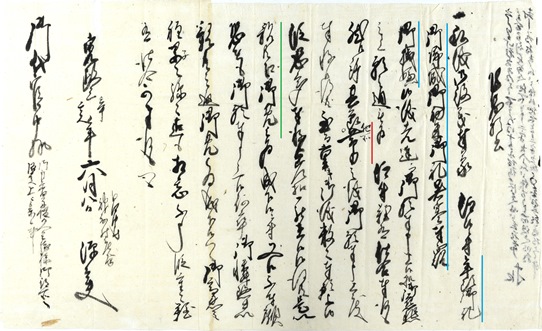
The second drawing is titled Kachū rizan no setsu sonae: the disposition of the household when leaving. Kaizuka identifies it with the Kishiwada party's departure from Sagara. Unlike the colored geographical plan, this sheet concentrates on groups of people in relation to Nagatomo and the castle's spaces.[10]
At its center stands the character go, an honorific reference identified with the lord. Groups carrying firearms, bows, and long spears appear around him, together with other parts of his following. The Ninomaru entrance is separately marked. Near it, the drawing places officials explicitly identified with the shogunate.[10][11]
The composition gives position to relationships that the first plan could not show. Blue water can distinguish an enclosure; it cannot identify which authority a group of men represents. Here the lord occupies the center of his following while another government's officials have their own place near a gate. The receiving agent and the authority commissioning him remain distinct within the same setting.
The space around the central character matters too. The groups are distributed rather than compressed into a list underneath Nagatomo's name. On the reproduced sheet, lines of writing occupy different parts of the open area, bounded by the indicated buildings and entrances. The drawing preserves an arrangement of presence: who is placed around whom, and where that assembly meets the castle's built boundary.[11]
Weapons belong to that arrangement. Their inclusion does not turn the sheet into evidence that a battle took place during the transfer. The declared occasion is departure. A lord's official movement could be represented through an armed following even when the document records neither an attack nor resistance. Reading every spear as an imminent encounter would replace the drawing's stated task with another story.
The two sheets consequently operate at different scales. One makes Sagara's enclosure system understandable within its coastal town. The other makes a visiting household understandable within the castle. The first provides places to enter and leave; the second orders people for a particular stage in their use. Together they give the receiving commission a physical setting that a sentence about confiscation alone would not supply.
6. After Possession, Dismantling
Sagara Castle was dismantled in 1788. The interval separates taking the property from removing its buildings. The shogunate's control could first be expressed through a receiving party occupying the existing arrangement; the later work changed the arrangement itself.[12]
The absence now encountered at Sagara therefore has a dated cause. It is not simply the gradual decay of a palace whose last lord stopped visiting. Construction had made a fortified residence; confiscation ended the Tanuma house's possession; dismantling removed the buildings that had given that residence its form. Each changed a different part of the relationship between household and place.
Removal was also uneven in its material consequences. A surviving bank in the former Ninomaru carries black pines beside the modern primary-school grounds. Makinohara identifies it as part of the castle's remaining earthwork landscape. The bank retains a line and a change of level, but it cannot supply the gate and palace arrangement visible in the old drawing.[13]
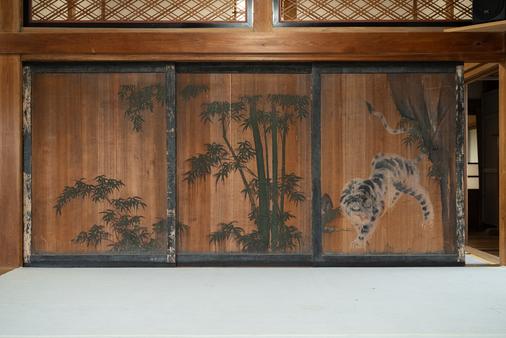
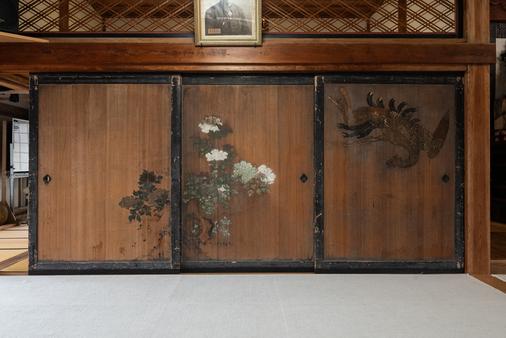
Some associated building elements have a different location. Hannya-ji, a temple outside the castle site, preserves painted cedar door panels thought to have belonged to the Honmaru palace. The municipality attributes their painting traditionally to Kanō Michinobu. Photographs show scenes of a tiger among bamboo and a phoenix with peonies, carried across separate framed wooden panels.[14][15]
The panel is a different unit of survival from an enclosure bank. It can be removed, retained, and installed indoors elsewhere. The painted surface continues to join carpentry and decoration, although it no longer establishes the location of the room for which it was made. Its castle attribution concerns provenance; its present temple setting concerns subsequent custody. The precise route by which the panels reached the temple remains less securely documented than their presence there.
These remains do not recreate one continuous castle interior. They preserve different parts of what the dismantling separated: ground at Sagara, associated decorated timber elsewhere, and drawings in collections beyond the former domain. Bringing them together is an act of historical explanation, not a claim that their current arrangement reproduces the castle of 1787.
7. The Castle Returns as a Record
Makinohara's museum now stands in the former Honmaru area. Its collection presentation includes a copy of a Sagara Castle drawing whose original is held by the University of the Sacred Heart in Tokyo. That is a different drawing from the one preserved in the Kishiwada headman's papers. The museum brings a documented image back to the place without claiming that the original sheet has always remained there.[16]
The distinction is useful at a site whose buildings have disappeared. A plan can restore relationships too extensive for one surviving bank to convey. An object can preserve material absent from a drawn outline. The modern museum gives these kinds of evidence a common point of reference at the former principal enclosure.
The Kishiwada papers add something neither a reconstructed palace nor a list of Tanuma's offices would necessarily show. The castle's ending drew another lord, his following, and village representatives into Sagara. Their records preserve the place at the moment when it ceased to belong to the household that had built it.
Sagara was lost through more than a change in its owner's reputation. A government appointed someone to take possession; that appointment brought people to the castle; their presence was organized within its spaces; its buildings were subsequently removed. The drawing in the village archive keeps one part of that process visible. It survived far away because the authority exercised at Sagara reached far beyond the town.
Next topic · HO Guides
Kanegasaki and Fujishima: A Shrine Can Move
The ground of a medieval campaign stayed where it was. The institutions preserving its memory acquired other addresses—and other responsibilities.
Continue readingSources and NotesView sourcesHide sources
Online sources were consulted on 16 September 2026. The two drawings in the Kaname family papers are cited through the municipality's reproductions and published interpretation. Associated journey manuscripts were known through the municipal course report, not independently transcribed. Dates expressed as numbered months retain the historical Japanese calendar. The article concerns construction, custody, and dismantling at Sagara, not a judgment on Tanuma's character or the overall merits of his policies.
- [1]
Kaizuka City, “古絵図をひも解く—相良城受け取りと岸和田藩,” Temps, no. 52, p. 4, two paragraphs accompanying figure 1. The undated map's approximate 1787 attribution comes from associated documents; no dated colophon or exact copying commission is claimed. https://www.city.kaizuka.lg.jp/bunkazai/kankobutsu/temps/tenpsitiran/25tenps/tenp52/tenp52html/tenp52_4.html
Return to the reference ↑ - [2]
Kaizuka City, “古文書講座—市内に残る身近な古文書—相良城請取と七人庄屋,” Temps, no. 65, p. 7, first two paragraphs, published online 1 June 2018. Used for the shogunate's order, Nagatomo's assignment, the headmen's journey, and their greeting. The underlying manuscripts and full teaching materials were not available; the report's reconstruction of the visitors' feelings and participants' modern political assessments are not adopted. https://www.city.kaizuka.lg.jp/bunkazai/kankobutsu/temps/tenpsitiran/30temps/65temps/temps65html/1527760863280.html
Return to the reference ↑ - [3]
Makinohara City, “田沼意次侯,” introductory local history and chronology entries for 1758, 1767, 1768, and 1780. The city's completion date is explicitly attributed: the Kaizuka article in note 6 instead gives 1779 in its concluding biographical paragraph. The underlying construction accounts were not recovered to resolve that difference. No invented start/completion distinction reconciles it. The approximately ten-day 1780 visit is not described as Tanuma's only lifetime visit: the same municipal chronology records an earlier one. General character assessments and unrelated causal claims on the page are not used. https://www.city.makinohara.shizuoka.jp/site/kanko/1588.html
Return to the reference ↑ - [4]
“相良城下町絵図,” Kaname family papers, figure 1 in Temps 52, pp. 4–5; the published reading in p. 5, paragraph beginning “【図1】を詳しく見ていくと.” The enclosure relationships are distinguishable from a complete reconstruction of palace rooms. https://www.city.kaizuka.lg.jp/material/images/group/38/52-6.jpg ; https://www.city.kaizuka.lg.jp/bunkazai/kankobutsu/temps/tenpsitiran/25tenps/tenp52/tenp52html/tenp52_5.html
Return to the reference ↑ - [5]
Same historical drawing, figure 1, reproduced in color; Its water, enclosure, street, and boat relationships are the basis of the visual discussion. Color categories were checked against the published reading of the legend. The small reproduction is not used to measure the site or independently decipher every label. Ships in the image are not a census or proof of commercial prosperity. https://www.city.kaizuka.lg.jp/material/images/group/38/52-6.jpg
Return to the reference ↑ - [6]
Kaizuka City, Temps 52, p. 5, figure 1 commentary, sentences on “大原口,” “金谷へ四り,” and the pine avenue. These inscriptions are read through the municipal transcription; the route toward Kanaya is not silently equated with every road later called Tanuma-kaidō. No modern distance conversion or intact present-day avenue is asserted. https://www.city.kaizuka.lg.jp/bunkazai/kankobutsu/temps/tenpsitiran/25tenps/tenp52/tenp52html/tenp52_5.html
Return to the reference ↑ - [7]
Makinohara City, “田沼意次侯,” chronology entries for 1786–1787, especially the eleventh-month confiscation and receiving agent; Kaizuka City's 2018 course report identifies that agent as Okabe Nagatomo. Only the sequence of loss of office, confiscation, and appointment is used. The sources' compressed accounts of other political events and private motives are not needed for this argument. https://www.city.makinohara.shizuoka.jp/site/kanko/1588.html ; https://www.city.kaizuka.lg.jp/bunkazai/kankobutsu/temps/tenpsitiran/30temps/65temps/temps65html/1527760863280.html
Return to the reference ↑ - [8]
Kaizuka City, Temps 52, p. 4, first paragraph defining the 七人庄屋 and identifying the Hatakenaka headman Gendayū's household. The family papers are cataloged as 要家文書. The 2023 cultural-property catalog also identifies the family's position and the scope of its archive. Its general periodization does not override the specific appointment date discussed in note 17. No funding obligations or a complete selection procedure are inferred. https://www.city.kaizuka.lg.jp/bunkazai/kankobutsu/temps/tenpsitiran/25tenps/tenp52/tenp52html/tenp52_4.html ; https://www.city.kaizuka.lg.jp/bunkazai/bunkazaidata/bunkazai/shi_shitei/komonjo/kanamekemonjo.html
Return to the reference ↑ - [9]
Kaizuka City, Temps 52, p. 5, opening paragraph, final clause “この時七人庄屋が…作成されたと考えられます.” The map's connection with the greeting visit is the municipal research interpretation, not an original commission quoted from an identified manuscript. https://www.city.kaizuka.lg.jp/bunkazai/kankobutsu/temps/tenpsitiran/25tenps/tenp52/tenp52html/tenp52_5.html
Return to the reference ↑ - [10]
“家中離山之節備,” Kaname family papers, figure 2, with Kaizuka City's complete commentary in Temps 52, p. 5. The identification of the occasion and central honorific follows the commentary. The essay uses the explicitly marked shogunal officials; it does not turn every other officer in the diagram into a securely identified shogunal witness. https://www.city.kaizuka.lg.jp/material/images/group/38/52-7.jpg ; https://www.city.kaizuka.lg.jp/bunkazai/kankobutsu/temps/tenpsitiran/25tenps/tenp52/tenp52html/tenp52_5.html
Return to the reference ↑ - [11]
Same historical disposition drawing, figure 2. Reproduction cited for the relationship of the central character, grouped writing, open area, surrounding buildings, and Ninomaru entrance. It is a schematic arrangement, not a picture of an independently witnessed assembly. The interpretation of what such a diagram makes legible does not establish exact numbers, a combat event, or the intended conduct of every group. https://www.city.kaizuka.lg.jp/material/images/group/38/52-7.jpg
Return to the reference ↑ - [12]
Makinohara City, “二の丸の松,” historical paragraph, for dismantling in 1788; “田沼意次侯,” 1788 chronology, for its position after confiscation. The narrative uses the year rather than converting the first- and second-month entries into Gregorian January and February. No complete demolition order, labor account, or disposal inventory was independently inspected. https://www.city.makinohara.shizuoka.jp/site/kanko/48209.html ; https://www.city.makinohara.shizuoka.jp/site/kanko/1588.html
Return to the reference ↑ - [13]
Makinohara City, “二の丸の松,” full historical and location description, updated 15 December 2022. The surviving bank and its black pines are identified in relation to the primary-school grounds. The source treats the bank as a remnant associated with the castle; the essay neither dates each living tree to 1768 nor assumes unrestricted entry to school property. https://www.city.makinohara.shizuoka.jp/site/kanko/48209.html
Return to the reference ↑ - [14]
Makinohara City, “般若寺,” paragraphs on “相良城の杉戸,” updated 15 December 2022. Palace provenance is presented as a considered attribution; the painter's name is traditional. These panels are not confused with the separate earlier Sagara Palace panels also held by the temple. The account does not document the complete chain of transfer from castle to temple. https://www.city.makinohara.shizuoka.jp/site/kanko/48207.html
Return to the reference ↑ - [15]
Shizuoka Prefectural Tourism Association, Hello Navi, “田沼意次ゆかりの地・牧之原で、相良城の遺構を巡る旅,” Hannya-ji section, December 2024, two photographs captioned “竹林と虎” and “牡丹と鳳凰.” The discussion uses their visible framed panels and pictorial subjects, not the report's inferred rescue by Tanuma sympathizers, a conjectured original panel count, or unrelated legends. https://hellonavi.jp/article/tanumaokitsuguyukari1 ; https://hellonavi.jp/storage/blog_article_paragraph_contents/1104/responsive_images/jgKmeqB1dGJcuhUEvTS7KawpwNse2ktucafkTnju__506_338.jpg ; https://hellonavi.jp/storage/blog_article_paragraph_contents/1105/responsive_images/vDBuNLDtozpb0XrKNTOojQGsjVkJxpD8r9uk4sbx__506_338.jpg
Return to the reference ↑ - [16]
Makinohara City, “牧之原市史料館,” introduction and principal objects, updated 4 September 2026; University of the Sacred Heart Library, catalog entry “21 遠江国相良城図.” The museum identifies its item as a copy and the university as custodian of the original. The university's full image viewer was not inspected, and no dimensions or fine visual details from that unseen image are asserted. The modern museum is identified with the former Honmaru, not with a surviving castle building. https://www.city.makinohara.shizuoka.jp/site/makinohara-life/1583.html ; https://library.u-sacred-heart.ac.jp/display_collection/digital_gallaery/Wa291_038_Z3_1/0985660.html
Return to the reference ↑ - [17]
Kaizuka City, “要家文書からみた七人庄屋,” Temps, no. 67, p. 2, “七人庄屋の武士的特権” and the explanation of the 1791 “他所帯刀御免につき願書,” online update 1 June 2019. The reproduced petition image was inspected but not independently transcribed. The specific 1789 appointment prevents automatic identification of the later officeholder as a member of the 1787 visiting group. The later petition illustrates graded permissions, not the actual terms of admission at Sagara. The complete family register and original journey papers were not collated to identify each traveler. https://www.city.kaizuka.lg.jp/bunkazai/kankobutsu/temps/tenpsitiran/30temps/tenp67/tenp67html/tempus68_2page.html ; https://www.city.kaizuka.lg.jp/material/images/group/38/kanamekemonjo_tashotaitounegai.jpg
Return to the reference ↑