Old Cedars and Ecological Time
Attraction
Yakushima’s old cedars compress ecological time. Official environmental interpretation generally reserves the term yakusugi for island cedars more than a thousand years old, while younger native trees and planted forests belong to different categories. Begin with those distinctions rather than making one celebrity tree carry the whole story. Age, growth conditions and survival history matter more than a dramatic but disputed numerical estimate. Slow growth on nutrient-poor granite and exposure to heavy rain can produce dense, resinous timber capable of surviving for centuries. Size alone is therefore a poor age test: a huge cedar may be younger than a smaller tree growing under harsher conditions. Bark texture, broken crowns and surrounding ecology provide clues, but exact ages often remain estimates unless the tree can be scientifically sampled.
Current visibility
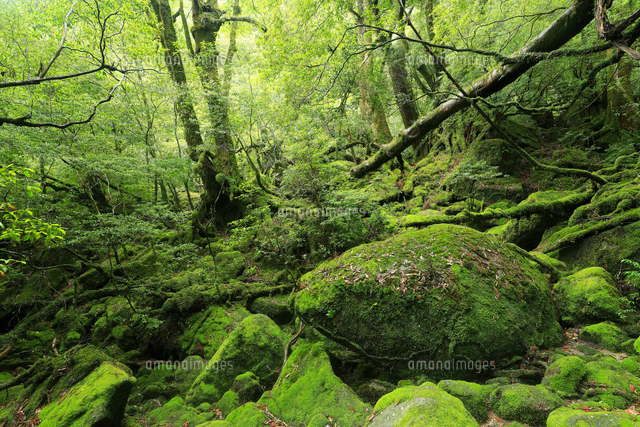
At Yakushima Forest History, “Old Cedars and Ecological Time” is grounded in present on-site evidence—the forest landscape—without implying that every historical layer survives as fabric.
Old Growth, Labor and Extractive History
Attraction
Yakushima’s mountain forests are ecological and historical landscapes at once. Cedar was cut, processed and transported by generations of workers, while the mountains also carried religious meaning. Old-growth trees therefore stand beside evidence of extraction rather than proving that the forest escaped human use. The more accurate picture holds reverence, labor and resource policy together without reducing the island to either untouched wilderness or a timber reserve. Stumps, springboard notches, old logging paths and the remains of forest railways make that history visible along some routes. Their presence does not cancel the forest’s ecological value; it shows how protected landscapes can contain long records of work and extraction. Notice where young cedars regenerate on old stumps, joining biological succession to the material traces of human use.
Current visibility
“Old Growth, Labor and Extractive History” can still be read at Yakushima Forest History through the forest landscape, the mountain terrain, and the road and path; the visibility claim concerns that setting, not a past moment preserved intact.
Historical Interpretation and Current Mountain Safety
Attraction
Historical interpretation cannot determine whether a mountain trail is safe today. It can explain why a forest zone matters and what kinds of historical traces may be present, but bus schedules, bridge conditions, closures, weather and required equipment belong to current official guidance. Check live information before entering the mountains, and treat any route description here as historical orientation rather than an operational instruction.
Current visibility
The place-specific feature discussed as “Historical Interpretation and Current Mountain Safety” is anchored by the mountain terrain, the forest landscape, and the bridge, but today's access or operating condition at Yakushima Forest History requires a current official check.
Logging Traces beside Old Growth
Attraction
Historic forest-use traces include cut stumps, former transport routes, worked surfaces and changes in stand structure. Read them collectively because the people who produced them are often anonymous in public memory. The historical subject is the relationship among domain policy, village labor, the high value of cedar and difficult mountain geography. These traces prevent the surviving old growth from being mistaken for a landscape outside history.
Current visibility
Cut stumps, former transport routes, worked surfaces, and altered stand structure remain visible beside old growth; no building is the subject of this forest-use Highlight.
Tree Size, Age and the Limits of Estimation
Attraction
Visual size cannot establish a cedar’s age. Yakusugi grow under distinctive island conditions and may develop complex forms over very long periods, but precise estimates for individual trees can remain disputed. Separate the well-supported category-level ecology from spectacular claims about one specimen. That restraint does not diminish the tree; it shifts attention toward growth pattern, weathering, setting and the unusually long ecological processes visible in its form.
Current visibility
“Tree Size, Age and the Limits of Estimation” can still be read at Yakushima Forest History through the forest landscape; the visibility claim concerns that setting, not a past moment preserved intact.
A Worked and Sacred Forest Landscape
Attraction
Yakushima is not best understood as primeval nature untouched by people. The island preserves extraordinary old-growth ecology alongside long relationships among mountains, timber, worship, labor and settlement. Human use should be acknowledged without making extraction the only story. The journey becomes historically richer when ancient trees, worked stumps, sacred associations and modern conservation are read as overlapping layers of one forest landscape.
Current visibility
The present landscape at Yakushima Forest History keeps “A Worked and Sacred Forest Landscape” legible through the forest landscape and the ritual setting, rather than through one preserved interior.