Map: GSI Japan Oda Castle was a lowland stronghold of the Oda family in southern Hitachi from the Kamakura period to the end of the sixteenth century. Its importance comes less from monumental masonry than from a wide system of baileys, earthen banks, and moats, and from the political writing and warfare that occurred within it. The central enclosure is now an archaeological park reconstructed and marked from excavation, while broader moat lines continue beyond the most legible public area. The site connects medieval regional lordship, the Southern Court cause, Kitabatake Chikafusa's writing, and the unstable survival of the Oda in the Sengoku period.
A Lowland Castle of Moats, Banks, and Interlocking Enclosures
Attraction
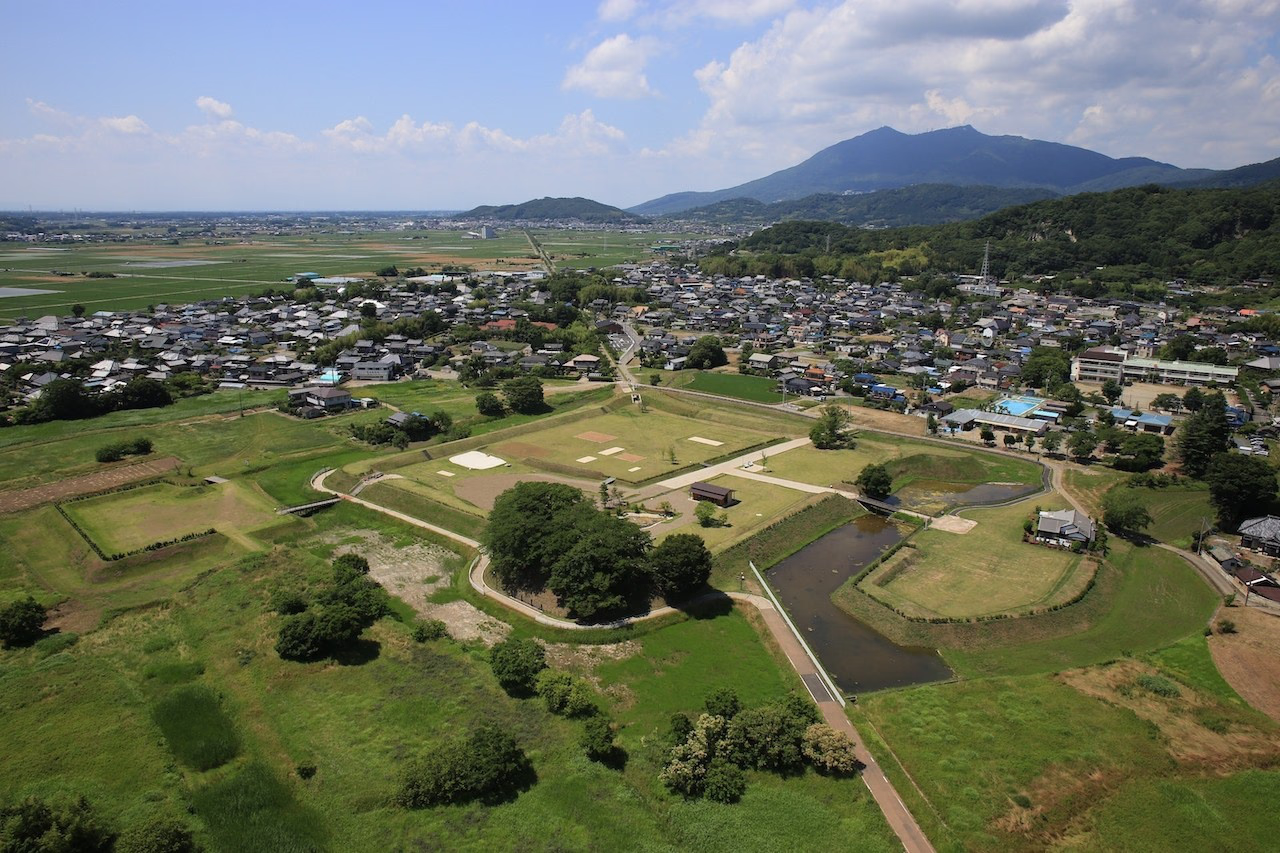
Oda Castle occupied flat ground south of Mount Hōkyō rather than a dramatic mountain summit. Its defensibility came from a central enclosure ringed by earthen banks and moats, with further baileys and water defenses spreading outward in a complex pattern. Much of the outer system was absorbed into fields, roads, railway infrastructure, and settlement, but broad moat traces still indicate a stronghold larger than the restored core. The absence of a stone keep is not evidence of an insignificant castle. Oda represents a regional form in which water management, earthwork, residence, administration, and defense were combined across a lowland landscape.
Current visibility
Restored banks and moats make the central enclosure legible, while much of the wider castle survives as archaeological or landscape trace.
The Hatta-Oda Lineage and Four Centuries of Regional Rule
Attraction
The castle's lords descended from Hatta Tomoie, a member of the Utsunomiya lineage who established a base at Oda after receiving authority in Hitachi under the Kamakura order. His leading descendants took Oda as their family name and maintained influence in southern Hitachi for roughly four centuries. This long duration matters more than a simple list of battles. The castle served as a household seat through changes from Kamakura vassalage to divided imperial conflict, Muromachi regional politics, and Sengoku competition. Its layered enclosures reflect a political center repeatedly modified rather than a fortress produced in one campaign.
Current visibility
The lineage history is interpreted through the castle ground and municipal displays; no medieval residential building remains standing.
Kitabatake Chikafusa and the Southern Court at Oda
Attraction
Kitabatake Chikafusa entered Oda Castle in 1338 while seeking an eastern base for the Southern Court. From here he sent letters urging warriors to support the cause and composed much of Jinnō Shōtōki, a historical argument about imperial succession and legitimate rule. The text gives the castle significance far beyond local military history. Oda briefly functioned as a communications and ideological center within a fragmented civil war. The building in which Chikafusa wrote cannot be identified above ground, so the responsible connection is site-level: the designated castle preserves the political setting of his residence and writing, not an authenticated surviving study.
Current visibility
The castle site is securely associated with Chikafusa's residence and writing, but no specific standing room or building can be shown.
Oda Ujiharu and a Castle Repeatedly Lost and Recovered
Attraction
In the Sengoku period, Oda Ujiharu became famous locally for continuing to rebuild power after repeated defeats and losses of the castle. The pattern reflects more than personal stubbornness. Oda stood within shifting competition among the Oda, Satake, Later Hōjō, and neighbouring houses, where alliances and control of subsidiary forts could matter as much as one decisive siege. Eventually Satake pressure displaced the Oda, and after Toyotomi Hideyoshi recognized Satake authority in Hitachi, the castle passed to a new holder and ceased to be the seat of an independent Oda domain. This is unrelated to the 1590 Odawara campaign despite the superficial similarity of the place names.
Current visibility
Sengoku phases are explained through excavation, earthworks, and municipal interpretation rather than standing battle-damaged buildings.
The Excavated and Re-presented Central Enclosure
Attraction
The central enclosure now functions as an archaeological park. Excavation guided the restoration of earthen banks, moats, paths, and pond features and the marking of former structures, while an adjacent guidance facility explains the Oda family and the survey results. These interventions make spatial relationships intelligible but are not original castle fabric. The distinction is visible in the clean edges and interpretive surfaces of the park. The outdoor area is generally available beyond the staffed facility's hours, whereas displays follow municipal closure days. This pairing of open ground and indoor evidence allows visitors to compare a carefully re-presented plan with finds and documentation without inventing a reconstructed keep.
Current visibility
The archaeological plan and selected landscape features are restored or marked; the guidance facility has separate current hours and closure days.