Read the article below. Interactive reading tools are available when scripts load.
Quick
Tori Busshi was a Buddhist sculptor active in the early seventh century; neither his birth nor death date is known. His name also appears as Kuratsukuri no Tori, linking him with saddle-making craftsmen. The received genealogy names Tasuna as his father and Shiba no Tattō as his grandfather, with the family connected to continental ancestry and early Buddhist practice. Their precise migration history remains uncertain. Crafts such as metalwork, woodworking and textile production offered skills relevant to making religious images. Modern scholarship connects this background with Tori’s later work, although no detailed account describes his training. His career becomes more specific when Empress Suiko’s court in central Japan commissions images in 605. [1][2][3]
In 605 Empress Suiko ordered princes and ministers to join in commissioning large bronze and embroidered Buddha images. Among them were Prince Umayado, later called Shōtoku, and the leading minister Soga no Umako. Tori was named to direct the work. The Nihon shoki, a court chronicle completed in 720, places installation of the bronze image at Asuka-dera, a temple in the Nara region, in 606; a separate temple tradition gives 609. The chronicle praises Tori’s solution when the image could not pass through the hall’s door. It records a rank award and rice fields in Ōmi, near Lake Biwa, as rewards for his service. The image associated with this commission has undergone later damage and repair, so its present appearance cannot simply stand for an untouched work of Tori’s lifetime. [3][9][1][7]
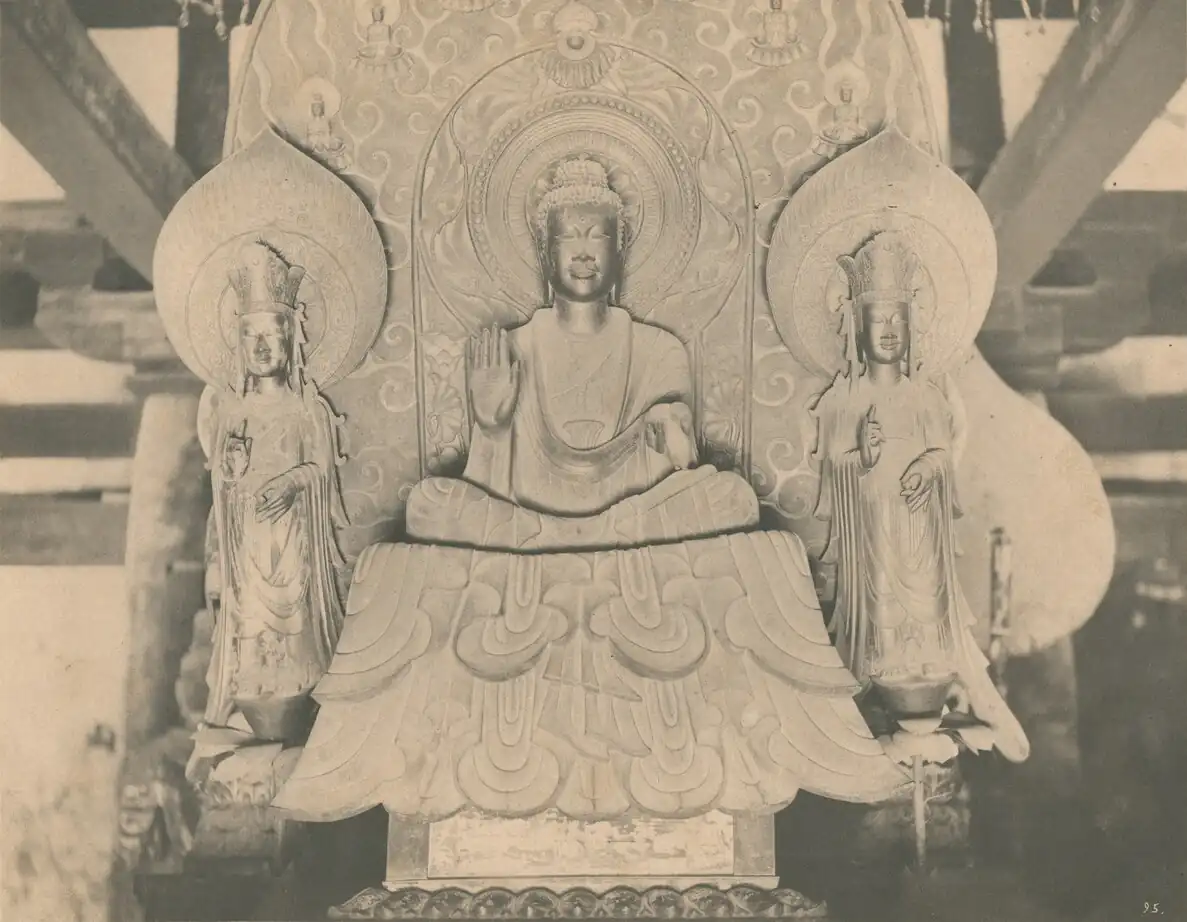
Tori’s most firmly attributed work is the gilt-bronze Shaka Triad at Hōryū-ji in Ikaruga, in present-day Nara Prefecture. It represents Shakyamuni, the historical Buddha, with two attendants beneath a shared halo. The inscription on the halo names Tori and dates completion to 623. It associates the work with the illness of Prince Umayado, later called Shōtoku, and members of his household. The initial prayer for recovery became a memorial after deaths in 622. The image was described as matching the prince’s body in size, linking a Buddha image with the person being commemorated. The inscription preserves patrons’ Buddhist hopes, rather than proving that the sculpted face was a literal portrait of the prince. [1][4][5][6]
The works associated with Tori have a strongly ordered appearance: frontal symmetry, large almond-shaped eyes, a restrained smile and patterned folds of clothing. Art historians compare these forms with Buddhist sculpture of China’s Northern Wei period. They were adapted within the religious and craft settings of seventh-century Japan. Related images are often called Tori-style or assigned to the Tori school. A seventh-century seated Buddha among Hōryū-ji’s donated treasures at the Tokyo National Museum is one such example. Its resemblance to the 623 triad supports a connection with related makers, not a secure personal attribution to Tori. The school’s importance therefore concerns transmitted forms as well as the biography of one named artisan. [1][2][8]
The record does not securely date Tori’s death or give a continuous account of his later career. The 623 Hōryū-ji triad remains his strongest named and dated work. The Buddha at Asuka-dera has a different history of survival, marked by fire and extensive repair. Modern investigations compare its metals and surface compounds to understand those changes. A 2017 conservation study found that the tested oxide ratios did not clearly separate areas thought original from areas thought repaired. Those tests help explain the surviving material but do not alone establish which parts Tori made. Tori’s biography remains incomplete, while the works preserve both the achievements of early makers and the labor of later people who kept them in religious use. [1][2][5][7][9]
Classic
Tori’s biography begins with a craft identity and a family tradition, not a securely dated birth. Busshi is the designation for a maker of Buddhist images; the name Kuratsukuri no Tori associates him with craftsmen who made saddles. These were people whose useful knowledge could include metal fittings, woodwork and textiles, skills that also mattered in producing sacred objects.
Historical disagreement · Where did Tori’s family come from?
The received genealogy names Tasuna as his father and Shiba no Tattō as his grandfather. Accounts connect the family with continental ancestry, but scholars differ over the place and period of its arrival. A familiar story traces the grandfather to China’s Southern Liang dynasty, while other interpretations place the lineage within an earlier immigrant community or emphasize ties with Baekje, a Korean kingdom.
The common ground is a family associated with imported knowledge and Buddhist activity. [1][2][3]
The Nihon shoki, a court history completed in 720, recalls Tori’s grandfather supplying relics and his father entering religious life. It also identifies his aunt with the early nuns, connecting the family’s religious practice with the small communities supported by leading households. That is a transmitted account of family service, rather than a diary of Tori’s upbringing. It nevertheless places the later maker within a setting where religious objects, teachers and practical craft knowledge could meet. Satō Akio’s account suggests that a craft group’s existing skills could have been redirected into Buddhist image production as new techniques arrived from the continent. The suggestion explains a possible mechanism of change without establishing a particular lesson, teacher or moment when Tori decided to become a sculptor. His detailed training remains unknown. [3][2][1]
The work for which he is remembered required patrons able to obtain materials and organize a project beyond the resources of a lone artisan. Empress Suiko’s court in central Japan and the powerful Soga ministerial household supplied that setting. Tori’s name becomes attached to a specific royal undertaking in 605, when large images in bronze and embroidery were commissioned. The combination itself makes a wider range of craft knowledge relevant: a sculptural image and a textile image had different material demands. The record names Tori in a position of responsibility, while the undertaking also involved the sovereign, princes, ministers and other workmen. His inherited background helps explain access to that world; the commission provides the clearer evidence of his own activity. The next stage brought skill into the court’s public recognition of merit and religious service. [2][3]
The large images commissioned in 605 belonged to a royal undertaking in Asuka, the court center in present-day Nara Prefecture. Suiko ordered a shared vow involving the prince, the leading minister and other princes and ministers. Prince Umayado, later called Shōtoku, and Soga no Umako were therefore participants in the patronage, while Tori was named as the craftsman responsible for producing the images. One was to be bronze and the other embroidered, both described in the chronicle using the conventional large Buddha-image measure. The project also received a gift of gold from Goguryeo, a Korean kingdom. Materials, skilled work and political relationships were brought together for a religious purpose. The named artisan mattered within this arrangement because patronage needed a person able to turn resources and a model into a completed object. [3][9]
Historical disagreement · When was the Asuka image completed?
The Nihon shoki records completion in 606 and installation of the bronze image in the main hall at the temple now called Asuka-dera.
The temple’s separate transmitted account gives 609, so the sources preserve different completion chronologies. [3][9]
The chronicle adds an episode in which the image was too large to pass through the hall’s doorway. Other workmen proposed breaking the entrance, but Tori is credited with bringing the image inside without doing so. The account celebrates practical ingenuity as part of religious service. It does not preserve enough technical detail to reconstruct his exact procedure. What it makes clear is that the commission required more than shaping a figure: an object also had to be transported and installed within a building. A maker’s responsibility could therefore extend from an accepted model to the practical success of the finished work in its intended setting. [3][9]
In its account of the reward, Suiko praises Tori’s family’s earlier religious service together with his own achievement. He received the court rank called Dainin and rice fields totaling twenty chō, a unit of land area, in the Sakata district of Ōmi, the Lake Biwa region. The rank recognized standing within the court, while the land offered a continuing source of revenue. The chronicle links that revenue with further temple construction undertaken by Tori. Craft skill thus appears within an exchange of service, status and resources that could support new religious work. The image associated with the Asuka commission is much larger than the later Hōryū-ji triad, but its survival through fire and repair makes the identification of original material more difficult. The commission remains a substantial part of Tori’s recorded career even where the present object cannot answer every question about the original. His next firmly attributed work arose from illness and loss within the prince’s household. [3][5][7][9][1][2][4]
Kuratsukuri no Tori, a maker of Buddhist images, is named on the halo of the gilt-bronze Shaka Triad now in Hōryū-ji’s main hall at Ikaruga, in present-day Nara Prefecture. The central figure is Shakyamuni, the historical Buddha, seated between two attendants under a shared halo. The halo is the radiant frame behind the figures; on its reverse, an inscription records the commission’s circumstances and the maker’s name. It dates completion to 623. This combination of object, date, purpose and named craftsman makes the triad a particularly important foundation for Tori’s biography. His identification rests here on more than a resemblance to other early statues. The work also preserves a specific connection between religious making and a royal household’s experience of loss. [1][4][5][2][6]
The inscription concerns Prince Umayado, later known as Shōtoku, together with his mother and a consort. The remembered sequence includes illness and deaths within the household, with the prince’s death placed in 622. The commission began as a prayer for recovery, but completion in the following year gave it a memorial purpose. The image was to correspond in size to the prince’s body, creating a devotional association between the Buddha and the person for whom the work was made. That association need not mean that Tori copied the prince’s features as a naturalistic likeness. The figure’s religious identity and its commemorative purpose could work together: the household’s hopes were expressed through the Buddha’s image. The inscription names aspirations toward awakening, rather than leaving the object as a monument whose intended meaning must be guessed from its appearance alone. The physical work outlasted the circumstances in which a prayer for healing became a response to bereavement. [1][2][4][6][5]
Historical interpretation · Reading the inscription and identifying its author
The inscription is itself a deliberately composed religious text. Historian Shinkawa Tokio connects its language about distress and the life-size image with Buddhist stories known in East Asia. His interpretation treats the household’s loss as understood through an existing religious vocabulary, rather than as an unmediated transcription of private grief. He also argues that Tori could have composed the text, a proposal that would connect the maker’s knowledge with the written explanation of the work.
That possible authorship is a scholarly interpretation, distinct from the inscription’s explicit naming of Tori as the image’s maker. The firmer connection is the commissioned object: patrons, artisan and religious purpose meet in a work dated to 623. Its visual order then opens another part of the story, the recognizable forms associated with Tori and related makers. [6][5][4][1][2][8]
The life-size description also follows a conventional reading of the inscription. In his conclusion, Shinkawa argues that the wording about the image and the prince’s body deserves renewed examination, rather than being reduced to that reading alone. This does not establish a different measurement; it marks a disputed interpretation of what the commission’s words mean. [10]
The Hōryū-ji triad supplies a named point of reference for the visual forms called Tori style. Satō Akio describes large, simplified eyes, lips with a restrained archaic smile and stiff, sharply ordered folds of clothing. The figures emphasize a frontal view and balanced arrangement rather than the appearance of a body caught in passing movement. Their robes turn repeated lines into a strong part of the image’s structure. The resulting presence is solemn and symbolic. The controlled expression and repeated lines organize the sacred figure’s presence for a viewer facing it. They help explain why the objects could support devotion while also serving a particular household’s commemorative purpose. [1][2][5][8][4][6]
Art historians compare this visual language with sculpture associated with Northern Wei China, including the Longmen cave tradition. The comparison places Tori within a wider East Asian history of Buddhist form. Knowledge reached Japan through people, objects and techniques; court and temple patronage then gave it local materials and settings. The finished images were not produced by the patron’s wish alone. Metalwork, modeling, casting and the arrangement of figures demanded a practiced body of craft knowledge. Tori’s specific working procedures are incompletely documented, but the surviving objects and the recorded commissions establish the scale of the undertaking. The continuity of recognizable forms across related images points toward knowledge shared or transmitted among makers. It does not require every work to have been produced by the same individual. [1][2][3][9][5][8]
Evidence boundary · A school attribution is not a signature
Kyushu National Museum’s description of a seated Buddha from the Hōryū-ji treasures now at Tokyo National Museum makes this distinction concrete. The seventh-century image shares expression, symmetry, frontality and patterned robes with the 623 triad. The museum associates its maker with the Tori school rather than securely naming Tori himself. Satō likewise discusses related images whose connection is stylistic, including works from later in the seventh century.
The category preserves evidence of a substantial community of production while leaving individual hands uncertain. A famous name can help organize that history, but the unnamed makers also contributed to the forms that survived. Tori’s importance is therefore both individual and collective: a named commission anchors the account, and related works show the wider reach of its visual language. What remains visible today also depends on the histories of damage and preservation that followed the makers’ lives. [8][2][1][5][7][9]
After the commission dated to 623, Tori’s life does not resolve into a securely recorded retirement or death. His birth and death dates remain unknown. Related images can enlarge the history of a school, but they cannot supply a reliable date for the end of his individual working life. The Hōryū-ji triad consequently remains the strongest point at which maker, date and object are brought together. It carries a memorial purpose whose circumstances belong to the prince’s household, while the craftsman’s private life is much less recoverable. The unequal record is part of the life as it can be told: patronage and finished work are clearer than childhood, personal belief or the final years. The surviving commissions provide the center of his biography. [1][2][8][5][4][6][3]
Evidence boundary · What can the material tests distinguish?
The Asuka Buddha presents a more difficult material history. Later records describe fire in 1196, and the surviving figure includes extensive repair. Its original form cannot be read directly from every part of the object now standing in the hall. A 2016 investigation brought art historians, conservation specialists and technical researchers together to compare different areas of the statue. The conservation study published in 2017 tested surface compounds through X-ray diffraction and considered them alongside information about metal composition.
The ratios of two copper oxides did not clearly distinguish areas previously considered original from repaired areas. The study also warned against taking one oxide as a straightforward indicator of exposure to fire. Scientific evidence added detail to the object’s history without removing the need to compare material results, written accounts and art-historical judgments. [7][9]
Preservation has been another form of work performed around the images. The Asuka Buddha’s repairs reflect efforts to keep a damaged sacred figure present in its temple, rather than a single uninterrupted survival of all its original metal. The better-preserved Hōryū-ji triad retains the connection between a named maker and the religious purpose written on its halo. Together the works make different parts of early Buddhist production accessible: patronage, technical skill, shared forms and the changing circumstances of religious use. Tori’s name remains consequential because it connects an artisan with this larger activity without replacing the other people involved. The material that survives has passed through their hands as well as his own. His own life ends beyond the secure record; the continuing history is that of the images, the temples and those who maintained them. [7][9][1][4][5][2][3][8]