Read the article below. Interactive reading tools are available when scripts load.
Quick
Shimazu Nariakira was born in 1809 into the ruling family of Satsuma, a domain in southern Kyushu. His father Narioki was its lord; his mother Iyohime came from the Ikeda family. Raised in the Shimazu household in Edo, now Tokyo, he encountered the foreign-learning interests of his great-grandfather Shigehide.[1][3][17]
His inheritance included financial recovery with a heavy social cost. From 1828 Zusho Hirosato administered reforms ordered by Shigehide and Narioki. Long debt repayment, illicit trade and a tightened sugar monopoly helped rebuild the domain’s finances; the Amami islanders bore severe burdens. This revenue base preceded Nariakira’s own industrial programme.[4]
Nariakira’s position as eldest son did not settle succession. His father’s consort Oyura supported her son Hisamitsu, Nariakira’s half-brother. The deaths of Nariakira’s children produced rumours of curses, and rivalry within the household became a conflict among retainers. In 1849–1850 Nariakira’s supporters suffered forced suicide, exile and dismissal; the rumours do not establish that the children were murdered.[5][6]
Senior shogunal councillor Abe Masahiro, the lord Date Munenari and relatives helped arrange Narioki’s retirement. Nariakira became Satsuma’s lord in 1851. He gained the office needed to direct projects, after a struggle that had already cost his followers their lives and positions.[6][1]
Nariakira established a laboratory within Kagoshima castle and developed a manufacturing site at Iso, beside the family villa Sengan-en. Chemical experiments, glassmaking and metalworking supplied a range of projects, including furnaces intended to cast iron cannon.[6][10]
Ships required permission as well as technical knowledge. In 1852–1853 he sought approval to build a large armed vessel, linking its purpose to trade with Ryukyu, the island kingdom under Satsuma’s control. Shogunal restrictions on large ships constrained the programme. Construction and furnace work were under way before Perry’s American squadron arrived in 1853; a letter later that year still reported the first reverberatory furnace unfinished. Such a furnace uses heat reflected from its roof to melt iron for casting. [8][7][19]
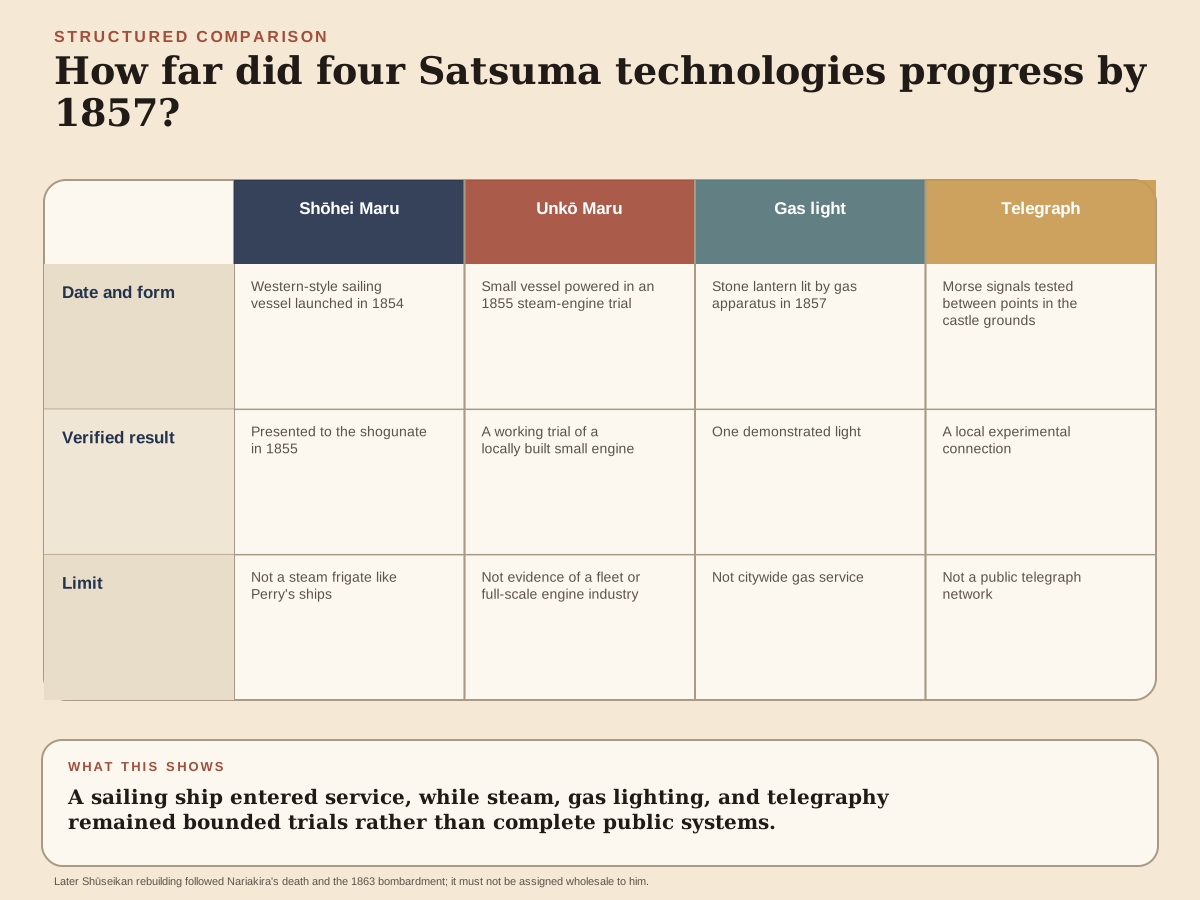
Iron-melting trials in 1854 exposed moisture and foundation problems; later cast cannon could be brittle or porous. Officials and craftspeople revised the furnaces and materials. Shōhei Maru, a Western-style sailing ship, was launched in 1854 and given to the shogunate in 1855. Makers Higo and Umeda, drawing on technical inquiries in Nagasaki, also produced the engine for the small experimental vessel Unkō Maru.[7][8][14]
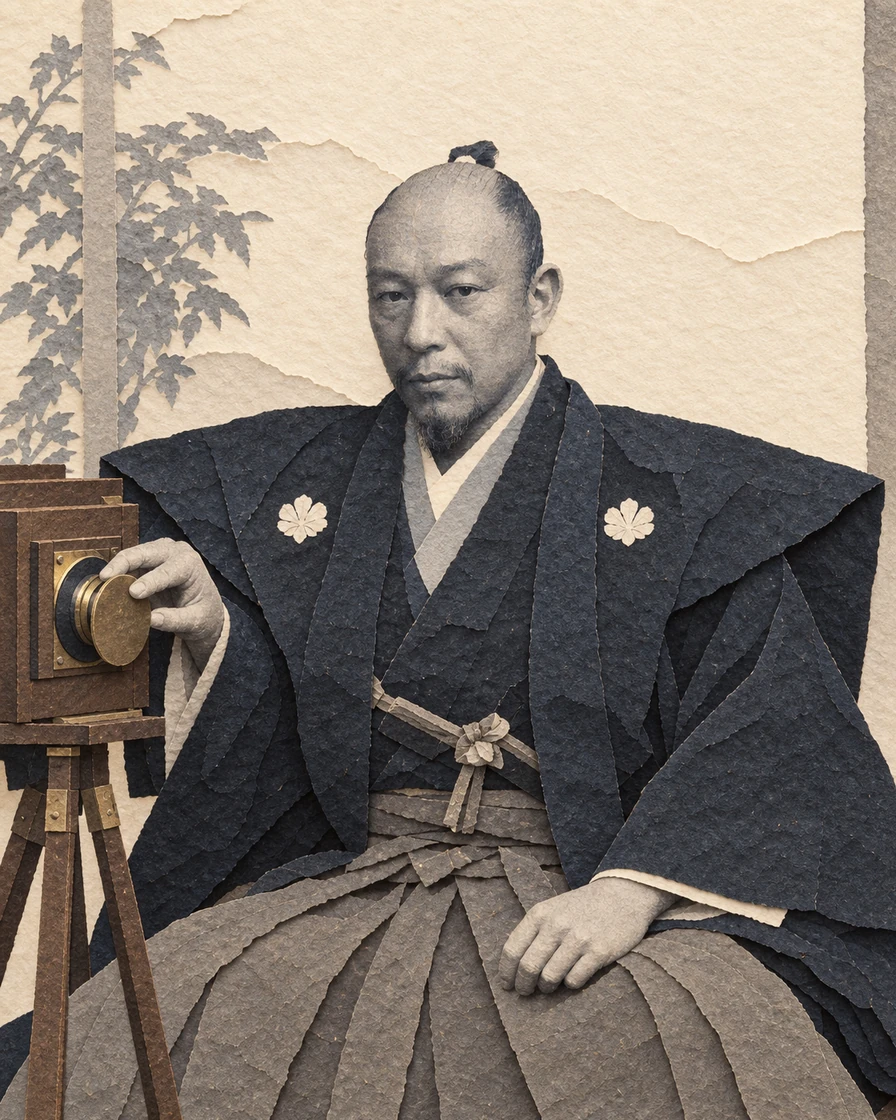
The programme extended to layered cut glass, gas lighting and telegraph experiments. In 1857 Ichiki Shirō photographed Nariakira on a silvered copper plate, and the industrial enterprise acquired the name Shūseikan. These were practical trials and products, rather than a citywide lighting or communications system.[9][6][16][1]
Alongside the industrial work, Nariakira developed political connections. In 1853 he adopted Atsuhime from a Shimazu branch family. Saigō Takamori, whom Nariakira employed in Edo from 1854, carried communications to allies in Mito and Fukui. After preparations extending into the winter of 1856–1857, Atsuhime became shogun Tokugawa Iesada’s principal wife.[17][14]
Nariakira joined those promoting Tokugawa Yoshinobu as successor to the childless shogun. The campaign sought influence within the shogunate, Japan’s military government, and cooperation with the emperor’s court. It failed when senior minister Ii Naosuke supported the Kii candidate, later known as Iemochi. Household connections did not give Nariakira control over the choice.[1][12][14]
Nariakira died in 1858. His nephew Tadayoshi succeeded as lord; Tadayoshi’s father Hisamitsu exercised practical authority as guardian. The industrial programme contracted, and British bombardment during the Anglo-Satsuma War of 1863 destroyed much of the works. Rebuilding under Tadayoshi and Hisamitsu produced a new machine factory in the mid-1860s.[1][15][6][10]
The enterprise consequently continued through decisions made after Nariakira’s death. Its later achievements were not all products of his seven years as lord. His surviving 1857 photograph also became part of that memory: designated an Important Cultural Property in 1999, it records an experiment conducted by a Japanese operator during his lifetime.[6][16]
Classic
Shimazu Nariakira was born in 1809, the eldest son of Narioki, lord of Satsuma in southern Kyushu, and Iyohime of the Ikeda family. He grew up in the Shimazu household in Edo, now Tokyo. His great-grandfather Shigehide encouraged foreign learning, an interest that helped shape Nariakira’s formation. The family’s position connected him both to Satsuma’s resources and to the political and intellectual contacts available in the shogunate’s capital.[1][3][17]
Foreign knowledge came through people able to read, translate and explain it. Nariakira’s contacts included Kawamoto Kōmin and Sugita Seikei, scholars of Western learning. Books were an entry into chemistry, machinery and military technology, but translating instructions did not itself supply a working furnace or ship. His later projects would require the skills and materials of the domain as well.[1][7]
The money available for those projects had its own history. In 1828 Shigehide and Narioki had ordered Zusho Hirosato to rebuild Satsuma’s finances. Zusho arranged extremely long, interest-free debt repayment, pursued illicit trade and tightened the monopoly over sugar from the Amami islands. These measures strengthened domain finances while imposing severe burdens on island communities. Nariakira inherited a fiscal capacity partly created through their labour and restricted economic choices.[4]
Narioki’s administration also supported glass production, initially bringing a glassworker from Edo to make medicine bottles. Nariakira inherited a workshop as well as recovered finances. He would extend work already present in the domain, while proposing an expensive and much wider programme. Control over that programme depended on obtaining the lordship.[9][6]
Succession remained contested despite Nariakira’s position as eldest son. His father’s consort Oyura supported her own son Hisamitsu, Nariakira’s younger half-brother. Retainers divided around the competing prospects.
Evidence boundary · Accusations around the children’s deaths
The deaths of several of Nariakira’s children intensified the conflict and gave rise to accusations of curses.
Such accusations belonged to the struggle; they do not establish a cause of death or prove murder.[5][6]
The dispute known as the Oyura affair brought punishments in 1849–1850. Leading supporters of Nariakira were ordered to commit suicide, and dozens of retainers suffered penalties including exile and dismissal. The household’s rivalry reached well beyond the two possible heirs. For followers, the outcome could remove a livelihood, separate a family or end a life.[5][6]
Historical interpretation · What lay behind the succession opposition?
The municipal history records fears that Nariakira’s projects would reverse the financial recovery achieved under Zusho. These concerns help explain why spending and succession were connected: the new lord would decide what to do with the treasury.
Opposition cannot be reduced to dislike of Western knowledge when Narioki’s administration had itself supported artillery training and glassmaking.[6][9]
Negotiation involving Abe Masahiro, a senior councillor of the shogunate, Date Munenari, lord of Uwajima, and relatives helped arrange Narioki’s retirement. Nariakira became Satsuma’s eleventh lord in 1851. His authority emerged through intervention within the existing political order, after severe punishment of his supporters. The office gave him means to commission work and assign personnel that his position as heir had not guaranteed.[6][1]
After taking office, Nariakira established an experimental laboratory within Kagoshima castle. Its work ranged across chemical processes, casting, glass, alcohol and other materials. The laboratory gave experiments a place within domain administration; promising methods could then be considered for larger production. This connection between testing and manufacture was central to the programme.[6]
At Iso, beside the Shimazu villa Sengan-en, land was cleared for industrial facilities. Furnaces and workshops would concentrate work on weapons and other products near the shore. The site brought together administrative patronage, craftspeople, fuel and water power. Imported technical descriptions had to be adapted to materials that Satsuma could obtain and processes its workers could make function.[10][7]
Water power required work beyond the factory enclosure. In 1852 Nariakira extended an existing channel that had carried water to Sengan-en, directing a new branch toward the industrial site. Water drawn from the Inari River at Sekiyoshi could then drive the works’ water wheels. The early programme thus reused the villa’s supply infrastructure for manufacture. The museum identifies furnace bellows among the equipment powered in this way. These depended on a maintained route from river to workshop, adding water management and channel construction to the skills needed at Iso. Industrial capacity rested partly on adapting an older landscape of water supply to new tasks. [20][10]
Shipbuilding exposed a different constraint. The shogunate, Japan’s military government, restricted the construction of large vessels. In 1852–1853 Nariakira sought permission for an armed ship, associating it with trade to Ryukyu. That kingdom lay under Satsuma’s control while maintaining its own government and tribute relations with Qing China. Foreign naval activity threatened a trade from which Satsuma profited; maritime capacity concerned domain income as well as defence.[8][18]
The application preceded Perry’s arrival in 1853. The American squadron made the imbalance of naval power more visible, but it did not create Nariakira’s interest in ships from nothing. Nor did authorization mean that the technical work was complete. In a letter written later in 1853, Nariakira reported that the first reverberatory furnace remained unfinished. A reverberatory furnace concentrates heat and flame reflected by its roof, allowing iron to be melted for casting. Making that process reliable would occupy the next stage of the enterprise.[8][7][19]
In 1854 Nariakira’s furnace programme at Iso near Kagoshima reached iron-melting trials. Casting still failed when moisture interfered with the process, requiring changes around the furnace floor. The structure also tilted because its foundation was inadequate. Bracing and repairs addressed a problem that translated plans alone could not solve. These difficulties emerge from contemporary letters discussed in Matsuo Chitose’s study of the Satsuma furnaces.[7]
Further trials did not remove every defect. In 1855 cannon bodies could remain brittle or develop holes, while the furnace lining deteriorated. The quality of iron and the endurance of heat-resistant materials affected whether melted metal became a usable weapon. Local potters made refractory bricks, and officials coordinated changes in construction and materials. Nariakira’s orders provided authority and continuity; workers had to discover which combinations would withstand repeated firing.[7]
Historical disagreement · How many furnaces did Nariakira build?
The sequence of the furnaces is itself a historical problem. Ichiki Shirō’s later account described three and placed completion of the second in 1856. Matsuo discusses a reconstruction from correspondence, official records and excavation that instead places the second in 1857 and concludes that the third was never constructed. Documents also record dismantling the unsafe first furnace in 1857.
These differences matter because a remembered number of furnaces can exaggerate the scale or speed of an enterprise still being corrected.[7]
Ships supplied another kind of result. Shōhei Maru, built at Setomura on Sakurajima, was launched in 1854 and presented to the shogunate in 1855. It was a Western-style sailing vessel, not a steam frigate matching Perry’s ships. The presentation connected Satsuma’s work to the shogunate’s naval programme. Makers Higo and Umeda also worked on a small steam engine, seeking technical information through visits and inquiries in Nagasaki. In 1855 their engine powered trials of the small vessel Unkō Maru.[8][14]
These experiments depended on resources beyond the individual workshop. Charcoal supplied heat; water wheels supplied mechanical power. The programme drew on regional craft skills and adapted foreign designs to available materials. Glassmaking developed from Narioki’s medicine-bottle production into Satsuma kiriko: coloured glass layered over a clear base and cut to produce patterns. This work joined a pre-existing craft to a new range of products.[7][10][9]
Other applications remained limited trials. Gas apparatus lit a stone lantern at Sengan-en in 1857, while a Morse telegraph experiment connected locations within the castle grounds. Neither established a citywide utility. That year Ichiki photographed Nariakira in Kagoshima castle using the daguerreotype process, producing an image on silvered copper. The surviving plate records a technical practice carried out by Ichiki, alongside the patronage of the man depicted. In 1857 Nariakira named the industrial enterprise Shūseikan.[9][6][16][1]
Alongside the industrial experiments, Nariakira worked through connections to other lords, the shogunate and the emperor’s court. This political strand developed across the same years. After Perry’s arrival in 1853, he cooperated with Abe Masahiro and with the lords of Mito and Fukui in efforts to strengthen government and promote cooperation between court and shogunate.[1]
One connection ran through marriage. A proposal from the shogunal household had reached Nariakira in 1850. In 1853 he adopted Atsuhime, a daughter of a Shimazu branch family, as the prospective wife of shogun Tokugawa Iesada. The marriage could strengthen Satsuma’s access and position within the existing government. It required several years of preparation, including adoption into the court noble Konoe Tadahiro’s family to establish the bride’s eligible lineage. Atsuhime became Iesada’s principal wife in the winter of 1856–1857.[14][17]
Political information also travelled through service relationships. Nariakira employed Saigō Takamori in Edo from 1854. Saigō subsequently carried confidential communications to Mito and Fukui, linking the Satsuma lord to allies beyond his own household. The work depended on messengers and contacts able to connect separate centres of authority. A domain lord could influence national affairs through these routes, without holding a shogunal office that empowered him to decide the outcome.[17][1]
The central contest concerned the childless Iesada’s successor. Nariakira supported Tokugawa Yoshinobu, son of the Mito lord Nariaki and head of the Hitotsubashi branch of the Tokugawa family. Supporters emphasized his age and governing capacity. The rival was Yoshitomi of Kii, later named Iemochi, whose claim emphasized bloodline. Nariakira’s own approach favoured cooperation between court and shogunate; in a 1857 letter quoted by the Shūseikan museum, he criticized reckless calls for expelling foreigners.[12][14][1][3]
Ii Naosuke, appointed the shogunate’s senior minister in 1858, supported the Kii candidate. Yoshinobu’s campaign failed. Satsuma’s household expected Atsuhime to assist its cause inside the shogunal residence, but marriage did not make her able to control the choice. The failure also marks a limit to Nariakira’s wider programme: industrial projects could proceed under domain orders, while the succession depended on authorities and loyalties beyond his command. Nariakira died later in 1858, leaving both an industrial enterprise and an unsuccessful political campaign.[14][12][1]
Nariakira’s nephew Tadayoshi succeeded him as lord. Hisamitsu, Tadayoshi’s father, exercised practical authority as guardian. The half-brother whose supporters had promoted his succession now oversaw his own son’s administration. It had to decide which parts of an expensive programme to maintain.[15][6]
Industrial retrenchment followed Nariakira’s death. In 1863 British bombardment during the Anglo-Satsuma War destroyed much of the works. The enterprise that emerged afterward therefore involved reconstruction as well as continuation. Tadayoshi and Hisamitsu supported rebuilding, including a new machine factory completed in the mid-1860s. The later factory was not a building erected by Nariakira during his lifetime.[6][10]
The physical breaks make his contribution more specific. He had commissioned facilities, sustained experiments and employed people who would continue working in changed circumstances. Later leaders chose further investment and new technical connections. Satsuma’s subsequent industrial and political achievements cannot all be assigned to the lord who died in 1858.[6][10][15]
His memory also passed through surviving objects and compiled accounts. Ichiki’s later recollections preserved information about the programme while creating the furnace chronology that subsequent research questioned. The 1857 photographic plate survived as a material trace of an experiment and was designated an Important Cultural Property in 1999. Nariakira’s legacy includes both kinds of evidence: accounts celebrating his leadership, and objects and documents revealing the collaborative, incomplete work it supported.[7][16][15]