Read the article below. Interactive reading tools are available when scripts load.
Quick
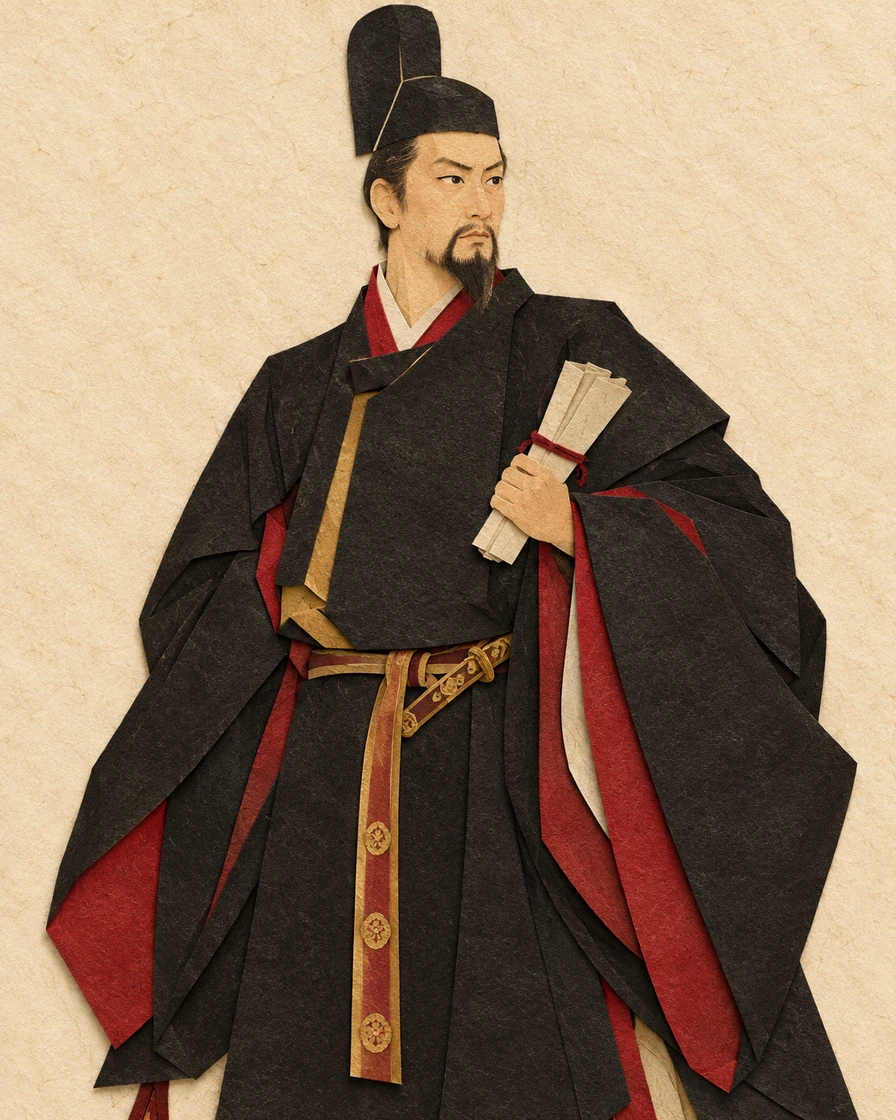
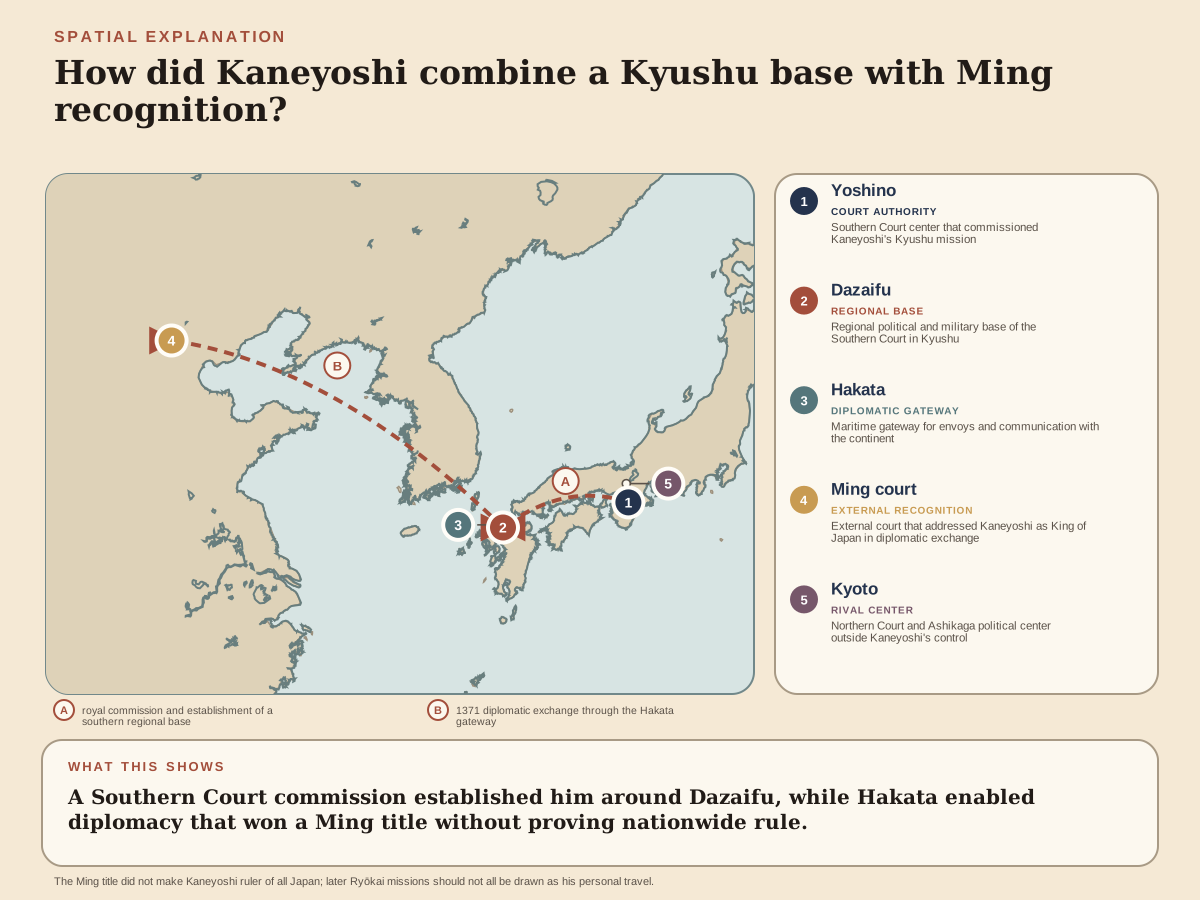
Kaneyoshi was a son of Emperor Go-Daigo; his birth year is uncertain, usually placed around 1330. His name is also read Kanenaga. After Go-Daigo’s restored government failed, the Southern Court opposed the Ashikaga-backed imperial court in Kyoto. Kaneyoshi received a commission to establish its power in the west. The court official Gojō Yorimoto accompanied him through the Inland Sea, helping protect and educate the young prince. He reached Satsuma in southern Kyushu in 1342, then moved north toward Higo, where Kikuchi Takemitsu became his principal military partner. By 1348 their base joined the prince’s imperial authority to a regional warrior following. [1][3][4][2][6][5]
Kyushu’s war became a contest among more than two fixed camps. Ashikaga Tadafuyu was the biological son of the Ashikaga ruler Takauji and the adopted son of Takauji’s brother Tadayoshi. He attracted a separate regional following. Kaneyoshi and Kikuchi Takemitsu fought competing Ashikaga representatives and coalitions of local families. In 1359 Takemitsu’s forces defeated Shōni Yorihisa at the Chikugo River, in the fighting also known as the Battle of Ōhobaru. Both armies suffered heavily, and the victors initially withdrew to Higo instead of immediately pursuing their opponents. The victory improved the prince’s position, but occupation of Dazaifu followed only in 1361. The headquarters established there rested on years of allied fighting. [2][5][7][1]
Kaneyoshi’s administration was known as the Seiseifu, the headquarters of the prince commissioned to command in the west. It moved between regional bases before its years at Dazaifu. Officials including Gojō Yorimoto issued documents on his behalf. The administration recognized holdings and dealt with disputes over income. In 1358 it ordered renewed investigation of a temple’s unpaid rice dues after an earlier investigator had failed to report. It confirmed the temple’s holdings and offices in 1360, and heard another complaint about withheld repair revenues in 1362. These cases put concrete demands before a government that depended on local officers to carry out its decisions. [16][2][4][6][8][9]
The Ming dynasty, founded in China in 1368, sought a Japanese partner who could restrain maritime raiding. Its envoys reached a region held by Kaneyoshi’s government and carried demands for tribute and action against the raiders. Initial contacts were hostile. In 1371 Kaneyoshi sent the monk Zulai with tribute goods and people recovered from captivity. Ming records treated him as “King of Japan.” The title placed him within a diplomatic relationship headed by the Chinese emperor, while his authority in Japan remained that of a regional Southern Court leader. Recognition abroad gave him a position the Kyoto shogunate had yet to obtain, but did not extend his control over all Japan. [10][11][12][3]
In 1371 the shogunate sent Imagawa Sadayo, known as Ryōshun, as its Kyushu commissioner. He built support from western Japanese forces and regional warriors, and took Dazaifu in 1372. Kaneyoshi withdrew and continued fighting, but his administration lost its strongest seat. Ming envoys reaching Hakata were detained by the new regional authorities and eventually went to Kyoto. The Ming court nevertheless continued using Kaneyoshi’s diplomatic identity. Around the mid-1370s the prince passed the western command to his nephew Yoshinari. Ming records knew Kaneyoshi as Lianghuai, but later missions under that name cannot all be assigned to him personally; some occur after his death. [1][17][5][2][10][11][12][3]
Kaneyoshi’s surviving literary record includes poems sent to his brother Prince Muneyoshi. A poem dated to 1371 expresses a wish to leave worldly life as its affairs grow more burdensome. A document of 1375 also records his transfer of Buddhist relics to Saiganden-ji. After passing the western command to Yoshinari, he eventually withdrew to Yabe in Chikugo, in present-day Fukuoka Prefecture. He died in 1383, before the courts were reunited in 1392. Several places claimed his burial, but their historical certainty is limited. Yatsushiro-gū was established in 1884 to honor him and Yoshinari amid renewed public commemoration of Southern Court loyalty. The memorials preserve a royal commander whose years of regional power had ended in retreat. [13][14][1][2][4][15]
Classic
Kaneyoshi was a son of Go-Daigo, the emperor who overthrew the Kamakura regime but lost control of the restored government to the Ashikaga. His birth year is uncertain, and the name is read both Kaneyoshi and Kanenaga. His mother is identified as Sanmi no Tsubone, a daughter of Tamemichi of the Mikohidari family. Go-Daigo’s Southern Court, based at Yoshino in opposition to the Ashikaga-backed Northern Court in Kyoto, sent royal sons to build support outside the capital region. Kaneyoshi’s western military commission made him one of those dispersed representatives. A commission conveyed the authority to lead and recognize service, but it did not supply the local forces needed to establish a base. [1][4][3][2][5][6]
Gojō Yorimoto, an experienced court official, traveled with the young prince and was responsible for his protection and education. The route passed through the Inland Sea, including the Kutsuna islands in Iyo, in present-day Ehime. The prince then stayed at Taniyama in Satsuma, the southern Kyushu province corresponding broadly to present-day Kagoshima. His arrival is conventionally dated to 1342, several years after the westward mission had been conceived. Yorimoto’s continued service connected the mobile princely household with the administrative practices of the court. His later role in issuing documents gave that connection a practical expression. [6][2][4][1]
Kaneyoshi began moving north in 1347 and established his base with Kikuchi Takemitsu in Higo by 1348. Higo lay in present-day Kumamoto, where the Kikuchi had land, followers and connections to other warrior families. Support also came from Aso-linked forces. The prince could give those warriors imperial recognition and a common regional leadership, while their forces made his authority defensible. Yorimoto worked with Takemitsu and issued many commands on Kaneyoshi’s behalf. [1][2][4][5][6]
The conflict between Ashikaga Takauji and his brother Tadayoshi divided the shogunate and reshaped Kyushu’s alliances. Ashikaga Tadafuyu, whom Tadayoshi had adopted, was Takauji’s biological son. He was welcomed by Shōni Yorihisa in northern Kyushu and gathered supporters by confirming warriors’ and religious institutions’ rights. His following competed with the shogunate’s Kyushu representatives and with Kaneyoshi’s Southern Court coalition. The prince’s alliance therefore operated amid competing sources of military leadership and documentary recognition. The Kikuchi and Aso-linked forces supplied a regional base from which he could contend with them. [5][2]
In 1359 Shōni Yorihisa sought to cooperate with Ōtomo Ujitoki and catch the southern forces between them. Takemitsu mobilized from the Kikuchi base with Kaneyoshi and crossed the Chikugo River to attack Yorihisa’s position. Fighting continued around Ōhobaru, in the vicinity of present-day Ogori. Kikuchi Takemasa and other warriors participated in the campaign. Yorihisa’s son Tadasuke died in the battle, and both sides sustained serious losses. The defeated forces withdrew toward Mount Hōman near Dazaifu. Takemitsu’s army lacked the strength for immediate pursuit and returned to Higo. [7]
The loss did not immediately erase the Shōni position or transfer Dazaifu to the prince. It did alter the balance in favor of the Southern Court’s coalition. In 1361 Kaneyoshi and Takemitsu moved their headquarters to Dazaifu and established the region’s strongest Southern Court center. Their achievement came while southern fortunes were weakening in other parts of Japan. The prince’s commission gave the coalition a court-backed leadership; Takemitsu and other commanders had supplied the forces through which it reached that seat. [1][7][2][5][6]
The Seiseifu was the prince’s western-command headquarters, established at successive places as his position changed. Its political authority traveled with the princely household and the officers serving it. Gojō Yorimoto issued commands in Kaneyoshi’s name and worked with Takemitsu, joining court expertise to warrior support. The occupation of Dazaifu in 1361 placed that administration at a traditional center of Kyushu government and overseas contact. Recognition of holdings and offices gave institutions reasons to seek its decisions. Complaints over rice revenues brought the household’s authority into the material affairs of temple administrators and local holders. [16][4][2][6][5][10][8][9]
Anrakuji, the religious institution at present-day Dazaifu Tenman-gū, complained that rice dues from Rakutoku had not been paid. In 1358 the administration ordered a Kusano official to investigate the conduct of Mawatari Sukefusa. An earlier investigator from the Mugio family had failed to submit a report. The renewed instruction shows a claim moving through local intermediaries whose response was uncertain. In 1360 the administration accepted the temple’s assertion of its holdings and offices and confirmed them. That recognition strengthened the temple’s documented position, while payment of the contested dues remains a separate question. [8][9]
In 1362 Anrakuji’s administrator Nobutaka brought a complaint involving Matsunobu Kotarō. The disputed rice was assigned to repairs of a building used for the institution’s offerings. Kotarō was accused of withholding it. The complaint appears in a princely command rather than in a record of an uncontested transfer of revenue. Such cases required officials to connect a central decision with people controlling property and produce in the countryside. Kaneyoshi’s administration could receive petitions, direct investigations and confirm recognized rights. The failed report in the earlier case also reveals the limits of that authority when a local intermediary did not respond. [9][8][6]
The Ming dynasty was founded in 1368 amid the collapse of Yuan rule in China. Maritime raiding threatened coastal communities and the new dynasty’s efforts to establish order. The raiders called wakō in Japanese belonged to maritime networks extending beyond a single government’s authority. In 1369 the Ming emperor sent a demand that Japan restrain the raiding and enter a relationship of tribute. He threatened military action if the raiding continued. Envoys arriving in northern Kyushu encountered Kaneyoshi’s government, although the prince did not rule Japan as a whole. Chinese accounts report violence against members of the early mission; the precise responsibility and motives are less securely documented than the diplomatic confrontation. [10][11]
A further Ming mission led by Zhao Zhi sought compliance, and in 1371 Kaneyoshi sent the monk Zulai to China. The mission brought horses and regional products as tribute. It also returned more than seventy people from the Chinese coastal districts of Mingzhou and Taizhou who had been carried away by raiders. Those returned captives gave the exchange a practical connection to the problem the Ming emperor had raised. The Ming record received the mission under the name Lianghuai and the title “King of Japan.” The language of tribute acknowledged the Chinese emperor’s superior position within that diplomatic order. Kaneyoshi remained a prince serving the Southern Court within Japan, with power dependent on his Kyushu coalition. [11][12][10][2]
Historical disagreement · Why did Ming recognize Prince Kaneyoshi?
Scholars differ over why the Ming court recognized this regional ruler. Wang Xinsheng’s account emphasizes incomplete information about Japan’s divided courts and an initial misidentification. Murai Shōsuke questions an explanation based on ignorance alone, pointing to substantial movement of people and information between the countries. He interprets the choice as an attempt to work with a ruler expected to address the raiding problem.
The recognition is documented, while its rationale remains open to those different readings. [10][11][2]
The diplomatic title and the prince’s actual regional resources could now become separated by a change of power on the ground. [10][11][2]
Imagawa Sadayo, the shogunate’s newly appointed Kyushu commissioner, arrived in 1371 with the task of restoring its regional position. He drew on forces gathered in western Japan and made connections with warriors inside Kyushu. In 1372 his coalition captured Dazaifu. Kaneyoshi’s household withdrew, and the Southern Court continued resistance from remaining bases in Chikugo and Higo. The new commissioner pursued its allies beyond the lost seat. Kikuchi Takemitsu is generally understood to have died in 1373, removing the military partner with whom the prince’s government had reached its height. The survival of the prince and remaining followers did not restore the concentration of authority once exercised at Dazaifu. [1][17][5][2][18]
Ming envoys arriving at Hakata in 1372 entered a region where the political balance had changed. The shogunate’s Kyushu authorities detained them at Shōfuku-ji before they eventually traveled to Kyoto in 1373. Ashikaga Yoshimitsu, the shogun in Kyoto, attempted to open relations of his own. His diplomatic standing did not immediately displace the Ming court’s recognition of Kaneyoshi. The title offered a claim to conduct exchanges that survived loss of the prince’s headquarters. For the new Kyushu authorities, possession of the region and access to international recognition were related problems. [10][11][12]
Kaneyoshi transferred the western command to his nephew Prince Yoshinari around the mid-1370s. The Southern Court’s regional resistance continued under a new prince as the remaining forces lost ground.
Evidence boundary · A diplomatic name after the prince’s death
Ming records continued to describe missions sent by the “King of Japan” Lianghuai. Some entries lie after Kaneyoshi’s death in 1383.
The name in those records therefore cannot by itself establish who authorized each ship or mission. His international identity had become a continuing means of recognition whose recorded use outlasted the individual prince. [2][3][4][10][12]
Poems preserved under Kaneyoshi’s name include an exchange with his brother Prince Muneyoshi. The heading of a poem in the Southern Court anthology Shin’yōshū places it in the autumn of 1371. Its speaker wishes increasingly to leave the world while worldly affairs multiply. The verse gives a form to the wish for withdrawal without supplying a complete record of the prince’s private state of mind or the causes of his eventual retirement. The exchange with his brother also preserved a connection between royal men working far from one another in the divided country. A relic-transfer document attributed to Kaneyoshi and dated 1375 records his participation in Buddhist patronage at Saiganden-ji. That act belongs to the years after Dazaifu’s loss, when his household’s place in regional government was diminishing. [13][14][1][2]
Kaneyoshi’s withdrawal from the western command placed its continuing responsibilities with Prince Yoshinari, a son of Emperor Go-Murakami and his nephew. The older prince eventually retired to Yabe in Chikugo. The shogunate’s forces continued attacking Southern Court positions and captured the Kikuchi base in 1381. Kaneyoshi is conventionally understood to have died in 1383 in the Yabe area. He did not live to see the 1392 reunification of the courts. His long western mission had produced an influential regional government, but its principal seat and military advantages had been lost before his life ended. [2][15][1][17][4][5]
Evidence boundary · Recognizing a tomb
Several locations in Chikugo and Higo have been associated with Kaneyoshi’s burial, without conclusive identification. A site at Yatsushiro received official recognition as his tomb in 1878.
The designation belongs to the nineteenth-century history of his remembrance. [1][4]
In 1884 Yatsushiro-gū was established following local petitions, with Kaneyoshi as its principal deity and Yoshinari also enshrined. The shrine formed part of renewed commemoration of people who had served Go-Daigo’s restoration and the Southern Court. Regional memory could preserve both the prince’s inherited claim to imperial leadership and the loyalty credited to those who had fought around him. [1][4][15][2]