Read the article below. Interactive reading tools are available when scripts load.
Quick
Kamatari was born into the Nakatomi family, which supplied ritual service to the royal court of Yamato in central Japan. His received dates are 614–669, although early reports give different ages at death. His father was Mikeko, and his mother belonged to the Ōtomo family. The name Fujiwara came only near the end of his life; it should not suggest that he began with the later family’s enormous influence. The Nihon shoki, a court chronicle completed in 720, says he declined a ritual appointment in 644 and stayed at Mishima, near present-day Osaka. Accounts of his learning and early friendships survive through later narratives, rather than a continuous record of his youth. His inherited connections gave him access to court life, but his decisive political alliance still lay ahead. [14][1][5][10][2][3]
By 645 Kamatari had allied with Prince Naka no Ōe, Empress Kōgyoku’s son and the future Emperor Tenji. Their target was Soga no Iruka, whose family exercised great influence at court. The chronicle makes a game of kemari, in which players kept a ball in the air, the occasion for their friendship, and describes study with the scholar Minabuchi no Shōan. These memorable scenes are received accounts, not eyewitness transcripts of how the conspiracy began. A marriage joined the prince to a daughter of Soga no Kurayamada no Ishikawamaro, drawing a Soga relative into the coalition. Kamatari also appears in the recruitment of armed participants for the palace attack. The alliance depended on connections within the court, including the family whose dominant branch it would destroy. [1][3][2][4]
In the traditional sixth month of 645, the conspirators attacked Soga no Iruka during a ceremony at Kōgyoku’s palace. Soga no Ishikawamaro read a formal presentation while Naka no Ōe and armed allies moved against Iruka. Kamatari helped coordinate the plan and stood with armed support. The chronicle describes hesitation and a violent attack, rather than a bloodless transfer of authority. Kōgyoku was present and withdrew into the palace; her advance knowledge or approval is not securely established. Iruka’s father Emishi died as their branch’s position collapsed. Other Soga relatives survived in government. Kōgyoku then abdicated to her brother Karu, who became Kōtoku, while Naka no Ōe became crown prince and Kamatari entered the new government as inner adviser. [3][4]
After the coup, Kamatari became uchi-tsu-omi, or inner adviser: a special counselor close to the ruler and crown prince. He was not the head of a clearly defined ministry equivalent to a modern prime minister’s office. Kōtoku’s government also appointed left and right ministers and scholars who had studied on the continent. The reform edict dated 646 called for changes to elite control of people and land, provincial administration, registers and obligations. Its surviving text does not prove that every clause took effect immediately or that Kamatari wrote the whole program. He remained influential when Kōtoku’s court divided and after the former Kōgyoku returned as Saimei in 655. His continuing position tied personal access to the long work of reorganizing government. [4][6][7][8][1][2]
Kamatari supported Buddhist teaching and ritual despite belonging to a family with inherited duties in royal ritual. Accounts associate his household with readings of the Vimalakīrti Sūtra, a Buddhist text, and with resources supplied for learning at Gangō-ji. His elder son Jōe became a monk and studied in Tang China; his son Fuhito later followed a political path. Two short poems attributed to Kamatari survive in the Manyōshū, an early Japanese poetry anthology. Kōfuku-ji’s tradition credits his wife Kagami with founding its predecessor, Yamashina-dera, in 669 to pray for his recovery. The family’s religious activity involved more than one person’s patronage. [1][10][14][2][9][13]
Kamatari’s late career included continental contacts after the defeat in 663 of the court’s effort to restore Baekje, a conquered Korean kingdom. In 664 the priest Chijō carried gifts to Guo Wucong, an envoy associated with Tang forces in former Baekje, at the emperor’s command. In 668 Kamatari sent two monks to present a ship as a gift for Kim Yusin, a leading commander of the Korean kingdom of Silla, through a Silla envoy. A later family biography also credits him with legal work that year. This became associated with the supposed Ōmi Code, named for Tenji’s court near Lake Biwa. No text survives, and scholars differ over whether a systematic code was completed or existed. Diplomatic acts are more specifically recorded than the code’s contents or implementation. [1][5][2][7][8]
In 669 Kamatari fell seriously ill at his house in Ōmi, near Lake Biwa, and Tenji visited him. On the fifteenth day of the traditional tenth month, the ruler granted him the Great Woven Cap, a high court rank, a ministerial honor and the Fujiwara name. He died the next day; these are traditional calendar dates, not automatically dates in October. His precise medical cause of death is not established. A later family biography records funeral rites in 670, while different traditions developed around his burial and memorial sites. The richly furnished Abuyama tomb near Osaka is a strong candidate for his grave, but its identity remains disputed. The later Fujiwara inheritance passed especially through Fuhito’s descendants; their achievements followed Kamatari’s death. [1][5][10][2][11][12][14][13]
Classic
Before he became an ancestor celebrated by the Fujiwara, Kamatari belonged to the Nakatomi, a family serving the royal court through ritual and increasingly through political office. His received genealogy names Mikeko as his father and identifies his mother with the Ōtomo family.
Evidence and interpretation · Was Kamatari born in 614 or 620?
Modern reference works conventionally date his birth to 614. That date derives from conflicting age reports: the Nihon shoki, the court history completed in 720, preserves traditions that he died aged fifty or fifty-six. Traditional counting of age gives different birth years from those reports. The familiar 614 date follows the fifty-six-year tradition, while the other would place his birth in 620.
The discrepancy changes the precision available for his beginning, rather than the identification of the man active in the mid-seventh-century court. [14][1][2][5][10][3]
Ritual service mattered politically because it placed a family near the sovereign and the ceremonies through which rulership was expressed. The Nakatomi had participated in earlier opposition to Buddhism, alongside the Mononobe family, but this history cannot simply be carried forward as Kamatari’s personal creed. His own later support for Buddhist learning and his son Jōe’s monastic career establish a different set of choices. The distinction helps explain a court in which inherited offices, imported learning and new forms of patronage could coexist within one household. The surviving accounts give no continuous picture of his childhood or the ambitions he formed before entering political life. [3][14][1][9][10][2]
In its account of 644, the Nihon shoki says Kamatari refused appointment as chief of royal ritual and withdrew to Mishima in the Osaka region. It next presents a visit to Prince Karu, later Emperor Kōtoku, and praises the prince’s hospitality. These episodes introduce Kamatari as a man judging the people around him, but the dialogue and moral portrait belong to a chronicle written after the participants’ deaths. Other accounts of his origin include different place traditions, with a later association linking him to Kashima in eastern Japan. Those stories show how several communities came to claim his beginning; they do not provide a securely reconstructed childhood itinerary. What becomes clearer in the following years is his movement from inherited court connections toward an alliance with a royal prince. [3][2]
The partner central to Kamatari’s later career was Prince Naka no Ōe, a son of Empress Kōgyoku and Emperor Jomei. The prince would eventually rule as Tenji, but in the mid-640s he was operating within a court dominated by Soga no Emishi and his son Iruka. The Nihon shoki links the prince and Kamatari through a game of kemari at Hōkō-ji, a Buddhist temple at Asuka in present-day Nara Prefecture. In this courtly ball game, players tried to keep the ball aloft; the story has Kamatari return the prince’s lost shoe and win his friendship. It then sends them to the scholar Minabuchi no Shōan and makes the journey to study an opportunity for secret conversation. The scenes explain the alliance through courtesy and learning, qualities the later narrative wants readers to recognize. They cannot independently establish the first meeting, every word exchanged or the partners’ complete intentions. [1][3][5]
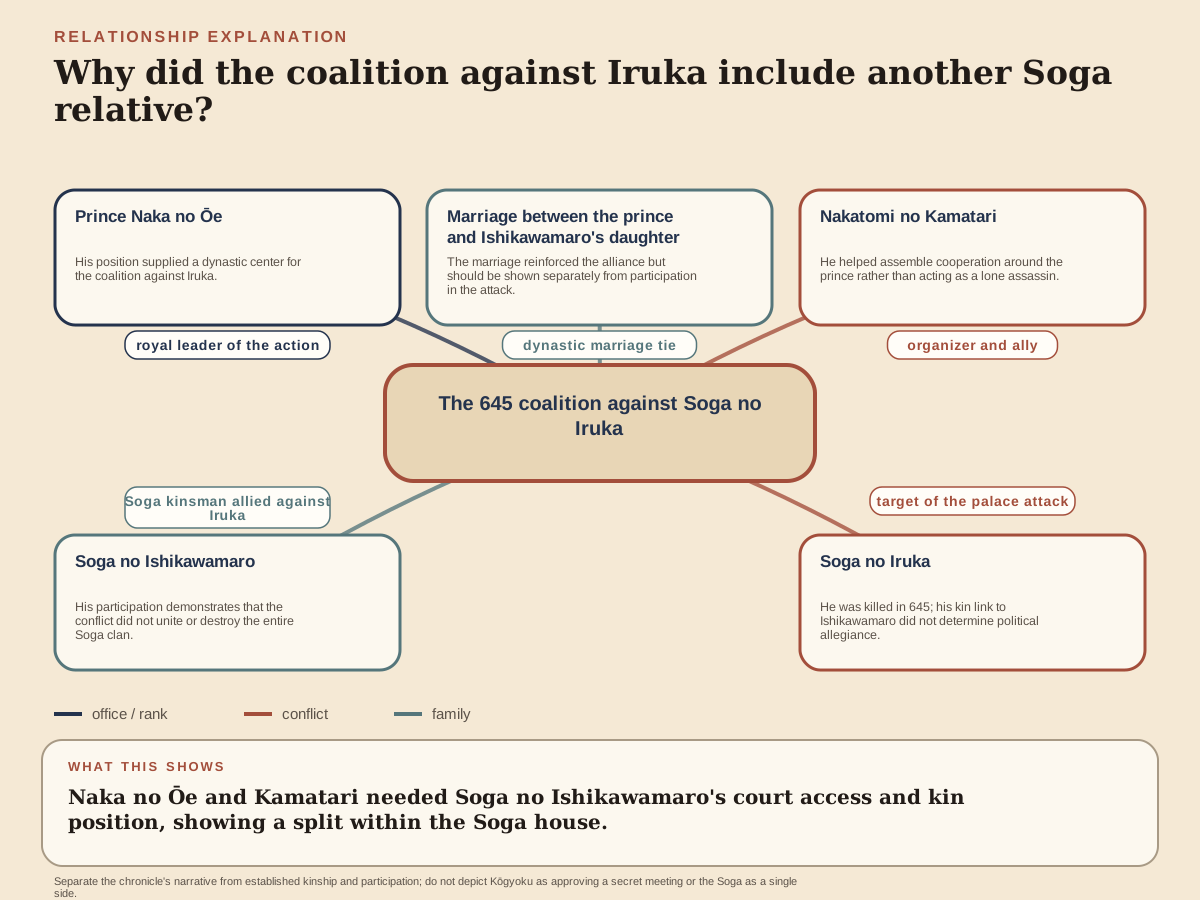
The conspiracy required a wider circle than the prince and his adviser. The chronicle attributes to Kamatari a proposal that Naka no Ōe marry into the household of Soga no Kurayamada no Ishikawamaro. Ishikawamaro belonged to the same large Soga kin group as Iruka, but became an ally of the men moving against him. A daughter married the prince, and Ishikawamaro later participated in the ceremony during which Iruka was killed and became right minister in the new government. The marriage therefore connects the planning narrative with relationships visible after the coup. Overthrowing Iruka’s branch involved cooperation with another Soga household, exposing a division within an influential family. [3][4]
Kamatari is also named in the preparation of armed participants, including Saeki no Komaro and Wakainukahi no Amida. Their later roles matter because an alliance of names could not by itself remove a minister inside the palace. The conspirators needed access, weapons and a moment when Iruka could be approached. The prince supplied royal standing; Kamatari supplied a place in the planning and coordination; the other allies supplied additional court and military connections. The source’s praise of Kamatari as a wise organizer should be read alongside these other contributions. Before the killing, success was not guaranteed by Tenji’s later reign or the eventual prominence of the Fujiwara. The next stage depended on whether this court alliance could act together at a specific ceremony. [3][4][5][14]
The attack came during a palace ceremony in the sixth month of 645, on the traditional calendar used by the chronicle. A formal presentation associated with the Korean kingdoms gave the conspirators an occasion to bring Iruka into the sovereign’s presence. According to the Nihon shoki, they also arranged for him to surrender his sword before entering. Soga no Ishikawamaro read the presentation while Naka no Ōe and the armed participants waited for the attack. This division of roles made the ceremony useful: it placed the target in an accessible space and occupied him with the court’s ordinary business. Kamatari appears in the arrangements and in the armed group controlling the operation, rather than as the sole man who struck Iruka. The prince and the armed attackers carried out the killing; Kamatari’s place was in the coalition and its coordination. [3]
The narrative describes hesitation among the intended attackers before Naka no Ōe moved and the killing was completed. It supplies speeches from Iruka, the prince and the empress, but these are part of a retrospective historical account, not a recorded exchange available word for word. Kōgyoku was present when her minister was attacked, and the chronicle has her retire into the palace’s interior. Her physical presence establishes the setting of the violence; it does not establish prior consent or a secure account of what she expected. For the coalition, controlling the palace and the immediate aftermath mattered as much as the blow itself. Iruka’s death would have left the conspirators exposed had his father’s household and supporters been able to restore their position. The subsequent collapse of that household turned a killing into a change in the court’s distribution of power. [3][4]
Emishi died the following day, and the chronicle records the destruction of his residence and historical materials kept there. The loss of a powerful ministerial branch was accompanied by the loss of records, a reminder that the victors’ later history did not inherit every earlier account intact. The Soga as a whole were not eliminated: Ishikawamaro became right minister under Kōtoku. Kōgyoku’s abdication, the installation of Karu as Kōtoku and Naka no Ōe’s appointment as crown prince formed the next settlement. Kamatari received the office of inner adviser. The new arrangement combined royal kin, surviving family houses and men who had acted in the coup. The new government was born through an assassination and depended afterward on cooperation among the royal family, surviving ministers and the men who had helped bring it to power. [3][4]
The inner adviser appointed in 645 was Kamatari, the man who had helped Prince Naka no Ōe, later Emperor Tenji, overturn Soga no Iruka’s branch. The new sovereign was Kōtoku, Naka no Ōe’s maternal uncle, while the prince became crown prince. Uchi-tsu-omi, the office rendered inner adviser, placed Kamatari close to the ruling household rather than at the head of one fully documented administrative department. Its exact responsibilities remain incompletely known, and it was not a permanent position prescribed by the later law codes. The later regular office of naidaijin developed in a different institutional setting. The appointment demonstrates political access and a consultative role; it does not give a complete chart of which decisions required his consent. [3][4][6]
Kōtoku’s government included Abe no Uchimaro as left minister, Soga no Ishikawamaro as right minister and learned specialists such as Takamuko no Kuromaro and the monk Min. The specialists had continental experience, giving the coalition knowledge of institutions beyond the court’s inherited family offices. The reform edict placed under the first month of 646 in the Nihon shoki called for ending certain elite controls over land and dependent people, reorganizing local administration, establishing registers and redefining taxes and labor. These provisions describe a court seeking to make people and resources more directly accessible to central government. Registration would identify households liable for obligations, while appointed officials and defined districts offered ways to extend supervision outside the palace. Such a program required local information, cooperation and enforcement; a proclamation alone could not supply those conditions. The surviving edict is transmitted in a chronicle completed in 720, so its wording and placement cannot be treated as an untouched administrative file from 646. Kamatari belongs to this governing effort, but the evidence does not isolate all its drafting or implementation as his personal work. [4][1][7][8]
Rank and resources strengthened the adviser’s position: the chronicle records a purple cap and increased household allotments in 654. Household allotments provided a material base for the adviser’s position, while the cap signaled his standing at court. By then the royal center had divided. Naka no Ōe had left Kōtoku’s court at Naniwa, present-day Osaka, for Asuka with his mother and other royals in 653, and many officials followed. Kōtoku died in 654, and the former Kōgyoku resumed the throne in 655 under the name later given as Saimei. Kamatari remained within government under Saimei and then Tenji. The continuity matters because the reforms outlasted a single settlement, while their leading actors still depended on shifting relationships inside the royal family. His long advisory career is clearer than the precise authorship of every measure associated with the period. [4][1][2][7][8]
During the same decades in which he served at court, Kamatari’s household also supported Buddhist learning and ritual. The later family biography describes yearly assemblies devoted to the Vimalakīrti Sūtra, a Buddhist scripture centered on a learned layman, and property supplied to Gangō-ji for doctrinal study. Modern biographical accounts likewise associate him with this patronage. The early assembly’s exact year varies between transmitted accounts. What remains common to the accounts is support for teaching and for monks able to sustain it. A wealthy political household could use part of its resources to make repeated instruction possible, connecting court prominence with a durable religious activity. This was a use of wealth and connections, not evidence that every political action Kamatari took followed one coherent religious policy. [1][10][4][3][15]
Evidence and interpretation · Dating the first Vimalakīrti assembly
Katō Kenkichi’s biography places a Vimalakīrti assembly in 657, while Horiike Shunpō’s account gives 658 for its beginning with the monk Fukuryō as lecturer. The family biography describes annual assemblies without fixing that first occasion in the passage quoted by Nakamoto.
These accounts support Kamatari’s patronage more securely than a single agreed starting date. [1][10][16]
Earlier Nakatomi participation in resistance to Buddhism does not make Kamatari an anti-Buddhist leader by inheritance. His own recorded patronage is evidence against that shortcut. The family’s next generation also took more than one path: Jōe, his elder son, became a monk and travelled to Tang China for study, while Fuhito later became a leading court politician. Their careers should not be flattened into a single plan devised by their father. They show that the household’s connections reached both religious learning and government. The Manyōshū, an early anthology of Japanese verse, preserves two short poems attributed to Kamatari, and the Chinese-style poetry collection Kaifūsō attributes another poem to him. Such attributions add a literary presence to the adviser’s surviving image, without providing a diary from which to recover his feelings throughout his life. [14][1][10][2][9]
The temple tradition most closely tied to his final illness concerns his wife Kagami, often styled Kagami no Ōkimi. Kōfuku-ji traces its origin to the temple she established at Yamashina, in the Kyoto region, in 669 while praying for Kamatari’s recovery. Its history places there Buddhist images associated with his earlier patronage. This is an institutional founding tradition, rather than a surviving contemporary transcript of the couple’s wishes. The foundation places Kagami’s initiative alongside her husband’s patronage in the family’s religious memory. The foundation moved to the Asuka region afterward, and Fuhito brought it to Nara in 710, when it received the name Kōfuku-ji. Kamatari did not live to found the Nara temple or direct its later power. The continuity runs through a wife’s foundation and a son’s later work, making the family’s inheritance a sequence of actions rather than one ancestor’s finished achievement. [2][13][5]
Kamatari’s last years unfolded while the court dealt with Tang China and Silla, a Korean kingdom, after the defeat in 663 of its effort to restore Baekje, another kingdom on the peninsula. The campaign had continued after Saimei’s death, leaving Tenji’s court to deal with its consequences. The Nihon shoki records gifts in 664 to Guo Wucong, an envoy connected with Tang troops stationed in former Baekje. The priest Chijō conveyed them at the emperor’s instruction. Modern biography places this exchange within Kamatari’s diplomatic activity. The different descriptions matter: an action associated with his advisory career could still be ordered by the ruler and carried out by another person. The episode gives a concrete glimpse of contact with a power that had helped defeat the court’s overseas allies, without supplying a complete record of the negotiations. [1][5]
In 668 the chronicle records Kamatari sending two monks to present a ship as a gift for Kim Yusin, Silla’s prominent military leader. The gift went through a Silla envoy visiting the court. Monks acted as intermediaries in an exchange between political elites. The ship gave the exchange a practical maritime component. These details locate the adviser in the practical maintenance of relations across the sea. The record describes this exchange, but does not establish a settlement of the larger strategic questions. For a court whose recent intervention had failed, continued contact was itself an important part of governing in a changed international setting. [5][1]
Historical disagreement · Was there a completed Ōmi Code?
A later Fujiwara family biography, compiled in the eighth century, associates Kamatari with revising legal provisions in 668 under Tenji. This account became linked to the Ōmi Code, named after the court’s location in the Lake Biwa region. The supposed code does not survive as a text that can be checked against the biography’s claims. Some interpretations accept legal compilation in Tenji’s reign and relate it to later revisions; others distinguish that work from the later Asuka Kiyomihara Code. Another position rejects the existence of a completed Ōmi Code because the retrospective testimony is insufficient and the formation of the law-code state belongs more firmly to later reigns.
The surviving evidence has not decisively settled the issue. Kamatari can therefore be presented as associated with legal work, while neither a finished code nor its nationwide implementation should be counted as a securely established personal achievement. [1][2][8][7]
Specific diplomatic exchanges and continuing access to Tenji give his final years a clearer shape than the lost code. [1][2][8][7][5]
The Nihon shoki places Kamatari at a royal hunt in 669 and later records serious illness at his house in Ōmi, the region around Lake Biwa. Tenji visited him on the tenth day of the traditional tenth month. On the fifteenth day, Prince Ōama conveyed the ruler’s award of the Great Woven Cap rank, a ministerial honor and the Fujiwara name. Ōama was Tenji’s younger brother and would later rule as Tenmu. The honor raised Kamatari’s standing at the end of his life; it was not the beginning of his decades of advisory work. He died the following day, the sixteenth day of that month. The sequence belongs to the traditional calendar; the numbered month is not a date in Gregorian October. Nor does the source establish a precise medical cause of death. [5][10][2][4][6]
Historical disagreement · Is Abuyama Kamatari’s tomb?
The later family biography records cremation at Yamashina in the intercalary ninth month of 670 and presents his funeral as a gathering honored by the court. Its account, including signs of heavenly approval, belongs to a commemorative narrative rather than independent confirmation of every detail. Burial traditions and later memorial claims are therefore questions of transmission as well as location. The Abuyama tomb, discovered in 1934 near Osaka, contains the remains of an older man in a lacquered cloth coffin, with a glass-bead pillow and traces of a gold-thread cap. Its exceptional furnishings have encouraged identification with Kamatari, and the city’s cultural-property account treats that identification as a strong hypothesis. Scholars nevertheless differ over the dating of the finds and the relationship between the archaeological remains and written burial accounts.
A high-status burial and a crown-like object do not by themselves establish the occupant’s name. Abuyama remains a leading candidate whose archaeological richness has not resolved the occupant’s identity. [10][2][12][11]
The name granted in 669 became the lasting family inheritance most closely associated with him. In 698 its transmission was restricted to Fuhito’s descendants, while other branches continued under the Nakatomi name and ritual service. The later Fujiwara were therefore a particular line of succession, not simply every member of Kamatari’s original clan renamed together. Fuhito’s work at Nara and the family’s later marriage and office-holding strategies enlarged that inheritance after Kamatari’s death. His family’s later prominence gave the accounts of its ancestor lasting importance, while the resulting order was built by successors. His own career has a firmer center: coalition formation, a violent palace rupture, a long advisory position, Buddhist patronage and recorded diplomatic work. He died as an honored courtier; the family’s later power belonged to those who inherited and enlarged his connections, name and reputation. [5][14][13][2][8][1][3][4][10]