Read the article below. Interactive reading tools are available when scripts load.
Quick
Mutsu Munemitsu was born in Wakayama in 1844, the sixth son of Date Munehiro, also known as Chihiro, a retainer of the Kishū Tokugawa domain south of Osaka. His father’s political downfall narrowed the household’s position. Munemitsu studied in Edo, now Tokyo, with teachers including Yasui Sokuken, then entered the Kobe naval-training circle of shogunal official Katsu Kaishū. He worked with the political activist Sakamoto Ryōma’s maritime association in Nagasaki and joined the Kaientai in 1867. Shipping and commerce connected men outside ordinary domain appointments to money, weapons and political patrons. These experiences preceded his work in the government created by the Restoration. [1][2][4]
After the 1868 Restoration replaced the shogunate with a government headed by the emperor, Mutsu entered foreign-affairs work and held provincial appointments, including Hyōgo and Kanagawa. He also took part in reform of his home domain, Wakayama, before domains were replaced by prefectures. In the early 1870s he advocated land-tax change and served in the Finance Ministry’s tax administration. A national government needed revenue that could support officials and new institutions across former domain boundaries. Mutsu worked within that administrative effort, then resigned amid dissatisfaction with domination by Satsuma and Chōshū networks. In 1875 he became a member of the appointed legislative council, the Genrōin. [1][2][3][5]
In 1878 Mutsu was convicted in connection with a Tosa Risshisha plan for an uprising against the government during the previous year’s Satsuma rebellion. He lost office and received a five-year prison sentence. During confinement he translated the British thinker Jeremy Bentham’s work on morals and legislation under the Japanese title 利学正宗. Released in 1883, he traveled in Europe and America in 1884–1886 and studied with the Austrian scholar Lorenz von Stein. A letter sent from Britain in 1884 asked his wife Ryōko for a photograph and a weekly exchange of letters. Family correspondence accompanied the work of rebuilding a career before he returned to the Foreign Ministry. [1][3][5][15]
As Japan’s minister in Washington in 1888, Mutsu negotiated a treaty with Mexico. Signed on 30 November, it supplied a reciprocal agreement with a country outside Asia, at a time when older Western treaties gave foreigners privileged jurisdiction in Japan. Mexican residents would come under Japanese law while receiving access beyond restricted settlements. The agreement created a useful precedent; it did not by itself replace Japan’s treaties with Britain and other powers. Japan had already concluded an equal agreement with Qing China in 1871. Mutsu returned to domestic political work with direct experience of negotiating reciprocity. [1][3][7]
Mutsu became agriculture and commerce minister in 1890 and won a seat for Wakayama in the first election to the House of Representatives. He worked through party relationships during the new parliament’s budget conflicts and remained minister under Prime Minister Matsukata Masayoshi. His portfolio also carried responsibility for the Ashio copper-mine pollution controversy. In 1891 the representative Tanaka Shōzō demanded action and challenged the minister over harm to farming communities. Mutsu’s son had been adopted into the mine owner Furukawa family. That relationship connected the minister’s household to the industry within his portfolio. Mutsu left the ministry in 1892 after further conflict within the government. [1][3][5][14]
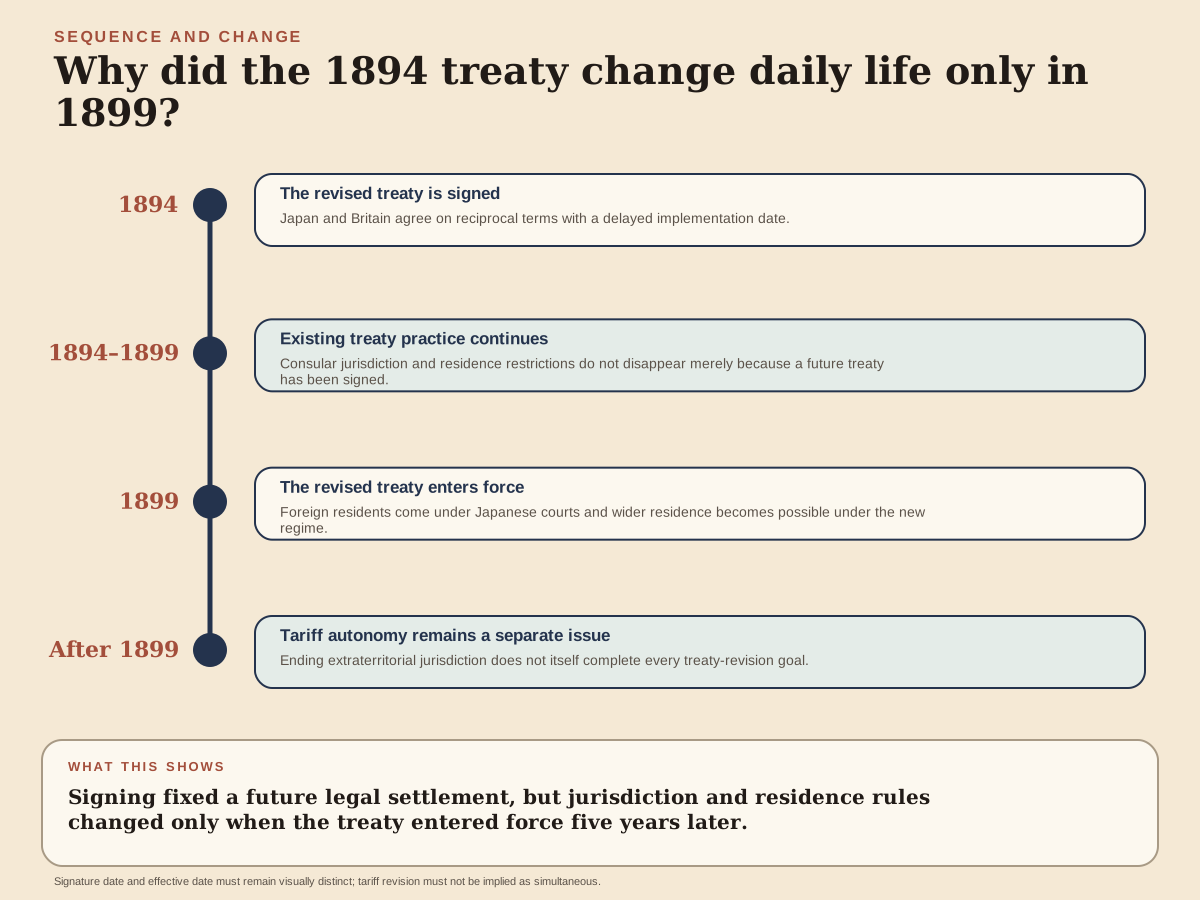
Mutsu became foreign minister in Prime Minister Itō Hirobumi’s second cabinet in 1892. After preparation, the cabinet adopted a negotiating policy in 1893. Japan’s minister in London, Aoki Shūzō, signed the Anglo-Japanese Treaty of Commerce and Navigation with British foreign secretary Kimberley on 16 July 1894. It ended British consular courts’ jurisdiction over their nationals in Japan after a five-year interval, while Japan accepted wider residence, travel and commercial access for foreigners. Other powers concluded similar agreements. The result restored an important part of legal authority in 1899; full tariff autonomy remained for later negotiation. Mutsu’s ministry also established examination rules for diplomatic and consular recruitment in 1893. [5][6][7][16]
The 1894 Donghak peasant uprising in Korea brought Qing troops at the Korean government’s request and a Japanese deployment in response. Mutsu supported an active policy that linked continued troop presence to demands for Korean administrative reform. Calls for withdrawal did not resolve the dispute. On 23 July Japanese forces attacked the royal palace in Seoul, forcing a change of political control. Japan’s envoy Ōtori Keisuke reported the operation and fighting to Mutsu. Naval combat with Qing forces followed before formal declarations in August. The foreign minister’s effort to improve Japan’s standing with Western powers thus ran beside coercive intervention in a neighboring country. [3][7][8][9]
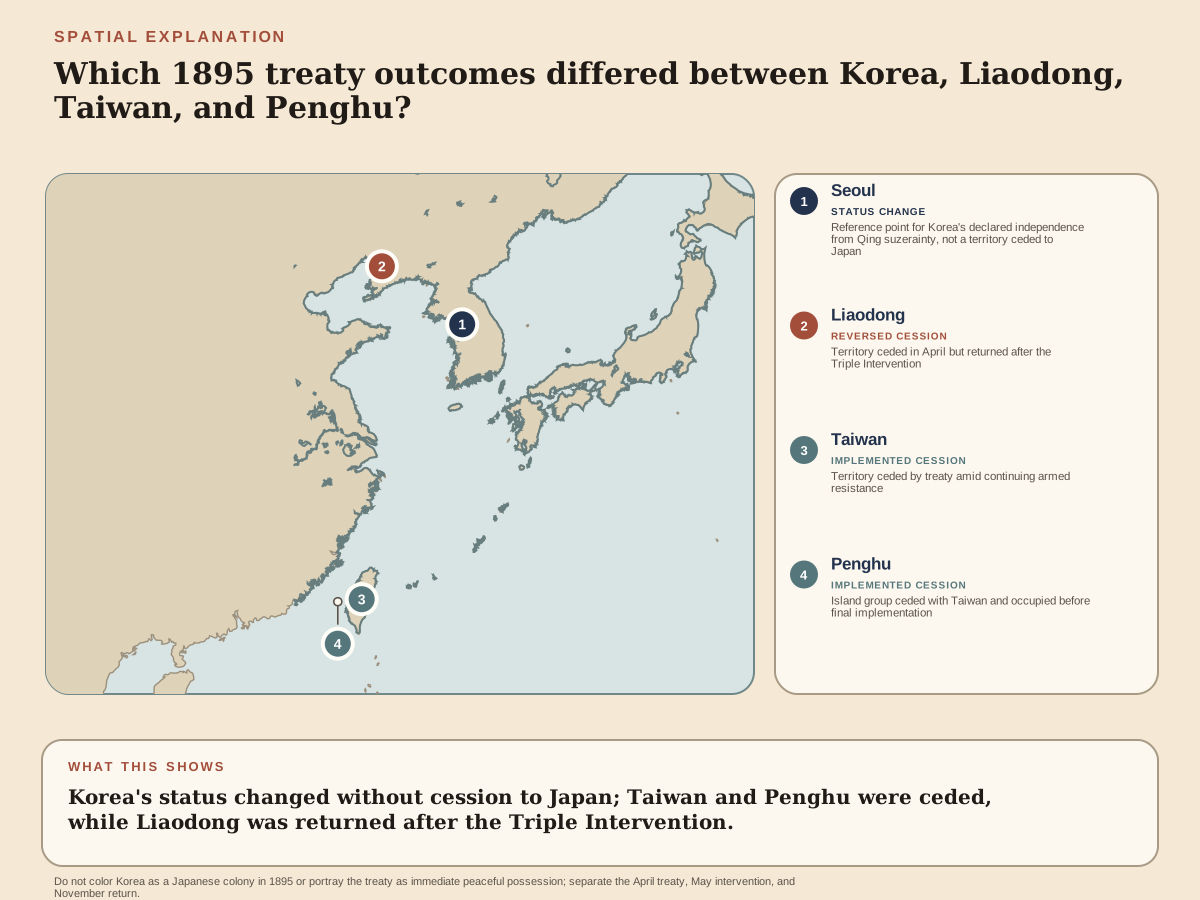
At Shimonoseki in 1895, Mutsu and Itō negotiated with the authorized Qing negotiators Li Hongzhang and Li Jingfang. Li Hongzhang’s wounding by a Japanese attacker on 24 March helped change Japan’s armistice position, although Taiwan and Penghu remained outside the ceasefire. The treaty signed 17 April ended Qing claims to tributary relations with Korea, ceded Taiwan, Penghu and Liaodong, and imposed an indemnity of 200 million silver taels. Russia, France and Germany then demanded Liaodong’s return. Japan accepted in May and concluded a return treaty in November. Military victory allowed harsh terms against Qing while leaving Japan unable to preserve every acquisition against stronger powers. [10][11][12][7]
Tuberculosis worsened during Mutsu’s final years. He left the Foreign Ministry in 1896 and died on 24 August 1897. His account of the war’s diplomacy, Kenkenroku, was printed confidentially in 1896 and reached public publication only in 1929. Its revised drafts and use of official information make it an important source from a participant whose own position must remain visible. Mutsu lived through conviction and return to office, parliamentary bargaining, treaty revision and imperial acquisition. The jurisdictional changes he negotiated took effect after his death, while the war settlement had already altered the lives and political standing of neighboring peoples. [2][3][5][13][6][11]
Classic
Mutsu Munemitsu’s original surname was Date. Born in 1844 in Wakayama, he belonged to the household of Date Munehiro, an official and historical writer of the Kishū domain south of Osaka also called Chihiro. His father’s fall in a factional struggle deprived the family of its former standing. Munemitsu’s study in Edo, now Tokyo, placed him with teachers such as Yasui Sokuken, whose training in Chinese learning belonged to an established scholarly world. His later diplomatic career began with this education and the loss of a secure place within domain service. [2][3][4]
In the 1860s he entered the Kobe naval-training circle of Katsu Kaishū, an official of the shogunate, Japan’s warrior government. There he met the political activist Sakamoto Ryōma. After the training institution closed, the men’s maritime work continued through the Kameyama association in treaty-port Nagasaki and, in 1867, the Kaientai. Navigation, foreign contact, shipping and commerce supplied practical forms of cooperation. Munemitsu used the name Mutsu Yōnosuke during this period. His change of name accompanied work across the boundaries of inherited domain service. [2][4][3]
These groups required captains, crews, merchants and patrons as well as politically connected leaders. Munemitsu participated in a setting where transport and negotiation mattered together. The 1868 Restoration established a government headed by the emperor and subsequently offered posts in foreign affairs and provincial administration to men with useful knowledge and connections. His entry into government followed that change of regime; the experiences of an unsettled young retainer acquired a new institutional use. [2][1]
Mutsu’s first Restoration appointments concerned foreign affairs, but his responsibilities soon ranged across provincial government and finance. He served in Hyōgo, around Kobe, and in Kanagawa, which included the treaty-port economy of Yokohama. He returned to help reorganize Wakayama’s administration. These were positions in governments undergoing repeated changes of territory and office. The 1871 replacement of domains by prefectures made former domain resources answerable to a national administration. [1][2][5]
He advocated land-tax change in 1872 and subsequently held senior tax-administration duties. The proposal and appointment belong to different stages of his work. A government expanding beyond domain finance needed a more regular claim on landed resources. Mutsu contributed proposals and administrative service within a wider process involving the Finance Ministry and local officials. His role did not concentrate every part of the eventual tax system in one author. [2][5]
The reform that followed joined landownership to tax assessment through certificates. These recorded rights in land and served as documents for taxation and payment. The 1873 law set the charge at three percent of land value, while urban land initially remained at one percent; its rate rose to three percent in 1875. In 1877 the rate was reduced to two and a half percent. The government sought a more uniform, stable source of revenue, but issuing the certificates required continuing local work. Mutsu’s proposals belonged alongside those of officials such as Kanda Takahira, who also advocated taxation based on recorded land prices. The eventual system developed through their proposals, deliberation and subsequent administrative changes. [17][18]
His dissatisfaction with Satsuma and Chōshū dominance helped bring resignation. These former domains supplied many leading officials and powerful relationships within the new government. An official from Wakayama could hold important appointments while remaining dissatisfied with how authority was distributed. His 1875 appointment to the Genrōin, a legislative council whose members were appointed rather than elected, offered another route into state affairs. Conflict over participation in government continued beyond the overthrow of the shogunate. [3][2][5]
The Satsuma rebellion of 1877 exposed conflict within the political order created by the Restoration. Mutsu became involved in plans associated with the Tosa Risshisha, a political organization whose activism included a projected armed challenge. In 1878 he was convicted, removed from office and sentenced to five years’ imprisonment. His later return to senior service followed a real conviction and deprivation of liberty. It was not an uninterrupted ascent through official appointments. [1][2][3][5]
During imprisonment he translated the British thinker Jeremy Bentham’s work on moral and legislative principles under the Japanese title 利学正宗. Release in 1883 allowed foreign travel in 1884–1886. He studied state questions with the Austrian scholar Lorenz von Stein in Europe. Translation and lectures gave his political experience contact with different accounts of law and government. The work was undertaken by a man who had already administered taxes and opposed the government, then experienced its penal authority. [3][5]
A surviving 1884 letter to his wife Ryōko asked for a photograph in Western dress and for letters every week even when there was no business to report. The letter records a wish to maintain frequent contact during separation. Overseas study entailed prolonged separation, and correspondence supplied a continuing relationship during it. His eventual Foreign Ministry appointment followed release and travel; the new post restored a public function after years spent outside official power. [15][5][3]
Mutsu took up duties in Washington in 1888 as the envoy heading Japan’s diplomatic mission, or legation. His rank was minister, the head of a legation. His assignment placed treaty negotiations alongside relations with the United States. In November he concluded Japan’s agreement with Mexico, a separate state whose representatives could accept terms that older Western treaty partners had resisted. [1][5][3]
The treaty allowed Mexican residents to live beyond the restricted foreign settlements in Japan on condition that they obey Japanese law. Most-favored-nation treatment, which could extend commercial advantages granted to other countries, was not conceded unconditionally. Reciprocal terms connected broader access for foreigners to recognition of Japan’s jurisdiction. Mexico was therefore a precedent for the revision of older arrangements, rather than a declaration that access should disappear. [7]
Japan and Qing China had already concluded an equal treaty in 1871. The Mexican agreement’s distinction lay in reciprocity with a state outside Asia and its relevance to negotiations with Western powers. Britain and the other treaty partners still had their own interests and terms to settle. Mutsu’s work showed one agreement could be made without the older jurisdictional privileges, while leaving the larger revision effort unfinished. [7][3]
In 1890 Mutsu entered the cabinet as minister for agriculture and commerce and gained an elected seat representing Wakayama. The House of Representatives gave opposition parties a role in national budget decisions. An official ministry appointment and an electoral mandate now existed together in his career. He cultivated relationships with political groups, using older acquaintances to work through disputes between ministers and the new parliament. [1][3][5]
The ministry also administered an industrial economy in which copper exports supported foreign payments and machinery imports. At Ashio in present-day Tochigi, mining and smelting damaged forests, rivers and farmland. The representative Tanaka Shōzō brought the affected communities’ claims into parliament in 1891, demanding cessation of harmful operations and pursuing Mutsu’s ministerial responsibility. A 1985 historical study describes the government’s published reply as leaving the cause under investigation while pointing to preventive equipment. The farmers’ injuries were not settled by that answer. [14]
Evidence boundary · Family connections and ministerial responsibility
Mutsu’s second son had entered the household of mine owner Furukawa Ichibē through adoption. The mine’s industrial and political connections therefore reached into the minister’s household.
This relationship is relevant to the distribution of access and influence; the recorded relationship alone cannot certify his private intention in each administrative decision. [14]
He remained in Prime Minister Matsukata Masayoshi’s cabinet but clashed with its Satsuma-associated leaders and contested responsibility for election interference. In 1892 he resigned and entered the Privy Council, the emperor’s advisory body, before receiving another cabinet appointment. [14][3][2][5]
Mutsu’s 1892 appointment placed him under Prime Minister Itō Hirobumi in a cabinet facing pressure from parliament and advocates of a harder foreign policy. The old treaties permitted foreign consular courts to try their nationals and limited Japan’s ability to set customs duties. Revision therefore concerned legal authority and economic terms as well as diplomatic reputation. Mutsu prepared the ministry’s approach before the cabinet adopted its policy in July 1893 and sent instructions to overseas missions. [3][6][7]
Aoki Shūzō, Japan’s minister in London, signed with British foreign secretary Kimberley on 16 July 1894. Mutsu directed policy from the Foreign Ministry; Aoki carried the negotiation to signature. The treaty required a five-year interval before implementation. Britain surrendered separate consular jurisdiction, and most-favored-nation terms became reciprocal. Japan in turn opened the interior to foreign travel, residence and commerce and ended the settlement restrictions. Recovery of jurisdiction required accepting a changed relationship between Japanese law and foreign access. [6]
The ministry’s 1893 examination ordinance tested languages, written summaries, law and economics and used written and oral stages. Its eligibility rules admitted adult men and included an exception for political offenders whose rights had been restored. The rules provided a formal basis for recruiting specialist officials. Treaty revision required missions and trained staff as well as ministerial direction. Other agreements followed the British treaty, but tariff autonomy remained incomplete and was recovered in 1911, after Mutsu’s death. [16][3][7]
Korean peasant rebellion in 1894 drew the royal government into requesting Qing military help. Japan deployed troops and pressed demands for changes in Korean administration. Mutsu’s foreign policy maintained an active role while Japanese military leaders pursued their own strategic aims. The presence of both armies did not remove Korea’s government from the question of what should happen on Korean territory. [3][7][9]
A US instruction of 20 July summarized Korean requests for withdrawal and neutral assistance, Chinese offers of simultaneous departure and Japanese arguments that reform was necessary before troops could leave. These were diplomatic reports from actors with particular access and interests. They nevertheless preserve the fact that Korean officials sought a different outcome from continued foreign military presence. Japanese declarations of respect for Korean independence existed beside demands backed by armed forces. [9]
On 23 July Japanese troops attacked the Gyeongbok royal palace in Seoul and sought a government headed by the king’s father, the Daewongun. Japan’s envoy Ōtori Keisuke reported in a telegram to Mutsu that Korea’s response to Japan’s demands was unsatisfactory and fighting had broken out. The military command and diplomatic channels had distinct functions, but the operation formed part of policy carried forward by the Japanese government. Combat with Qing forces followed before formal declarations in August. The war’s opening changed the Korean court’s freedom of action before it produced the later treaty between Japan and Qing. [8][3]
The Qing government appointed Li Hongzhang and Li Jingfang with full powers to negotiate; Mutsu and Itō represented Japan. Talks began at Shimonoseki in Yamaguchi on 20 March 1895. Japan initially demanded occupation of strategic places and payment of military expenses as terms for an armistice. After a Japanese attacker wounded Li Hongzhang on 24 March, Japan softened that position and a ceasefire followed on 30 March. Taiwan and Penghu were excluded, leaving Japanese military pressure on territories it intended to acquire. [10]
The 17 April treaty required Qing to recognize Korean independence and end the tributary rites linking the two courts. It transferred sovereignty over Taiwan, Penghu and Liaodong, imposed 200 million silver taels in indemnity and opened additional cities to Japanese commercial activity. A clause allowed residents of ceded territories two years to dispose of property and leave; those remaining could be treated as Japanese subjects. The terms joined territory, payment, commercial rights and the future status of inhabitants. Korean and Taiwanese representatives had no equal place among the four named plenipotentiaries. [11][10]
Russia, France and Germany advised return of Liaodong on 23 April, presenting Japanese possession as a danger to the Qing capital and Korean independence. The Japanese cabinet decided to accept on 4 May. Mutsu instructed the envoy in Russia the next day to submit the commitment to relinquish permanent possession. The November return treaty provided additional compensation. His work now involved explaining and executing retreat from a signed acquisition. The government’s power to impose terms on Qing proved greater than its ability to keep all those terms against a European coalition. [12][7]
Evidence boundary · Reading a participant’s diplomatic memoir
Mutsu’s tuberculosis progressed during the war and its aftermath. He resigned as foreign minister in May 1896 and died in 1897. The illness coincided with work on Kenkenroku, his account of diplomacy from the war’s beginning to treaty ratification in May 1895. Drafts bear revisions and additions.
The text therefore belongs to sustained recollection and composition informed by official records, rather than a transcript written as each decision occurred. [2][3][5][13]
The Foreign Ministry printed the work in 1896 but kept it confidential; public release followed in 1929. Its position inside the diplomatic establishment gave Mutsu information unavailable to many readers while also shaping the story he presented. The surviving collection includes material on domestic politics, treaty revision, war, peace and the return of Liaodong. Letters from other officials record questions and exchanges around that work. They supply further actors and occasions against which the memoir can be understood. [13][5]
The British treaty’s jurisdictional changes came into force in 1899, after his death. Tariff autonomy was completed still later. The 1895 settlement had already transferred territories and imposed payments while leaving Korea exposed to Japanese pressure. Mutsu’s career joined efforts to make Japan’s legal standing reciprocal to policies that enlarged unequal power elsewhere. The same minister who had regained office after imprisonment could achieve lasting diplomatic change and participate in the loss of other governments’ room to decide. [6][7][11][8][9][1]