Read the article below. Interactive reading tools are available when scripts load.
Quick
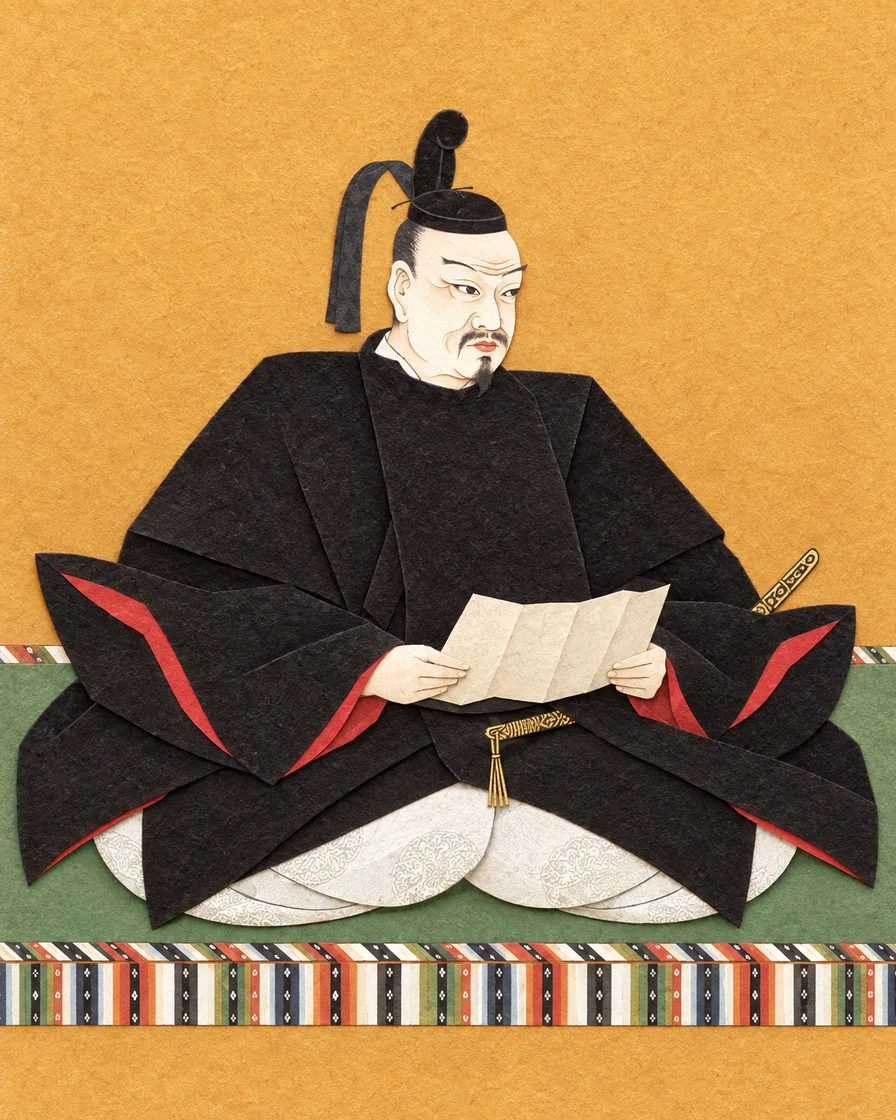
Mōri Terumoto was born in 1553, the son of Takamoto and grandson of Motonari, whose expansion had made the family a major power in western Japan. Takamoto’s death in 1563 placed Terumoto at the head of the house while still a child. Motonari remained his guardian until his own death in 1571. Terumoto then relied on his father’s brothers, Kikkawa Motoharu and Kobayakawa Takakage. These senior relatives headed allied houses of their own. His inheritance therefore joined family seniority to a network of experienced men and separate military resources, rather than giving him an army and government controlled through his decisions alone. [1][3]
Terumoto’s surviving documents show authority exercised through small, formal acts. In 1571 he confirmed a retainer’s inherited holding. A 1577 instrument allowed Iida Motonobu to use the character moto from his lord’s name. In 1588 another permitted him to change his byname from Kosaburō to Saburō Saemon-no-jō. The latter resembled an official title but was a designation authorized within the house, rather than an imperial court appointment. Grants of land rights and names bound service families to the Mōri lord. The six-document collection now at Kokugakuin University preserves part of that relationship across several stages. [3]
Terumoto sheltered Ashikaga Yoshiaki, the ruler of the warrior government expelled from Kyoto by Oda Nobunaga, and helped supply Ishiyama Honganji, the Buddhist center fighting Nobunaga in Osaka. The Mōri house faced advancing forces led by Hashiba Hideyoshi, later known as Toyotomi Hideyoshi. Peace at Bitchū Takamatsu in 1582 ended that immediate confrontation as Nobunaga’s death transformed the national struggle. Further negotiations, including mediation by the Buddhist cleric Ankokuji Ekei, settled territorial boundaries. Terumoto then supported Hideyoshi’s campaigns in Shikoku in 1585 and Kyushu in 1587. Cooperation gave his regional house a recognized place within the expanding national order. [1][3]
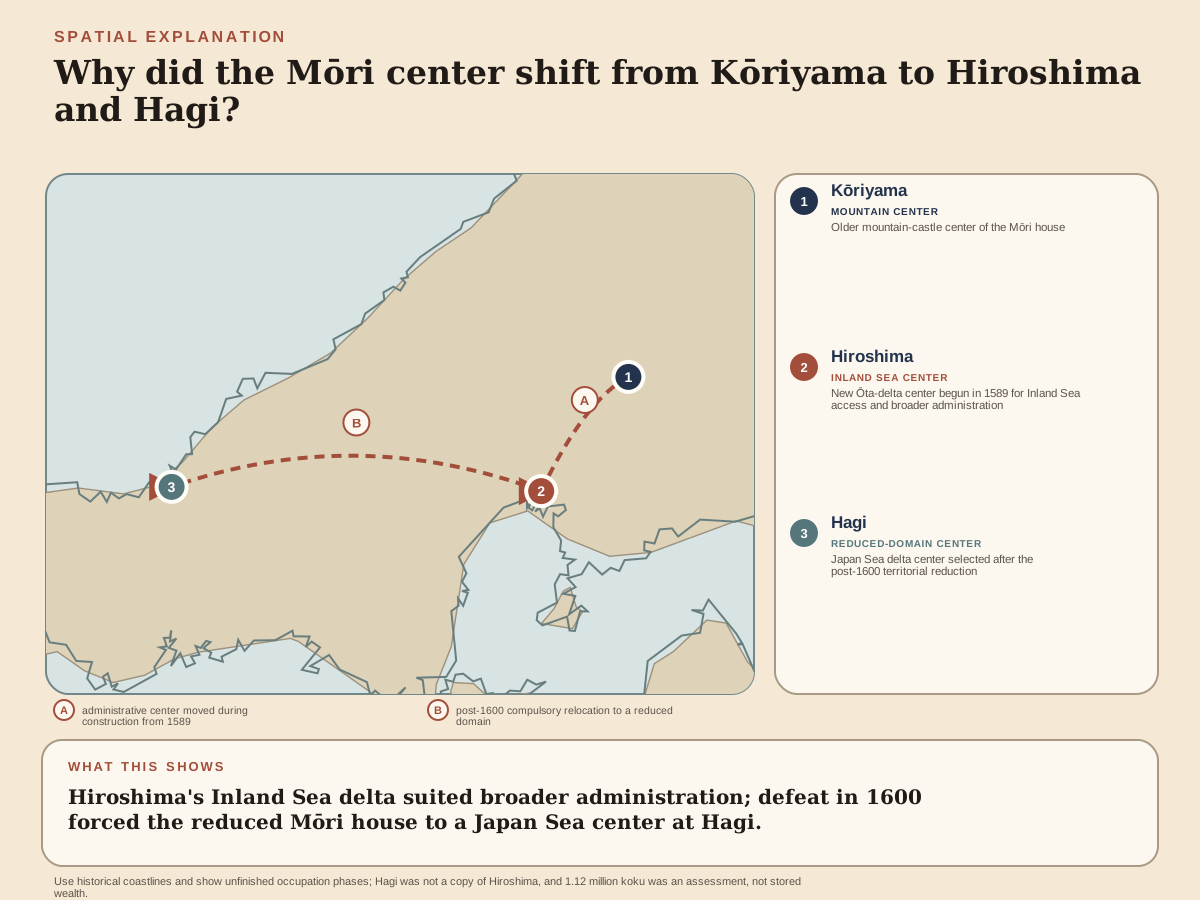
Terumoto began Hiroshima Castle in 1589 on the Ōta River delta, replacing mountain-based Kōriyama as his main residence. His orders assigned moat works to retainers, and Ninomiya Naritoki and Hirataya Sōemon organized the town plan. He entered the castle in 1591 while it remained unfinished. That year the assessment of the Mōri holdings was fixed at approximately 1.12 million koku, a measure of agricultural yield used for lordly resources. Stonework continued into 1593 and construction into 1599. The new center brought castle, planned settlement and river access together, making the lord’s residence part of the organization of an extensive territory. [4][1]
Under Hideyoshi, Terumoto’s large confirmed holdings brought obligations beyond western Japan. He served in the invasions of Korea and became one of the senior lords known as the Five Elders. The wars beginning in 1592 and renewed in 1597 mobilized territorial houses for operations overseas. Hideyoshi continued to issue detailed instructions from Japan; surviving orders to other lords show demands for rotating reinforcements. Terumoto’s high standing therefore combined extensive resources with service to a ruler who determined their deployment. After Hideyoshi died in 1598, the senior lords had to sustain an arrangement centered on his young son Hideyori. [1][7][2]
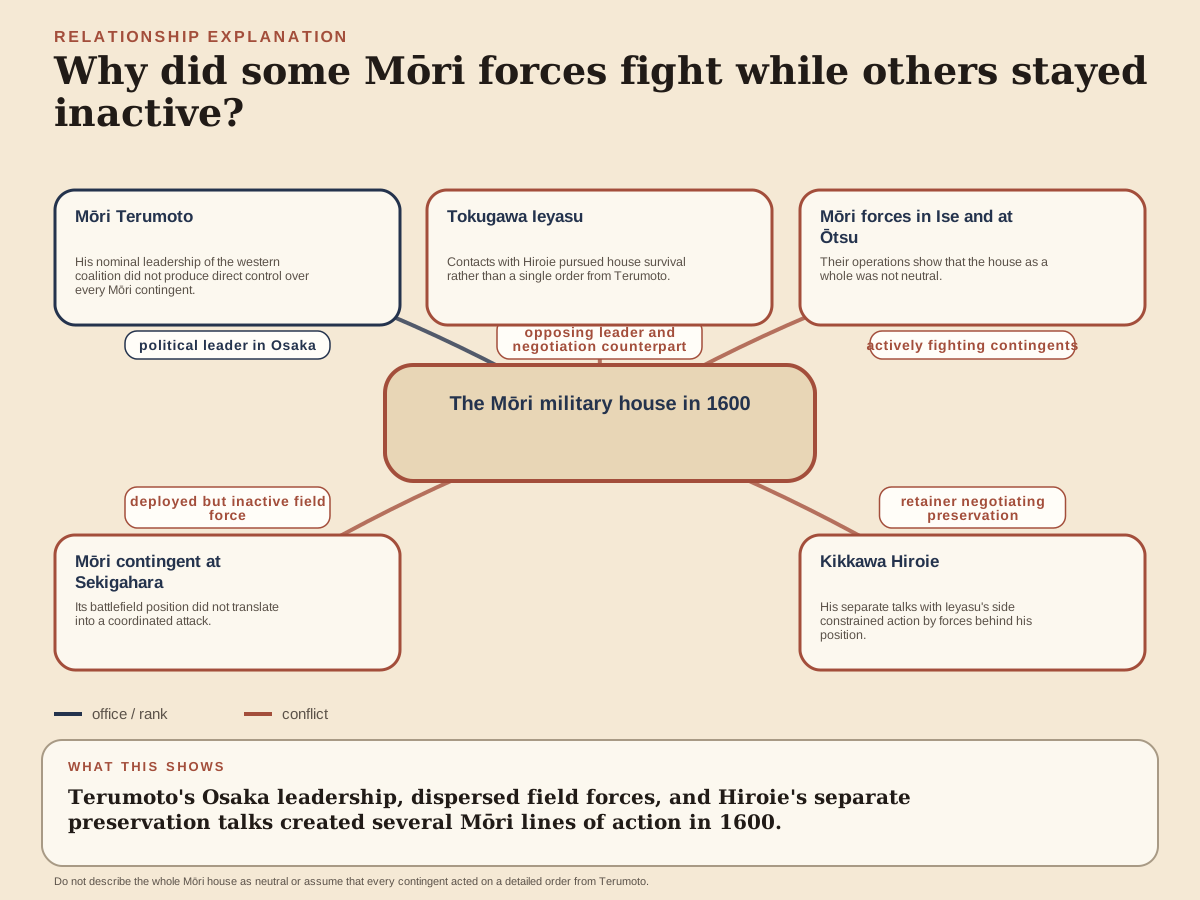
In 1600 Terumoto became a leading figure of the coalition opposing Tokugawa Ieyasu, another senior territorial lord, and remained at Osaka Castle with Hideyori. He and Ukita Hideie appealed jointly to other lords for participation. Mōri armies operated in Ise and against Ōtsu Castle, although forces associated with the house did not fight at Sekigahara itself. Terumoto’s cousin Kikkawa Hiroie negotiated with Ieyasu for the protection of the house, and the senior Mōri figure Fukuhara Hirotoshi supported that course. After the coalition’s defeat, Ieyasu held Terumoto responsible. His subsequent oath guaranteed Terumoto and Hidenari their lives and the lands of Suō and Nagato, a much reduced settlement. [2][3]
After 1600 Terumoto retired in favor of Hidenari and took the religious name Sōzui, but continued to direct the house’s government. The loss of Hiroshima required another center within Suō and Nagato. Following negotiations with the Tokugawa warrior government, construction began at Hagi in 1604, on a river delta facing the Sea of Japan. Terumoto entered the unfinished castle that year; work continued until 1608. In 1621 he sent Hidenari an admonition on conduct toward the household and the shogunate. He died in 1625. His later career preserved government and succession after defeat had removed much of the territory he once ruled. [1][5][6]
Classic
Mōri Terumoto was born in 1553, the son of Takamoto and grandson of Motonari. In 1563 he succeeded his father as head of the Mōri house. Motonari continued to guide its government until his own death in 1571. The house had acquired territories and alliances through Motonari’s long career. Terumoto’s title placed him at their center before he had comparable experience. [1][3]
Kikkawa Motoharu and Kobayakawa Takakage were Takamoto’s brothers and Terumoto’s uncles. Their support connected the main Mōri line with the Kikkawa and Kobayakawa houses. The arrangement supplied military and political assistance from men who possessed their own bases and relationships. It also meant that maintaining the family’s influence required cooperation within this wider structure. Terumoto’s later service under Toyotomi Hideyoshi, who became Japan’s military ruler, continued to involve Takakage, who held an important position in the new national order. Senior relatives remained part of the means by which the heir’s authority could be exercised. [1][3]
Written confirmations and letters give the inherited house a more concrete form. A document issued in Terumoto’s name in 1571 confirmed a retainer’s succession to his father’s holding. The Kokugakuin University catalogue connects the receiver, called Sugata Kameishi, with the man later called Iida Motonobu. The catalogue’s reconstruction depends on later family records as well as the surviving documents. At the secure level, the confirmation shows Terumoto’s government addressing another household’s inheritance in the same period that his own grandfather’s death changed his position. Such acts maintained the relationships through which territorial authority worked. [3]
Evidence boundary · Connecting a retainer’s names and letters
The six documents now mounted together at Kokugakuin University came from the Iida retainer family. Some address the receiver under Sugata names and others under Iida names.
The catalogue uses the later family compilation known as the Hagi Domain Records of Retainer Houses to connect these identities. The 1571 confirmation allowed succession to a father’s holding. A separate letter refers to a man’s death at Tachibana, which the catalogue associates with fighting near Hakata in northern Kyushu; its year is reconstructed as 1570. The documents preserve military loss alongside the arrangements that allowed a service household to continue. [3]
In 1577 Terumoto authorized the character moto for Iida Kosaburō, identified in the catalogue as Motonobu. A grant of a character from a superior’s personal name was a recognizable mark of affiliation. The university explanation notes similar Mōri instruments for many retainers and interprets them as a means of bringing men of varied origins into the house’s service. Terumoto himself had received teru from Ashikaga Yoshiteru, the shogun who headed the warrior government. Name patronage thus worked at different levels: his connection to the shogun and a retainer’s connection to him were expressed through comparable written acts. [3][1]
The 1588 instrument authorized Motonobu’s new byname, Saburō Saemon-no-jō. Its wording drew on the language of offices, but the catalogue expressly distinguishes such permissions from official appointments. Terumoto’s actual court advancement under Hideyoshi belonged to another system of recognition. Keeping the two apart allows the reader to see how house government could distribute honors without itself becoming the imperial court. The retainer’s altered name, confirmed holding and continuing correspondence were several parts of one relationship of service. Each required an act from the lord rather than a pedigree alone. [3][1]
Ashikaga Yoshiaki, the shogun expelled from Kyoto by Oda Nobunaga, reached the Mōri sphere in 1576. His position connected Terumoto’s regional opposition to a wider claim against Nobunaga. Supplying Ishiyama Honganji likewise linked Mōri resources with a fortified religious center whose resistance had national significance. These connections required provisions and military action, not merely declarations of loyalty. The house’s struggle against Nobunaga’s western commanders placed pressure on the eastern parts of its sphere while senior Mōri relatives helped sustain the defense. [1][3]
At Bitchū Takamatsu in 1582 Terumoto’s side concluded peace with Hideyoshi. Nobunaga’s killing at Honnōji opened the succession struggle in which Hideyoshi rose. In 1583 Terumoto sent Ankokuji Ekei to negotiate boundaries with Hideyoshi. Holding territory depended on turning the military settlement into agreed terms that both governments could use. [1]
Terumoto’s forces participated in Hideyoshi’s campaigns against Shikoku in 1585 and Kyushu in 1587. The former adversaries had become superior and cooperating territorial lord. Terumoto’s retained holdings supplied resources for campaigns beyond his own borders, while Hideyoshi’s confirmation gave those holdings standing within the national settlement. The arrangement preserved the Mōri house’s extensive position at the price of accepting obligations directed from above. Hiroshima’s subsequent construction and the formal assessment of the lands developed within that new relationship. [1][3][4]
Hiroshima Castle’s chronology places Terumoto’s first capital visit in 1588, when he visited Hideyoshi’s residences. Later that year he was close to settling the new castle site. Construction began in 1589, with digging and moat work assigned through the house’s government. The location on the Ōta delta opened the residence toward waterways and the Inland Sea, unlike Kōriyama’s mountain setting. The move altered the physical center from which the Mōri territories were governed. It also involved creating a settlement around that center rather than transferring the lord’s residence alone. [4][1]
The castle chronology names the construction officer Ninomiya Naritoki and Hirataya Sōemon in the town planning completed around the traditional first month of 1590. These officials organized the settlement as the lord’s construction orders were carried out. In 1591 the surveyed Mōri holdings were rated at approximately 1.12 million koku. A koku was a grain measure; the figure expressed assessed productive resources across lands, not an amount stored in the castle. Hideyoshi’s confirmation and the house’s surveys connected this regional government with the accounting and recognition of the national ruler. [4][1]
Terumoto entered Hiroshima Castle around the intercalary first month of 1591. The official chronology states that the principal sections were probably ready while the castle remained incomplete. Stonework was finished in 1593, and it gives 1599 for the end of construction. The sequence shows a government operating from a center still being built. Retainers, planners and workers continued the project after the lord had moved in. Hiroshima outlasted his tenure: following the settlement of 1600, it passed to Fukushima Masanori. Terumoto lost the administrative home whose construction had occupied much of the preceding decade. [4][1]
Mōri forces served in Hideyoshi’s invasions of Korea. The house’s recognized territorial resources were now committed to a war beyond Japan. Retaining a large regional domain under Hideyoshi did not shelter it from the ruler’s continental ambitions; its armies and resources belonged among the means used to pursue them. [1][7]
Terumoto’s preparations also extended to the government he would leave behind. A copied set of instructions addressed to Sase, the official assigned to remain in his territories during the Korean expedition, covers lodgings, coastal officers and the movement of messages to and from Nagoya, Hideyoshi’s invasion headquarters in northern Kyushu. It provides for guards and shipping on the Korea route and directs that rice be allocated where inhabitants face hunger. The same instructions leave signed sheets and a scribe for official business. These provisions show the administrative work required to send a lord overseas while maintaining authority at home. They record intended arrangements, rather than accounts proving that supplies arrived or hunger was relieved. [9]
Nagoya City Museum explains the renewed invasion of 1597 through the failure of negotiations with Ming China. Hideyoshi then directed the war chiefly from Kyoto and Osaka. One surviving order, assigned by related evidence to 1598, required Shikoku lords to rotate reinforcements to Busan. It was addressed to those lords, not issued by Terumoto. The document provides a concrete view of the national military system in which territorial resources had to answer continuing overseas demands. Orders sent from Japan could specify duties while leaving commanders to manage distance and communication with the fighting front. [7]
Terumoto became one of the Five Elders, the senior territorial lords associated with the government of Hideyoshi’s heir. Their prominence depended on lands and forces as well as their place near the ruling family. Hideyoshi’s death in 1598 left Hideyori too young to govern through his own political experience. Terumoto’s later presence in Osaka connected him with the heir’s protection, but other senior lords and administrators held resources and responsibilities of their own. The arrangement required cooperation among powerful houses. Its breakdown would expose the distance between Terumoto’s senior position and his capacity to command those houses together. [1][2][3]
Mōri Museum describes the administrator Ishida Mitsunari’s approach to Terumoto through the Buddhist cleric Ankokuji Ekei. Terumoto and Ukita Hideie then issued joint appeals for lords to join the rising against Tokugawa Ieyasu, another senior territorial lord. The two names represented major territorial resources alongside the administrators involved in the struggle. Terumoto remained at Osaka, guarding Hideyori, while armies conducted the campaigns. His location and rank provided the coalition with an important political center. They did not give him direct control over every decision made by its military partners. [2][3]
Historical interpretation · Inactive at Sekigahara, active elsewhere
Mōri troops were prominent in operations along the Ise route and against Ōtsu Castle. Those campaigns prevent the house’s entire war from being described as neutral or inactive. At Sekigahara, however, the decisive forces did not act as Terumoto’s coalition position might suggest. Hiroie, the son of Terumoto’s uncle Motoharu, negotiated with Ieyasu on terms intended to preserve the Mōri lands. Fukuhara Hirotoshi aligned with that course. These arrangements contributed to battlefield inactivity.
The house’s political head, senior relatives and field forces occupied different positions within a war fought in its name. [2][1]
Ieyasu’s oath of the tenth day of the traditional tenth month of 1600 guaranteed the lives of Terumoto and his son Hidenari and granted Suō and Nagato. The museum explains it as the outcome of a settlement that had initially threatened complete confiscation. Political responsibility fell on Terumoto despite his absence from the battlefield. During the Edo period the oath was treasured as evidence for the family’s possession of its remaining territories and kept in a decorated lacquer box. A document issued by the victorious opponent became part of the foundation of the Mōri house’s continued government. [2][3]
Hidenari became head of the reduced Mōri house while Terumoto entered retirement under the religious name Sōzui. Terumoto continued handling government. Retirement therefore changed the formal headship without immediately removing the father’s administrative role. Suō and Nagato lay in present-day Yamaguchi, far west of the Hiroshima center the family had lost. The new government had to operate within the lands recognized by Ieyasu’s settlement and under the authority of the Tokugawa shogunate. [1][2][3]
The choice of a new castle site involved discussion with the shogunate among candidates at Yamaguchi, Hōfu and Hagi. The institutional history explains Hagi’s advantages through river and sea transport: the Abu River divided around a delta, and waterways could carry building materials, dues and household supplies. Construction began in 1604 at Shizuki Mountain and its foot. Terumoto moved into the partly completed castle during that year and continued conducting government as the work proceeded. Completion followed in 1608. The move repeated the earlier task at Hiroshima of organizing a castle and town on a delta, now within a diminished territory. [5][4][8]
Shunan City Library describes a twenty-one-item admonition that Terumoto gave Hidenari in 1621. It addressed the son’s conduct, filial behavior and relations with people within and beyond the house, especially the shogun and shogunate. The surviving record gives the father’s later concern a practical setting: the house still possessed lands and a successor, but its security depended on the political order that had reduced it. Terumoto died at Hagi in 1625. The government he left continued from the center he had helped build after defeat, while the preserved oath and family documents recorded the limits within which that survival had been secured. [6][1][2][5]