Read the article below. Interactive reading tools are available when scripts load.
Quick
Minamoto no Yoshiie was born in 1039, the eldest son of the warrior official Yoriyoshi. His mother came from the family of Taira no Naokata; the name Hachiman Tarō associated him with Iwashimizu Hachiman Shrine. He accompanied his father against the Abe family in the north during the Former Nine Years’ War, which lasted from 1051 to 1062 despite its name. The Abe remained powerful until assistance from the Kiyohara of Dewa changed the balance. Victory in 1062 brought Yoshiie appointment as governor of Dewa, a northern province on the Japan Sea side, in 1063. His military career was developing inside the court’s system of office and reward. [1][4][5][9][3]
After his 1063 appointment to Dewa, Yoshiie held further provincial and military offices. He protected the Fujiwara household, whose regents helped govern beside the emperor, and took part in maintaining order in Kyoto. In 1079 he pursued Minamoto no Shigemune under imperial orders; in 1081 he accompanied police officials to arrest monks at Onjōji. These duties brought an armed following into the service of rulers and great households. By 1083 he was governor of Mutsu and also held a northern military command. His return north would put official responsibility alongside personal involvement in the affairs of a regional family. [1][3][7][2][4]
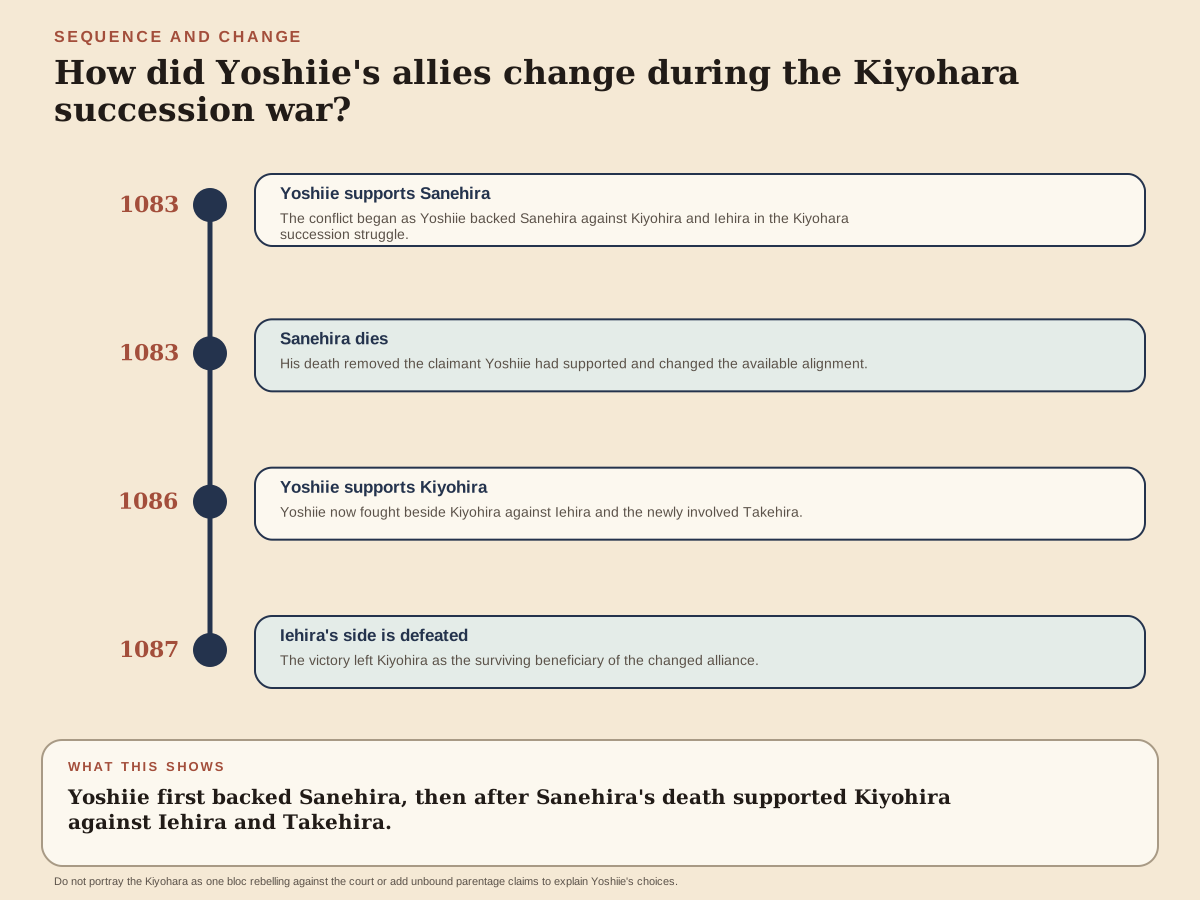
In 1083 Mutsu governor Yoshiie entered a conflict within the Kiyohara, who had become powerful after the earlier Abe war. He first supported Kiyohara no Sanehira against Kiyohira and Iehira. When Sanehira died, Yoshiie accepted the brothers’ submission and divided six districts between them. The arrangement failed: in 1086 Iehira attacked Kiyohira’s household, and Kiyohira escaped while his family suffered killings. Yoshiie then took Kiyohira’s side and attacked Iehira. An intervention in regional succession had become a campaign whose authorization the court would refuse. [2][4][5]
In 1086 Yoshiie attacked Iehira at Numa in Dewa, but resistance, hunger and winter conditions forced his army back. Kiyohara no Takehira joined Iehira, and they moved to Kanazawa. Yoshiie returned against them in 1087. A prolonged siege and blockade brought hunger inside the stronghold before it fell. Iehira and Takehira were killed, and their leading followers were beheaded. Kiyohira emerged as the surviving regional power, while Yoshiie’s battlefield success still lacked the court’s recognition. The campaign’s immediate result was a changed northern ruling network, accompanied by substantial loss of life. [2][4][1][5]
After the 1087 victory, the court refused campaign rewards and removed Yoshiie as governor of Mutsu in 1088. The Oshu Gosannenki war narrative says that he paid his followers from his own resources. His reputation attracted landholders seeking connections with him, but the court prohibited donations to Yoshiie in 1091. That year, a land dispute between his followers and those of his brother Yoshitsuna threatened fighting; Fujiwara no Morozane helped secure arbitration. The court then ordered estates established under Yoshiie’s name dissolved in 1092. Military prestige had become a source of relationships and resources whose growth authorities in Kyoto could restrict. [1][2][3]
In 1098 Yoshiie received higher rank and permission to enter retired Emperor Shirakawa’s court. The honor recognized his standing, but troubles involving his sons threatened the household. Complaints against Yoshichika, governor of Tsushima, led to his removal and exile in 1102; Yoshikuni was involved in fighting in Hitachi in 1106. Yoshiie died that year. After his death, Taira no Masamori was sent against Yoshichika and reported his defeat in 1108. Yoshiie’s reputation survived, while family disorder and rival commanders limited the continuity of the power he had assembled. [1][3][8]
After Yoshiie’s death in 1106, stories continued to enlarge the fame of Hachiman Tarō. Accounts celebrated an exchange of poetry with his enemy Abe no Sadatō and his recognition of an ambush from disturbed geese. These are transmitted warrior tales, not independently verified scenes of his life. The surviving illustrated narrative of the Latter Three Years’ War dates to 1347, more than two centuries after the fighting. It presents heroic combat alongside siege and slaughter. Yoshiie’s remembered figure helped sustain the prestige of the Minamoto name; that long afterlife is separate from the limited and troubled authority he held while alive. [1][6][3]
Classic
Yoshiie was born in 1039 into the Kawachi branch of the Minamoto, a family of military aristocrats serving the Heian court. He was Yoriyoshi’s eldest son; his mother was a daughter of Taira no Naokata, another warrior official. Such households occupied a middle level of aristocratic society, taking guard posts and provincial appointments while maintaining their own armed followers. Court status and the capacity to bring men into service reinforced one another. Yoriyoshi’s career therefore supplied more than a famous ancestry: it placed Yoshiie within a working connection between officials in Kyoto and armed action in the provinces. [2][3][1]
In the conflict later called the Former Nine Years’ War, Yoshiie followed his father into Mutsu, on northern Japan’s Pacific side. The Abe family held strong local positions around the Kitakami basin and resisted the forces sent against it. The war ran from 1051 to 1062, with intervals of accommodation rather than continuous fighting. After Abe no Yoritoki died, his son Sadatō continued the resistance; Yoriyoshi suffered a serious defeat at Kinomi in 1057. Yoshiie fought under his father’s command as their forces confronted a regional power able to sustain resistance over several years. [1][4][5][9]
The decisive shift came when the Kiyohara of Dewa, across the north toward the Japan Sea, joined Yoriyoshi. Their alliance supplied forces the Minamoto had previously lacked. Abe positions fell in 1062, and Sadatō died after the fighting at Kuriyagawa, in the area of present-day Morioka. The Kiyohara emerged with greater regional standing, while the Minamoto received court recognition for their campaign. Yoshiie’s award in 1063 included court rank and the governorship of Dewa. Victory had been converted into advancement through a decision made in Kyoto. [4][9][5][1][3]
The familiar name Hachiman Tarō was connected in transmitted accounts with Yoshiie’s coming-of-age ceremony at Iwashimizu Hachiman Shrine. The same traditions would surround him with stories of extraordinary courage and generosity, enlarging the reputation acquired in his northern service. His appointment to Dewa followed a shared victory and gave him an office within the region in which the Kiyohara had also advanced. He would spend the following decades moving between provincial responsibilities and the protection of powerful people in the capital. Northern warfare had opened that career; continued employment and patronage would shape its next stages. [1][4][3]
Yoshiie’s career after 1063 continued through appointments made by the Heian court. Following Dewa, he served in other provinces, including Shimotsuke in eastern Japan, and held guard and police-related posts. A provincial governor served within the court’s territorial administration, exercising authority through an appointment made in Kyoto. His military following could help discharge official duties, while access to appointments depended on relationships in Kyoto. The same man could thus be a provincial official, a protector of an aristocratic household and a commander of his own associates. [1][3][7]
In Kyoto, Yoshiie guarded the Fujiwara regent household and helped maintain urban order. The regents were aristocrats who exercised authority beside the emperor; protection of their household joined military service to a powerful center of patronage. Guarding patrons and enforcing orders kept him engaged in the capital’s political society. In 1079 he was ordered to pursue Minamoto no Shigemune after fighting in Mino. A shared Minamoto name did not prevent one member from enforcing an imperial command against another. The ties that supplied authority for this action crossed the boundaries of the family. [1][3]
In 1081 Yoshiie went with police officials to Onjōji, a major temple near the capital, to arrest monks. The action belongs to the coercive work through which military aristocrats supported government. An armed household could be called upon when an official order needed men capable of executing it. The arrests carried a government order into a temple through the cooperation of police officials and an armed household. Yoshiie’s standing therefore rested on repeated employment as well as the memory of the Abe war. His connections with court office and aristocratic patrons remained part of the structure of his power. [3][1][7]
By 1083 Yoshiie was governor of Mutsu and held the title chinjufu shōgun, a commander associated with the northern military headquarters. That title describes a court military office, distinct from the later position at the head of a shogunal government. The northern provinces were already connected with aristocratic interests in Kyoto through a succession of governors and supervisory officials. Yoshiie entered this field with experience, an armed following and a renowned family name. The Kiyohara, however, possessed regional resources of their own. Their internal division would create opportunities for his intervention without making his official authority unlimited. [1][7][3][4][5][2]
Chronological uncertainty · When did the Mutsu appointment begin?
The appointment chronology is not uniform. The reference biographies place his appointment in 1083, while the officer table in Namekawa Atsuko’s study lists him as governor in office in 1081.
These are different statements about timing, not evidence for two separate appointments. His intervention in the Kiyohara conflict in 1083 remains the narrative’s chronological anchor. [1][2][7]
When Yoshiie was serving as governor of Mutsu in 1083, the Kiyohara held much of the regional power created by the defeat of the Abe. The family was now divided among Sanehira, Kiyohira, Iehira and their associates. These were conflicts within a northern ruling network, rather than a unified Kiyohara rebellion against Kyoto. Yoshiie’s provincial office gave him standing to intervene, but the forces and affiliations involved had histories of their own. The ally on which his father had relied was no longer a single partner with a common military purpose. [2][4][5][7]
Yoshiie initially aided Sanehira against Kiyohira and Iehira. During this phase, the opponents attacked Sanehira’s household while he was away campaigning in Dewa. Sanehira’s sudden death altered the alignment. Kiyohira and Iehira submitted to Yoshiie, who accepted them and divided the six districts of northern Mutsu between the two. His role changed from military supporter of one claimant to arbiter of the resources left by that claimant’s death. A settlement made through the governor could redistribute control, but it could not by itself make the surviving parties share a durable interest. [2][4]
The division did not end the struggle. In 1086 Iehira turned against Kiyohira, attacking his residence. The transmitted account says that Kiyohira escaped while his wife, children and other members of the household were killed. This violence destroyed people whose relationship to the rivalry lay in membership of the household being attacked. Yoshiie now supported Kiyohira and brought forces against Iehira. The governor who had divided territory was fighting to sustain one recipient of that division against the other. Territorial arbitration and armed partisanship had become successive parts of the same intervention. [4][2]
Yoshiie sought an official court order authorizing the pursuit of the Kiyohara opponents. The court did not supply it, treating the struggle as private warfare. Holding a provincial office and conducting a campaign under recognized imperial authorization were separate conditions. The difference would matter when victory raised claims for rewards. For the moment, the immediate task was to overcome Iehira’s fortified position. Yoshiie committed his armed following to Kiyohira’s cause while the court declined to recognize a campaign against the rival claimants. [2][5][7][4]
Evidence boundary · A later record of hunger and retreat
In 1086 Yoshiie led forces against Kiyohara no Iehira’s position at Numa in Dewa, on northern Japan’s Japan Sea side. He was fighting on Kiyohira’s side after the attack on that man’s household. The campaign met sustained resistance, then severe problems of hunger and cold.
A transmitted account preserved in a later diary describes soldiers dying and men eating horseflesh during this failed operation. Its account of deprivation places the army’s need for food and shelter beside the commander’s military reputation. Yoshiie withdrew without taking the position. The retreat left Iehira’s position intact and gave his allies time to regroup. [2][4]
Kiyohara no Takehira came to Iehira’s aid, and the two moved to the stronghold of Kanazawa. Their cooperation gave Yoshiie a combined enemy at a new position. In 1087 he attacked again, while the war tradition also remembers his younger brother Yoshimitsu coming to help. The narrative gives the regional warrior Kimiko no Hidetake a role in advising a blockade when the attack stalled. A choice about denying supplies, like the availability of regional allies, could change the conduct of the campaign. Yoshimitsu’s arrival and Hidetake’s advice gave the campaign additional resources through family and regional connections. [4][1][10]
The siege lasted long enough for hunger within Kanazawa to become part of the transmitted story of its fall. Closing access to supplies made the fortification a place in which endurance depended on dwindling food. The account proceeds from deprivation to capture and killing. Iehira was killed and Takehira beheaded; leading followers were also executed. These actions ended the rival leaders’ resistance by destroying people as well as a military position. Yoshiie had withdrawn at Numa, but at Kanazawa a prolonged blockade helped wear down the stronghold’s defenders. The army’s earlier hunger and the subsequent deprivation inside the stronghold placed access to supplies at the center of both failure and victory. [4][2][6]
Kiyohira survived the struggle and inherited much of the regional strength previously held within the Kiyohara network. He became the founder of the northern Fujiwara line associated with Hiraizumi. Yoshiie’s position was different: he had won a campaign and strengthened his reputation among warriors, but had not established a lasting Minamoto government in the north. The court’s refusal to recognize the war left a further question about the reward due to those who had fought. Surviving a siege and taking a stronghold settled the contest on the battlefield; securing recognition and resources remained unfinished work. [5][1][2][4]
When Kanazawa fell in 1087, Yoshiie’s campaign ended without the official authorization he had requested from Kyoto. The court treated the fighting as private warfare and declined to distribute campaign rewards. In 1088 another governor replaced him in Mutsu. The result differed sharply from the appointment to Dewa after the Abe war. Men who had followed him through a costly siege had fought in a victorious campaign for which the official reward channel remained closed. Yoshiie’s standing as commander and his position as an appointed official no longer supplied the same outcome. [2][1][7][4]
Historical reception · Paying the followers from private resources
The Oshu Gosannenki says that Yoshiie met the claims of his men from his own resources. This story became an important explanation of the loyalty surrounding his name. It depicts a relationship in which the commander assumed a material obligation when court rewards failed to arrive. Paying followers could bind the memory of their service to him personally, while transferring the burden from public recognition to household resources.
Details of the payment are transmitted through this war narrative. Its emphasis on generosity helped give the campaign a meaning beyond the destruction of Iehira and Takehira. [2][1][5]
Yoshiie’s military reputation also attracted connections with people holding fields and estates in the provinces. The recorded restrictions refer to donations of land-title documents as well as the creation of estates under his name. For landholders, an association with a renowned armed protector could offer support in a contested environment. For Yoshiie, such ties joined reputation to claims on resources. These transactions were made within a political order in which court decisions still governed recognition and the legality of estates. Their growth created an issue for authorities concerned with the landholding arrangements and armed followings attached to his household. [1][3]
In 1091 a conflict between Yoshiie’s followers and those of his brother Yoshitsuna threatened to become fighting between the brothers. Their Fujiwara patron Morozane arranged intervention and investigation to prevent the clash. A court order restricted armed movement into Kyoto and prohibited donations of land documents to Yoshiie. In 1092 a further order called for estates established under his name to be dissolved. Brotherhood had provided no automatic settlement when the interests of their respective followings collided. The patron and court that employed warriors could also mediate disputes and limit the resources through which their households expanded. Yoshiie remained a renowned military figure, but the room available for using that renown had narrowed. [3][1]
In 1098 Yoshiie received the court rank of Senior Fourth Rank, Lower Grade, and permission to enter retired Emperor Shirakawa’s court. Shirakawa had abdicated but continued to exercise political authority through his own court. The grant placed Yoshiie within the company admitted to that powerful household. It was a mark of standing after years in which his land connections had encountered restrictions. Admission and rank, however, did not give him control over all appointments or create a government of his own. His career still joined personal following with service to people whose recognition remained consequential. [1][3]
Evidence boundary · Charges against Yoshichika
Yoshiie’s son Yoshichika had been appointed governor of Tsushima, the islands between Japan and Korea. Complaints from Dazaifu, the court’s regional headquarters in Kyushu, in 1101 accused him of killings, appropriation of official goods and disobedience. Accounts describe Yoshiie sending a follower to bring him back, an effort that failed to restore the expected obedience. Yoshichika was removed from office and exiled to Oki in 1102. The son’s provincial appointment had opened a route to service resembling that of the father, but his conduct brought the household into conflict with official authority. Yoshiie’s influence over a following did not assure control of every member of the next generation. [8][3]
The removal and exile establish the court’s response. The summaries used here do not independently verify each reported offence or recover every participant’s account of what happened in Tsushima. [8]
In 1106 another son, Yoshikuni, was involved in fighting in Hitachi, in eastern Japan. The event added to the troubles affecting Yoshiie’s standing in Kyoto. He died in 1106, leaving a household whose reputation was larger than its capacity to avoid internal and official conflict. The honor of 1098 and the disorder of his final years belong together: access to a retired sovereign had increased his distinction without ending the competing interests around his family. His life had been spent using office, patrons and armed relationships to act across several regions. After his death, the household’s continuing position rested with sons already entangled in conflicts with officials and other armed families. [3][1][8]
Evidence and interpretation · Was Yoshichika killed in 1108?
In 1107, after Yoshiie’s death, the court sent Taira no Masamori to pursue Yoshichika. Masamori reported victory in 1108, advancing the standing of a rival military house. Questions about Yoshichika’s reported death and later claimants to his identity entered the subsequent tradition.
The reported campaign and its benefit to Masamori remain distinct from certainty about every detail of the dead man’s identification. [8]
For Yoshiie’s following, the wider consequence was an interrupted succession rather than an unbroken inheritance of authority. The later prominence of Minamoto descendants would develop through further conflicts and alliances, not through a settled political arrangement left intact in 1106. [8][1][3]
Historical reception · The qualities of an exemplary warrior
Yoshiie died in 1106, but Hachiman Tarō remained a name around which stories of warrior excellence could gather. His connection with Hachiman Shrine joined military identity to a religious association remembered at shrines in many places. Transmitted accounts portray courage, generosity toward followers and an ability to inspire fear in enemies. Some stories extend that formidable reputation into the supernatural, making his presence or name a force against spirits. The man who had relied on regional allies and court recognition acquired an afterlife in which martial power seemed to operate with extraordinary independence. [1][3][4]
One familiar story places Yoshiie in pursuit of Abe no Sadatō at Koromogawa. The enemies exchange lines of poetry, and Yoshiie, impressed by Sadatō’s reply, holds his arrow. The episode presents cultivated language and restraint within a battle narrative. Another tale says that Yoshiie learned strategy from the scholar Ōe no Masafusa and detected concealed troops when geese broke their formation. It joins learned instruction to tactical observation, giving the famous warrior a source of knowledge beyond personal force.
Both scenes belong to transmitted storytelling; they preserve the qualities later narrators associated with him, without establishing each action and dialogue as an observed event. [1]
Evidence boundary · A war pictured more than two centuries later
The surviving Go-Sannen Kassen Emaki, an illustrated handscroll of the northern war, was produced in 1347. Its pictures are attributed to Hidanokami Korehisa, while different calligraphers supplied the texts of the surviving volumes. Three volumes remain from a work thought originally to have comprised six, and the early stages of the story are lost from the surviving pictures.
The artwork therefore joins several makers and an incomplete material history to a war remembered more than two centuries after its end. Its repeated compositions intensify scenes of combat and slaughter as Kanazawa falls. Glorious warrior identity and the destruction within a siege could be represented in the same object. [6]
The Minamoto name carried memories of the northern campaigns into later generations. Yoshiie’s fame offered descendants an admired predecessor, but his lifetime had not ended with uncontested family leadership or a permanent territorial government in the north. The Kiyohira line’s regional consolidation, court restrictions on Yoshiie’s land connections and the troubles involving his sons made different paths out of the same wars and relationships. His afterlife drew power from victories, service and stories of generosity. The historical career also preserves defeat, dependence, arbitration and loss. Those limits give the remembered warrior a human scale: admiration could outlast a man whose command over people and outcomes had always been finite. [1][3][5][8][2][4]