Read the article below. Interactive reading tools are available when scripts load.
Quick
Maeda Toshiie came from a local warrior family at Arako in Owari, now part of Nagoya in central Japan. His childhood name was Inuchiyo. Institutional biographies give 1537, 1538 or 1539 for his birth; a late traditional-calendar date accounts for part, but not all, of this variation. Service to Oda Nobunaga, the lord expanding control of Owari, opened his route to advancement. [1][2][4]
Toshiie entered Nobunaga's close-service circle and became known for spear fighting and the flamboyant behavior called kabukimono. Favor brought opportunity but could be withdrawn. He formed a household with Matsu; their marriage is traditionally dated to 1558, although the Maeda Tosanokami Museum leaves the year uncertain. Her household work and relationships later helped preserve the family. [1]
In 1559 Toshiie was expelled after killing another Oda attendant. Later accounts describe the quarrel more vividly than the secure facts permit. He still fought with Oda troops: Nagoya's civic history places him at Okehazama in 1560 as a rōnin, a warrior without recognized service, and credits reinstatement to merit in the 1561 Mino campaign. Nobunaga's decision restored his route to reward. [1]
After reinstatement, Toshiie served through Nobunaga's campaigns in central Japan. He moved from close attendance toward unit command and territorial responsibility. In 1569 he succeeded to the Maeda house in place of an elder brother, joining Oda service to leadership of family followers. Greater command required him to mobilize men and maintain supply, while exposing his household to the costs and rewards of expanding Oda power. [1]
Under Shibata Katsuie's command on the Sea of Japan side of central Honshu, Toshiie gained Fuchū in Echizen, now Fukui Prefecture, in 1575. The grant was assessed at about 33,000 koku, a unit expressing estimated rice-producing capacity. Campaigns there challenged Ikkō leagues, communities linked to True Pure Land Buddhism that could also defend local authority against conquest. Administering the new holding prepared Toshiie for the provincial grant of Noto in 1581. [1][3][5]
Nobunaga granted Toshiie Noto in 1581, the peninsula projecting into the Sea of Japan north of Kanazawa. Komaruyama near Nanao became his center. Officials had to organize local service and revenue alongside claims inherited from earlier rulers. The Maeda gained a larger body of followers while remaining under Nobunaga and the northern command associated with Katsuie. The grant's recognition would be unsettled by Nobunaga's death a year later. [5]
In 1582 Akechi Mitsuhide attacked Nobunaga at Honnō-ji, a Kyoto temple, killing the ruler whose grant supported Toshiie's Noto position. Hashiba Hideyoshi, an Oda commander later known as Toyotomi Hideyoshi, defeated Mitsuhide and competed with Shibata Katsuie over succession. Toshiie initially remained in Katsuie's northern command network. His choice would expose his province and household to the outcome. [1][3]
At Shizugatake in 1583 Toshiie entered the conflict on Shibata Katsuie's side but withdrew and accepted Hideyoshi's ascendancy. He then participated in the movement against Katsuie's base at Kita-no-shō. Later accounts frame the choice as betrayal of one friend or loyalty to another. That moral drama is incomplete. Toshiie commanded a domain household whose survival depended on the victor. His surrender helped preserve the Maeda, but it also contributed to Katsuie's defeat and cannot be sanitized as passive neutrality. [1][3][4]
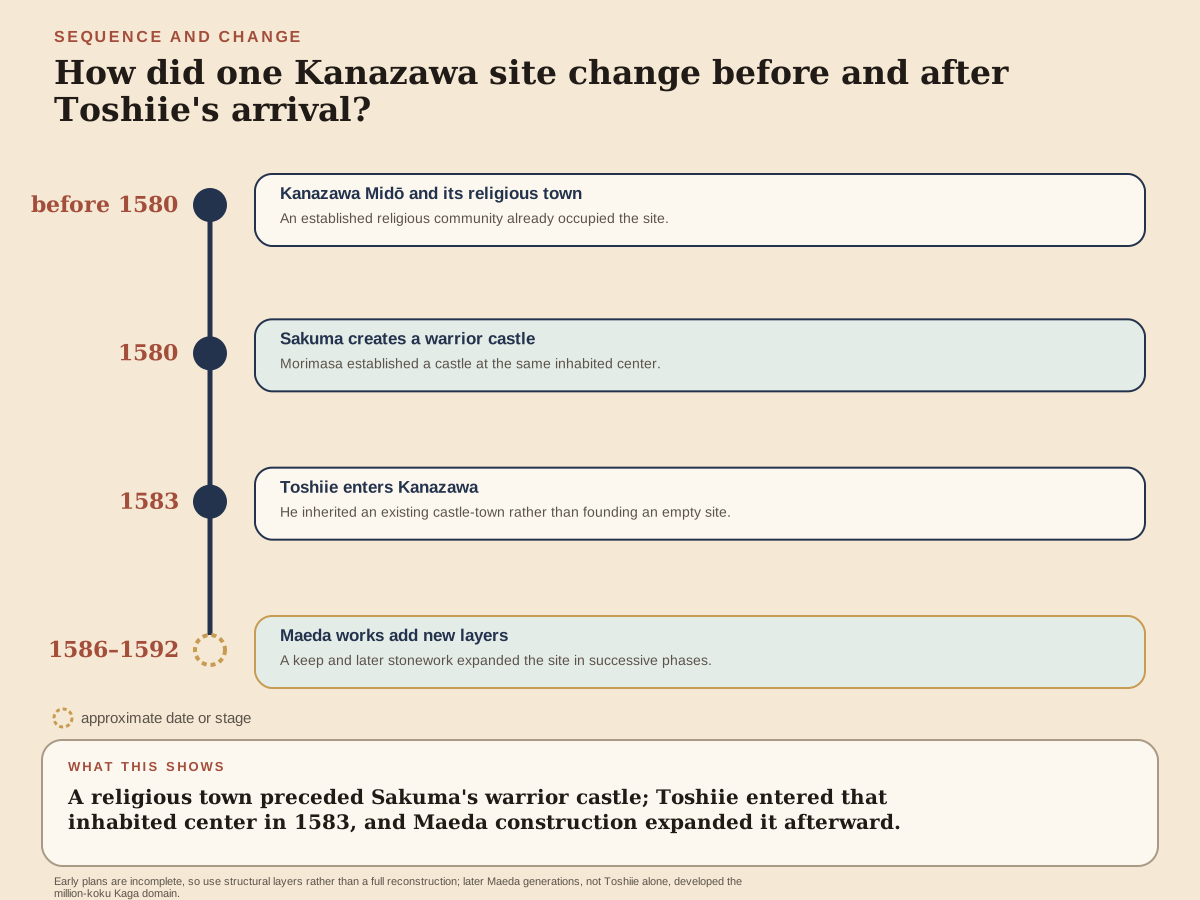
Toshiie entered Kanazawa Castle in 1583 after submitting to Hideyoshi. A Honganji-linked Buddhist establishment, Kanazawa Midō, and its religious town had preceded the warrior castle established under Sakuma Morimasa in 1580. Toshiie developed the inhabited center with a keep in 1586–87 and high stone walls in 1592. His successors continued building after him. [3][5]
Matsu maintained household finances and relationships as the Maeda moved from Owari to Noto and Kanazawa. Contacts with Hideyoshi and his wife Nene helped negotiation between ruling families. After Toshiie's death she took the religious name Hōshun-in. In 1600 she went to Edo as a political hostage, helping reconcile the Maeda with the powerful territorial lord Tokugawa Ieyasu. Her residence there preceded his shogunate, founded in 1603, and lasted until 1614. [4]
In 1590 Toshiie led forces on Hideyoshi's northern approach to the Hōjō war, operating with allied commanders through Shinano and Kōzuke while the main siege enclosed Odawara. This was not a ceremonial attendance. The northern army crossed Usui Pass and reduced Hōjō-aligned positions, weakening the Hōjō's support network outside Odawara. Toshiie's role showed his elevation within Toyotomi command. [6]
During Hideyoshi's last decade Toshiie stood as a leading daimyō (a territorial warrior lord). Maeda holdings across Kaga, Noto, and Etchū reached roughly 770,000 koku during his lifetime. He attended central politics, performed military and ceremonial obligations, cultivated tea and Noh, a stylized theatrical drama, and managed succession with Matsu and the wider household network. His eldest son Toshinaga took over house leadership in 1598. “Five Elder” later became the familiar label for the top guardians named around 1598; it did not mean an equal five-man cabinet operating unchanged throughout the decade. [4]
Hideyoshi died in 1598, leaving the young Hideyori at the center of a guardian system involving Toshiie, Tokugawa Ieyasu and other powerful territorial lords alongside senior administrators. Toshiie resided with or near the Osaka political center and served as an important guardian and mediator. Hideyori's title did not give a child effective control. Nor could Toshiie simply inherit Hideyoshi's authority. The regime now depended on adult houses whose resources and interests were unequal. [7]
Ieyasu's marriage alliances drew objections from leaders who regarded them as breaches of the Toyotomi settlement. Toshiie's mediation helped check immediate conflict, but illness reduced his role and he died in Osaka in 1599. Military lords then attempted to attack Ishida Mitsunari, a senior Toyotomi administrator, amid grievances from the Korean war and disputes over rewards. The loss of a mediator changed the balance; surviving leaders still had to decide how to secure their positions. [4]
Toshiie's eldest son Toshinaga preserved and enlarged the main house's holdings after Sekigahara in 1600; his brother Toshimasa lost his Noto territory. Matsu's hostage residence in Edo helped secure relations with Ieyasu. In 1605 Toshinaga passed leadership to his younger half-brother and adopted heir Toshitsune. Later rulers and communities developed the scale and cultural life remembered as 'million-koku Kaga.' Oyama Shrine, established at its present site in 1873, made founder memory public; its Hōkoku festival began in 1877. These developments through 1912 belong to successors, not Toshiie's own actions. [3][4][5][7][8]
Classic
Maeda Toshiie was born at Arako in Owari, now part of Nagoya in central Japan, into a local warrior household. His childhood name was Inuchiyo; his father was Maeda Toshimasa. Institutional accounts give different birth years: Nagoya's ward history uses 1537 and notes a 1538 alternative, Ishikawa Prefectural Library records a late traditional-calendar date in 1538, and the Maeda Tosanokami Museum uses 1539. Conversion of a late Japanese-calendar date can account for the 1538/1539 difference, but does not settle the separate 1537 version. His family's opportunities lay in service to Oda Nobunaga, the warrior lord expanding control of Owari. [1][2][4]
Owari contained competing forts and warrior service groups. The Maeda's opportunities depended on relations with the Oda and on the conflicts through which Nobunaga enlarged his power. Household training prepared Toshiie for armed service and the conduct expected of a retainer. Family status offered entry into that world, but personal access and performance would determine how far he could rise within it.
Toshiie's early gains came through close personal service, not possession of an independent province. Family status opened the household door; favor and discipline determined whether it stayed open.
The later Maeda domain would grow from successive grants, transfers and alliances, not from an estate Toshiie already possessed in childhood. He began with a recognized family position and the possibility of service. Securing that position under Nobunaga, losing it and winning it back would form the next stages of his life.
As a young man Toshiie entered Nobunaga's close-service circle. He became known for spear fighting and for the conspicuous style associated with kabukimono, warriors who adopted flamboyant dress and provocative behavior. Proximity to the lord could bring assignments and reward, but also rivalry and close discipline. Family connections, military performance and personal favor worked together. Nobunaga's expanding household offered opportunities to someone who could turn conspicuous courage into dependable service. [1]
Toshiie's conspicuous dress advertised his standing within the service circle, without giving us a complete account of his personality. Access remained unequal: Nobunaga could reward an attendant or remove him. As Oda territory expanded, close service opened routes into command and land administration. Courage that attracted attention in battle still had to become dependable performance within the household.
Toshiie married Matsu while his position still depended on Nobunaga's favor. The marriage is traditionally dated to 1558, although the Maeda Tosanokami Museum does not regard its year as established. Matsu belonged to the same broad Owari network and became central to household management and political relations. Competition among attendants over possessions and access could turn violent; one such dispute soon cost Toshiie his recognized position.
In 1559 Toshiie killed another attendant in Nobunaga's service and was expelled. Later accounts name the victim Jūami and connect the dispute to an ornament, insult or rivalry. The exact quarrel is less securely preserved than the killing and dismissal. Nobunaga's punishment removed access to reward and protection, showing that armed skill did not exempt a retainer from household discipline. Toshiie's new family also lost the security attached to recognized service. [1]
While dismissed, Toshiie continued to fight with Oda forces. Nagoya's civic account places him at Okehazama in 1560 as a rōnin, a warrior without recognized service to a lord, and credits his return to merit in the following year's Mino campaign. Nobunaga's victory at Okehazama over the invading Imagawa army had enlarged the opportunities attached to Oda service. Reinstatement nevertheless depended on the lord's judgment, not an automatic right after a fixed penalty.
Dismissal and reinstatement reveal the discretionary character of close warrior service. A lord could punish a retainer and later restore him when renewed performance made that advantageous. Return did not overturn the original killing or make discipline impersonal. It re-established a relationship on which Toshiie's household and future commands depended.
Campaigning changed the scale of Toshiie's work. A commander had to mobilize followers and secure supplies, turning close personal service into delegated authority. In 1569 Toshiie succeeded to the Maeda household leadership in place of an elder brother. Recognition by Nobunaga joined his Oda duties to control of family followers and altered the expectations of kin and dependents. [1]
Oda expansion took him beyond Owari into the wars of central Japan. Keeping followers together and securing cooperation in newly subordinated districts mattered alongside martial reputation. The house could reward service through land, but these confirmations rested on a superior who continued to expect military performance. [1]
Matsu managed household relations and children as the family gained wider responsibilities. The service organization relied on marriages and succession as well as troops. Toshiie's enlarged command also connected him more closely to confiscation and coercion within Oda campaigns. His authority over men and land grew together with responsibility for how service was carried out.
The Maeda succession displaced an elder brother's expected position. Kin and attached followers retained interests of their own even after leadership passed to Toshiie. Within the enlarged house, service still involved reciprocal claims: Nobunaga expected performance from Toshiie, who expected confirmed land and reward, and his retainers reproduced that relationship beneath him. This chain made a former attendant into a commander capable of administering a larger grant.
Toshiie served under Shibata Katsuie's command on the Hokuriku front, along the Sea of Japan side of central Honshu. The campaigns challenged rival warrior houses and Ikkō leagues linked to Jōdo Shinshū, the True Pure Land Buddhist tradition. Such leagues could combine temple networks with communities defending local power. Belief, landholding and resistance to conquest overlapped. Toshiie's place under Katsuie was a military assignment through which Oda expansion brought new territorial opportunities. [3]
In 1575 service in the Oda campaigns brought Toshiie a holding at Fuchū in Echizen, now part of Fukui Prefecture, assessed at about 33,000 koku, a unit expressing estimated rice-producing capacity. The grant gave him revenue and the obligation to organize collection and military service in a conquered district. Roads, ports and winter conditions shaped what could be supplied and when troops could move. Maintaining the territory required local cooperation under the threat of force, as well as followers who could administer it. [1][5]
The Echizen assignment expanded Toshiie's experience of government beyond a unit's command. The Fuchū grouping connected several Oda commanders in regional administration, while their houses retained distinct personnel and claims. Its revenue helped support the Maeda service organization. In 1581 Nobunaga rewarded Toshiie with Noto, giving him responsibility for an entire province.
The new grant extended the Maeda's northern responsibilities from an Echizen district to a coastal peninsula. Command, transport and collection would now have to function across a wider territory.
Nobunaga granted Toshiie Noto in 1581. The peninsula projects into the Sea of Japan, north of present-day Kanazawa. Komaruyama near Nanao became the Maeda's practical center, connected to existing settlement and coastal transport. A provincial grant gave Toshiie wider authority, but his officials still needed local knowledge and service relationships. Older warrior families and religious institutions retained claims that could be confirmed, displaced or absorbed within the new administration. [5]
Provincial government brought Toshiie's established retainers into contact with older local families. Land confirmations could enlist those families; confiscation could provoke opposition. Temples held property and social authority, while coastal transport connected revenue-producing villages to the new center. Matsu and other household women maintained relationships through correspondence, child-rearing and marriages. Their work helped sustain a house whose members and obligations were now spread across a province.
Toshiie remained responsible to Nobunaga for military service and reporting, within the northern command associated with Katsuie. The enlarged province gave the Maeda a larger retainer body and revenue base, while making more households dependent on the lord's decisions. Courtly practices such as tea gatherings also helped maintain relations with other leading men. This position was only a year old when Nobunaga's death unsettled the authority behind it.
Noto had been politically valuable under earlier Hatakeyama rulers. Maeda government reused routes and local knowledge that long preceded its arrival. Its new authority came from Oda conquest and redistribution, leaving the grant vulnerable when the ruler who had authorized it disappeared. Toshiie's next alignment would determine whether this provincial position could remain secure.
In 1582 Akechi Mitsuhide attacked Nobunaga at Honnō-ji, a Kyoto temple, and Nobunaga and his heir Nobutada died. Hashiba Hideyoshi, an Oda commander later known as Toyotomi Hideyoshi, defeated Mitsuhide and gained leverage in the struggle over Oda succession. Katsuie still held senior standing and northern forces. Toshiie initially remained within Katsuie's bloc, while needing recognition for the Noto grant issued by the dead ruler. His northern position made a new source of protection essential. [1][3]
Katsuie's northern command tied Toshiie to an existing superior, while Hideyoshi's military gains made accommodation attractive. Retainers expected their holdings to survive the succession struggle. Matsu's connection to Hideyoshi and his wife Nene provided another channel between the houses, alongside military obligations.
The Oda heirs and senior retainers remained possible sources of authority while settlements were negotiated. Katsuie's command ties and Hideyoshi's growing military strength pulled Toshiie in different directions. Provincial security, household connections and obligations to the former command could not be resolved by one simple profession of loyalty. As competition moved toward war, a declaration would have to be sustained by actual troops and movement.
The competition moved from negotiated succession to military confrontation. Toshiie's Noto position would now depend on which coalition could enforce recognition.
At Shizugatake in 1583 Toshiie fought within Katsuie's coalition against Hideyoshi, then withdrew rather than continuing resistance. He submitted to Hideyoshi and subsequently participated in the advance against Katsuie's base at Kita-no-shō. Withdrawal, submission and renewed military action turned an old command relationship into a new alignment. For Katsuie, it reduced support when the coalition was already under pressure. For the Maeda, it opened a route to recognition by the emerging victor. [1][4]
Submission protected Toshiie's provincial position and the followers dependent on it, while abandoning a superior under whom he had served for years. Matsu's relationships with Hideyoshi's household offered a channel for negotiation. Later accounts give that connection an intimate role in reconciliation, but do not securely reconstruct a private conversation deciding the war. Hideyoshi also had reason to accept an experienced northern house with troops and local connections.
Hideyoshi rewarded the submission with additional Kaga territory, and Toshiie entered Kanazawa. Accepting an experienced regional house supplied the victor with followers and local knowledge while signaling that useful submission could preserve standing. Toshiie's old obligation to Katsuie and the benefits of accommodation with Hideyoshi remained in tension. The reward secured a new position without turning the earlier withdrawal into passive neutrality. [3]
Later Maeda commemoration emphasized the survival of the house, while Katsuie-centered accounts sharpened the charge of betrayal. Both judgments concern the same visible change of allegiance. Toshiie's withdrawal helped preserve his household and contributed to his former commander's defeat. Those consequences remain together even when their moral weight is assessed differently.
In 1583 Toshiie entered Kanazawa Castle and began making it the Maeda center. The site had earlier held Kanazawa Midō, a Honganji-linked Buddhist establishment around which a religious town developed. Sakuma Morimasa captured it in 1580 and established a warrior castle. After Morimasa's defeat at Shizugatake, Toshiie received an inhabited center with older claims and routes. Castle building and town reordering now served the expanded Maeda position in Kaga and Noto. [3]
Kanazawa concentrated command and collection in a center recognized by Hideyoshi. Toshiie developed a keep in 1586–87 and high stone walls around the main enclosure in 1592, according to the castle office's history. These works gave his grant a more substantial administrative and defensive seat. Tea gatherings and Noh, stylized drama combining music, movement and verse, linked the new household center to wider elite networks. Later rulers continued to reshape it.
The castle town depended on roads to Noto and Etchū, its agricultural hinterland and coastal exchange. Collection and transport had to remain predictable enough to sustain markets as well as military service. Later fires and rebuilding changed the castle's structures repeatedly. Kanazawa retained its role as the Maeda center even as different generations reshaped its visible form. [3][5]
Maeda government reorganized religious institutions within the town rather than simply removing their communities. Temples and their property became part of a new urban order on the former Mida site. Holding that center required administration and local accommodation after conquest, alongside the defenses through which the house displayed its authority.
Matsu, Toshiie's principal wife, maintained the large household through changes of base and superior ruler. Relations with Hideyoshi and his wife Nene provided access between ruling families; children and their marriages extended that network. Financial and residential management made movement from Owari to Noto and Kanazawa possible. Her position was constrained by gender and household hierarchy, but it placed her within decisions essential to the family's continuity. [4]
Household management carried resources and authority between residences. Gifts and ceremonies sustained relationships; marriages and child placements connected the Maeda to other houses. Matsu's influence worked through the position of an elite wife and mother, within a hierarchy headed by Toshiie. The work was political even when it took place away from the battlefield. Her later hostage residence would impose a cost on her personally while helping preserve the family.
After Toshiie's death Matsu took the religious name Hōshun-in. In 1600 she went to Edo as a political hostage, helping reconcile the Maeda with the rising authority of Tokugawa Ieyasu, a powerful territorial lord. This preceded the foundation of the Tokugawa shogunate in 1603. She remained there until 1614, long after her husband's living role had ended. [4]
The household contained children from different maternal lines, as well as adopted and foster relationships. Their placements affected succession and marriage alliances. Matsu's role within this network was substantial without making every child hers or every decision solely hers. After 1599 the interests of living heirs and household members determined how the family's relationships would be used. [4]
In 1590 Toshiie commanded on the northern approach to Hideyoshi's campaign against the Hōjō, the ruling warrior house of the Kantō in eastern Japan. The main army besieged Odawara, while northern contingents attacked its supporting castles. Kitamoto's civic history places Toshiie's and Uesugi Kagekatsu's forces at Matsuida in Kōzuke in the latter part of the traditional third month. These dates use the Japanese calendar then in force. Their advance through the mountain routes weakened the Hōjō's regional network, rather than merely adding troops around Odawara itself. [6]
A senior lord could set direction but could not personally perform every operation. Retainers and soldiers bore combat; local communities faced requisition, disruption, and new authority. Hideyoshi used overwhelming display as well as force. The coalition showed that refusal brought not a duel with one rival but a converging national apparatus. Negotiations at Odawara occurred under that pressure. After Hōjō submission, Hideyoshi redistributed the Kantō and proceeded to confirm or displace northern lords. The campaign therefore joined battle to administrative reordering. Toshiie's participation strengthened his standing because he performed as a reliable Toyotomi commander. It also increased dependency. His Kaga and Noto position remained recognized within a regime that expected expensive military service. Large holdings supplied men and revenue, but they also made the Maeda more visible and obligated.
Toshiie's northern command helped extend pressure beyond Odawara's main enclosure into the routes and castles supporting Hōjō resistance. Military operations were followed by Hideyoshi's territorial redistribution. The service strengthened Toshiie's standing as a senior Toyotomi commander, while mobilization and requisition imposed costs on the communities through which the coalition moved. Courtly refinement and Kanazawa building continued alongside, rather than replacing, this military work.
By the 1590s Maeda holdings across Kaga, Noto and Etchū were commonly assessed at roughly 770,000 koku. The figure described rated productive capacity across the household's territories, not produce collected personally by Toshiie. Extensive holdings brought expensive attendance and military obligations. In 1592 he joined Hideyoshi at Hizen Nagoya in northern Kyushu, the Japanese base for the invasions of Korea. His tea practice, through networks associated with the tea masters Sen no Rikyū and Oda Urakusai, belonged to the same elite world as this service.
Tea gatherings and Noh performance connected Toshiie to leading warrior and court-facing households. His patronage began a relationship between Maeda rule and Kanazawa's cultural life; later rulers and practicing artisans extended it. As he aged, household succession also became urgent. His eldest son Maeda Toshinaga took over the house leadership in 1598, leaving Toshiie able to attend the Toyotomi succession at Osaka.
By 1598 Hideyoshi had entrusted leading territorial lords with responsibilities around his young son Toyotomi Hideyori. These guardians became conventionally known as the Five Elders; the Five Commissioners continued administrative work alongside them. The lords retained unequal armies, territories and interests. Toshiie's senior standing could help mediation, but gave him no automatic authority over his fellow guardians. [4]
Wealth sustained central attendance, construction and military preparation. Those costs continued after leadership passed to Toshinaga; senior standing depended on services performed by the domain as well as Toshiie's personal reputation.
Hideyoshi died in 1598, leaving the young Hideyori as heir. The guardians had the armies needed to protect him, but also resources with which to pursue their own interests. Toshiie's presence at Osaka supplied a senior mediator whose authority rested on service, relationships and his domain. It did not transfer Hideyoshi's supremacy to him. [7]
The commissioners managed administrative functions while the major lords retained armies and territories of their own. Hideyori's position supplied a recognized heir but not the capacity to direct these adults personally. Toshiie's presence near Osaka offered a senior guardian distinct from Ieyasu. His own son's position in Kaga made mediation important to the Maeda as well as the Toyotomi household. [4]
Osaka and Fushimi supplied connected political spaces for the heir's household and the meetings of adult leaders. Oaths and negotiated assurances recorded commitments that rivals could cite against unilateral action. Enforcement nevertheless depended on those same lords' willingness to cooperate. Toshiie's mediation could preserve an accommodation, but its strength rested on resources and relationships outside any single guardian's control.
For the Maeda, stable Toyotomi succession and secure family tenure could support one another without being identical interests. Toshinaga still needed recognition for his own leadership and holdings.
Ieyasu's marriage diplomacy drew objections that he was violating the Toyotomi settlement. Marriages could turn family connections into a wider bloc, altering the balance among guardians. Negotiated oaths and visits checked immediate conflict, with Toshiie's standing helping sustain accommodation. Enforcement still rested on lords whose interests differed.
Illness reduced Toshiie's capacity to travel and mediate during these disputes. He died in Osaka in 1599. The guardian settlement lost a senior participant whose standing had made unilateral action more costly. Toshinaga and Matsu now faced a new political balance, while the military lords and commissioners remained divided. Toshiie's death altered those constraints without deciding the choices that followed.
An attempt by military lords to attack Ishida Mitsunari, a senior Toyotomi administrator, followed Toshiie's death. Grievances from the Korean war and disputes over rewards and administration contributed to the conflict. His removal had changed its timing and the possibilities for mediation, but further negotiations and mobilizations still lay between this incident and Sekigahara in 1600. The Maeda successors had to secure their position within that changing struggle.
Funeral and commemoration made Toshiie a dynastic ancestor. The founder's reputation could support household continuity, while it could no longer perform his living role among the guardians. Succession shifted responsibility to heirs who needed recognition from the power emerging after him.
After Toshiie's death, his eldest son Toshinaga faced Tokugawa suspicion and the approach to Sekigahara in 1600. Matsu's hostage residence in Edo helped secure the main house's relations with Ieyasu. A different outcome befell Maeda Toshimasa, Toshiie's second son: his Noto holdings were confiscated after Sekigahara. The principal house gained confirmation and further land, bringing the combined Kaga, Noto and Etchū holdings to the scale remembered as Kaga Hyakumangoku, or 'million-koku Kaga.' In 1605 Toshinaga passed leadership to his younger half-brother and adopted heir Maeda Toshitsune. The dynasty's survival depended on these living successors, not a settlement completed by its founder. [4][5]
Later lords invited specialists, organized workshops, and extended participation. Craft workers and performers sustained skills through teaching and practice, within a town supported by commerce. Official Kanazawa materials distinguish later masters and rulers even when tourism shorthand begins with Toshiie. Material places have layered dates. Kanazawa Castle underwent repeated fire and reconstruction. Kenrokuen's celebrated form belongs largely to later Maeda periods. Tatsumi waterway was designed and completed in 1632, decades after Toshiie's death. Oyama Shrine was moved to its present site in 1873, and its famous gate completed in 1875. These are valid reception relations, not sixteenth-century fabric or Toshiie's personal projects. House histories, painted battle screens, portraits, genealogies, and festival narratives shaped founder memory. They preserve valuable information while reflecting later Maeda needs. A battle screen painted after the events can reveal how the domain organized memory without functioning as a battlefield photograph. [3][7]
Abolition of domains in the Meiji period ended Maeda government, while Kanazawa's residents preserved practices and objects developed under it. Oyama Shrine recast Toshiie as a public ancestral figure, linking his entry into Kanazawa to civic memory. By 1912 the city's cultural inheritance reflected several generations of rulers, makers and communities. His foundation remained important within that longer history.
Oyama Shrine provided a new setting for founder memory after domain government ended. Its Hōkoku festival began in 1877, and the shrine received a special imperial shrine rank in 1902. By 1912 commemoration had joined the city's inherited practices and buildings to a public image of Toshiie as ancestor. [7][8]