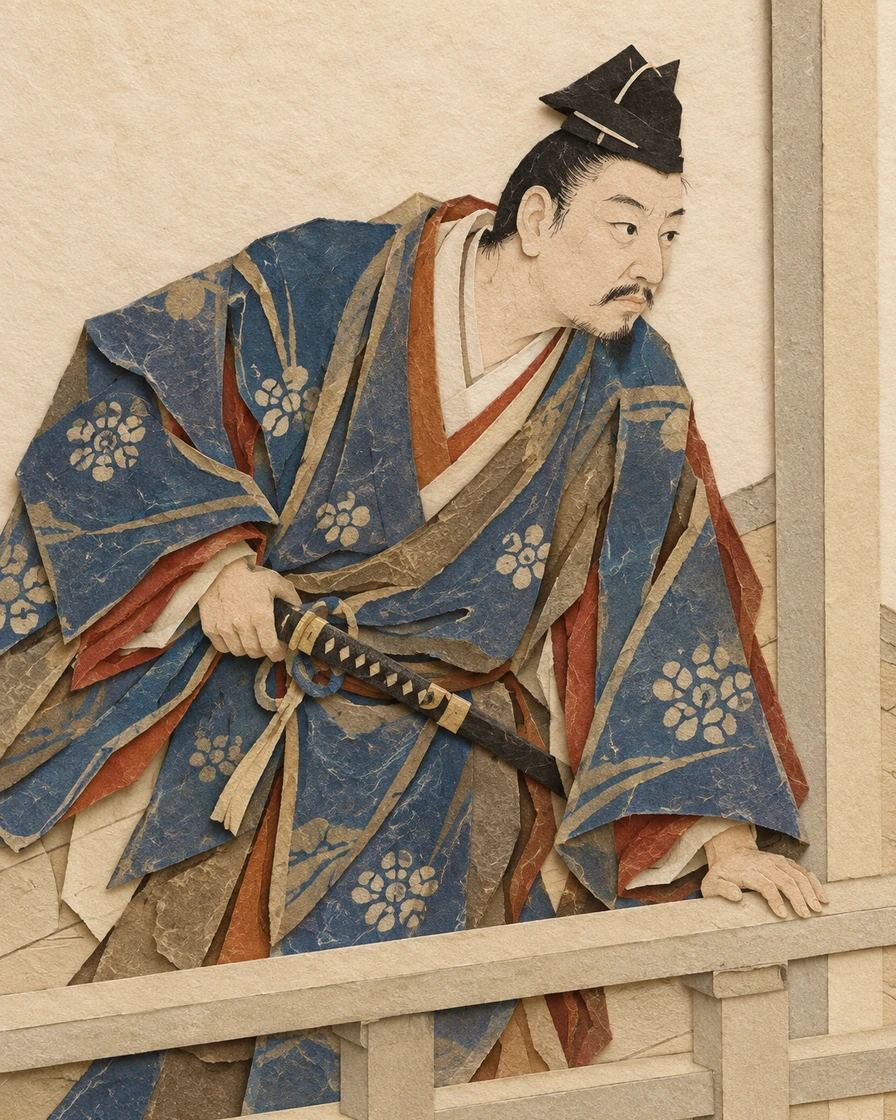
Read the article below. Interactive reading tools are available when scripts load.
Quick
Moronao’s birth year is unknown, but his family belonged to the Ashikaga’s longstanding retainers. He served Ashikaga Takauji when the Ashikaga turned against the Kamakura government in 1333. After its fall, he held posts under Emperor Go-Daigo’s restored government, including work in an institution hearing disputed claims. In 1335 he accompanied Takauji to the east, remaining close to him as the Ashikaga broke with the emperor’s government. When a new Ashikaga regime took shape in Kyoto, Moronao served as shitsuji, the ruler’s senior executive. Takauji formally received the shogunal office in 1338. His regime supported the imperial court in Kyoto, known as the Northern Court, against Go-Daigo’s Southern Court at Yoshino. Moronao’s household service had become a channel through which the new ruler conducted government. [1][2][3][13]
Military service brought claims for rewards, often expressed as rights to land and its income. Moronao received applications and transmitted Takauji’s decisions, but a grant did not itself remove rival occupants. His office issued implementation orders directing local officers and warriors to act. One surviving order of 1345 concerns a steward’s rights in Kusumi, in Kii Province, granted by Takauji three years earlier. It instructs local agents to put the recipient’s representative in possession. The document preserves a demand for action, rather than proof that the transfer was completed. For recipients awaiting income and local people facing a new claimant, the effectiveness of the executive’s order mattered materially. [2][5][3][4]
Moronao also commanded armies against the Southern Court. In 1338 his forces defeated Kitabatake Akiie at Ishizu near Sakai, and Akiie was killed. A decade later the Kusunoki army challenged Ashikaga control in Kawachi. After earlier Ashikaga commanders had failed, Moronao and Moroyasu led a larger campaign with other commanders. They defeated Kusunoki Masatsura at Shijōnawate in 1348. Moronao then advanced on Yoshino, burning the Southern Court’s residence and forcing Emperor Go-Murakami to flee to Anō. The victories increased his standing, while the Southern Court survived its loss of men and residence. [1][9][8]
Takauji’s brother Tadayoshi managed much of the government’s judicial and administrative business. Moronao’s executive role overlapped with his work, particularly where military rewards affected existing land claims. Their conflict led Takauji to dismiss Moronao in 1349. Moronao called Moroyasu’s forces to Kyoto and surrounded the residence where Tadayoshi had sought refuge with Takauji. The pressure forced Tadayoshi to withdraw from government and brought Moronao back to office. Takauji’s son Yoshiakira took a larger role in administration. Two prominent Tadayoshi supporters, Uesugi Shigeyoshi and Hatakeyama Naomune, were exiled and then killed. The change of officials was secured through armed pressure and removed opponents whose families and allies survived. [2][8][6][1]
Tadayoshi’s adopted son Tadafuyu, a biological son of Takauji, gained support in western Japan and Kyushu. In 1350 Takauji and Moronao moved west to campaign against him. Tadayoshi left Kyoto, allied with the Southern Court and assembled forces against them. His supporters drove Yoshiakira from Kyoto in 1351, and fighting spread across the Ashikaga’s regional networks. Takauji’s side was defeated at Uchidehama near present-day Ashiya. Takauji made terms with Tadayoshi, while Moronao and Moroyasu surrendered and took Buddhist vows. The executive who had compelled Tadayoshi’s retirement now lost his own place in government. [1][8]
After the settlement, Moronao and Moroyasu were taken toward Kyoto with Takauji. Near the Muko River in 1351, they and other Kō family members were killed by men led by Uesugi Yoshinori. Yoshinori was the adopted son of Shigeyoshi, whom Moronao had ordered killed after the 1349 purge. Moronao’s death came after surrender, ending a career of administrative service, military victories and violent rivalry. The war chronicle Taiheiki later gave him a hostile literary persona, including stories of sexual pursuit and contempt for authority. The 1748 play Kanadehon Chūshingura reused that persona in its treatment of the much later Akō revenge. The stage villain’s motives belong to that literary history; surviving administrative documents preserve a different part of Moronao’s life. [2][1][8][10][11][4]
Classic
Moronao was the son of Kō no Moroshige, in a family established among the Ashikaga’s hereditary retainers. His birth year is unknown. He served closely beside Ashikaga Takauji when the Ashikaga rebelled against the Kamakura government in 1333. The regime’s fall briefly placed Takauji and his men within Emperor Go-Daigo’s restored government. Moronao served in the Zasso Ketsudansho, an institution handling disputed claims, and in the Kubodokoro, a court-service body whose precise functions remain unclear. These posts put an Ashikaga retainer within the new government’s administrative arrangements. [1][2]
In 1335 a Hōjō rising displaced Ashikaga forces from Kamakura, and Takauji moved east to recover the family’s position. Moronao remained beside him as an executive dealing with the business of the campaign and household. Takauji’s eastern position became a rival source of recognition for warriors and their service. Moronao transmitted his lord’s decisions as that conflict widened into war against Go-Daigo’s government. By late 1335 Moronao was already performing functions associated with the ruler’s executive. [1][2][3]
The Ashikaga established a regime in Kyoto in 1336, supporting the imperial line later known as the Northern Court. Go-Daigo’s competing Southern Court continued from Yoshino. Takauji formally received the shogunal title in 1338. As shitsuji, the ruler’s senior executive, Moronao relayed commands and matters requiring Takauji’s attention. He also held posts examining rewards and handling land disputes. The tasks brought his authority into the same estates and provincial relationships on which the new government depended. [13][2][3][4][5]
Moronao headed an office examining reward petitions and transmitted Takauji’s grants and donations. Rewards could consist of rights over land and income, placing a new beneficiary against existing holders or occupiers. Civil war made the gap between a recognized claim and effective possession especially serious. Implementation orders directed provincial governors and other agents to enforce grants that could otherwise remain ineffectual. Checking the grant and arranging its execution therefore formed substantive parts of the executive’s work. The center relied on people with military and local resources to carry a decision beyond the document. [2][5][3][4]
A document preserved in Wakayama orders action over the estate-steward rights in Kusumi, a district of Kii Province. Such rights concerned administration and income from the land. The grant came from Takauji in 1342; Moronao’s implementation order followed in 1345. Addressed to a Fujinami warrior, it instructed him to act jointly with a Yuasa leader and put the beneficiary’s representative in possession. The property had formerly been associated with Akahashi Moritoki of the fallen Hōjō regime. A grant made by the new government thus required particular local men to transfer rights that had belonged within the old ruling network. The interval between grant and order is preserved, though the document does not establish the date or outcome of actual enforcement. [4][5]
Historian Kameda Toshitaka’s research treats implementation orders as a response to the difficulty of realizing rewards during civil war. Initially a recipient often submitted a further petition to obtain an implementation order after receiving the grant. Issuance without that additional petition became more common over time. The system continued to develop after Moronao’s death and became part of the later executive office. In Moronao’s own period, the Kusumi order shows its dependence on named provincial actors working together. Their authority to execute the decision supplied something the grant alone could not provide. Their participation also connected the distribution of rewards to changing local alliances. [5][3][4]
The executive who relayed Takauji’s grants also led forces against the Ashikaga government’s enemies. In 1338 Moronao defeated Kitabatake Akiie at Ishizu, in Izumi Province near present-day Sakai. Akiie’s death removed an important Southern Court commander. The war continued, and southern forces again challenged control around Kyoto and its neighboring provinces. Moronao’s office and military command gave him both a role in recognizing service and a direct place in the campaigns that generated claims for rewards. [1][2][8][9][5]
In 1347 Southern Court forces under Kusunoki Masatsura defeated earlier Ashikaga attempts to suppress them in Kawachi and nearby areas. The government then sent an army led by Moronao, his brother Moroyasu and other commanders, including Sasaki Dōyo. The campaign aimed to break the southern forces and advance on their court at Yoshino. At Shijōnawate in 1348, the Ashikaga army defeated Masatsura and his supporters. Masatsura and his brother Masatoki died in the defeat. Moronao proceeded toward Yoshino, where his forces burned the Southern Court’s residence. Emperor Go-Murakami withdrew to Anō in the mountains of present-day Nara Prefecture. [9][1]
The campaign inflicted losses on the Southern Court’s commanders and displaced its royal household. It increased Moronao’s standing after failures by other Ashikaga commanders. Moroyasu’s forces and provincial offices supplied important support to the Kō family’s political position. Southern resistance continued, while the victors’ own government became divided over personnel, land and authority. The military resources that had helped defeat the Southern Court could also be assembled against opponents within Kyoto. In 1349 Moronao’s removal from office brought those resources directly into a dispute with Tadayoshi. [1][9][8]
Takauji’s brother Tadayoshi handled much of the early government’s land adjudication and administrative affairs, while Moronao transmitted the ruler’s rewards and examined applications. The allocation of rights for military service could conflict with efforts to preserve existing holdings. Kameda Toshitaka identifies a specific procedural dispute in a supplementary law restricting executive implementation orders in favor of a judicial channel controlled by Tadayoshi. The question concerned who should make a grant effective and through which institution it should pass. It placed Moronao’s authority within a dispute about government procedure as well as the claims of individual warriors and proprietors. [2][8][6][7]
In 1349 Takauji dismissed Moronao from the executive office amid the conflict. Moronao brought Moroyasu, whose provincial command supplied armed support, into Kyoto. His forces surrounded Takauji’s residence, where Tadayoshi had taken refuge. The resulting agreement removed Tadayoshi from government and restored Moronao’s position. Takauji’s son Yoshiakira was brought from Kamakura to take on administrative responsibilities. Uesugi Shigeyoshi and Hatakeyama Naomune, leading figures around Tadayoshi, were exiled to Echizen and subsequently killed on Moronao’s orders. The use of force to alter the government was followed by the deaths of opponents whose kin retained reasons and resources to act against the Kō. [1][8]
Historical disagreement · Were the Kannō factions fixed social camps?
An influential interpretation divides the conflict into supporters of established proprietors around Tadayoshi and newer warriors seeking land around Moronao. Kameda challenges a rigid division of that kind. His account points to warriors in Izumi who changed their service as governors associated with different leaders succeeded one another. He argues that the rival groupings formed relatively late and remained fluid.
The particular dispute over implementation orders provides evidence of conflicting procedures without making every participant’s allegiance identical. [8][12][6]
After his removal, Tadayoshi could build a new coalition drawing on people whose interests and loyalties extended across provinces and the competing courts. [8][12][6]
Tadayoshi’s position was connected to that of Tadafuyu, whom he had adopted. Tadafuyu was Takauji’s biological son, making the conflict one in which recognized household relationships and parentage followed different lines. He developed support in western Japan and Kyushu, and Takauji sent Moroyasu against him in 1350. That campaign did not settle the challenge. Takauji then moved west with Moronao and other forces. While they were away, Tadayoshi left Kyoto and organized resistance, obtaining an alliance with the Southern Court. An administration that had fought that court now faced it joined to one of its own former leaders. [1][8]
Warriors and provincial commanders rallied to Tadayoshi in several regions. His supporters drove Yoshiakira from Kyoto early in 1351. In the east, Uesugi forces also defeated Kō family representatives. The war reached beyond the residence siege of 1349 because the same leaders were connected to provincial offices, clients and family branches. Takauji and Moronao turned back from the western campaign to face the crisis around the capital. They fought opponents who included former allies of the Ashikaga government as well as Southern Court forces. [8][1]
In 1351 Takauji’s forces were defeated at Uchidehama in Settsu, near present-day Ashiya. Moronao and Moroyasu were wounded during the fighting. Takauji sought an agreement with Tadayoshi. The Kō brothers surrendered and took Buddhist vows as part of the settlement. The religious change removed Moronao from the position he had recovered through armed pressure two years earlier. Takauji remained able to negotiate as head of the dynasty, while his executive lost the office and military standing through which he had served. The terms ended this phase of fighting without ensuring the safety of the surrendered Kō household. [1][8]
Following the settlement with Tadayoshi, the surrendered Kō brothers traveled toward Kyoto under Takauji’s leadership. Near the Muko River in Settsu, Uesugi Yoshinori’s men attacked them. Moronao, Moroyasu and other family members were killed in 1351. Yoshinori was the biological son of Uesugi Noriaki and the adopted son of Shigeyoshi. Shigeyoshi had been exiled and killed after Moronao’s armed intervention in 1349. The adopted family relationship connected the killing to the earlier purge. Moronao’s taking of Buddhist vows and the agreement between the Ashikaga brothers had not protected him from an opponent whose household had suffered under his orders. [2][1][8]
The literary villain and his historical motives
The war chronicle Taiheiki fashioned Moronao into a figure of forceful, contemptuous behavior. It tells of his pursuit of the wife of Enya Takasada and of accusations leading to Takasada’s destruction.
That story gives a personal motive to events; it is not an independently documented account of Moronao’s private intentions. In the puppet play Kanadehon Chūshingura, first performed in 1748, the Moronao character served as the counterpart of Kira Yoshinaka in a story drawn from the Akō revenge. The older chronicle’s character and love-story supplied material for portraying the much later antagonist. Repetition on the stage gave the medieval executive an afterlife in which audiences encountered him chiefly through a dramatic role. [10][11]
Administrative documents place Moronao among people dealing with applications, contested rights and the execution of the ruler’s decisions. The Kusumi order preserves a specific claim, an earlier grant and the local agents instructed to carry it out. Kameda’s research restores those procedures to the assessment of early Ashikaga government. His later work also questions theories that divide the founders’ powers or supporters into consistently separate categories. That attention makes the executive’s contribution more visible without removing the executions and armed pressure through which he defended his place. [2][4][5][6][7][12][1][8]