Read the article below. Interactive reading tools are available when scripts load.
Quick
Ishikawa Kazumasa was born around the 1530s into a warrior family serving the Matsudaira in Mikawa, now eastern Aichi Prefecture. His exact birth year remains uncertain. The Matsudaira depended on the stronger Imagawa house, so family standing gave him access to service within a constrained regional lordship.
Matsudaira Takechiyo, the future Tokugawa Ieyasu, spent formative years within Imagawa-controlled hostage politics. Later tradition places Kazumasa among the retainers connected to him in this period. The broad context is sound, but intimate childhood scenes and unbroken companionship are less secure than later storytelling suggests. Service meant maintaining household ties while the Matsudaira heir lacked independent territorial power. [4]
Oda Nobunaga killed Imagawa Yoshimoto at Okehazama in 1560. The Matsudaira heir, then called Motoyasu and later Ieyasu, returned to Okazaki. He gradually secured greater independence and allied with Nobunaga in the early 1560s. Kazumasa became part of the adult retainer organization supporting that change. Later biographies associate him with mediation, although individual assignments are less securely documented than the alliance.
In 1563–1564, Buddhist communities and allied warriors in Mikawa resisted Ieyasu in the uprising known as the Mikawa Ikkō conflict. Religious affiliation, local leagues, warrior ties, and lordly service overlapped; Ishikawa relatives did not necessarily choose alike. Kazumasa remained aligned with Ieyasu and emerged within the western Mikawa command structure. Settlement and renewed service required bargaining as well as force. Ieyasu needed functioning communities and a retainer organization after a conflict that had divided both.
Kazumasa rose to senior responsibility in western Mikawa and at Okazaki. The alliance with Nobunaga carried Tokugawa forces into wider campaigns, including Anegawa in 1570. His work joined command with communication between houses. The experience helped make him a trusted representative when the Tokugawa later faced the growing power of Toyotomi Hideyoshi, a leader of Japan’s unification wars.
Takeda expansion threatened Ieyasu’s territories in the early 1570s. His defeat at Mikatagahara, conventionally dated to the Japanese year 1572, put the retainer organization under severe pressure. The Takeda leader Shingen’s death in 1573 and the joint Oda–Tokugawa victory over his son and successor, Takeda Katsuyori, at Nagashino in 1575 changed the balance. Kazumasa’s senior service belonged to the organization sustaining command and negotiation through those reversals.
By the late Tokugawa–Oda alliance years, Kazumasa held senior responsibility in western Mikawa and was associated with command at Okazaki. The 1579 removal and death of Ieyasu’s son Nobuyasu transformed the political meaning of that center, but surviving accounts of responsibility and private counsel are contested. Kazumasa’s office involved security, retainers, documents, and communication; it did not give him control over Nobunaga or Ieyasu.
Oda Nobunaga’s death in 1582 abruptly destabilized the political order that had framed Tokugawa strategy. Ieyasu survived the crisis and moved into former Takeda territories while Oda successors competed. Kazumasa remained within the senior decision and diplomatic network; later accounts connect him to communications with the rising Hideyoshi, then known as Hashiba. Expansion was not a foreknown march toward Tokugawa rule: local lords, former Takeda retainers, Hōjō power, Oda claimants, and Hideyoshi all retained agency.
In 1584, Ieyasu and Oda Nobukatsu opposed Hideyoshi in the Komaki–Nagakute conflict. Tactical results did not erase Hideyoshi’s wider resources or his ability to detach allies. Kazumasa served within the negotiation network that followed. His contact with Hideyoshi’s side is evidence of office, not by itself proof of prior disloyalty. The historical issue was how the Tokugawa could retain autonomy after battlefield resistance while Hideyoshi’s national coalition strengthened.
In 1585, Kazumasa left Ieyasu and entered Hideyoshi’s service in Osaka. Matsumoto’s official history records that family members went with him. The National Archives places the departure amid renewed demands for hostages. Its presentation of Tōdaiki identifies Kazumasa’s third son, held by Hideyoshi, as a possible factor. Political disagreement or personal insecurity may also have mattered. The private motive remains uncertain; later stories of secret self-sacrifice are not established by the outcome.
Hideyoshi gave Kazumasa lands in Izumi, near Osaka. Matsumoto’s official account describes his pre-transfer holding as 100,000 koku, a rice-yield measure of territorial income. The grant made him a territorial lord in the Toyotomi coalition. Continued service sustained that position, and Hideyoshi retained the power to relocate him again.
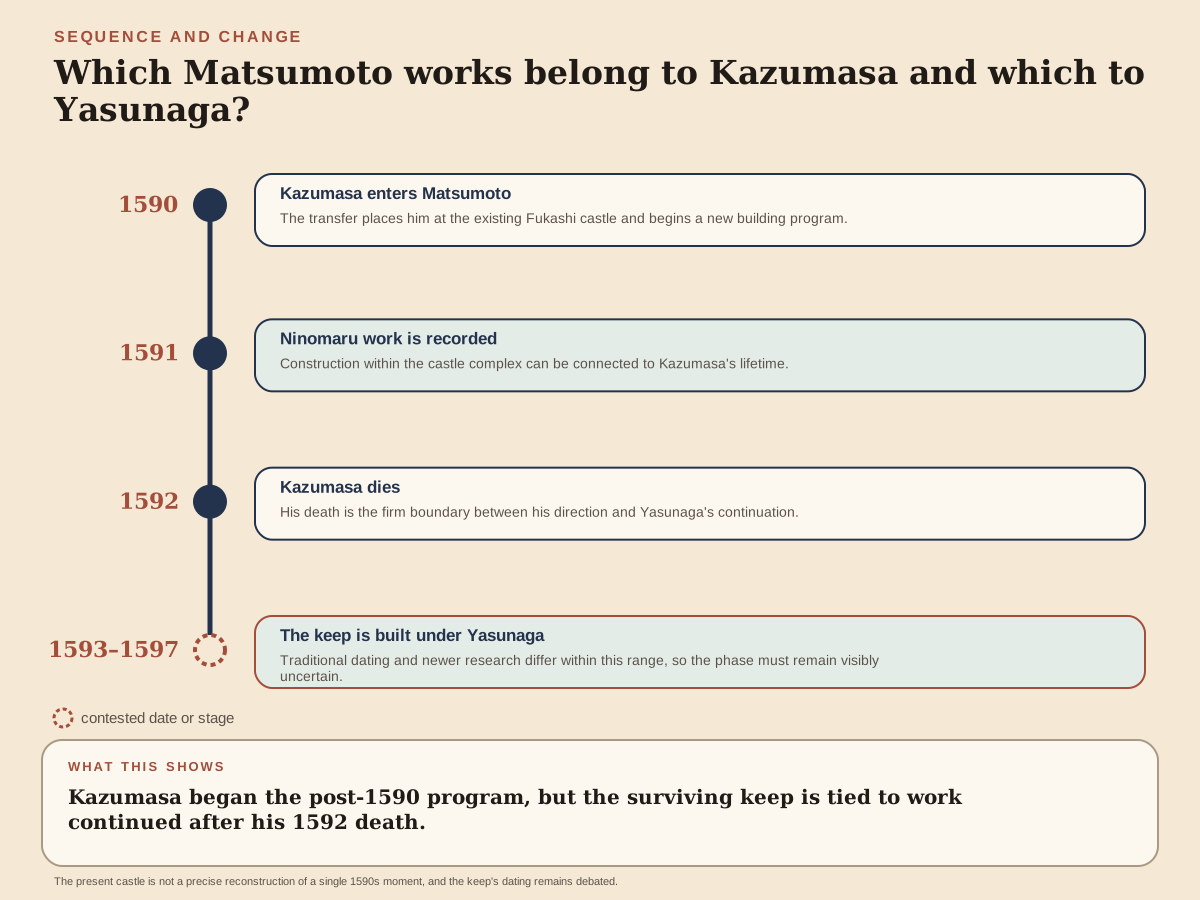
After Hideyoshi defeated the Hōjō in 1590 and transferred Ieyasu to the Kantō, around present-day Tokyo, Kazumasa entered Matsumoto in Shinano, now Nagano Prefecture, from Izumi with an officially listed holding of 80,000 koku. The move replaced Ogasawara Sadayoshi and Hidemasa, who went east. Matsumoto was not an empty site: Fukashi Castle, Takeda occupation, Ogasawara recovery, town plots, roads, residences, and temples preceded him. Kazumasa’s task was to extend that inherited center as part of the Toyotomi reordering beside the newly relocated Tokugawa sphere.
Kazumasa began a major building phase after reaching Matsumoto in 1590. City chronology places works underway in 1591, and the later chronicle Shinpu Tōki credits him with work in the second enclosure. He directed an expansion of an inherited castle and town. His son Yasunaga would continue the program after his death.
Kazumasa died in 1592. Yasunaga continued the castle works. The familiar 1593–1594 main-keep date has been challenged by Matsumoto’s 2025 commissioned study, which proposes about 1596–1597. The surviving keep therefore belongs to the son’s lordship, even when the wider program is described as a father-and-son achievement.
National narratives often remember Kazumasa as the senior retainer who defected from Ieyasu; Matsumoto history remembers the Ishikawa father and son as builders who transformed an inherited castle and town. Both labels select evidence, but neither resolves his motive or makes him sole author. Yasunaga continued the keep, supported Tokugawa forces in 1600, and lost Matsumoto in 1613 after the Ōkubo Nagayasu affair. Ichikawa Ryōzō and others helped buy back the sold-off keep after 1872. Kobayashi Unari and fellow supporters formed a preservation society in 1901, with repairs beginning in 1903.
Classic
Ishikawa Kazumasa was born in Mikawa, a province in what is now eastern Aichi Prefecture, around the 1530s. Many biographies give 1533, although the year remains uncertain. His family already had connections to the Matsudaira warrior house. He entered service through an established local network rather than as an outsider seeking his first patron.
Matsudaira Takechiyo, the child later known as Tokugawa Ieyasu, lived under the control of stronger regional houses while his family struggled to hold Mikawa. Sending an heir as a hostage was a way to guarantee a dependent lord’s allegiance. The Ishikawa family remained part of the Matsudaira service network, and later tradition associates Kazumasa with Takechiyo during the Imagawa years. The surviving record is less clear about his personal movements than it is about that connection. [4]
The Matsudaira’s territory remained in Mikawa even while the heir was elsewhere. Retainers helped keep the house functioning across that separation. They maintained local relationships and carried demands and information between the family and its superior power. Kazumasa’s later emergence as a trusted officer grew out of this dependent order; he did not begin in the service of an independent national ruler.
Imagawa authority could provide recognition and stability as well as restriction. Matsudaira retainers had to work within it while preserving their own house. Yoshimoto’s death in 1560 would remove the strongest figure above them, leaving those local ties to bear much more political weight.
His childhood is poorly documented. The adult record gives a much firmer picture: he became a senior servant of the Matsudaira heir who would eventually rule Japan as Tokugawa Ieyasu. Their long association makes Kazumasa’s later departure for Ieyasu’s rival Toyotomi Hideyoshi, a leader of Japan’s unification wars, a consequential break.
In 1560, Oda Nobunaga defeated and killed Imagawa Yoshimoto at Okehazama. The Matsudaira heir, then called Motoyasu and later Ieyasu, returned to Okazaki in Mikawa. His former superior’s death gave him room to act, but the Imagawa still had retainers and territorial claims. Holding Okazaki provided a base from which to rebuild Matsudaira authority. Kazumasa was now an adult member of the retainer organization taking shape around him.
An alliance with Nobunaga in the early 1560s redirected the Matsudaira’s position. The Oda ceased to be the enemy on one frontier and became a partner whose campaigns would make demands on Mikawa. Hostage and family arrangements helped secure the transition. Later biographies credit Kazumasa with mediation, although the details of individual assignments are less certain than the alliance itself.
Motoyasu needed local families to accept his direction and retainers to carry it beyond the castle. Kazumasa’s importance grew within this organization. His position did not depend on a single celebrated exploit: sustained command and trusted communication gave a senior servant influence over whether the new autonomy would hold.
In 1563–1564, Buddhist communities and allied warriors in Mikawa resisted Ieyasu. The uprising is known as the Mikawa Ikkō conflict, after the devotional Buddhist movement around which many participants organized. Temple affiliation and local rights could clash with a warrior’s obligation to his lord. The Ishikawa family was known for its connection to this religious community, and many relatives joined the resistance. Kazumasa remained with Ieyasu. [4][8]
His position as a western Mikawa “flag head”—a commander over groups of retainers—placed him between his lord and men with their own family attachments. Victory did not make these ties disappear. Ieyasu needed a territory that could function after a conflict dividing both communities and retainer families.
The conflict left Ishikawa relatives on different sides. Kazumasa’s continued service to Ieyasu therefore meant choosing among obligations, rather than simply following a united family. The settlement strengthened Matsudaira rule, but the lord still needed cooperation from the communities over which he claimed authority.
Kazumasa’s western Mikawa command placed him between Ieyasu and several retainer groups. Senior service involved keeping troops supplied and carrying orders as well as leading men in battle. Okazaki remained politically central as the house expanded eastward. Responsibility at the castle brought access to the lord’s correspondence and command arrangements. [4][8]
The alliance with Nobunaga carried Tokugawa troops into campaigns beyond Mikawa, including Anegawa in 1570. Kazumasa’s standing connected him to that widening military organization. Senior commanders worked through retainers who had followers of their own; orders also depended on provisions reaching the field. His place in the hierarchy mattered more consistently than the individual feats attached to him in later warrior tales.
Diplomatic assignments brought a senior retainer into contact with another house’s resources and expectations. Understanding an opponent could make him a better representative, while exposing him to suspicion at home. For Kazumasa, command and negotiation were related responsibilities. The experience would become especially important when Hideyoshi emerged as the strongest successor to Nobunaga.
Takeda military capacity, regional alliances, and pressure on Tōtōmi and Mikawa threatened the territorial base on which Tokugawa authority depended. Mikatagahara, conventionally dated to the Japanese year 1572, was a major Tokugawa defeat. The political consequence mattered beyond casualties. Defeat could encourage wavering retainers, weaken allies’ confidence, disrupt tax and transport, and expose castles to further pressure. Senior service after defeat involved preserving command. Messengers needed routes, garrisons needed provisions, and local officers needed to know whether the lord’s orders remained credible. [9]
The Oda alliance supplied essential strategic context. Assistance did not remove Tokugawa agency, but survival cannot be credited to Ieyasu or one retainer alone while allied resources disappear. The Takeda leader Shingen’s death in 1573 altered the opposing system. The change should not be described as a reward for Tokugawa endurance; it was an independent contingency whose consequences unfolded over time.
Historical disagreement · Nagashino and the rotating volleys
Nagashino in 1575 became a story of technological innovation, often pictured as three ranks rotating through volleys with three thousand guns. The University of Tokyo Historiographical Institute’s research project treats that familiar reconstruction as disputed and compares documents, military narratives and battle images rather than assuming the scene is established. [10]
The effectiveness of allied firearms is distinct from proof of one exact firing drill. The victory cannot be credited to a simple technological formula with terrain, defensive preparation and Oda–Tokugawa cooperation removed. [10]
What the campaign demonstrates securely is a changed balance produced by joint Oda–Tokugawa action against Shingen’s son and successor, Takeda Katsuyori. Victory relieved pressure but did not end every threat or administrative demand.
Kazumasa’s senior standing belonged to the organization that sustained command through these reversals. It was expressed through assignments and access to information. Mobilizing that organization also imposed burdens on the people supplying and transporting provisions; victory did not end the costs of war.
A senior envoy had to understand how much pressure his own house could sustain. The defeats and recoveries of these years gave Kazumasa experience of that problem. Later negotiations with Hideyoshi would again require the Tokugawa to judge military confidence against the resources of a stronger power.
Okazaki served as a center associated with Matsudaira Nobuyasu, Ieyasu’s eldest son. In 1579, Nobuyasu was removed and ordered by Ieyasu to take his own life. The reasons and the distribution of responsibility remain contested in accounts of the affair. Kazumasa’s precise role is uncertain; his later defection does not settle what he advised six years earlier. [7]
Kazumasa’s responsibility at Okazaki involved supervising people and communication on his lord’s behalf. The removal of the heir changed the center’s political position. An officer could hold authority there without controlling Ieyasu’s final decisions. Interpretations connecting Nobuyasu’s death directly to Kazumasa’s departure in 1585 must still explain the interval between the two events. [1][4]
Responsibility at Okazaki gave Kazumasa knowledge of the house’s command arrangements and its internal relationships. Losing such an officer would expose more than a gap in personnel. It could make an opposing lord familiar with the organization Ieyasu depended on. This was one reason the departure of 1585 had consequences beyond a change of personal allegiance.
In 1582, Nobunaga was killed at Honnō-ji in Kyoto. Ieyasu, then away from his own territory, returned to safety as the Oda leadership broke apart. Earlier that year, Nobunaga’s forces had destroyed the Takeda house. Ieyasu now sought control in former Takeda provinces, including Kai and Shinano, inland from his Mikawa base. He had to secure former Takeda retainers’ support and contend with the Hōjō, the powerful house ruling the Kantō around what is now Tokyo. Expansion depended on agreements as well as armed occupation.
At the Oda center, Hideyoshi’s victories and political maneuvers increased his authority. Ieyasu needed information about a figure who was becoming more than another Oda commander. Later accounts associate Kazumasa with congratulatory or diplomatic missions. Such contact helps explain why he became legible to Hideyoshi’s government before 1585, but it does not prove that defection was already planned. Diplomatic familiarity creates multiple possibilities. It can improve negotiation for one’s present lord, expand personal options, or expose a messenger to suspicion. In 1582–1583, neither Hideyoshi’s national predominance nor Ieyasu’s eventual shogunate was secure.
The administrative effects of expansion were substantial. Newly accepted retainers needed rank and grants; revenue claims had to be verified; defensive arrangements and supply lines had to be revised. Knowledge became a strategic asset. A senior officer familiar with Mikawa and the new territories could represent the house effectively—and would be costly to lose.
In 1584, Ieyasu allied with Oda Nobukatsu, Nobunaga’s son, against Hideyoshi. The Tokugawa won important engagements in the Komaki–Nagakute campaign, yet their ally could make terms independently. Nobukatsu’s settlement with Hideyoshi left Ieyasu with less political support than the battlefield results suggested. Kazumasa served within the subsequent negotiation network. He could carry terms and report the opposing power’s strength, but the final choice belonged to his lord. [1]
Hideyoshi’s strength lay partly in his ability to detach Ieyasu’s partners. Continued resistance therefore required a judgment about what the Tokugawa could sustain alone. Kazumasa’s contact with Hideyoshi’s side gave him a view of that emerging center. It also created the familiarity through which an official envoy could later become a recruit. Diplomatic contact in 1584–1585 does not establish that he already intended to change sides.
The negotiated aftermath did not instantly settle hierarchy. Pressure continued into 1585 and 1586 through alliances, family arrangements, titles, and demonstrations of submission. Thus Komaki–Nagakute should not be the triumphal prelude to inevitable Tokugawa victory. It was a moment when battlefield resilience and political isolation could exist together, placing unusual weight on the people who translated between them.
In 1585, Kazumasa left Ieyasu’s service while serving as a senior retainer and Okazaki castellan. The National Archives of Japan places the departure amid Hideyoshi’s renewed pressure for hostages and Ieyasu’s refusal to provide more. Matsumoto’s official history separately records that Kazumasa took members of his family to Osaka and entered Hideyoshi’s service. These establish a consequential change of allegiance; they do not provide a confession of motive. [1][4]
Evidence and interpretation · Why did Kazumasa leave?
The National Archives presents the early Edo Tōdaiki’s suggestion that Kazumasa’s third son, held as Hideyoshi’s hostage, helped prompt his departure. Its exhibition also places the break after Hideyoshi’s renewed hostage demand and the Tokugawa council’s refusal. The first is a chronicle’s explanation; the second establishes political circumstances, not Kazumasa’s private reasoning. [11][12][1][2]
Accommodation, insecurity within the Tokugawa house and advantages offered by Hideyoshi have also been proposed as explanations. The cited archival descriptions do not establish their relative weight. Several pressures could have coincided. [11][12][1][2]
Neither the hostage account nor subsequent Tokugawa benefit proves that Kazumasa secretly coordinated his departure with Ieyasu. A change of allegiance is documented more securely than a single motive. [11][12][1][2]
Kazumasa knew the organization he had left. The later military writer Daidōji Yūzan’s Suruga Miyage records a change to Takeda-style military arrangements. It supports identifying that interpretation and its source, rather than claiming that every Tokugawa secret was exposed or that his departure alone caused the reforms. Hideyoshi gained an experienced officer whose acceptance also demonstrated his ability to recruit an opponent’s senior men.
Hideyoshi gave Kazumasa lands in Izumi, near his political center in Osaka. Matsumoto’s official account describes his holding before the 1590 transfer as 100,000 koku. A koku was a rice-yield unit used to assess a lord’s territorial income, not a payment of cash. The grant made Kazumasa a territorial lord within Hideyoshi’s coalition. His authority now depended on the power he had approached as a Tokugawa negotiator. [4]
The surviving account establishes Kazumasa’s substantial new lordship more firmly than the details of his administration in Izumi. Continued service sustained his position, while Hideyoshi retained the power to relocate him. In 1590, that authority moved him from the vicinity of Osaka to inland Shinano.
Hideyoshi’s defeat of the Hōjō in 1590 brought a large redistribution of territories. Ieyasu moved east to the Kantō, the eastern region around present-day Tokyo, and Ogasawara lordship at Matsumoto gave way to Kazumasa. His new holding was listed at 80,000 koku. Matsumoto lay in Shinano, now Nagano Prefecture, along the inland approaches to Ieyasu’s new sphere. The placement is commonly understood in relation to Toyotomi oversight of the relocated Tokugawa, although the transfer itself is better documented than Hideyoshi’s precise intentions. [4][5]
A predecessor of the present castle, Fukashi, developed through local rule and Takeda use. Its exact early form remains partly uncertain. After the Takeda fall in 1582, several claimants moved through the site. Ogasawara Sadayoshi recovered it, renamed Fukashi as Matsumoto, and developed fortifications and the castle town. Official Matsumoto material describes Ogasawara work on fortifications and the layout of the castle town. This continuity matters. “Kazumasa built Matsumoto” can mean he initiated a major new early-modern construction phase; it cannot mean he founded settlement on vacant ground. The domain assessment was a claim about taxable capacity, not cash available for immediate construction. [4]
The new grant had to support the retainer household as well as the castle. Kazumasa brought followers into a town already shaped by Ogasawara rule. His building program would extend that inherited center. Its most visible surviving architecture would take shape under his son Yasunaga after his death.
After entering Matsumoto in 1590, Kazumasa began a new phase of castle works. City chronology places construction underway in 1591, including work associated with a palace in the second enclosure. The later local chronicle Shinpu Tōki credits him with promoting the works and Yasunaga with continuing them. This gives him a substantial role in the project without attributing every surviving tower to his brief tenure. [4][5]
Building a castle required the procurement and transport of timber and the work of specialist carpenters and stoneworkers. Those are general requirements of construction, not evidence of a particular labor order issued by Kazumasa. The surviving local account assigns the initiative to the father and the continuation to Yasunaga; neither attribution makes the lord the sole maker of the structure.
Kazumasa died in 1592, while away in connection with Hideyoshi’s Korean campaign mobilization. Yasunaga continued the building program. The familiar 1593–1594 keep date comes from an earlier municipal assessment. A 2025 study commissioned by Matsumoto instead dates its principal construction to about 1596–1597, using newly examined timbers felled in 1596. Both place the surviving main keep after Kazumasa’s death. [4][5][6]
Descriptions of the castle as a father-and-son achievement refer to a building program spanning two lordships. Kazumasa established its initial direction, and Yasunaga held authority during the main keep’s construction. The workforce and the town outlasted the first patron. Succession continued the project rather than starting it again on empty ground.
The 2025 study also separates two southern additions previously grouped together: it places the Tatsumi turret with the earlier keep complex and proposes a Moon-viewing addition around 1626. The present ensemble thus combines successive building and alteration, not one completed monument left by Kazumasa.
Memory gives different weight to the same person depending on scale. A national Tokugawa story sees 1585: the trusted Okazaki officer who left for Hideyoshi. A Matsumoto place story sees 1590: the incoming lord who began a defining construction phase. “Traitor” centers obligation to Ieyasu. It correctly signals a broken service relationship but often claims knowledge of motive that the evidence does not provide. “Castle builder” centers local material change. It correctly recognizes Kazumasa’s initiative but can erase Ogasawara foundations, Yasunaga’s construction, specialist knowledge,. One is a political transfer; the other is phased place authorship.
Yasunaga chose the Tokugawa side in 1600 in a political world changed by Hideyoshi’s death. That choice was his own, not evidence of Kazumasa’s hidden plan. In 1613 he lost Matsumoto in connection with the Ōkubo Nagayasu affair. Later lords continued to occupy and alter the castle. The end of Ishikawa rule did not end the building’s history. [5]
Preservation required later actors too. After the keep was sold off in 1872, Ichikawa Ryōzō and others helped buy it back. In 1901, Kobayashi Unari and fellow supporters formed a preservation society; repairs began in 1903. Their intervention helped make the castle a lasting object of local memory, long after Ishikawa rule had ended.