Read the article below. Interactive reading tools are available when scripts load.
Quick
Ishida Mitsunari was born in 1560 in northern Ōmi, in present-day Shiga. His father Masatsugu and elder brother Masazumi belonged to a local warrior family. While young, he entered the service of Toyotomi Hideyoshi, whose campaigns would establish a government over Japan’s military lords. Mitsunari participated in the campaign of Shizugatake in 1583 and gained increasing responsibility. In 1585 he received the court title Jibu-no-shō (治部少輔), a junior deputy post in the court’s ceremonial administration. The title signaled recognition; his subsequent work was exercised through Hideyoshi’s military and territorial government. Land, towns and the movement of provisions would become central to that work. [1][3][5][2][15]
Mitsunari’s administrative work reached the rules under which farming communities supplied revenue. A 1589 order described by the National Museum of Japanese History required reports of unlawful treatment of peasants, retained customary tax-rice transport costs and specified Kyoto’s standard measure. It also prohibited concealing peasants who had fled. A wooden measuring standard linked to surveys in the Shimazu domains in 1594–95 shows another part of this work: establishing the units used to assess land. At Sawayama, Mitsunari served as Hideyoshi’s deputy from 1591 and became a territorial lord in his own right in 1595. Rules and measurements supported government, but disputes over the allocation of surveyed land remained. [2][3][8][4]
Mitsunari became an administrator of Sakai in 1586 and helped rebuild Hakata after Hideyoshi’s Kyushu campaign in 1587. Merchants such as Shimai Sōshitsu and Kamiya Sōtan participated in restoring the city and supplying the government. Their property and warehouses could support armies, while military demands also threatened their businesses. Mitsunari later issued a letter forbidding soldiers’ violent entry and unauthorized lodging at Shimai’s premises. In 1590 he led the unsuccessful attempt to flood Oshi Castle during the conquest of the Hōjō house. Hideyoshi repeatedly instructed the water operation, and the castle surrendered after the Hōjō’s main stronghold at Odawara had fallen. The failure was real, but its planning cannot be assigned to Mitsunari alone. [1][5][6][7]
Hideyoshi invaded Korea in 1592, seeking an advance through the peninsula toward Ming China. Mitsunari worked at Nagoya in Hizen, the Japanese staging base in present-day Saga, on shipping and military supply. He crossed to Korea in 1593 with fellow administrators Masuda Nagamori and Ōtani Yoshitsugu, inspecting the campaign and participating in negotiations. His work made him part of the invasion government, rather than an outside critic of the war. Disputes over campaigning and policy strained relations among its commanders and officials. After Hideyoshi’s death in 1598, Mitsunari helped arrange the return of the forces to Japan. The end of the war left political disagreements within the government that now served Hideyoshi’s young son. [1][4][10]
After Hideyoshi’s death, Mitsunari served among the senior administrators responsible for preserving the government for Hideyori, Hideyoshi’s young son. Tokugawa Ieyasu, a leading territorial lord, held a separate place among its senior guardians and expanded his political connections. Mitsunari opposed that expansion. In 1599 commanders hostile to Mitsunari pressed for his removal, and the confrontation ended with his retirement to Sawayama. The episode is often called the “seven generals’ attack,” but historian Watanabe Daimon presents it instead as a political and legal complaint mediated by Ieyasu and Hideyoshi’s widow. The popular scene of Mitsunari seeking refuge inside Ieyasu’s house is not securely established. Retirement deprived him of his central administrative position, while leaving his territorial base. [1][10][8]
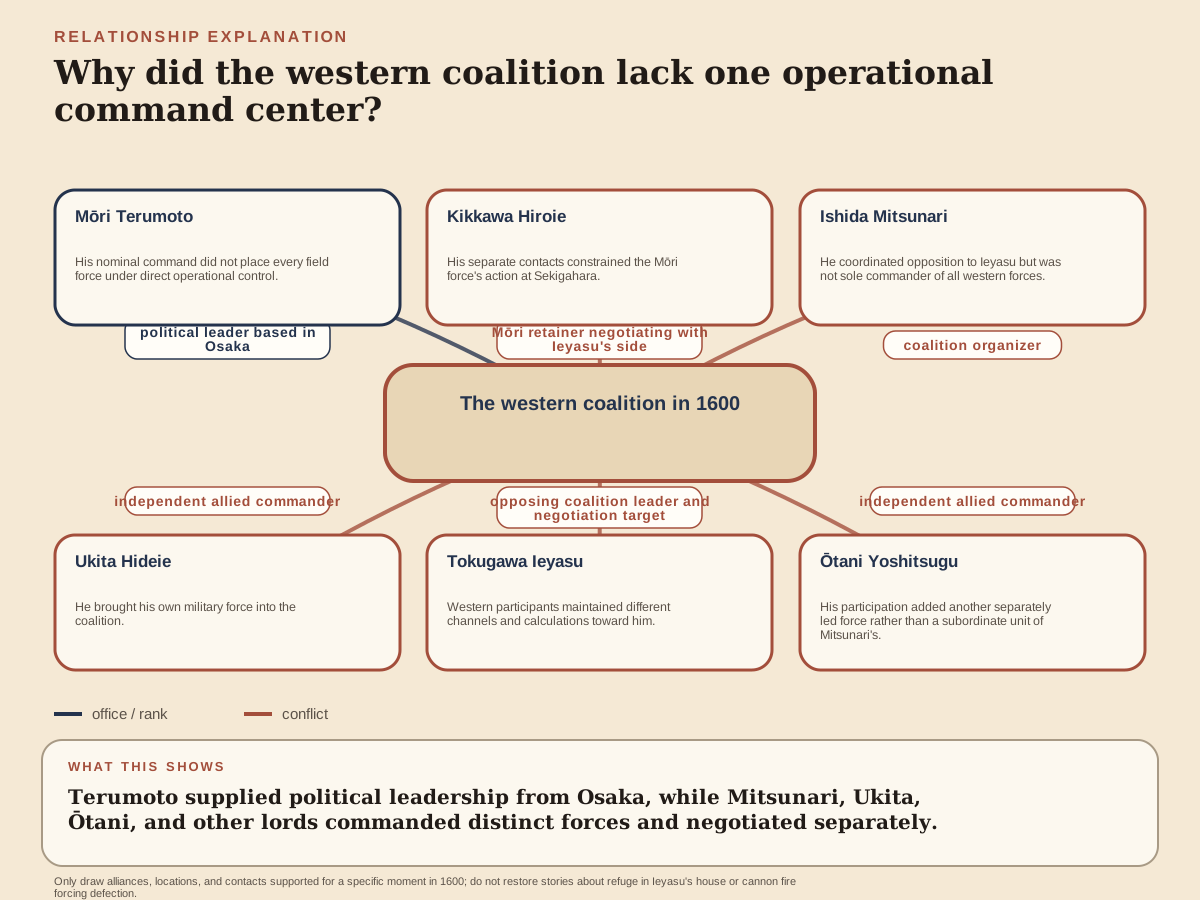
In 1600 Ieyasu marched east against the Uesugi house, and Mitsunari organized forces opposing him. Mōri Terumoto took a leading position in Osaka, while commanders such as Ukita Hideie and Ōtani Yoshitsugu brought their own forces to the coalition. Letters sought further participation; shared orders offered protection to local institutions. An order for Saienji temple carried the names of Mitsunari, Konishi Yukinaga, Shimazu Yoshihiro and Ukita Hideie. Yet a commander on Ieyasu’s side also issued protection for the same temple. The alliance likewise faced separate negotiations: Kuroda Nagamasa, serving Ieyasu, approached Kikkawa Hiroie within the Mōri house and Kobayakawa Hideaki. A coalition’s declared purpose did not settle each commander’s conduct. [1][11][12][9]
The coalition was defeated by Ieyasu’s forces at Sekigahara in 1600. Kobayakawa Hideaki attacked allied forces, helping turn the battle against Mitsunari’s side. Mitsunari escaped, was captured and was executed in Kyoto that year. His Sawayama lordship and role in the Toyotomi administration were lost. Later accounts supplied dramatic explanations for the battle, including a story that Ieyasu forced Hideaki to move by firing at him. The National Archives’ comparison places that episode in distinct later narrative layers, rather than treating it as a secure contemporary report. Mitsunari’s defeat should be read alongside his administrative career and the separate choices within his coalition. [1][12][8][13][2][3]
Classic
Ishida Mitsunari (1560–1600) served Toyotomi Hideyoshi, the ruler who brought Japan’s competing military houses under a single government. He came from Ishida village in the Sakata district of northern Ōmi, in present-day Shiga near Nagahama. His father Masatsugu and elder brother Masazumi belonged to the local warrior family. The biographies differ over the precise age at which he entered Hideyoshi’s service, but agree that he did so while young. As a young servant, he acquired responsibilities while Hideyoshi’s military power expanded. Mitsunari took part in Shizugatake in 1583, during Hideyoshi’s consolidation of military power. [1]
In 1585 Mitsunari received junior fifth rank, lower grade, and the title Jibu-no-shō (治部少輔), a junior deputy post in the imperial court’s ceremonial administration. The title was not the name of the provincial land-survey work through which he would help govern. Court recognition and service to Hideyoshi gave different forms of standing to the same man. His practical assignments included administration in the commercial city of Sakai, military logistics and territorial assessment. A later measuring instrument associated with the Shimazu domains and letters concerning merchants show those responsibilities in particular places. They locate his career within an expanding government that needed more than victorious armies to carry its instructions into effect. [1][3][5][15]
A document dated to the traditional tenth month of 1589 carries Mitsunari’s seal and instructions for a farming community. The museum identifies its recipient as probably Saji in present-day Shiga. Its four clauses, summarized in the collection record, combine restraints on burdens with control of revenue and people. Unlawful treatment of peasants was to be reported; the expense of transporting tax rice was to follow existing practice. Peasants fleeing elsewhere were not to be hidden, and transactions were to use the Kyoto measure. The order offered a channel for complaints while protecting the government’s ability to collect assessed dues. Its survival establishes the instruction, rather than the experience of every household receiving it. [2]
A wooden measuring standard associated with the 1594–95 survey of the Shimazu domains bears instructions attributed to Mitsunari. The cultural-property explanation describes marks dividing a shaku, a unit of length, and directions connecting length with the units used for fields. A ken was specified as six shaku and three sun, with a sun one tenth of a shaku. The instruction then defined the dimensions counted as a tan of land. Such standards made measured plots comparable for assessment within this operation. Yet measurement did not itself decide who would receive the land. The University of Tokyo’s report on the Shimazu documents describes continuing allocation disputes and a 1597 letter in which Mitsunari’s retainer Atagi Hideyasu addressed the difficulty. [3][4]
Hikone’s municipal history separates two stages of Mitsunari’s authority at Sawayama. From 1591 he administered it as Hideyoshi’s deputy; in 1595 he became its lord with an assessed holding of about 194,000 koku. A koku was a rice-based unit used to express the assessed productive value of territory, rather than a yearly gift of that amount of rice. The distinction matters because administering the ruler’s land and holding a lordship were related but different positions. Mitsunari acquired a territorial base while continuing assignments that reached into other houses’ domains. Those assignments involved persuasion, instructions and disputed distribution as well as numerical assessment. The same official who helped specify measurement had to work through the interests of the people governing the measured territory. [8][1][4][3]
Mitsunari’s duties in Sakai and Hakata linked the new government to urban commerce. After the Kyushu conquest in 1587, Hakata’s reconstruction involved the merchants Shimai Sōshitsu and Kamiya Sōtan, working under the territorial arrangements made by Hideyoshi’s government. The Shimai family documents preserve the pressure that military supply later placed on commercial property. Warehouses were ordered cleared for rice, and Sōshitsu himself crossed to Korea on Hideyoshi’s orders. A letter from Mitsunari, tentatively dated to 1592 in the museum catalogue, forbids violent military entry and soldiers’ lodging at Shimai’s premises. Protecting a merchant’s property and drawing on the merchant’s resources belonged to the same relationship with government. [1][5]
In 1590 Mitsunari took command of a siege at Oshi, in present-day Gyoda in Saitama. The castle belonged to the Narita house, allied with the Hōjō lords whose main stronghold was Odawara. The besiegers attempted to surround Oshi with water by constructing and connecting embankments. Gyoda’s heritage explanation describes a circuit that also used natural high ground and existing banks. The later account of an enormous newly built embankment cannot simply be read as a complete plan of the surviving earthworks. The flooding failed to bring down the castle. A museum historian’s account of Hideyoshi’s instructions shows the ruler repeatedly pressing the operation, including after Odawara had fallen. [6][7]
Oshi’s defenders surrendered after the loss of the Hōjō’s main position, rather than because the water siege had succeeded. The operation therefore belongs among Mitsunari’s military failures. The surviving instructions also make it a failure within Hideyoshi’s wider campaign, not evidence that Mitsunari independently devised every part of an ill-conceived method. His urban and logistical assignments likewise required cooperation from people whose interests military operations could damage. The government needed merchants’ stores and fields’ assessed revenue while relying on its officials to regulate some of the resulting burdens. The invasion of Korea would extend those demands across the sea. [6][7][5][2][3][1]
Nagoya in Hizen, in present-day Saga, served as Toyotomi Hideyoshi’s Japanese headquarters for the invasion of Korea. Mitsunari worked there on ships and the movement of provisions for armies operating across the sea. The Shimai documents show one urban supplier’s involvement: warehouse space was demanded for rice, and the merchant Sōshitsu was ordered to the peninsula. Supply therefore depended on people and property beyond the command tents of the leading generals. In 1593 Mitsunari crossed to Korea with Masuda Nagamori and Ōtani Yoshitsugu, both officials serving Hideyoshi. The biographies describe inspection, participation in the campaign and diplomatic work involving Ming China. His administrative role placed him inside the machinery sustaining the invasion. [1][5][4]
Working between Hideyoshi and the military houses meant handling assignments whose consequences reached beyond a single lordship. The Shimazu publication report traces correspondence concerning the deployment of the young Shimazu heir and the advice of officials including Mitsunari. The same body of documents connects survey and allocation matters in Japan with obligations to serve overseas. Mitsunari’s office involved transmitting decisions and negotiating their application through other lords’ households. Campaign reports and disagreements over policy also became politically charged. Modern historian Watanabe Daimon emphasizes that the commanders later opposing Mitsunari did not all share one grievance arising from Korea. [1][4][10]
Hideyoshi died in 1598 while Japanese armies remained in Korea. Mitsunari helped arrange their withdrawal and reception in Japan. The Shimazu documents’ publication report situates the return amid continuing fighting with Ming and Korean forces. The ruler’s death thus required coordinated military action as well as an adjustment of authority at home. Senior lords and administrators were now expected to protect the succession of Hideyori, Hideyoshi’s young son. The work of the war had ended without removing disputes among the men who had carried it out. Mitsunari’s position within the government would soon become the subject of a confrontation in its own right. [1][4][10]
Mitsunari was one of the administrators conventionally described as the five bugyō of Hideyoshi’s final government. A bugyō was an official assigned executive or administrative responsibilities; the group’s composition should not be projected unchanged across Mitsunari’s whole career. Tokugawa Ieyasu, a powerful territorial lord, belonged to a different circle of senior guardians entrusted with the succession. The young Hideyori inherited Hideyoshi’s place without his father’s ability to settle disagreements by personal command. Mitsunari contested Ieyasu’s growing influence, while the death of the senior lord Maeda Toshiie in 1599 removed an important figure in the balance of power. These conflicts developed within the government serving the young heir. [1][4][10]
Historical disagreement · What happened in the confrontation with Mitsunari in 1599?
Commanders opposing Mitsunari moved against his political position in 1599. The conventional narrative turns that confrontation into an armed attack by seven generals and a dramatic flight to Ieyasu’s protection. Watanabe Daimon’s published reassessment instead describes demands that Mitsunari answer politically and legally for his conduct. He attributes the settlement to mediation involving Ieyasu and Hideyoshi’s widow, known as Kita no Mandokoro. He also notes differences in the lists of participating commanders and in their reasons for opposition.
The exact reconstruction remains a matter for source-based historical judgment; the retirement to Sawayama is the shared outcome relevant to Mitsunari’s position. [1][10]
Retiring to Sawayama removed Mitsunari from the center of administrative power. His lordship still gave him a base from which to communicate with other military houses. Those houses’ loyalties and calculations did not remain fixed while he was out of office. A specialist lecture summarized by Gifu’s Sekigahara museum describes Ōtani Yoshitsugu returning to political activity in 1599 in cooperation with Ieyasu. Yoshitsugu would join Mitsunari’s coalition the following year. That change is more informative about the unstable succession than a story in which every later ally had always belonged to an anti-Ieyasu party. The coalition Mitsunari built in 1600 had to be assembled through fresh decisions. [1][8][11][12]
Ieyasu’s eastern campaign against the Uesugi house opened the circumstances for Mitsunari’s rising in 1600. Mōri Terumoto occupied the leading coalition position in Osaka; Ukita Hideie and other territorial lords supplied armies of their own. Mitsunari had to recruit and coordinate partners rather than issue orders as their undisputed ruler. The Gifu exhibition synopsis describes a letter to Sanada Masayuki seeking participation and reporting the coalition’s campaign against Tanabe Castle. Such a letter shows the information and appeals used to bring an ally into the struggle. [1][12][9]
The coalition circulated a written indictment of Ieyasu to other lords and took Fushimi Castle near Kyoto. Ieyasu broke off the Uesugi campaign and turned west with commanders including Kuroda Nagamasa and Fukushima Masanori. Mitsunari and other coalition leaders gathered at Ōgaki Castle in present-day Gifu. Recruiting partners now had an immediate military purpose: assembling forces to face Ieyasu’s returning army. [16][12][18][19]
Another document offered protection to Saienji temple shortly before Sekigahara. It was issued jointly in the names of Mitsunari, Konishi Yukinaga, Shimazu Yoshihiro and Ukita Hideie. The four names made visible the alliance of separate military commands. The same exhibition records a protection order for the temple from Ikeda Terumasa, a commander on Ieyasu’s side. A local institution sought guarantees from forces whose victory was not yet decided. The two guarantees show the temple’s practical response to the danger of the competing armies. [9]
Kuroda Nagamasa helped Ieyasu negotiate with men inside the opposing coalition. The Fukuoka museum’s account identifies approaches to Kobayakawa Hideaki, a commander in the coalition, and to Kikkawa Hiroie, a senior figure of the Mōri house. Terumoto’s position in Osaka and the choices of Mōri commanders in the field were consequently different questions. Hiroie’s arrangements contributed to Mōri forces remaining inactive during the decisive battle. Ōtani Yoshitsugu, by contrast, had moved from cooperation with Ieyasu in 1599 to participation in Mitsunari’s rising. Neither the house name nor a commander’s earlier connection supplies a complete account of the later decision. Mitsunari’s coalition depended on those decisions at the point when coordinated fighting mattered most. [12][11][1]
At Sekigahara in 1600, Mitsunari’s coalition could not turn its assembled forces into a coordinated victory. Mitsunari’s troops fought Kuroda Nagamasa’s men, while Kobayakawa Hideaki turned against the coalition and attacked Ōtani Yoshitsugu’s force. Yoshitsugu’s troops collapsed, and Mitsunari’s line also broke. Important Mōri forces remained inactive despite their house’s leading place in the coalition. Mitsunari escaped from the battlefield toward northern Ōmi. [12][19][17]
His escape did not preserve a base to which he could safely return. At Sawayama, his father Masatsugu and elder brother Masazumi were left defending the castle. Ieyasu sent forces including Hideaki’s against it, and the castle fell. Mitsunari had survived the battle, but the lordship that had sustained him after his retirement in 1599 was now lost. Meanwhile, Terumoto remained in Osaka Castle beside Hideyori. Kuroda Nagamasa and Fukushima Masanori secured the Mōri withdrawal from the castle. The coalition’s defeat was being followed by the dismantling of the positions from which its leaders had opposed Ieyasu. [19][16][12]
Men serving Tanaka Yoshimasa, one of Ieyasu’s commanders, captured Mitsunari in northern Ōmi. He was taken to Kyoto and executed in 1600 alongside Konishi Yukinaga and other defeated coalition leaders. The ally who had signed Saienji’s protection order with him now shared his punishment. Mitsunari died with his political position broken and his territorial base lost. Hideyori’s household remained at Osaka, even as the coalition assembled to oppose Ieyasu was broken. [17][19][16][9]
History and legend · Did gunfire force Hideaki to change sides?
The National Archives’ exhibition compares versions of the story that Ieyasu fired at Hideaki to force him into action. The main narrative of the official compilation Chōya Kyūbun Hōkō, completed in 1842, does not contain that episode. A quotation it preserves from Sekigahara Gunki Taisei, a military chronicle of 1713, does contain it. These are different layers of later writing, not interchangeable eyewitness statements. Evidence limit: These later versions do not securely establish that gunfire caused Hideaki’s change of sides, or fix its exact moment. [13][1]
Images of Mitsunari’s circle also belong to different periods of remembrance. The Gifu exhibition distinguishes an Edo-period portrait of his retainer Shima Sakon from an illustrated life of Mitsunari commissioned from 1942 onward. The later scroll recounts a historical life through modern pictorial narration. Such works help explain how the defeated commander and his companions remained present in cultural memory. The village regulations, measuring standard and merchant letters show the administrative work that connected territorial government with military demands. His final coalition depended on partners whose decisions he could not control. [9][2][3][5][4][12][1]