Read the article below. Interactive reading tools are available when scripts load.
Quick
Kennyo was born in Osaka in 1543, the son of Shōnyo, head of Honganji. The temple belonged to the Buddhist tradition founded by Shinran, centered on faith in Amida Buddha. His father’s death in 1554 placed the child at the head of the community, with senior family members helping to govern. In 1559 the imperial court granted Honganji the status of monzeki, a rank associated with temples led by members of aristocratic or imperial families. Kennyo’s wife Nyoshunni came from the Sanjō court family and had adoptive connections with warrior houses. He conducted major memorial observances and rebuilt halls damaged by fire in the 1560s. The institution he led already combined religious duties, elite relationships and substantial urban resources. [1][17][12][2]
Honganji’s Osaka headquarters stood on elevated ground near waterways connecting the city with Kyoto and the Inland Sea. A town of merchants, craftspeople and households developed around it. Residents held property and managed local affairs, but temple protection came with obligations, including payments and labor. The settlement brought worshippers and goods into contact with Honganji’s religious administration. Such resources made the place more than a refuge for Kennyo’s family. Once war began, the same population needed food and protection, and the sea routes carrying supplies became military objectives. Defending the temple meant defending a community whose homes and livelihoods were rooted there. [16][2][3]
In 1570 Oda Nobunaga was campaigning against the Miyoshi warrior family near Osaka when Honganji joined the fighting against him. Pressure on its headquarters had turned relations with Nobunaga into open war. Kennyo sent appeals to provincial followers and sought help from regional powers. A museum-described letter of 1571 asked the believers of Kaga, in present-day Ishikawa, to cooperate with a temple official sent there. These connections gave Honganji reach beyond Osaka, while local communities retained their own leaders and circumstances. Alliances also remained changeable: in 1572 Ashikaga Yoshiaki, the Kyoto-based military ruler known as the shogun, asked the regional lord Takeda Shingen to mediate between Nobunaga and Honganji. The network that sustained resistance could still be used to seek peace. [3][1][17][6][15]
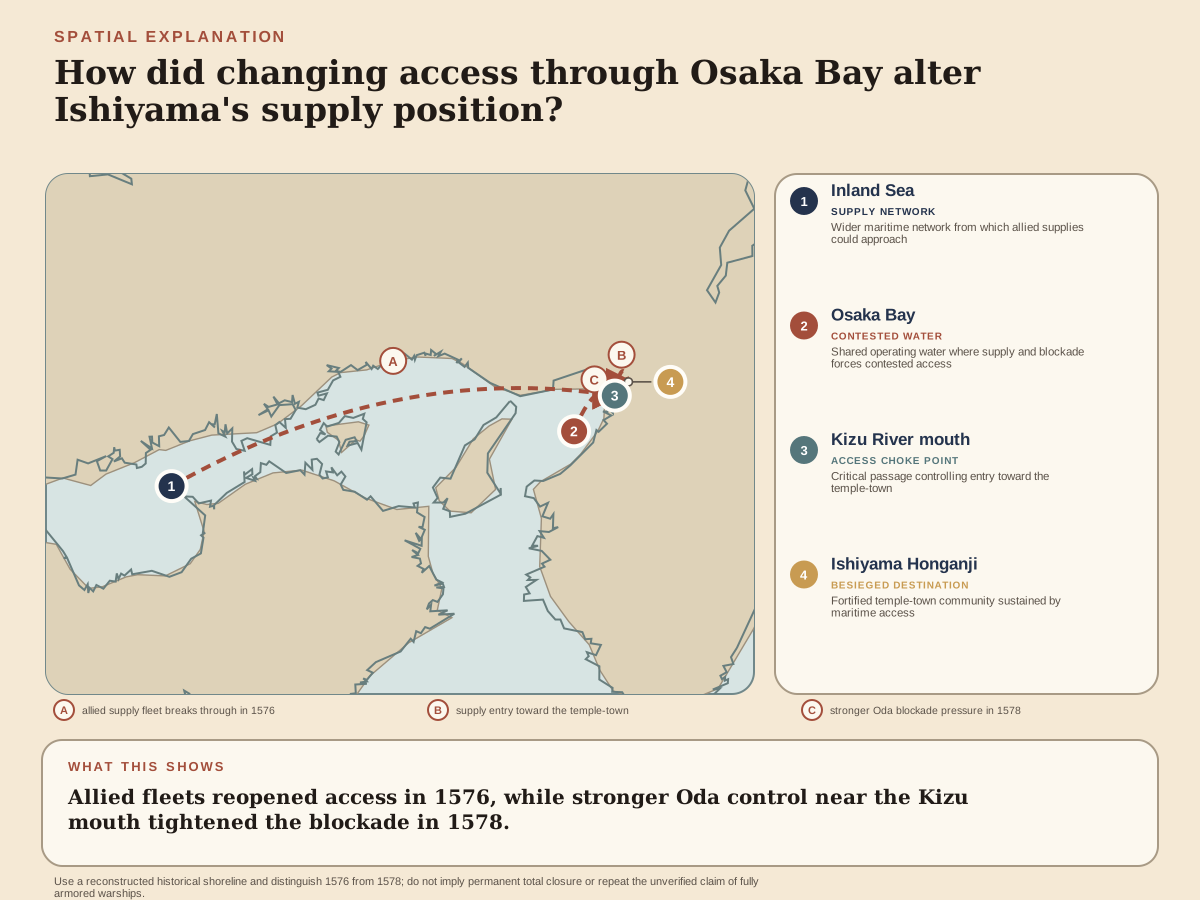
By 1576 Oda forces were tightening their positions around Honganji. A temple-side attack inflicted a serious defeat on the besiegers before Nobunaga brought relief and strengthened the surrounding forts. Honganji also depended on provisions delivered by forces associated with the Mōri, the powerful family of western Honshū. In the first battle at the Kizu River mouth in 1576, the western fleet defeated Oda vessels and brought food into Osaka. Two years later, large vessels commanded by Nobunaga’s naval officer Kuki Yoshitaka used heavy guns to reverse the balance. Their success made the approach to Honganji harder to supply. The headquarters survived for a time, but Kennyo faced increasing pressure on the routes that kept its defenders and inhabitants fed. [3]
In 1580 envoys of the imperial court helped negotiate a settlement between Nobunaga and Honganji. Kennyo accepted the terms and left Osaka with his wife, temple officials and the sacred image of Shinran. He established himself at Sagimori in Kii, present-day Wakayama. His eldest son Kyōnyo opposed the withdrawal and remained with supporters for several more months. Both father and son continued seeking help from provincial followers. Kyōnyo eventually departed later in 1580, and the temple and town burned. The defense had ended, but the family had to recover unity and the community had to find another home. [3][4][5][8][13]
At Sagimori, Kennyo continued leading a community that had survived the Osaka war. After Nobunaga’s death in 1582, a letter to followers in Higo, present-day Kumamoto, urged renewed faith and gratitude. Kennyo interpreted the enemy’s fall as Buddhist punishment. He also reconciled with his son Kyōnyo in 1582. Under Toyotomi Hideyoshi’s patronage, Honganji moved to Kaizuka in 1583, Tenma in Osaka in 1585 and Kyoto in 1591. Kennyo lived to see the principal halls established in the new Kyoto home and died in 1592. His last decade restored a center for worship after he had relinquished the old fortified town. [4][7][13][17]
After Kennyo’s death in 1592, his eldest son Kyōnyo succeeded him. In 1593 Hideyoshi instead recognized the younger son Junnyo, supported by their mother Nyoshunni. The historical accounts used here differ over the authority of a document presented as Kennyo’s grant to Junnyo. Kyōnyo later established a separate Honganji on Kyoto land provided by Tokugawa Ieyasu in 1602. The eastern and western institutions thus took shape after Kennyo’s lifetime. Later images remembered him both as a religious head and as an armed opponent of Nobunaga; their dates matter when using them as evidence. [13][14][17][12][9][11]
Classic
Kennyo was born in Osaka in 1543 into Honganji’s hereditary religious leadership, within a Buddhist community devoted to Amida Buddha. His father Shōnyo had established the main temple there after the destruction of its previous headquarters at Yamashina, near Kyoto. When Shōnyo died in 1554, Kennyo became the eleventh head while still a child. Yūsei-ni, a senior woman of the household, helped support his early leadership. The succession preserved continuity of religious office through a family whose responsibilities reached beyond a single temple building. [1][17][4][12]
In 1559 Emperor Ōgimachi recognized Honganji as a monzeki temple. This status normally belonged to foundations associated with imperial princes or the highest court families. Honganji’s connection with the Kujō court house helped make the recognition possible. The temple’s leadership now occupied a more formal place within the court’s religious hierarchy. Its administration included the Shimotsuma family of temple officials, while relatives assisted religious affairs. Kennyo’s wife Nyoshunni was a daughter of the court noble Sanjō Kinyori, with adoptive ties to the regional warrior leaders Hosokawa Harumoto and Rokkaku Yoshikata. Her sister was married to Takeda Shingen, the powerful lord of Kai in central Japan. These were connections that later offered routes for diplomacy. [17][15]
Kennyo’s prewar leadership included the commemoration of Shinran, the teacher whose life and writings grounded the community. A major memorial service was held in 1561. He also visited followers in Izumi and Kii, around present-day southern Osaka and Wakayama, in 1563. When the main halls burned in 1564, they were rebuilt the following year. His religious administration continued the distribution of authorized texts and the production of woodblock editions of Rennyo’s pastoral letters. Rennyo, an earlier Honganji leader, had used such letters to explain faith to followers. Ceremonies, buildings and texts occupied Kennyo’s religious leadership before his prolonged confrontation with the expanding warrior ruler Oda Nobunaga. [12][17]
The Osaka temple occupied elevated ground above surrounding lowlands and wetlands, with access to the Yodo River route toward Kyoto. Connections to the Inland Sea also brought shipping within reach. The main temple had moved to Osaka in 1533, before Kennyo’s birth. Urban institutions grew through the work of earlier religious leaders and residents. The historian of architecture Itō Takeshi reconstructs this development in part from Shōnyo’s diary, written during Kennyo’s father’s leadership. It describes a settlement with commerce and property arrangements already established before Kennyo’s war. [16][3][17][12][2]
Land claims could belong to the temple, to town groups and to individual property holders. Town elders managed local affairs, including control of gate keys, while Honganji exercised judicial authority and received rents and offerings. Residents also supplied labor for building and waterworks. The temple’s protection supported settlement, but living within its jurisdiction carried practical demands. Contacts with merchants in nearby Sakai helped bring goods and contributions to the headquarters. [2]
Evidence boundary · The temple town through an opponent’s chronicle
During the war, Ōta Gyūichi’s account describes Honganji’s neighborhood as a crowded place reached by pilgrims and commerce.
Ōta wrote from the perspective of Nobunaga’s side, but his account also notices the stakes of households attached to the temple town. In his description of the eventual evacuation, continued resistance came partly from people whose families and possessions depended on the place. For them, accepting peace and surrendering the headquarters were separate difficulties. Homes could not be carried away as readily as an official seal or a sacred image. This population was a resource for the defense and a responsibility that became harder to sustain when access to provisions narrowed. [3]
Nobunaga’s campaign against the Miyoshi warrior family near Osaka in 1570 brought Oda forces close to Honganji. Kennyo’s institution had previously met Nobunaga’s demand for a large war levy, according to modern biographical accounts. The same accounts connect the rupture with pressure to surrender the Osaka headquarters. In Ōta Gyūichi’s chronicle, Honganji’s attack occurs while Nobunaga is engaged with the Miyoshi forces at Noda and Fukushima. The religious center became an active opponent within a conflict involving several neighboring powers. Even armed groups from Saika and Negoro, south of Osaka, appear in the account with changing alignments rather than one permanent allegiance. [3][1][17]
Evidence boundary · An appeal is not proof of complete command
Kennyo could address followers far beyond the immediate battlefield. Hakusan’s Torigoe museum describes a letter dated to the traditional eleventh month of 1571 and directed to the believers of Kaga, in present-day Ishikawa. It asked them to cooperate with a temple administrative officer, Shichiri, who was being sent to the province. The appeal combined the head temple’s authority with the work of a regional representative.
The museum record explains a reproduction of the letter; the instruction itself does not establish how completely its recipients complied. Nor does it place every armed group associated with the label Ikkō-ikki, uprisings involving these Buddhist communities, under Kennyo’s direct command. [6][3]
Marriage connections offered another route through the conflict. Kennyo’s wife and Shingen’s wife were sisters, giving the powerful Kai lord a family connection with Honganji. Inaba Tsuguharu’s research report on a newly identified Nobunaga letter describes Yoshiaki asking Shingen in 1572 to mediate between Nobunaga and Honganji. Yoshiaki was the Ashikaga shogun, the military ruler whom Nobunaga had helped establish in Kyoto. His request shows that the participants were still seeking accommodations during a period often compressed into a single alliance against Nobunaga. The report instead traces changing commitments and disagreement among the shogun’s advisers. Kennyo’s resistance depended on relationships that could supply assistance, attempt mediation or pull in different directions as the war developed. [15][17][3]
Historical interpretation · A victory in an Oda-side account
The struggle for Honganji involved a ring of positions around the town as well as access from the water. In 1576 Ōta’s chronicle describes an attack from the Osaka side that overwhelmed Oda forces and killed their commander Harada. Nobunaga then came to relieve his surviving troops and drove back the attackers. His forces strengthened their forts and placed additional defenses near the shore.
The chronicler gives the relief the shape of a heroic Oda recovery, but the sequence also shows Honganji’s capacity to inflict losses on a force trying to close its approaches. Success in that local battle did not remove the continuing pressure of the siege. [3]
In 1576 a western fleet brought provisions toward Osaka with ships associated with the maritime allies of the Mōri, the powerful warrior house of western Honshū. Ōta names several groups, including Noshima, Kurushima and the Kodama. These were men and vessels connected with western powers, whose cooperation Kennyo needed; they were not simply Honganji’s own standing navy. Oda ships attempted to stop them at the Kizu River mouth. The western force used incendiary weapons and arrows, destroyed enemy vessels and brought rice into the Osaka side. The immediate result was practical as well as military: the blockade had failed to prevent another delivery. Honganji’s religious and diplomatic connections mattered because they could produce ships, armed crews and food at a particular entrance to the town. [3][6]
In 1578 Nobunaga’s naval commander Kuki Yoshitaka brought large gun-carrying vessels into the waters near Osaka. Ōta describes them defeating smaller boats and holding positions that obstructed approach to the shore. Later that year, the chronicle records another western fleet attacking and being driven off by the large guns. The reversal at sea did not instantly end the defense, but it made successful supply more difficult. For Kennyo and the people remaining within the headquarters, preserving access had become as pressing as defeating an enemy force in the field. [3]
Historical interpretation · Saving lives and preserving the faith
The settlement of 1580 was negotiated through the imperial court, whose envoys traveled between the opposing sides. Ōta names representatives associated with the Konoe, Kajūji and Niwata court families. His account describes consultation within Honganji involving Kennyo’s wife and senior members of the household before a pledge was delivered. The agreement required withdrawal from the Osaka center. Ōta presents the decision as a means of sparing lives, an explanation recorded by a writer favorable to Nobunaga. Honganji’s own later histories emphasize preservation of the faith.
The two perspectives agree on the central action: Kennyo accepted peace and prepared to leave. [3][12][13]
Kennyo departed with his wife and senior officials, transported by vessels from Saika. The temple chronology records the removal of Shinran’s sacred image and the establishment of the headquarters at Sagimori. Taking the founder’s image allowed the head temple’s religious functions to continue at another place. The Osaka fortifications could not follow the departing household. Kyōnyo, Kennyo’s eldest son, remained with supporters who resisted surrender. Ōta associates some of that resistance with people whose households and property were bound to the town. The cost of evacuation fell unevenly on the people who had sustained the defense. [3][4][12][8]
Documents preserved in later copies show father and son still addressing provincial followers from their separate positions. Wakayama’s prefectural museum holds Edo-period copies of their 1580 letters to the Sakata, Azai and Ika districts of northern Ōmi, in present-day Shiga. The museum identifies Kennyo as writing after his move to Sagimori, while Kyōnyo’s appeal followed from the continuing resistance. Their requests show that the same religious network could be approached by divided leaders.
Evidence boundary · Who burned the Osaka headquarters?
Kyōnyo eventually left Osaka later that year, and the temple and its settlement burned around the conclusion of the evacuation.
The accounts used here do not establish a responsible arsonist. The site was lost, while Kennyo’s household, followers and religious work continued elsewhere. [5][3][4][7][12]
Nobunaga’s death in 1582 gave Kennyo an occasion to interpret the war for distant followers. A letter to priests and believers in Higo, in present-day Kumamoto, is described in a cultural-heritage record published by the Sumitomo Foundation. Its explanation attributes to Kennyo the belief that Nobunaga’s fall was Buddhist punishment and a vindication of the defenders’ devotion. The message also urged gratitude, deeper faith and the nembutsu, the invocation of Amida Buddha’s name. The letter’s work was to sustain faith and observance among people far from the relocated headquarters. Losing Osaka had changed Kennyo’s material position without ending his pastoral authority. [7][4]
Kennyo reconciled with Kyōnyo in 1582. The following year he moved from Kii to a temple at Kaizuka, south of Osaka, where he remained for about two years. That temple is now called Gansen-ji; the name was granted in 1607, after his residence there. The move to Tenma, north of the old Osaka center, followed in 1585 under the patronage of Toyotomi Hideyoshi, the ruler consolidating power after Nobunaga’s death. A new headquarters had to be established within the territorial order Hideyoshi was building around Osaka. [13][9][10][4][17][1][12]
In 1591 Hideyoshi provided a new site in Kyoto, and Honganji transferred there. The relocation formed part of the changes to the city under his government. It placed the religious center again near the imperial court whose recognition had strengthened Kennyo’s office decades earlier. The founder’s hall was moved from Tenma, and a new Amida hall was established in 1592. Kennyo died that year, leaving a functioning religious center after a decade of displacement. The surviving temple histories give the migrations a story of continuity, but that continuity required successive places, buildings and relationships with the rulers controlling them. [12][17][4][13][14]
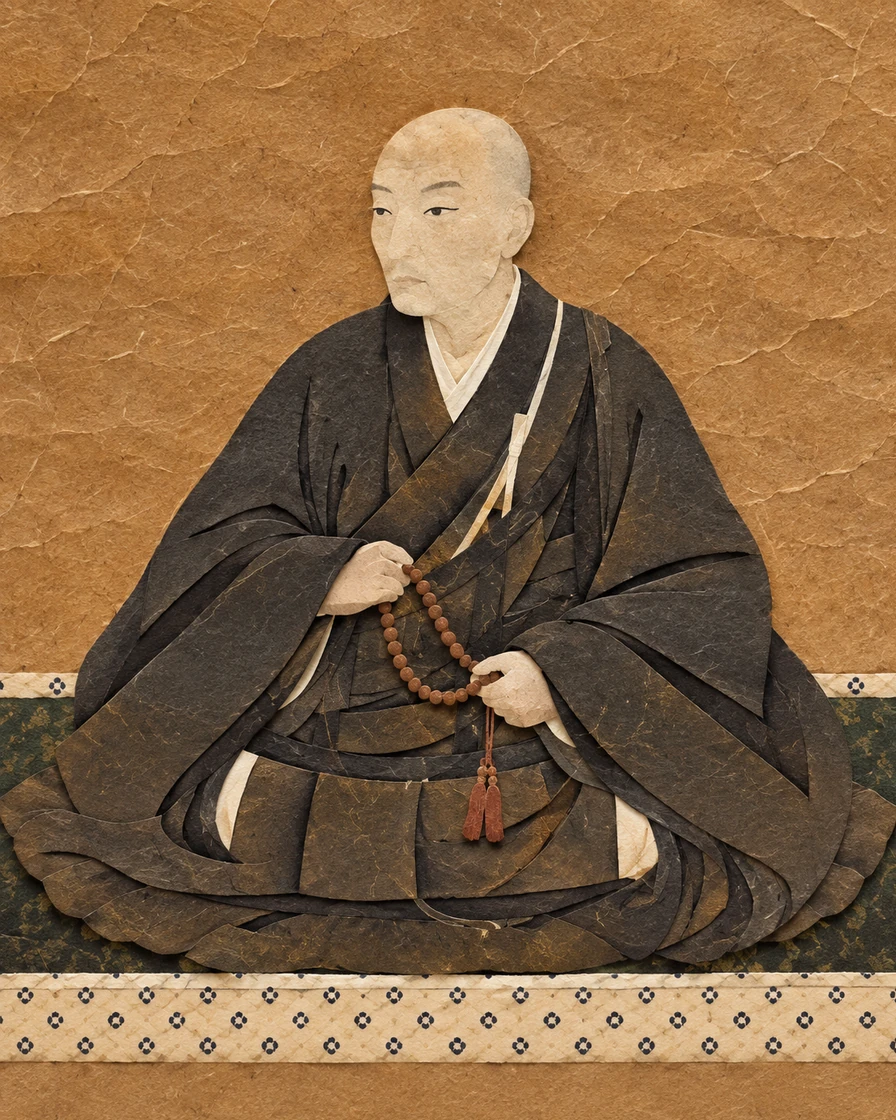
Kyōnyo initially succeeded Kennyo after his death in 1592. A portrait preserved at the Kaizuka temple provides a trace of that position. Its back inscription identifies a gift from Kyōnyo to the local temple leader Ryōchin in 1593. The city’s cultural-property description presents Kennyo seated in formal religious robes with prayer beads and a fan. It also notes later additions to parts of the painting. The gift nevertheless places remembrance of the former head within his son’s exercise of religious authority. [13][14][9]
Later in 1593, Nyoshunni promoted the younger son Junnyo, and Hideyoshi recognized him as the head of Honganji.
Historical disagreement · Was Kennyo’s succession grant authentic?
A document presented as Kennyo’s grant figured in this succession. The accounts consulted here treat its authority differently: the Hongwanji-ha research survey records it as a grant, while Heibonsha’s historical place-name entry reports that it has been called a forgery.
The document’s authenticity is therefore left unresolved here. [14][17]
What is clear in these accounts is the outcome of the ruler’s intervention: Kyōnyo retired from the headship and Junnyo took his place. In 1602 Tokugawa Ieyasu provided Kyoto land for Kyōnyo’s separate Honganji, leading to the later eastern and western institutions. That division arose through decisions after Kennyo’s death, rather than as a settled result of his own withdrawal in 1580. [14][17][13]
Historical reception · A later warrior image
A different image in Ishikawa’s prefectural history museum shows Kennyo with armor beneath his robes and swords at his side. The museum dates it to the eighteenth century.
Its inscription recalls a message from the beginning of the Osaka war in 1570, but the painting itself belongs to a much later period. It records the martial image through which later followers remembered their religious leader. Read alongside the migrations and the 1582 pastoral letter, that memory captures one part of a longer career. Kennyo’s authority had sustained resistance, accepted a painful settlement and continued the work of worship after the old headquarters was gone. [11][4][7][3][17]