Read the article below. Interactive reading tools are available when scripts load.
Quick
In 833, Fujiwara no Yoshifusa became head of Emperor Ninmyō’s secretariat at Heian-kyō, present-day Kyoto. Born in 804 as the second son of Fujiwara no Fuyutsugu, he had entered that service in 826 and went on to join the council of senior officials. His political career therefore developed through work beside the sovereign as well as family standing. [1][3]
He married Minamoto no Kiyohime, a daughter of Emperor Saga who had received the Minamoto surname as an imperial subject. [6] Yoshifusa’s sister Junshi was Ninmyō’s consort and mother of Prince Michiyasu. These were different connections: one linked Yoshifusa to Saga’s family; the other placed his nephew among possible future emperors. The succession crisis of 842 made the second relationship decisive. [1][2][3]
After retired Emperor Saga died in 842, Crown Prince Tsunesada was removed amid accusations of a plot. Prince Abo had sent a confidential report to Saga’s consort Tachibana no Kachiko; she entrusted it to Yoshifusa, who presented it to Emperor Ninmyō. Punishments followed, and Prince Michiyasu, Yoshifusa’s nephew, replaced Tsunesada as heir. [2]
The record establishes Yoshifusa’s place in the chain of reporting and his family’s benefit. It does not settle whether the alleged plot was real or prove that he invented it. He became minister of the right in 848. The new heir and the advancing minister were now positioned for the next imperial succession. [1][2]
Prince Michiyasu became Emperor Montoku in 850. Yoshifusa’s daughter Meishi, Montoku’s consort, bore Prince Korehito, who became crown prince while still an infant. Yoshifusa was consequently both the emperor’s uncle and the heir’s maternal grandfather. The child’s selection mattered more than kinship alone: it placed this particular branch of the imperial household next in line. [1][3]
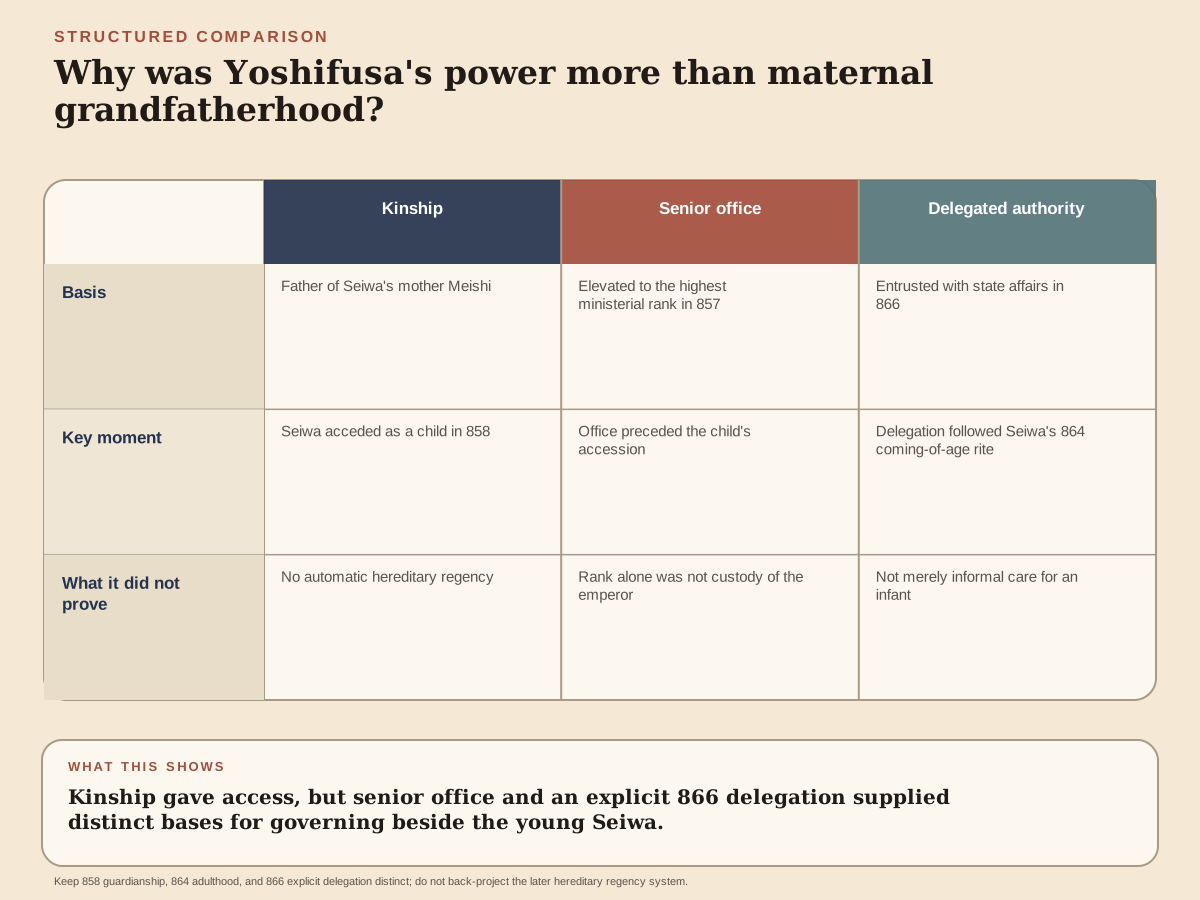
Yoshifusa became daijō daijin, the highest minister, in 857. Montoku died the following year, and Korehito succeeded as Emperor Seiwa. Yoshifusa’s guardianship of the young sovereign is generally associated with this accession. The surviving explicit authorization to conduct government, however, belongs to 866; senior rank and guardianship should not conceal that later step. [1][2][3]
In 866, the palace’s Ōten Gate burned. The ensuing conflict ended in Tomo no Yoshio’s removal and strengthened Yoshifusa’s position. A surviving imperial authorization directed Yoshifusa to conduct the affairs of government. Seiwa had undergone his coming-of-age ceremony in 864, so this authorization addressed more than the immediate problem of a child’s accession. [1][2]
Later narratives make the fire a vivid story of accusation and rescue; their details cannot all be read back into contemporary proceedings. Yoshifusa had adopted his nephew Mototsune, who advanced after the crisis. Yoshifusa also participated in official historical compilation. When he died in 872, he left a successor within his household and a precedent for delegation, rather than a fully completed hereditary system. [1][2]
Mototsune later assisted emperors through authorizations of his own. The value of Yoshifusa’s precedent lay in showing how an imperial subject could combine ministerial standing with authority to act for a sovereign. Later developments were subsequent choices, not events Yoshifusa lived to direct. [1][2]
The Ōten Gate affair acquired another life in the twelfth-century Ban Dainagon Emaki, three painted scrolls about the fire and Tomo no Yoshio’s downfall. The scrolls’ narrative belongs to a much later court. Yoshifusa’s Shirakawa residence also outlasted him: a later holder offered it to Emperor Shirakawa in 1075. Political precedent, transmitted property and a painted story preserved different parts of his world. [2][4][5]
Classic
When Emperor Ninmyō succeeded in 833, Fujiwara no Yoshifusa became head of the imperial secretariat at Heian-kyō, the capital in present-day Kyoto. The appointment placed him beside a new sovereign before he became the grandfather of another. Born in 804, he was the second son of Fujiwara no Fuyutsugu and had entered secretariat service in 826. His later advancement to the council included appointment as a councillor in 834 and provisional middle counsellor in 835. Family standing provided a starting position; successive appointments gave him places within the court’s working hierarchy. [1]
Yoshifusa’s marriage connected that career to Emperor Saga’s family. His wife, Minamoto no Kiyohime, was Saga’s daughter but had received the Minamoto surname as an imperial subject. [6] Their daughter Meishi would become an imperial consort. Yoshifusa belonged to this network through marriage while remaining a subject holding ministerial office. His connection to the imperial family and his position within government were distinct sources of standing. [1][2][3]
Another connection ran through Yoshifusa’s sister Junshi. She was Ninmyō’s consort and the mother of Prince Michiyasu, the future Emperor Montoku. Kiyohime’s marriage and Junshi’s position did different work. The former joined Yoshifusa’s household to Saga’s descendants. The latter made Yoshifusa the maternal uncle of a prince who might succeed Ninmyō. Neither relationship made Michiyasu crown prince by itself: another prince, Tsunesada, already occupied that position. [1][2][3]
These relationships help explain the stakes of the approaching crisis without supplying a secret plan for it. Yoshifusa had a court career, a connection to Saga’s family and a nephew whose future depended on succession decisions. His means were particular appointments and particular relatives, rather than a single Fujiwara clan acting with one intention. In 842, Saga’s death and a report against the crown prince’s circle brought these positions together. [1][2]
In 842, retired Emperor Saga died and the court removed Crown Prince Tsunesada. The allegation concerned a plan associated with people around the prince. A confidential report passed from Prince Abo to Tachibana no Kachiko, Saga’s consort, then through Yoshifusa to Emperor Ninmyō. This chain gives Yoshifusa a specific action in the Jōwa crisis: he conveyed information to the reigning emperor. Kachiko and Abo were participants in that transmission, rather than incidental names behind a Fujiwara achievement. [2]
The consequences went beyond replacing a name in the line of succession. Members of Tsunesada’s circle were punished and excluded from their existing positions; Tachibana no Hayanari and other accused men suffered removal or exile. Prince Michiyasu, Ninmyō’s son by Yoshifusa’s sister Junshi, became the new crown prince. A prince’s household could organize service and future careers around an expected accession. Removing the prince also damaged the people attached to that expectation. The new heir redirected those prospects toward Ninmyō’s son and Yoshifusa’s nephew. [1][2]
Historical disagreement · Conspiracy or a succession crisis?
Explanations centered on Fujiwara advancement read the Jōwa incident through the rivals removed and the family that benefited; older accounts also emphasized competition between groups of officials. Kamiya Masayoshi instead asks how succession itself was organized. His reconstruction places the dispute between the Saga–Ninmyō and Junna–Tsunesada lines, and sees its outcome as strengthening direct father-to-son succession.
A change in succession and Yoshifusa’s advantage do not establish that he fabricated the reported plot. He transmitted the accusation and benefited from the result; the existence of the alleged conspiracy remains a separate evidentiary question. [2]
The distinction also keeps Ninmyō visible. The report reached a reigning sovereign, and the succession changed in favor of that sovereign’s son. Yoshifusa’s interests and Ninmyō’s dynastic position could converge without being identical. The accession prospect belonged to Ninmyō’s son; the report passed through that son’s maternal uncle. Those connections explain how imperial succession and Yoshifusa’s advancement became intertwined. [1][2]
Yoshifusa became minister of the right in 848. By then his nephew had held the position of crown prince for several years. The crisis had given his household a closer route to the next reign, but Montoku’s accession and the choice of Montoku’s own heir still lay ahead. [1][3]
In 850, Ninmyō died and Prince Michiyasu became Emperor Montoku. That year Yoshifusa’s daughter Meishi bore Prince Korehito. The child became crown prince while still an infant, ahead of older sons born to other consorts. The exact infant age is reported differently in the reference accounts, but the political distinction is secure: succession was directed toward the son whose maternal grandfather was Yoshifusa. Montoku’s other children show why being related to an emperor was insufficient. Selection among possible heirs determined which maternal household would stand beside the next sovereign. [1][3]
Historical disagreement · Eight months or nine?
The reference accounts differ by a month: Mezaki Tokue’s biography and the French historical dictionary describe Korehito as nine months old, while Satō Sōjun’s entries give eight months. Neither account describes an older child.
The discrepancy does not alter the political point that an infant was selected ahead of older half-brothers. [1][3][8]
Meishi’s position joined two generations of relationships. Montoku was Yoshifusa’s nephew through Junshi, while Korehito was his grandson through Meishi. Through Meishi’s mother Kiyohime, the child also descended from Emperor Saga. The maternal family was therefore part of the imperial family’s own recent history. This was not a replacement dynasty. The arrangement brought a minister’s household closer to a throne that continued to be occupied by an imperial descendant. [1][2][3]
Yoshifusa’s appointment as daijō daijin in 857 supplied another kind of standing. This highest ministerial rank had earlier been associated with imperial princes. Its significance was the elevation of a subject to the top of the ministerial hierarchy; its duties were not a modern prime minister’s clearly itemized executive brief. Kamiya distinguishes the rank’s guardianship function from the later explicit delegation of the affairs of government. The difference explains why an office date cannot by itself settle the beginning of Yoshifusa’s regency. [2][3]
Historical disagreement · When did Yoshifusa’s regency begin?
Montoku died in 858, and Korehito took the throne as Emperor Seiwa. A young sovereign required adult support, and Yoshifusa combined the position of maternal grandfather with the highest ministerial rank. Many accounts associate his regency with this accession. The surviving unambiguous command to conduct government dates from 866, however, and historians differ over whether it confirmed an existing arrangement or constituted a further grant of authority.
Yoshifusa’s importance does not depend on erasing that distinction. [1][2][3]
The succession placed a child, his mother’s family and the council in a new relationship. It did not eliminate the council or all other senior ministers. When conflict broke out in 866, the relationship between guardian, sovereign and ministers still required an imperial decision. [2]
In 866, the palace’s Ōten Gate burned. Seiwa had already undergone his coming-of-age ceremony in 864. The crisis thus confronted Yoshifusa as the guardian of an emperor who had passed an important threshold, rather than simply renewing the circumstances of the accession eight years earlier. The fire brought rival ministers, accusations and public responses to a damaged palace into the same political moment. [1][2]
Evidence boundary · The arson story and the earlier record
Later accounts tell how Tomo no Yoshio accused Minamoto no Makoto and how Yoshifusa saved Makoto from punishment. Kamiya separates this developed story, familiar from later narrative and painting, from what the contemporary chronicle actually records. The early proceedings do not supply every link of the later arson accusation. They do preserve intervention in a threatening conflict around Makoto and an imperial response that prevented it from proceeding unchecked.
The earlier record establishes the intervention around Makoto without establishing every detail of the later arson narrative. [2]
The fire prompted ritual responses as well as investigation: the court ordered recitation of the Great Perfection of Wisdom scripture at Sūfukuji and other religious observances. These measures addressed the public calamity separately from assigning criminal blame. Ōyake no Takatori subsequently reported against Yoshio; questioning, arrest and punishment followed. Yoshio’s fall removed a senior participant at court. These recorded proceedings establish that accusations had practical consequences, without requiring the later story’s private conversations or the claim that Yoshifusa had secretly arranged the fire. [2]
Historical disagreement · Guardianship and delegated government
Within this crisis, the emperor explicitly directed Yoshifusa to conduct the affairs of government. The expression later identified with sesshō, or regency, described a delegated action and authority; it was not simply another statutory office added beside daijō daijin. Kamiya interprets the 866 command as a response to a particular crisis that later became a precedent. Other accounts place the effective beginning in 858 and read 866 as confirmation.
Both dates belong in the career, but they answer different questions: when Yoshifusa began guardianship and when explicit delegation is securely recorded. [1][2]
Yoshifusa had adopted Mototsune, the son of his brother Nagara. Mototsune advanced to middle counsellor after the affair. Adoption provided a successor within Yoshifusa’s household, while promotion gave that successor a position in government. Neither act automatically transmitted every power Yoshifusa held. Mototsune would need imperial authorizations of his own. Yoshifusa’s participation in the compilation of the Shoku Nihon Kōki, an official history, also left him among those responsible for recording the court’s past; he was a contributor, not its sole author. [1][2]
Yoshifusa died in 872 after illness. His life ended with a powerful household and a documented precedent for delegation. The later institutional history of Fujiwara regency continued through people who survived him. [1][2]
Mototsune’s later regency drew on Yoshifusa’s example, but successive imperial commands gave that example new applications. The continuing need for authorization is part of Yoshifusa’s legacy: a successful precedent could guide later arrangements without functioning as an inherited, unchanging job description. The mature forms of government associated with later Fujiwara ministers were the work of subsequent generations. [1][2]
Property followed a different path. Kyoto City’s history of the Shirakawa area records Yoshifusa’s residence there, outside the capital, and its later transmission among Fujiwara household heads. In 1075, Fujiwara no Morozane offered the property to Emperor Shirakawa. The residence’s later imperial connection was a transaction carried out more than two centuries after Yoshifusa’s death. It cannot be included among his own building achievements or decisions. [4]
The twelfth-century Ban Dainagon Emaki gave the Ōten Gate affair a durable visual narrative. Its three painted scrolls move through the fire, exposure and Tomo no Yoshio’s downfall. The Idemitsu Museum dates the work to the twelfth century; it cautiously attributes a leading role in its production to the painter Mitsunaga. The scrolls convey how a later court made the affair intelligible through scenes and characters, not how an eyewitness recorded its investigation. [5]
The gap between those scenes and the earlier chronicle changes Yoshifusa’s role as well. In the developed story he can appear as a rescuer against a clearly identified wrongdoer. In the administrative record, the secure questions concern interventions, punishments and the authorization to govern. That authorization, the transmitted residence and the later painted narrative each preserved a different part of his career’s consequences. [2][4][5]