Read the article below. Interactive reading tools are available when scripts load.
Quick
Mototsune reached the right ministry in 872, the year his adoptive father Yoshifusa died. The family relationship gave his career a direction: born in 836 to Fujiwara no Nagara, he had been adopted by Nagara’s brother, the minister whose service supplied later regents with a precedent. Mototsune’s own rise proceeded through court appointments. Emperor Montoku capped him in 851, and under Seiwa he became head of the imperial secretariat and then a councillor. [1]
The Ōtenmon upheaval accelerated that rise. After Ban no Yoshio’s downfall in 866, Mototsune advanced to middle counsellor ahead of seven men. The promotion reveals the benefit he received from the crisis without proving every later account of his role in bringing it about. Yoshifusa’s death left a family successor whose governing commission still had to be established. [1][3]
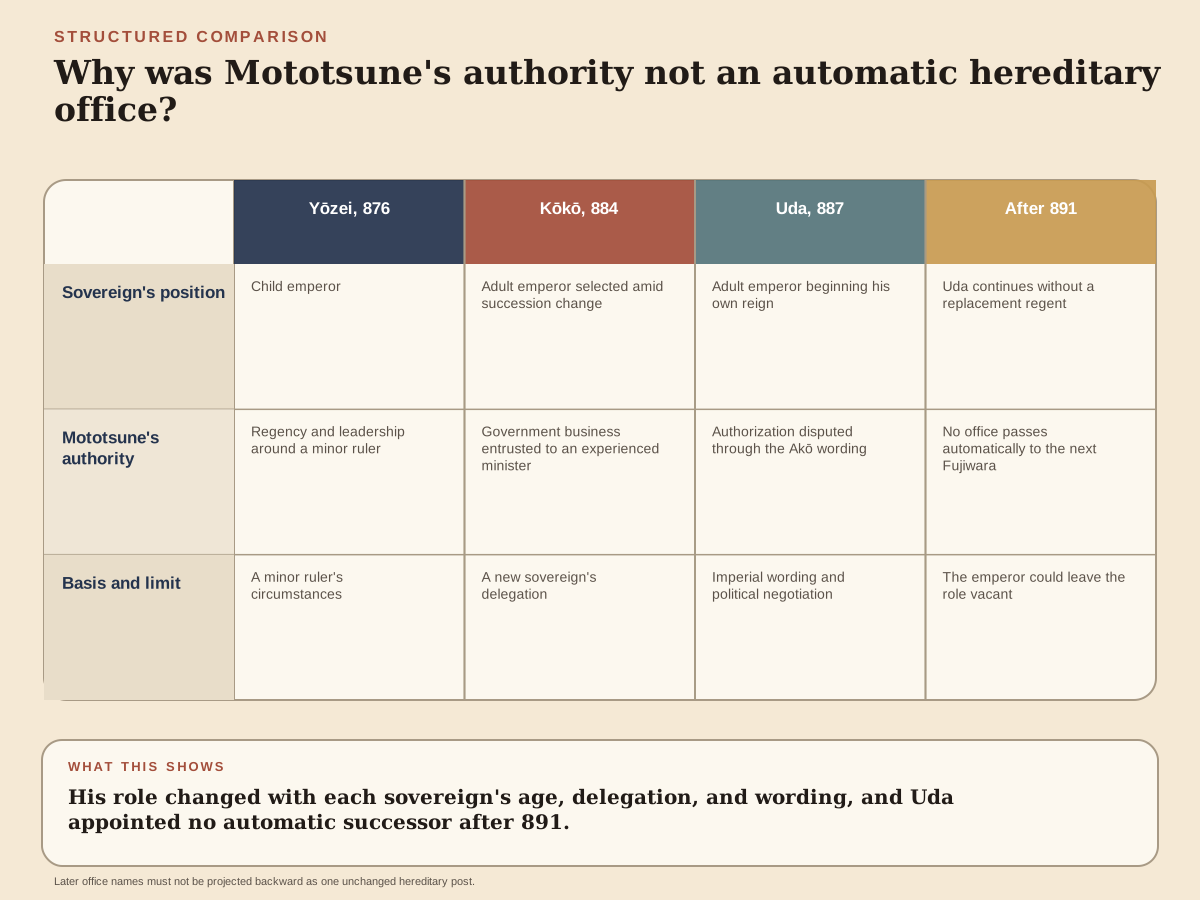
Seiwa’s abdication in 876 made the young Yōzei emperor and Mototsune regent. The decree invoked Yoshifusa’s precedent. Appointment to the highest ministry followed in 880, when Seiwa died. These steps distinguished an assignment to assist a child ruler from a place at the summit of the ministerial hierarchy; they did not simply repeat an appointment made in 872. [1][3]
At the same time, Mototsune participated in palace lectures on the Nihon Shoki, Japan’s early imperial history. Begun in 878, the series acquired a format in which a learned specialist worked with several students who raised questions. Senior court nobles attended. The reading finished in 881 and its closing feast followed in 882. Liang Xiaoyi interprets these gatherings as a way to consolidate Mototsune’s leadership among nobles. The connection between learning and government would outlast him. [5]
Mototsune helped remove Yōzei and install Kōkō in 884. The official chronicle’s illness explanation differs from the later Gukanshō portrayal of a cruel ruler. The change of emperor is secure; every story told to justify it is not equally secure. Kōkō entrusted governing business to Mototsune, giving him the substance of the later kanpaku role under an adult emperor. [1][4]
When Kōkō died in 887, his son Sadami became Emperor Uda with Mototsune’s support. Sadami had previously entered the subject nobility and had to return to imperial status before accession. The powerful minister helped this transition, but the new emperor also needed usable terms for their working relationship. A document intended to secure assistance would instead open a dispute about what that assistance meant. [6][2]
Uda’s initial commission used kanpaku. A subsequent reply to Mototsune’s formal resignation compared him to an ancient Chinese Akō. Critics read that designation as withholding active governing duties. Mototsune refused to leave the point unresolved. The dispute drew in Tachibana no Hiromi, the document’s author and maternal grandfather of two imperial princes, whose punishment became another issue. Revised wording and a proposed connection through Mototsune’s daughter Onshi complicated a settlement. [2]
The emperor could not make an objection disappear merely by requesting assistance under the first document. Yet Mototsune’s success did not establish uninterrupted family possession of the office. He died in 891, and Uda proceeded to govern without appointing a replacement regent or kanpaku. Mototsune had strengthened a precedent; the next ruler still chose how to use it. [2][1][8]
Mototsune’s family and his learned activities continued along different paths. His son Tokihira led another Nihon Shoki lecture series in 904–906; Tokihira’s brother Tadahira, another of Mototsune’s sons, sponsored one begun in 936 and completed with a feast in 943. Liang interprets these later gatherings, too, in relation to the leadership their sponsors were building. The recurrence shows a practice available to successors, rather than a single ceremony confined to Mototsune’s lifetime. [5][9]
Another continuation travelled through books. Mototsune had participated in compiling the Nihon Montoku Tennō Jitsuroku, the history of Montoku’s reign. A ten-book edition printed in 1709 carries the collective attribution to Mototsune and others. Such witnesses preserve his association with imperial historiography. They should be read alongside the changing appointments and disputed accounts that prevent his career from becoming a simple story of inherited, unlimited power. [1][7][8][4]
Classic
Historical disagreement · Did regency follow inheritance?
By 872 Fujiwara no Mototsune was right minister. Yoshifusa, his adoptive father, died that year, leaving him at once a senior official and the successor to an influential family head. Later descriptions sometimes make the next step seem automatic, placing his regency immediately after Yoshifusa’s death.
Satō Sōjun questions that sequence: a family inheritance should be distinguished from a governing appointment that the throne would make in 876. The distinction begins with the way Mototsune had reached his position. [1]
He was born in 836 to Fujiwara no Nagara, Yoshifusa’s brother. Adoption placed him in Yoshifusa’s household line. In 851 Emperor Montoku personally capped him at his coming-of-age ceremony, a public association with the ruler. His subsequent offices supplied experience as well as status. Under Seiwa, who came to the throne in 858, Mototsune headed the imperial secretariat. He became a councillor in 864. These appointments preceded the upheaval that brought his most conspicuous early advancement. [1]
Evidence boundary · Advancement and agency in the Ōtenmon crisis
The Ōtenmon fire of 866 became a political crisis in which Ban no Yoshio fell. Mototsune’s biography credits him with conveying the innocence of Minamoto no Makoto, an initially accused minister. Kamiya Masayoshi’s study of the crisis emphasizes problems in the construction of its narrative. Later accounts leave Mototsune’s precise part in producing the outcome harder to reconstruct than the promotion that followed: he became middle counsellor ahead of seven men after Ban’s downfall.
His advancement identifies a beneficiary of the crisis while leaving questions about the extent of his agency. [1][3]
The right ministry in 872 added a major office to that record of service. Yoshifusa’s name could supply a precedent and adoption could identify the successor to his family leadership, but neither described all the powers Mototsune would exercise. Seiwa was still emperor. Only a subsequent change of ruler would produce the explicit regency commission that later writers were tempted to move back to this year. [1]
Seiwa abdicated in 876 in favor of the young Yōzei. The decree entrusting Mototsune with regency invoked Yoshifusa’s service as precedent. There was also a difference: Seiwa remained alive as retired sovereign. Kamiya interprets the arrangement as one in which Mototsune exercised delegated imperial powers while a guardian above the child ruler still existed. In 880, on Seiwa’s death, Mototsune became daijō daijin, the highest minister. Kamiya reads the timing as a further adjustment to the disappearance of that guardian. This is a historical interpretation of the relationship between two appointments, rather than proof that the highest ministry had a single, unchanging statutory function. [1][3]
The separation mattered inside the court. Mototsune had been right minister; Minamoto no Tōru held the left ministry, a senior position in the ordinary ministerial hierarchy, and had served as Yōzei’s tutor while he was crown prince. Mototsune was the maternal uncle of Yōzei: his sister Takako was the emperor’s mother. Kinship strengthened his claim to service without erasing the standing of another senior noble. Liang Xiaoyi uses these relationships to explain why inheriting Yoshifusa’s example did not make Mototsune’s political base equally secure. [5][4]
Evidence boundary · Humility in a formal petition
Mototsune’s ceremonial resignation petition of 876 made a comparison with Yoshifusa. It praised the predecessor’s kinship, standing and achievements, then lowered the petitioner’s own qualities.
Such self-deprecation belonged to the form of a resignation petition; it does not provide transparent access to his private feelings. Liang nevertheless finds political significance in the categories selected for comparison. A precedent was being presented through a document that specified the qualifications of the man associated with it. [5]
The palace’s Nihon Shoki lectures offered a second setting in which office and learning met. The series began in 878. In 879 its organization changed: a learned specialist expounded the history while three or four students supplied the questioning role. The sessions took place in the east wing of the Giyōden within the palace. Court nobles from the right minister downward attended the exposition. Reading finished in 881, and a closing feast followed in 882 in the right minister’s palace quarters south of the attendants’ office. By then Mototsune had risen to the highest ministry. [5]
The gathering’s membership is as revealing as its subject. Liang finds no trace of Tōru’s attendance throughout the series; Tōru was staying away from court during Yōzei’s reign. That absence is not evidence of an edict barring him from the lectures. It does help define the company assembled around Mototsune. The changes in format gave senior officials repeated occasions to hear exposition and questions together while one prominent senior minister was absent. Liang interprets this as a means of integrating the nobles under Mototsune’s leadership. Details of the frequency remain unknown, despite the chronicle’s phrasing that reading took place daily. [5]
Regency, promotion and learned assembly thus supplied different forms of authority during the same years. None by itself answers how an adult emperor would work with Mototsune. Yōzei’s departure would raise that question in a new form. [1][5]
In 884 Yōzei left the throne and Kōkō became emperor with Mototsune’s support. Mototsune was therefore involved in more than assisting the ruler already in place: he helped bring about a change of ruler.
Historical disagreement · Why did Yōzei leave the throne?
The sources disagree over its justification. The Nihon Sandai Jitsuroku, the official chronicle, explains Yōzei’s departure through illness; the later Gukanshō presents a ruler whose cruelty warranted removal. Atsutani Kazuo’s biography explicitly identifies the difference.
A secure transition need not carry with it certainty about every incident later used to explain the transition. [1][4]
Kōkō was an adult emperor. His relationship with Mototsune could therefore not be described simply as guardianship for a child. He issued a decree entrusting the minister with governing affairs. Kotō Shinpei describes the intended operation in concrete terms: matters submitted to the emperor and matters issued in the emperor’s name were to be consulted about with Mototsune. This gave the minister a place in the movement of business to and from the ruler. Satō describes the arrangement as the practical substance of kanpaku, assistance to an adult emperor, before Uda’s document used that wording in 887. [1][2]
The same court also honored Mototsune through learned and artistic collaboration. A screen for his fiftieth-birthday celebration involved poems by Sugawara no Michizane, calligraphy by Fujiwara no Toshiyuki, and painting by Kose no Kanaoka. Arai Hiroki identifies Taira no Korenori as the organizer, drawing on the explanation attached to the poems. Evidence for the arrangement comes from those transmitted poems and their explanation. They preserve the coordination of several specialists for a ministerial celebration. The account shows another form of association with Michizane before the poet’s letter became involved in the Akō dispute. [6]
Kōkō’s death in 887 made the succession urgent again. His son Sadami had been removed from imperial status and given the Minamoto surname in 884. He returned to imperial status before becoming Uda. Arai emphasizes how late the succession arrangements were made in Kōkō’s last illness. Mototsune supported the new ruler, whose position had required a reversal of that earlier status change. Uda wanted his assistance in government. The working arrangement inherited from Kōkō now had to be stated for this emperor, and its written expression would prove less stable than either man’s rank. [6][1][2]
Uda’s initial 887 commission used kanpaku. Mototsune submitted a formal resignation; the emperor’s reply compared him to an ancient Chinese Akō. The objection concerned the duties attached to that designation. If the comparison conferred distinction without active governing business, it could diminish precisely the function Uda wanted Mototsune to perform. A dispute about an apparently honorific word therefore reached the practical question of who would handle affairs on behalf of an adult emperor. [2]
Kotō’s study reconstructs the exchange from eight 888 extracts of Uda’s diary preserved in volume 30 of the Seiji Yōryaku. In the traditional sixth month, scholars debated the meaning without reaching a conclusion. Uda asked Mototsune to undertake business under the first 887 document. Mototsune insisted that the Akō question be settled before proceeding. A revised reply followed. This sequence helps explain his negotiating strength: the emperor’s request for cooperation did not resolve the minister’s objection to the terms of cooperation. [2]
Tachibana no Hiromi had written the contested document. He was also the maternal grandfather of two imperial princes. The consequences could thus reach a scholar-official and a branch of the imperial household, rather than remaining a contest between two offices. Hiromi’s punishment became an issue later in 888. Uda also proposed receiving Mototsune’s daughter Onshi into his household as part of the negotiations. Arai confirms that she subsequently became an imperial consort. The proposal and that eventual relationship should be kept distinct; neither warrants treating a marriage arrangement as a complete explanation of every disputed document. [2][6]
Historical disagreement · A letter within the Akō negotiations
Michizane’s intervention belongs within this extended process. Kotō corrects an entry previously assigned to the sixth month to the eleventh month and connects it with Michizane’s arrival in the capital and his letter to Mototsune. A different placement changes the relationship between the letter and the diary’s exchanges. It is consequently too simple to make one letter an independently proved, instantaneous end to the whole affair.
The surviving extracts permit a sequence of argument, revision and threatened consequences; they do not give an uninterrupted record of every negotiation. [2]
Mototsune’s insistence fits Satō’s assessment that he gave particular weight to the forms through which Yoshifusa’s precedent could be made coherent. The duties expressed in writing helped determine the terms on which the emperor could obtain cooperation. Mototsune died in 891, after illness had led him to submit a resignation late in the preceding year. Uda then governed without appointing another regent or kanpaku. The minister had made his position difficult to disregard during his lifetime; succession to that position remained a separate decision. [1][2][8]
The gap after Mototsune’s death prevents his career from being read as the foundation of an office that his household immediately possessed without interruption. Uda retained Fujiwara ministers while governing without a regent or kanpaku. Mototsune’s sons would still participate in court leadership, but they did so through subsequent appointments and relationships. A practice their father had helped shape was available to them without making every later outcome an effect of his original design. [8][5][9]
Tokihira led a Nihon Shoki lecture series in 904–906. Tadahira sponsored the series that began in 936 and ended with its closing feast in 943. Liang places these gatherings beside Mototsune’s earlier series, interpreting each in relation to the sponsor’s effort to consolidate leadership. The continuity is specific: successive leaders assembled nobles around a transmitted imperial history. It does not require a claim that every lecture had identical membership, frequency or political effect. [5]
Mototsune’s involvement in another imperial history, the Nihon Montoku Tennō Jitsuroku, also survived through textual transmission. Kariya’s Murakami Collection holds a ten-book printed edition dated Hōei 6, or 1709. Its catalogue attributes the compilation to Mototsune and others and identifies a preface dated Gangyō 2, or 878. The printed witness is separated from his lifetime by centuries. It preserves a collective attribution to a history of Montoku’s reign, rather than proving that Mototsune personally wrote every passage. [1][7]
These continuations give his career two readable afterlives: a recurring form of learned assembly and a history carrying his name through later editions. The disputed regency chronology, competing accounts of Yōzei’s removal and fragmentary record of Akō negotiations remain part of that inheritance. They preserve a minister whose influence was considerable while preventing the forms associated with him from becoming evidence of limitless or automatically hereditary power. [5][7][1][4][2][8]