Read the article below. Interactive reading tools are available when scripts load.
Quick
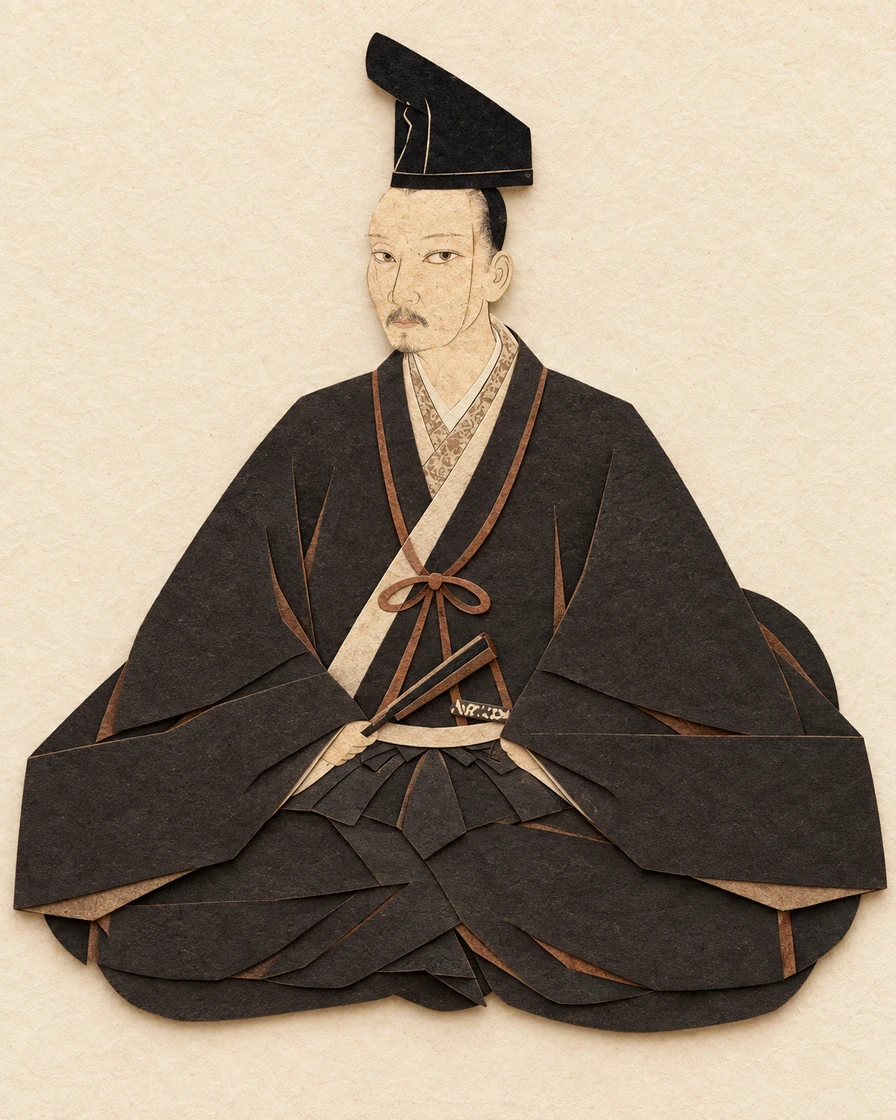
Born in 1394, Yoshinori was a son of Ashikaga Yoshimitsu, the Kyoto shogun. He was a younger full brother of Yoshimochi, who followed their father as shogun. Yoshinori entered Shōren-in in 1403 and took Buddhist vows in 1408 under the name Gien. Shōren-in was a prestigious Tendai temple whose leadership was associated with high-ranking families. Gien rose to become head of Tendai in 1419, resigning in 1421. This was an established religious career, with its own offices and connections. He remained a member of the ruling Ashikaga family, a relationship that later brought him back into secular government. [1][2][15][6]
Yoshimochi died in 1428 without naming the successor who would govern after him. Senior officials agreed to settle the choice among his brothers by drawing lots at Iwashimizu Hachiman, a shrine associated with warrior patronage. The lot selected Gien. He returned to secular life, took the name Yoshinobu and inherited the Ashikaga household. Formal appointment as shogun followed in 1429, when he became Yoshinori. The familiar lottery was only one stage: officials accepted the selection, and the imperial court conferred the military office. He would begin governing with advisers whose cooperation had made that transition possible. [1][2]
Yoshinori began with senior advisers, then increasingly insisted on decisions centered on the shogun. He revived judicial panels and limited the discretion of the kanrei, the senior coordinating official of the Kyoto government. Directly serving administrators and warrior retainers helped carry his orders into effect. He also intervened in provincial governors’ household successions, replacing leaders with men close to him. These governors, called shugo, combined military and policing authority with access to regional revenues. Changes of office could therefore transform a family’s resources as well as its standing. By 1440 the killing of powerful governors had increased uncertainty among other leading households. [2][1][3]
After Emperor Shōkō died without a son in 1428, Yoshinori supported the accession of Go-Hanazono, a prince of the Fushimi imperial house. He rose to the highest court rank and became minister of the left in 1432. Court status and the shogun’s household connections reinforced one another, although resistant courtiers could be punished. Yoshinori set aside his Hino wife and elevated a woman of the Ōgimachi Sanjō house. His patronage also helped secure an imperial poetry anthology, commissioned in 1433 and completed in 1439 under Asukai Masayo’s editorship. The anthology preserved courtly writing through the efforts of poets and compilers; its selections also reflected unequal access to patronage. [1][2][13][14]
Yoshinori had once headed Tendai, but as shogun he used armed force against resistant groups at Enryaku-ji in 1433. Temples held land, maintained clerical hierarchies and dealt with the government through different groups and representatives. Connections through the shogunal family also mattered. Some aristocratic monks became his formally recognized sons, receiving status useful for religious succession. Takatori Ren’s recent study finds that temples and court families sometimes sought these ties and the protection they offered. The arrangements could strengthen Yoshinori while meeting other institutions’ needs. His religious policy combined punishment with patronage and negotiated relationships whose terms differed from temple to temple. [1][6][11]
Yoshinori resumed missions to Ming China in 1432 after their interruption under Yoshimochi. Five ships departed that year, with the mission reaching the Ming capital in 1433. The diplomatic framework treated the shogun as king of Japan bringing tribute to the emperor. Tallies authenticated the official voyages. Government, temples, lords and merchants combined their resources in ships and cargoes, trading goods such as copper and swords for Chinese products. Exchange could supply revenue to ship operators and the government through their own cargo and charges on merchants. The resumption strengthened the shogun’s access to maritime resources through partners who organized the voyages. [7][8][9][1]
Ashikaga Mochiuji governed from Kamakura as kubō, the head of the Ashikaga government in the east. His senior coordinating official, the Kantō kanrei Uesugi Norizane, sought accommodation with Kyoto. Their relations broke down in 1438, and Mochiuji attacked Norizane. Yoshinori supported Norizane and ordered provincial forces to act against Mochiuji. Military defeats and defections forced Mochiuji to surrender and enter religion. Norizane requested mercy, but Yoshinori refused. Mochiuji and his son Yoshihisa died in 1439. The defeat extended Kyoto’s authority, while surviving family claims continued to draw eastern warriors into conflict. [4][5][3]
Akamatsu Mitsusuke’s position grew less secure as Yoshinori favored another family branch and confiscated his brother’s lands. Rumors threatened further loss of provincial offices. In 1441 Mitsusuke invited Yoshinori to his Kyoto residence and had him killed during a banquet. Mitsusuke returned to Harima, where a coalition led by Hosokawa and Yamana forces eventually defeated him. The Yamana gained the Akamatsu governorships and associated revenues. Yoshinori’s young son Yoshikatsu inherited the household in 1441, became shogun in 1442 and died in 1443. Senior lords again managed a succession and government whose strength rested on their continuing cooperation. [3][2][12]
Classic
Yoshinori was born in 1394 into the household of Yoshimitsu, the third Muromachi shogun. His mother came from the household of a temple official at Daigo-ji’s Sanbō-in. She was also the mother of Yoshimochi, giving the brothers a shared maternal connection to the religious establishment. In 1403 the younger brother entered Shōren-in, a Tendai temple headed by monks drawn from prestigious families. He took vows in 1408 and was known as Gien. His subsequent advancement belonged to the hierarchy of that religious world. [1][2][6][15]
Gien became a senior cleric and was appointed head of the Tendai school in 1419. He resigned in 1421. His advancement illustrates the access to distinguished religious posts available to members of the shogunal family. Takatori Ren’s study of entrants to aristocratic temples stresses that such institutions needed suitably high-status successors and that admission involved agreements among several powerful houses. Ashikaga sons could help fill those needs as the family’s standing rose. A religious appointment could thus connect a temple’s continuity to the standing of a warrior household. [1][6]
The monastery provided Gien with a recognized position outside the shogun’s secular office. His family relationship nevertheless remained politically consequential. His religious life was therefore part of the experience and institutional connections he brought to government. [1][6][2]
The succession problem arose in 1428 at Yoshimochi’s death. He had not designated the person who would follow him. Senior officials agreed on a lottery involving his brothers and used Iwashimizu Hachiman for the choice. The shrine procedure supplied an accepted means of decision where the previous ruler had left none. Its result selected Gien, but the agreement of experienced officials also mattered: they had arranged the procedure and recognized its outcome. Religious sanction and political consent were joined at this point in the succession. [1][2]
Gien left religious life and initially took the secular name Yoshinobu. Household succession occurred in 1428, while formal appointment as shogun came in 1429. The court ceremony confirmed an office separate from his earlier clerical positions. He then used the name Yoshinori. His change of name was said to reflect an unwelcome association between Yoshinobu and a phrase meaning to hide oneself from the world. [1][2]
The new ruler at first sought the views of senior advisers and followed preceding practice. Taking over the household and receiving the shogunal commission did not immediately replace the administration through which policy was carried out. Yoshinori’s later efforts to draw decisions closer to himself developed within that existing government. [2][3][1]
Yoshinori’s early consultation with senior officers gradually gave way to a stronger insistence on his own decisions. In 1428 he revived the hikitsuke, panels associated with judicial deliberation, and sought to constrain the kanrei’s authority. The kanrei coordinated affairs within a government sustained by powerful provincial houses. Yoshinori strengthened administrators serving more directly under the shogun, making their role in government and adjudication more consequential. The institutional change concerned where cases were considered and whose officials carried the resulting decisions. Concentrating authority required people able to translate a ruler’s decision into a document or order. [2][1][3]
Direct military retainers provided another means of strengthening the shogun’s position. The government still depended on provincial governors and their troops, but armed service did not run exclusively through those governors. Yoshinori also placed close attendants at the heads of Imagawa, Kyōgoku and Togashi branches. In the Hatakeyama house he displaced Mochikuni in favor of his brother Mochinaga. A succession decision could put an associate in control of a household whose provincial responsibilities supplied military resources. Personal access to the shogun consequently affected authority exercised well outside his Kyoto residence. [3][1]
In 1440 Isshiki Yoshitsura and Toki Mochiyori were killed, and close associates gained from the resulting changes. Governorships carried economic opportunities through administration of estates and other lands. A family threatened with losing an office faced the possible loss of the revenues supporting its retainers. Yoshinori’s interventions therefore reached both the political ranking and the material basis of provincial households. The Akamatsu family would experience favor for another branch and confiscation within its own kin group. That setting made a ruler’s personnel decisions consequential for people whose armed cooperation the government continued to need. [1][3]
Emperor Shōkō’s death in 1428 without a son required a choice within the imperial family. Yoshinori supported Go-Hanazono, a son of Fushimi Prince Sadafusa. Go-Hanazono entered the succession as the formally recognized son of the retired Emperor Go-Komatsu, whose own line had lost its heir. His birth into the Fushimi house and his place in Go-Komatsu’s line were distinct relationships. Yoshinori helped secure a candidate through an arrangement that preserved the imperial family’s own forms of succession. [1][18]
Yoshinori’s advancement through court rank continued after his military appointment. He became minister of the left in 1432, following a move in 1431 to the Muromachi residence formerly used by Yoshimitsu. Office and residence gave his authority a visible place within Kyoto’s political hierarchy. Household connections brought court families closer to that authority. Yoshinori set aside the Hino woman who had been his wife in favor of a woman from the Ōgimachi Sanjō house, and punished the first wife’s brother. These changes reduced one family’s privileged access while giving another woman a higher position. The Hino connection nevertheless continued through Hino Shigeko, mother of the future shoguns Yoshikatsu and Yoshimasa. Marriage, childbirth and recognition within the household could produce different relationships with the same wider kin group. [1][2][12][16]
In 1433 Yoshinori’s recommendation to Go-Hanazono led to an imperial commission for the Shinshoku Kokin Wakashū, a selection of Japanese poems. Asukai Masayo was appointed compiler, the first member of his poetic house to receive sole responsibility for an imperial anthology. The appointment changed which family held this distinction. Yet the Asukai house lacked the accumulated books and knowledge of precedent needed to complete such a collection unaided. The commission depended on assistance from courtiers and learned monks. [19][13]
Gyōkō, a monk-poet, managed documents in the compilation office and assisted Masayo’s work throughout. Ichijō Kaneyoshi supplied the prefaces. The anthology was completed in 1439 and became the last completed imperial collection of Japanese verse. A manuscript now at the National Institute of Japanese Literature preserves another stage of the work: its closing note, dated 1440, describes copying from an intermediate draft after the anthology’s completion. The volume extracts 649 poems from the collection’s 2,144. Its surviving handwriting is not securely identified as Gyōkō’s own. The retained draft supplied material for a new selection even after the official collection was complete. [19][13]
The anthology’s exclusions also mattered. The monk-poet Shōtetsu, disfavored under Yoshinori, had none of his poems included and lost rights to his hermitage estate. Patronage gave Masayo’s house a distinguished commission and brought other specialists into the work; a poet outside that favor could lose both recognition and material support. Yoshinori could help initiate an imperial collection and affect access to it, while its production relied on the learning and labor of people beyond his household. [14][19][13]
In 1433 Yoshinori used military force against Enryaku-ji groups that resisted the government. His former position as head of Tendai had not removed conflicts between the shogunate and the religious institutions around Mount Hiei. Temples possessed revenues and hierarchies of their own, while some representatives operated within systems established for shogunal supervision. These different relationships gave religious affairs a place within administration, regional landholding and armed politics. Coercion could involve losses of property as well as attacks on clerics. [1][6][11]
The shogunal family also entered temple leadership through actual sons and monks formally recognized as sons. This latter relationship, called yūshi, did not necessarily involve upbringing within Yoshinori’s household. Recognition could confer the prestigious descent required for entry to a high-ranking religious position. Takatori argues that Yoshinori’s reign was particularly active in making such arrangements. His study also identifies requests from temple and aristocratic actors, alongside the shogun’s own use of family standing. A temple seeking a qualified heir or political protection could help create a connection that subsequently enhanced the shogun’s authority. [6]
A document issued by Yoshinori’s son Yoshimasa in 1463 returned several estate rights to a Mount Hiei cleric. The Kyoto Tachibana University archive interprets those rights as probably having been confiscated under Yoshinori. The restoration belongs to the son’s reign, but it preserves an indication of how clerical service and landed resources could be rearranged across generations. Its wording and format also reflect supervision through designated temple representatives. Together with the negotiated relationships examined by Takatori, the document helps distinguish particular institutions and people within a field often summarized simply as temple suppression. [11][6]
The resumption in 1432 reversed the interruption of missions under Yoshimochi. Five ships left Japan, and the mission entered the Ming capital in 1433. A further six-ship mission departed in 1434. Access operated within a tributary framework: the Ming court received an embassy presented on behalf of the king of Japan. The shogun used that diplomatic style to secure recognition and exchange across the sea. Tallies established a voyage’s authenticity within this official relationship, while actual transactions were conducted through several forms of exchange. [7][8][9]
The 1432 fleet included interests associated with the government, Shōkoku-ji, the Yamana and other lords and temples. Official representation under the shogun’s name therefore coexisted with different providers of ships and cargoes. Merchants supplied much of the additional cargo carried alongside diplomatic gifts. Some goods were exchanged with the Ming government at prices it set, and others were sold through authorized merchants or along the route. Exports included copper, sulfur, swords and fans; Chinese silk, copper coins, books and other goods returned to Japan. The voyages linked clerical and political connections to merchants’ knowledge of transport, markets and goods. [9][7][8]
Ship operators benefited from cargoes of their own and charges levied on merchants’ imports. Yoshinori’s government gained access to resources through this organized exchange. The commercial proceeds depended on partners and on conditions set in Ming territory, making foreign recognition materially consequential at home. The resumed connection continued beyond his death under later arrangements dominated by powerful houses and temples. A supposed treaty of 1434 is recorded in later compilations, but specialists question its historical basis. The securely attested missions and the institutions operating them provide the clearer basis for understanding what Yoshinori restored. [8][1][7][10][9]
The Ashikaga house at Kamakura governed the east under a branch related to the Kyoto shoguns. Mochiuji held the title kubō, while Uesugi Norizane served as Kantō kanrei, the senior coordinating official. Relations with Kyoto had changed over Mochiuji’s life: Kyoto assistance helped restore him after the Uesugi Zenshū rebellion of 1416–1417. His subsequent campaigns against regional opponents, and Kyoto’s connections to other eastern warriors, increased tensions among the governments and their supporters. Norizane’s preference for accommodation placed him uneasily between Mochiuji and the Kyoto administration. [4][5]
In 1438 a dispute surrounding the coming-of-age of Mochiuji’s son Yoshihisa contributed to the rupture with Norizane. Mochiuji attacked the senior official, and Yoshinori ordered military support for Norizane. Imagawa, Takeda, Ogasawara and other provincial forces helped form the campaign against Kamakura. Eastern defections also weakened Mochiuji’s position. The resulting defeat was achieved by a coalition whose members had different regional interests and relations with the two Ashikaga governments. Yoshinori’s reach depended on mobilizing those forces rather than carrying out a personal expedition. [4][5]
Mochiuji surrendered, took Buddhist vows and was confined at Eian-ji in Kamakura. Norizane asked that his life be spared, but Yoshinori did not accept the request. Mochiuji killed himself in 1439 when forces closed on the temple; Yoshihisa died separately at Hōkoku-ji. Other sons survived the immediate collapse of the Kamakura government. Warriors around the Yūki family subsequently supported surviving heirs, and the government defeated that resistance in 1441. One son, Shigeuji, would return to eastern leadership in the late 1440s, after Yoshinori’s death. The coalition had removed a ruler, but hereditary claims and local alignments continued beyond the victory. [4][5][3][17]
The killings of Isshiki Yoshitsura and Toki Mochiyori in 1440 made severe intervention in provincial households visible. Within the Akamatsu family, Yoshinori favored men of another branch and confiscated the lands of Mitsusuke’s brother. Rumors also threatened changes to Mitsusuke’s governorships. Those events establish the pressures surrounding the household before the assassination. In 1441 Mitsusuke invited the shogun to his Kyoto residence for a banquet associated with celebration of the eastern victory. Yoshinori was killed there during a performance. His death ended a reign that had brought court rank, military orders and provincial succession increasingly around his person. [1][3][2]
Mitsusuke withdrew to Harima and arranged funeral rites for Yoshinori. The government’s decision to pursue him took time, and the subsequent campaign relied on forces led by powerful provincial houses. Hosokawa and Yamana troops defeated Akamatsu forces; Mitsusuke killed himself later in 1441. The Yamana received the governorships of Harima, Bizen and Mimasaka. These offices brought opportunities to administer lands and collect revenues, adding economic resources to the victors’ political position. The response avenged a ruler while strengthening households that could supply the armies required to act. [3]
Yoshinori’s son Yoshikatsu, born in 1434 to Hino Shigeko, inherited the Ashikaga household while still a child. He formally became shogun in 1442 and died the following year. Yoshimasa, another son, then inherited the household, receiving the shogunal office later. Senior lords advised the young ruler and dealt with unrest demanding debt relief in the aftermath of the killing. Yoshinori’s authority had been extensive, but its exercise required cooperation from institutions and people whose resources survived his death. [12][16][3][6][7]