Read the article below. Interactive reading tools are available when scripts load.
Quick
Agatainukai no Michiyo was a court woman active from Emperor Tenmu’s reign in the late seventh century; her birth date is unknown. Her father was Azumahito, and her clan did not belong to the court’s most powerful families. She married Prince Mino and had children including Katsuragi, later known as Tachibana no Moroe. Biographies associate her with the upbringing of the future Emperors Monmu and Shōmu, although the exact nursing relationship is reconstructed rather than documented in detail. A wooden document dated to 701 names her, written as Michiyo with different characters, in a record of supplies. It offers a contemporary trace of the palace-connected life otherwise known mainly through later accounts. [1][3][4][2][5]
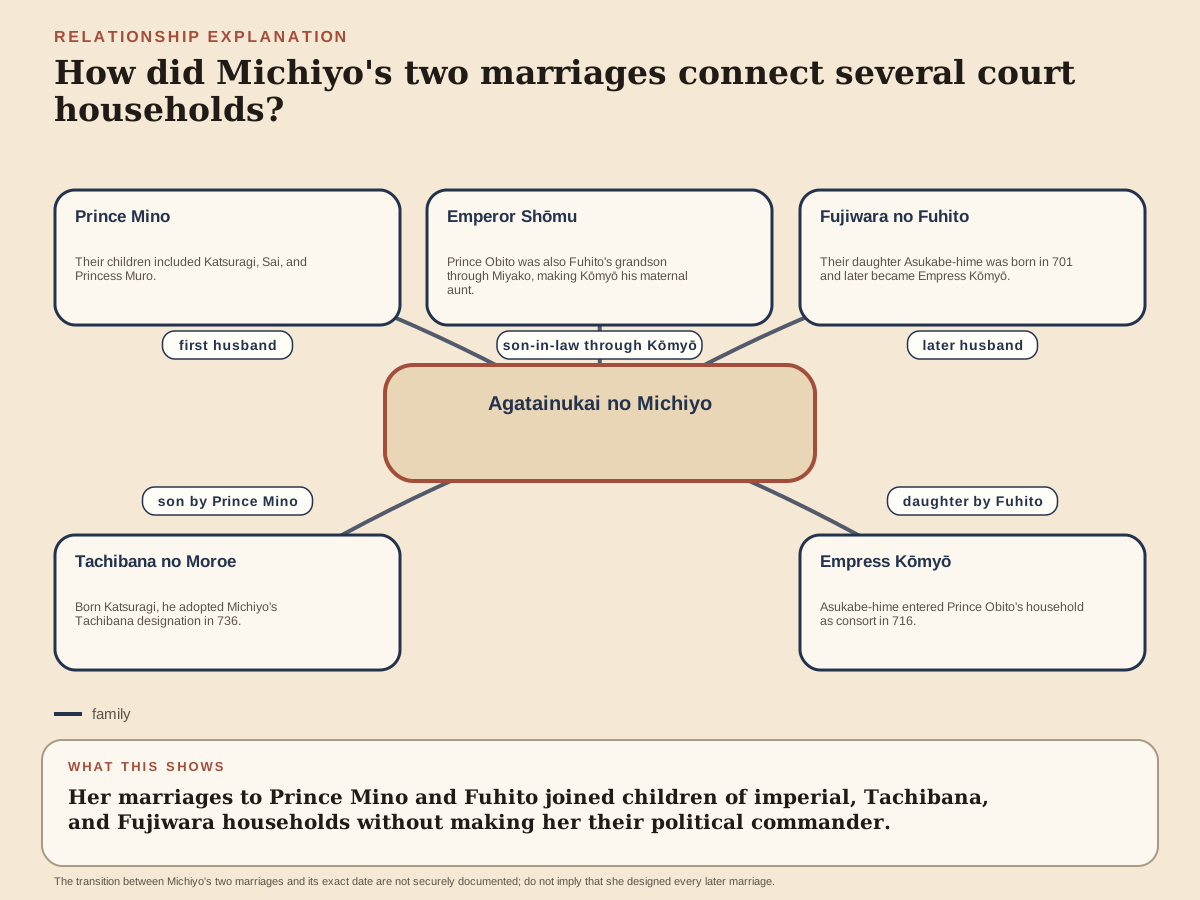
Michiyo subsequently married Fujiwara no Fuhito, a leading court official; the exact circumstances of leaving Prince Mino are not securely detailed. Their daughter Asukabe-hime, later Empress Kōmyō, was born in 701. Fuhito’s daughter Miyako, from another relationship, was already a consort of Emperor Monmu and bore Prince Obito that same year. In 716 Michiyo’s daughter became Obito’s consort. Michiyo’s children also linked different aristocratic households: Princess Muro married Fuhito’s son Fusasaki, while Tabino, a daughter of Michiyo and Fuhito, married her maternal half-brother Katsuragi. These ties joined imperial, Fujiwara and later Tachibana connections through the same mother, without proving that she personally directed every marriage. [1][3][4][5]
In 708 Empress Genmei rewarded Michiyo’s longstanding service with the Tachibana name. The received account connects the grant with a tachibana citrus floating in a ceremonial cup. The honor belonged to Michiyo personally; her children did not all automatically become members of a new Tachibana clan. Her own court standing continued to rise: in 717 she advanced to Junior Third Rank, and in 721 to Senior Third Rank. Ranks placed people within the court’s hierarchy and carried access to material support, but were distinct from specific jobs. The name and promotions recognized an individual career that extended across successive reigns, rather than status derived solely from Fuhito. [1][3][4][6]
Fuhito died in 720, ending Michiyo’s marriage but not every operation of his household. Historian Yoshie Akiko argues that she helped maintain its continuing administrative and economic functions. An imperial proclamation of 749 later praised her for preserving Fuhito’s house after his death. During retired Empress Genmei’s final illness in 721, Michiyo took Buddhist vows and prayed for her recovery. That year she also sponsored images of Maitreya’s Pure Land at Kōfuku-ji in memory of Fuhito. Maitreya is the future Buddha; his Pure Land is a Buddhist realm. Religious commitment accompanied continued household and court connections; it did not place Michiyo outside the political world she had served. [1][4][8]
In 727 Michiyo petitioned for Agatainukai no Ioyori, a relative, to receive the hereditary status title sukune in place of muraji. The successful request concerned the standing of a member of her birth clan. It shows her acting through court access on an interest not reducible to Fuhito’s former office. In 729 her daughter Kōmyō was appointed empress, an exceptional elevation of a consort of non-imperial birth. Prince Nagaya’s fatal political crisis occurred earlier that year, but the sequence does not securely establish Michiyo’s personal direction of his fall. Her influence is clearest where the record identifies an action, such as the petition, rather than where a later outcome invites an unrecorded motive. [4][3]
Michiyo died in 733; her age is unknown. Shōmu sent Prince Takayasu to supervise the funeral, and she received posthumous Junior First Rank. Kōmyō commissioned Kōfuku-ji’s West Golden Hall for her mother’s repose, completed in 734. In 736 Katsuragi and Sai obtained permission to leave the imperial register and adopt the Tachibana name. Later documents distinguish books associated with Michiyo’s West House from other household collections, but their interpretation and the precise division of her property remain debated. In 760 she received Senior First Rank and the honorific Great Lady. Her career ended with her death; its resources, remembered service and religious commitments continued through several descendants. [1][3][7][4]
Classic
Agatainukai no Michiyo entered palace service during Emperor Tenmu’s reign in the late seventh century. Her father was Agatainukai no Azumahito. The clan had links with the court, but she did not begin as the daughter of one of the families already dominating its highest offices. That distinction gives her later prominence a history of its own. She is identified as an inner court woman, or naimyōbu, a designation for women holding Fifth Rank or above. The term describes ranked status; it does not by itself establish the precise palace office she held at every stage. Her work developed close to sovereigns whose households needed continuing service as rulers changed. The individual woman’s familiarity and standing could therefore connect one reign with the next. [1][4][3]
Historical interpretation · Reconstructing the nursing relationship
Her first husband was Prince Mino, a member of the imperial family. Their children included Katsuragi, born in 684 and later called Tachibana no Moroe, Sai and Princess Muro. Katsuragi’s birth came a year after that of Prince Karu, the future Emperor Monmu. Biographies identify Michiyo as a nurse or caretaker to Karu and later to Prince Obito, the future Emperor Shōmu. Yoshie Akiko treats the nursing connection as a reconstruction from births, court service and subsequent trust, rather than a surviving detailed account of feeding or daily care.
The broader association with the imperial children is important even where its exact practical form is unclear. It placed family formation and service to the dynasty within the same part of her life. That relationship would remain relevant when she later married Fujiwara no Fuhito, a leading court official. [1][3][4][6][2]
A smaller and more contemporary record brings Michiyo into view in 701. A wooden slip excavated in the former Fujiwara capital records provisions for a woman named Michiyo, with her name written 道代 rather than the more familiar 三千代. The inscription is dated to the eleventh month of the first Taihō year, a traditional calendar date. Its damaged wording appears to record five cords being supplied; the reading of the item is tentative. The wood was subsequently reshaped and reused, and its later purpose is unknown. Nara’s National Research Institute for Cultural Properties identifies the recipient as Fuhito’s wife and the mother of the future Empress Kōmyō. The record gives her an administrative presence independent of a later family tree. It is a trace of supplies reaching a named person, not a complete account of all her property or palace duties. Such records make the ordinary material support behind a court life briefly visible. [5][4]
Historical disagreement · When did Michiyo remarry?
Michiyo’s marriage to Fuhito connected her palace service with a household advancing close to the center of government. He was the father of Miyako, a consort of Emperor Monmu, and would become Minister of the Right. Michiyo had previously been Prince Mino’s wife. The transition between those relationships is not described securely enough to reconstruct a private rupture or an exact wedding date. Later genealogical wording can imply that she remarried only after Mino died in 708, but this does not fit the chronology of her daughter Kōmyō’s birth in 701.
The common ground is the changed household and the children associated with each union. Michiyo’s daughter Asukabe-hime, the future Kōmyō, was born to Fuhito in the same year that Miyako bore Prince Obito. The two infants occupied different generations of the same expanding family network. [1][3][4][6][5][10]
Evidence boundary · Marriage ties and private negotiations
Obito was the son of Monmu and Miyako; Michiyo’s own daughter was Miyako’s half-sister. When Asukabe-hime became Obito’s consort in 716, the marriage therefore joined an imperial prince with his maternal aunt. The relationship carried court and household significance, not merely a change in the young woman’s domestic circumstances. Signed biographies credit Michiyo with helping the marriages that brought Miyako and Kōmyō into the imperial household. Her continuing service supplied a plausible practical basis for such influence.
Yet an account of family connections remains more secure than a detailed narrative of private negotiations. The marriage in 716 established a consort’s position; the appointment of Kōmyō as empress would come later. The later appointment would change the formal relationship between an aristocratic woman and the throne. [1][3][4][2]
Other marriages linked Michiyo’s children across the households around them. Princess Muro, her daughter by Mino, became the wife of Fuhito’s son Fusasaki. Tabino, a daughter of Michiyo and Fuhito, married Katsuragi, Michiyo’s son by Mino. Tabino and Katsuragi were thus maternal half-siblings, children of the same mother and different fathers. Their descendants would inherit connections through both parents. These unions help explain why the early Fujiwara and Tachibana were connected rather than simply two permanently opposed camps. The names that later organized clan histories can conceal how closely particular people’s interests and resources overlapped. For Michiyo, the relationships linked children from both marriages to the dynasty and to influential officials. The connections also depended on continuing service, recognized status and the resources maintained by these households. [3][4][1][2]
Empress Genmei’s reward in 708 made Michiyo’s longstanding service visible in a new name. The sovereign had succeeded Monmu, and Michiyo had already served through several changes of ruler. The received account locates the grant at the great accession thanksgiving rite, the Daijōsai. A tachibana citrus floating in a cup supplied the name by which she would also be remembered. The full designation Tachibana no Sukune combined the new name with a hereditary status title, sukune. An honored designation could recognize a particular person’s relationship with the ruler while also expressing her place within the aristocratic order. Here the reward acknowledged service already performed. The ceremony did not create her palace connections from nothing; it gave them an unusually durable public expression. [1][3][4]
Yoshie emphasizes that the grant was initially Michiyo’s personal honor. Her sons by Mino remained members of the imperial family, and her daughters were not simply renamed as members of a newly established Tachibana clan. In 736, after her death, Katsuragi and Sai would petition to adopt the designation and leave the imperial register. That later act created a new relationship between their descent, their status and their mother’s honored name. The reward of 708 had honored the mother; the request of 736 changed the sons’ formal status. Princess Muro, their sister, did not make the same change. The difference makes clear that children sharing a mother could occupy different formal positions within the political order. Their connections could remain strong without every person being enrolled in the same clan. A maternal name was therefore one resource available to descendants, rather than an automatic rule organizing the whole family. [4][1]
Michiyo’s rank recorded another aspect of her position. In 717 she advanced from Junior Fourth Rank, Upper Grade, to Junior Third Rank; in 721 she reached Senior Third Rank. Rank was a place in the court hierarchy, distinct from the duties attached to a particular office. High standing also mattered materially through support allocated to aristocratic households. Yoshie’s study follows both Michiyo’s own status and the people and revenue associated with her household. The evidence brings her into view as someone whose position required administration and resources. It does not establish the precise palace post she held throughout all these years. That combination of recognized service and material standing helps explain why her activities remained consequential after Fuhito died. The loss of a husband did not erase the woman’s own ranked career or every institution operating around her. The next stage of her life involved both that continuity and a significant religious response to another impending loss. [3][4][6][1]
Historical interpretation · Preserving Fuhito’s household
Fujiwara no Fuhito’s death in 720 removed one of the leading officials at court and changed the household shared with his wife, Agatainukai no Michiyo. He had held the office of Minister of the Right. The title of Grand Minister found in later references to his house was a posthumous honor, not an office he had occupied while alive. The distinction matters because the household’s continuing activities were more enduring than the deceased man’s last working appointment. Historian Yoshie Akiko follows records of people attached to the household and argues that Michiyo had a substantial role in maintaining it. The interpretation gains support from an imperial proclamation issued in 749. It praised her service to successive sovereigns and specifically remembered her care for Fuhito’s house after his death.
The praise is retrospective, but it supplies a stated basis for associating her with that continuity. It is stronger evidence than simply assuming that a famous official’s widow must have taken charge of everything he left. [1][4]
Historical disagreement · Vows during illness or after death?
Genmei’s final illness brought a different response in 721. She was now a retired sovereign; her daughter Genshō occupied the throne. The signed World Encyclopedia biography describes Michiyo taking Buddhist vows and praying for Genmei’s recovery.
Another compressed biography places her entry into religious life after Genmei’s death, but the fuller account locates it during the illness. Her vows were connected with a ruler whom she had long served. Religious commitment accompanied an existing relationship of service. Michiyo’s court rank, household responsibilities and family connections continued to matter afterward. Taking vows therefore did not mean that every secular relationship had been abandoned. Her religious life remained closely connected with the people and institutions of her earlier service. [1][4][2][3][8]
Kōfuku-ji provides another trace of her response to bereavement. The temple had been established at the new Heijō capital in association with Fuhito in 710. Its institutional history records Michiyo sponsoring images of Maitreya’s Pure Land, a Buddhist realm, in the Golden Hall in 721, for the first anniversary of his death. Maitreya is the Buddha expected in the future; the commission gave Buddhist form to remembrance. Genmei and Genshō also sponsored the North Round Hall for Fuhito’s repose. The activities placed a family’s loss within religious institutions supported by several members of the ruling circle. Michiyo appears as a patron in her own name, alongside sovereign patrons rather than disappearing into their acts. The commissions depended on material resources, makers and the continuing work of a temple. Her place in this activity connects devotion with household management and court relationships. Those relationships also remained available for action on behalf of her birth clan. [4][8][7]
Historical interpretation · Acting for the birth clan
In 727 Michiyo used her standing on behalf of Agatainukai no Ioyori, a relative from her birth clan. She petitioned for him to receive the title sukune rather than muraji, and the request was granted. These were hereditary status titles, or kabane, associated with a clan’s position in the court order. They were distinct from both an individual’s ranked grade and the duties of a government job. The action concerned a member of the clan into which Michiyo had been born. Yoshie reads the petition as evidence of her acting in a role resembling clan leadership.
That is an interpretation of a specific intervention, not proof that she held a formally defined office as head of every Agatainukai household. The practical point is nonetheless clear: she could bring a request about a relative’s standing before the ruler and obtain a change. The career that connected her with the Fujiwara and the dynasty had not made her original clan irrelevant. [4]
Evidence boundary · Influence and an unrecorded political plan
Kōmyō’s appointment as empress in 729 brought another major change within Michiyo’s family. Her daughter had entered Prince Obito’s household as a consort in 716. Obito had become Emperor Shōmu, and the later appointment placed Kōmyō in the office of empress. Unlike earlier holders, she was not herself a woman of imperial birth. Her new position strengthened the connection between an aristocratic household and the sovereign’s family. Michiyo’s service and the marriages associated with her had helped establish that connection. A compressed biographical tradition describes her as overcoming imperial relatives’ opposition to the appointment. The record of the outcome is firmer than a detailed account of how she personally secured it. The long sequence from service and marriage to elevation should therefore remain a history of changing positions, rather than a private plan known to have existed in full from the beginning. [3][4][1][2]
Nagaya’s fall makes the political setting of 729 unavoidable. The prince’s crisis ended in his death earlier in the year in which Kōmyō became empress. The events have often been read together as a struggle over the configuration of power near the throne.
Their sequence does not, however, provide a secure instruction from Michiyo ordering Nagaya’s removal. Her influence need not be enlarged by assigning her every action that benefited her family. The petition for Ioyori, her ranked service and the remembered preservation of Fuhito’s house provide more specific ways to follow her activity. Her daughter Muro’s marriage to Fusasaki also linked a Fujiwara branch with children from her earlier royal marriage. The relevant political world consisted of connected households, not simply a single clan acting with one unchanging intention. Michiyo’s contribution lay in relationships that carried both access and resources across these divisions. Their continuation after her death would depend on the people who inherited them, not on the permanent presence of the woman who had helped hold them together. [4][1]
Michiyo died in 733, with no secure birth date from which to calculate her age. Shōmu sent Prince Takayasu to oversee funeral arrangements, and the court accorded her honors appropriate to very high standing. She received posthumous Junior First Rank that year. Her daughter Kōmyō commissioned Kōfuku-ji’s West Golden Hall for her repose; it was completed in 734. A surviving fragment of the construction report records materials used in the undertaking. Nara National Museum identifies the project with the image-making office attached to the empress’s household. The document carries remembrance into the practical world of officials, materials and recorded quantities. It shows an institutional operation supporting memorial devotion, rather than only a later story of a daughter’s grief. [1][3][7]
The inheritance of Michiyo’s name followed a different route. In 736 Katsuragi and Sai asked to leave the imperial register and take her Tachibana designation. The request was accepted, and Katsuragi became Tachibana no Moroe. Their sister Muro did not undergo the same change. Property and religious collections also passed through daughters.
Historical disagreement · Who inherited Michiyo’s household resources?
A postscript dated to 740 on a Buddhist scripture distinguishes books of Michiyo’s West House from books marked with another household seal. Historian Yoshie Akiko interprets the Great House as Fuhito’s household and Kōmyō’s Inner House as a successor drawing on both parents’ resources. She also discusses Ogura Shigeji’s different identification of the Great House with Muro and his reading of Kōmyō’s mark as a claim to her mother’s inheritance.
These are competing interpretations of the document, not a settled account of rivalry between the sisters. They make the significance of maternal resources visible while leaving their exact allocation uncertain. [1][4]
The court continued to recognize Michiyo after her death. The proclamation of 749 remembered service extending into Shōmu’s own reign as well as her preservation of Fuhito’s house. In 760 she received Senior First Rank and the honorific Great Lady, or Dai Fujin. Neither honor made her a reigning empress or supplied a new lifetime office. Her children and descendants carried relationships, resources and religious commitments into later court politics. Some connections developed cooperatively, while later conflicts changed the arrangements formed during her life. The exact disposition of household revenue and service personnel after her death is not fully recoverable. What remains is a career with its own rank, interventions and material traces, alongside the marriages through which it is often remembered. Michiyo’s death removed the person whose service had connected these worlds; inheritance preserved parts of that work without preserving the whole arrangement unchanged. [3][4][7][5]