Read the article below. Interactive reading tools are available when scripts load.
Quick
In 764, Fujiwara no Nakamaro tried to mobilize military forces as his authority deteriorated against the retired Empress Kōken. He had helped place Emperor Junnin on the throne in 758 and held the court's highest ministerial office. Kōken, however, had claimed control of major affairs and now had officials and troops prepared to act for her.
The struggle began over orders and the instruments used to issue them. Kōken sent supporters to take station bells and seals from Junnin's establishment. Nakamaro's son tried to recover them and was killed. Nakamaro was stripped of office and status. He escaped with the Council of State's seal, while Kōken's government warned northern provinces not to obey documents issued under that stolen seal.
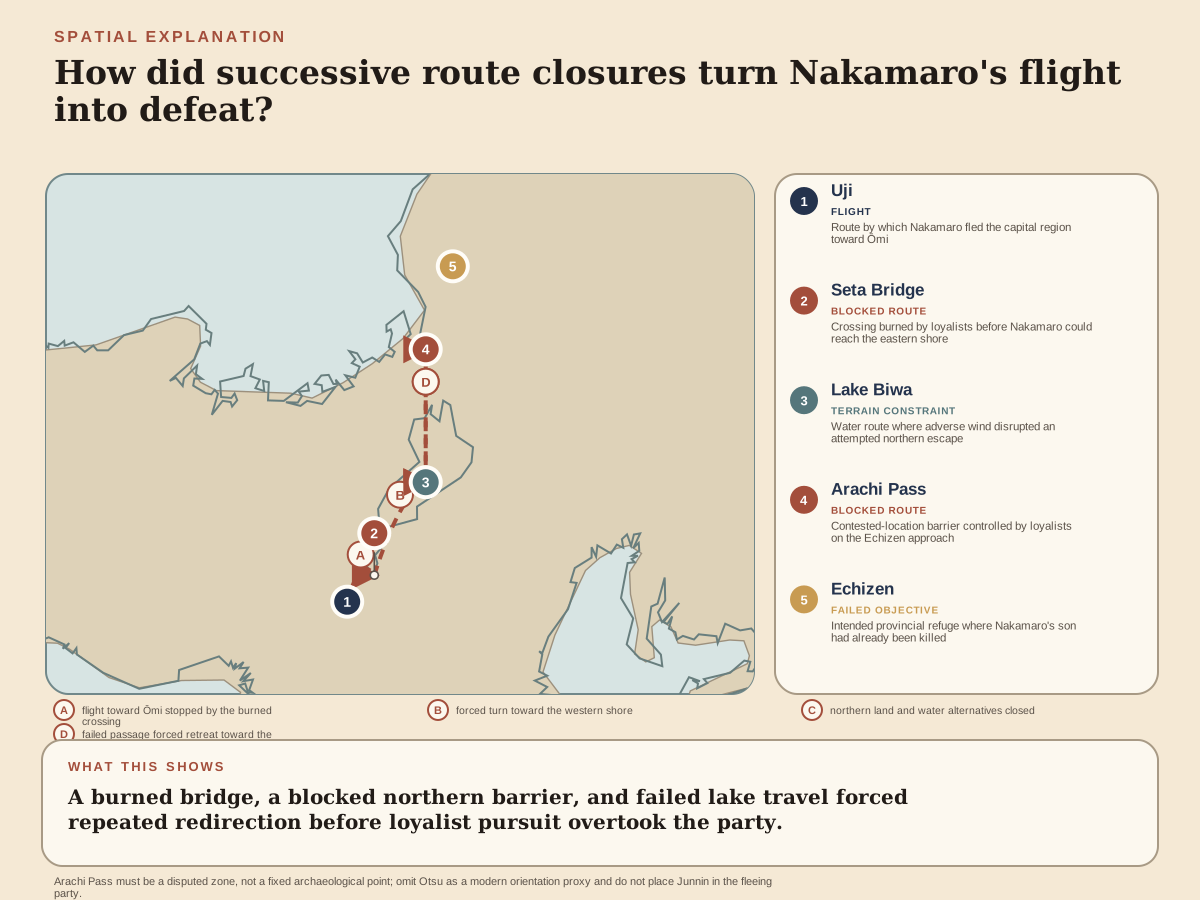
Nakamaro fled through Uji toward Ōmi, hoping to reach Echizen, where his son held the governorship. Loyalist troops took a different route and burned the Seta bridge ahead of him. He turned along the western shore of Lake Biwa. Other loyalists reached Echizen, killed his son, and closed his route through the Arachi barrier. Nakamaro backed Prince Shioyaki as a rival sovereign, but could not turn that claim into a secure northern base.
An attempted boat passage north was disrupted by wind; another overland attempt was blocked. Nakamaro's forces retreated south and fought near Miozaki in the Takashima area. Loyalist reinforcements helped break them. Nakamaro was captured while trying to flee by boat and killed with members of his family. The Shoku Nihongi records this course from the victors' perspective.
Junnin was deposed and sent to Awaji in the following month. Kōken returned to the throne as Shōtoku. The monk Dōkyō subsequently gained extraordinary rank under her patronage, but had not personally conducted every part of the campaign. Loyalists included other Fujiwara as well as officials from different families: Nakamaro's defeat was not the removal of the entire Fujiwara lineage.
Classic
Fujiwara no Nakamaro had risen through close ties to Empress Dowager Kōmyō and through his support for Prince Ōi, who became Emperor Junnin in 758. Nakamaro received the name Emi no Oshikatsu and in 760 became Taishi, the Tang-style name then used for the highest ministerial office. His authority included influence over appointments, the imperial household, and military administration.
Kōmyō died in 760. The retired Empress Kōken remained politically active and increasingly challenged the minister and Junnin. In 762 she claimed major matters and rewards and punishments for herself, leaving routine business to the reigning emperor. The monk Dōkyō, who had attended her illness, gained her confidence.
This division affected the officials expected to act on government commands. Provincial forces, station bells, seals, and documents could supply military authority only if people recognized the command behind them. Nakamaro's family connections in provincial offices offered possible support outside the capital, especially in Echizen.
In 764, Nakamaro obtained a military supervisory position and attempted to expand the forces available to him. Officials reported his moves to Kōken. The conflict therefore entered the military sphere through administrative preparations before it became a flight from the capital and a series of battles.
The two centers drew on different recognized relationships. Junnin occupied the throne, with Nakamaro directing much of its administration. Kōken invoked her earlier reign and the authority inherited within the royal household. Her 762 declaration claimed the division of business; it does not establish that everyone accepted a settled constitutional arrangement. An official could carry out an order from one center and subsequently face accusation by the other. Dōkyō's access to Kōken mattered within this struggle over appointments and commands, beyond their personal relationship.
The military preparations exposed that uncertainty. The Shoku Nihongi says Nakamaro enlarged the force covered by his supervisory appointment and sent instructions under the Council of State's seal. The senior recording official Takaoka no Hiramaro reported the action. The chronicle presents Nakamaro's intentions through a hostile account, but identifies the administrative step that alerted Kōken's side: an order had to pass through an official who would not keep the preparations secret.
Kōken ordered supporters to take station bells and seals from Junnin's establishment. These instruments mattered to official movement and the authorization of commands. Nakamaro's son Kunimaro attempted to recover them and was killed. Kōken stripped Nakamaro of his offices and privileges, turning a contest within government into a declared rebellion.
Nakamaro escaped carrying the Council of State's seal, a different instrument from the bells and seals already seized. Kōken's government told the northern provinces not to obey documents bearing that stolen seal. Possession of the object did not settle whose orders were binding. The officials receiving the documents now had an explicit counter-order.
He fled through Uji toward Ōmi. Loyalist commanders moved by the Tawara route and burned the Seta bridge before he reached it. That closed an important crossing toward the eastern side of Lake Biwa. Nakamaro turned to the western shore, aiming for Echizen, where his son was governor.
Loyalists reached Echizen ahead of him, killed his son, and blocked the Arachi barrier. Nakamaro advanced Prince Shioyaki as a rival sovereign. The dynastic claimant and the seal gave his side a way to frame its commands, but did not recover the lost access to a provincial base.
An attempt to travel north by boat failed in adverse wind. An overland approach was also blocked, forcing his troops back south toward Miozaki in the Takashima area. They fought the pursuing army there; reinforcements led by Fujiwara no Kurajimaro helped the loyalist side prevail. Officials such as Kibi no Makibi also supplied military counsel.
Nakamaro's forces broke. He tried to escape by boat but was captured and killed, together with his wife and other family members. These details come from the Shoku Nihongi and later court records. Their named routes and commands explain the defeat more specifically than a general claim that Kōken had greater influence.
Nakamaro's defeat ended his personal command of government and military resources. His rival sovereign, Prince Shioyaki, also died. The victors rewarded loyal officials and removed or punished members of the defeated grouping. The surviving record does not justify treating every member of their families as having shared the same role.
Emperor Junnin remained a separate problem after the battle. In the tenth month of 764 he was deposed and sent under guard to Awaji. Kōken returned to the throne as Shōtoku, combining the office of reigning sovereign with the authority she had exercised while retired.
The dispositions followed named connections rather than a purge of all Fujiwara. Nakamaro's elder brother Toyonari, who had earlier been removed from office, was restored as Minister of the Right. Kurajimaro had fought on Kōken's side. Family membership alone therefore did not determine allegiance.
The fighting also added to the hardships of years marked by drought and poor harvests. A post-conflict order remitted the year's rent, referring to famine and military mobilization. Such a measure acknowledged losses without recording an exact nationwide battle casualty total or proving that all burdens had been removed.
Punishment was selective even within Nakamaro's immediate household. The chronicle records that his sixth son Satsuo was spared execution, attributing the exception to his earlier Buddhist practice, and exiled to Oki. That explanation belongs to the victors' record. It gives one named disposition rather than grounds for assuming that every relative was executed, pardoned or judged in the same way.
The regime also reversed the office names introduced under Nakamaro. Its order to restore the former names followed the victory, making the removal of his administrative imprint a public act. Personnel, provincial offices and the Council of State continued to function. The reversal ended his control and altered the language of office without abolishing the institutions through which both factions had acted.
Junnin's exile continued beyond the settlement of 764. The Shoku Nihongi reports that he attempted to leave his enclosure on Awaji in 765, was intercepted by the provincial officials' troops, and died there the following day. It supplies no independently established medical cause. Deposition had left a former sovereign under guard, rather than creating a peaceful retirement comparable to Kōken's earlier position.
Shōtoku's victory gave her government room to make new appointments and sponsor religious works. Dōkyō was appointed Daijin Zenji after the fighting in 764, then became Daijō-daijin Zenji in 765 and Dharma King in 766. His exceptional rank belonged to the victorious sovereign's patronage; it did not make him the general responsible for every loyalist maneuver or the hereditary successor to her throne.
The contrast between the seized instruments and Nakamaro's stolen Council of State seal shows an administrative consequence of the struggle. Commands had to be recognized and conveyed by officials, not simply stamped. Counter-orders, provincial appointments, and control of crossings helped decide which claimant could make government institutions act.
Religious commemoration also followed the fighting. Shōtoku's million miniature pagodas, containing Buddhist sacred formulas, were completed and distributed to temples in 770. The project was a later material response to the rebellion, not equipment used to win it.
The succession question continued into the Usa Hachiman oracle affair of 769 and Shōtoku's death in 770. Those episodes had their own circumstances. Nakamaro's defeat had changed the ruling coalition in 764, while leaving the court, its provincial administration, and the need to determine a legitimate heir in place.
The first appointment was accompanied by Kōken's public explanation that taking Buddhist vows did not prevent her from governing and that a sovereign in that position could have an ordained minister. This was her justification for an exceptional appointment. It neither established unanimous acceptance at court nor made Dōkyō's later elevation and succession controversy already inevitable in 764.
Memory of the defeated sovereign changed on a much longer timescale. The designation “Junnin” was conferred posthumously in 1870. Earlier records identified him through deposition or Awaji, including the Shoku Nihongi's description as the deposed emperor. Using the familiar name helps identify him today, but must not conceal how the victorious court had reduced his standing. The later title belongs to a separate act of recognition more than a millennium after his reign.