Korea entered the twentieth century as an empire under Gojong, but Japanese military intervention reduced its freedom to act. During the Russo-Japanese War, Japanese troops secured positions on the peninsula. Russia’s recognition of Japanese predominance in the 1905 Portsmouth Treaty was made without Korean participation.
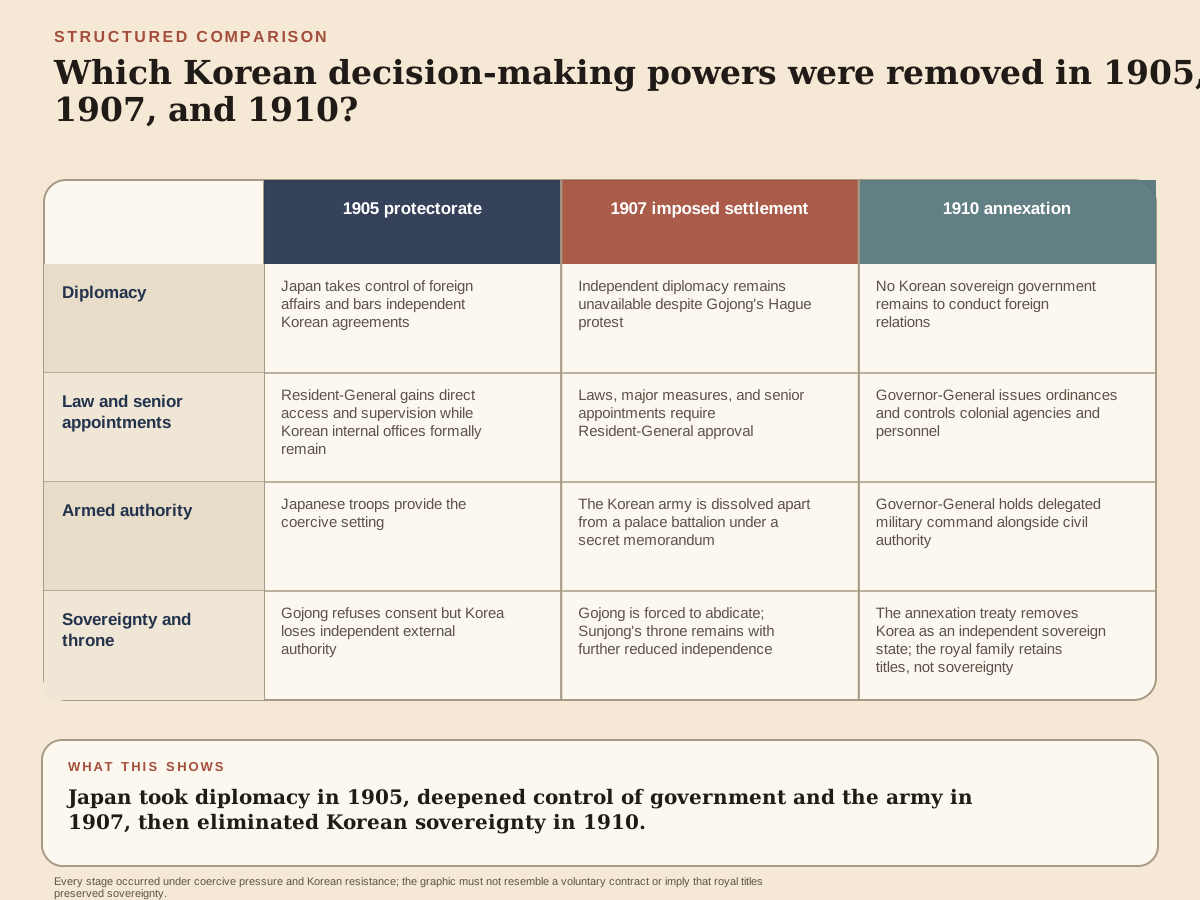
In November 1905, Itō Hirobumi pressed Korean ministers to accept a protectorate agreement under Japanese military pressure. Gojong refused consent. The agreement signed by Hayashi Gonsuke and Pak Che-sun placed foreign affairs under Japan and prohibited independent Korean international agreements. A Japanese Resident-General in Seoul gained direct access to the emperor.
Gojong attempted to challenge the protectorate by sending envoys to the Hague Peace Conference in 1907. They failed to secure a hearing. Japan used the mission to increase pressure on him, and he was forced to abdicate. His son Sunjong became emperor, leaving the throne in place while its independence diminished further.
The July 1907 agreement extended Japanese control into domestic government. Laws, major measures and senior appointments required the Resident-General’s approval. A secret memorandum specified Japanese posts in courts, prisons and ministries and the dissolution of the army apart from a palace battalion. Disbanded soldiers joined resistance as Japan expanded its means of repression.
Korean opposition used schools, associations and fund-raising as well as the remaining diplomatic channels. An Jung-geun took part in patriotic education after 1905, worked with an academic association and helped run two schools. In 1907 he joined the National Debt Repayment Movement, which sought to repay foreign debt through Korean contributions. After Gojong's abdication and the army's dissolution, he moved abroad and joined armed resistance. These activities connected education and financial independence with efforts to preserve a state whose powers Japan was progressively removing.
The move to formal annexation was a Cabinet decision, not simply the personal wish of one Resident-General. On July 6, 1909, Japan approved a policy to annex Korea at a suitable opportunity. Until then it would reinforce military and police presence and give Japanese officials broader control over Korean administration.
The same policy brought communications and settlement into imperial planning. Korean railway management was to be placed under Japan’s railway authorities and connected with the South Manchurian Railway. Japanese settlement was to be encouraged. These measures aimed to consolidate rule before the formal transfer of sovereignty.
Itō had resigned as Resident-General in June 1909. His assassination at Harbin in October therefore followed the adoption of annexation policy. Military operations against the Korean Righteous Armies and police consolidation restricted organized resistance; Koreans continued resisting through armed action and diplomatic protest despite those measures.
On June 3, 1910, the Japanese Cabinet settled the proposed governing framework after annexation. The Japanese Constitution would provisionally not apply to Korea. A Governor-General appointed by the emperor would exercise wide administrative authority. Separate colonial finances, initial Japanese subsidies and control of railways and communications were planned alongside the removal of Korean sovereignty.
Resident-General Terauchi Masatake and Korean prime minister Yi Wan-yong signed the annexation treaty on August 22. Article 1 purported to transfer the Korean emperor’s entire sovereignty permanently to Japan, and Article 2 accepted the annexation. The signers acted as representatives; Sunjong did not personally sign the instrument. The treaty’s claim of imperial approval did not establish free consent in the conditions of military domination.
The treaty was announced on August 29 and became effective under its publication clause. Annexation ended the protectorate form: Japan now claimed direct authority over the territory rather than supervision of a separate Korean government. The formal steps completed a takeover whose diplomatic, military and administrative components had developed over several years.
The man who shot Itō at Harbin on October 26, 1909 was An Jung-geun. He had commanded Korean resistance incursions in 1908. Russian military police arrested him at the station, and Japanese authorities subsequently tried him in the Kwantung jurisdiction. He argued that he had acted as an officer fighting for Korean independence. Executed on March 26, 1910, he left unfinished writings, including an argument for peace in East Asia. His act belonged to an existing struggle against Japanese control; the July Cabinet decision shows that it did not initiate annexation policy.
The Japanese imperial government authorized the transfer and published it through its official instruments. Cabinet ministers had fixed the annexation policy and governing framework; Terauchi carried it through in Seoul. The later imperial ordinance specified the governor's administrative powers and military command. These were distinct acts within the takeover, rather than a treaty negotiated privately by Emperor Meiji. The imperial sanction did not make the constraints surrounding the Korean court disappear.
Control of public discussion accompanied the final steps. Writing retrospectively in 1920, the journalist F. A. McKenzie described Korean newspaper suspensions and arrests before the announcement. His hostile account of Japanese rule is evidence of reported repression, rather than a record of every official's intention. A published treaty and proclamations consequently represented the authorities' completed decision in a setting where opponents' ability to organize or print objections was restricted.
For King Gojong and the Korean court, the war unfolded as a struggle fought on Korean territory while outside powers claimed the right to direct reform and military movement. His court’s constrained choices belong to the action chain rather than serving only as background to a Japan–Qing contest.
Born as Yi Myeong-bok in Seoul in 1852, Gojong belonged to a branch of the Yi house ruling Korea’s Joseon dynasty. His biological father, Yi Ha-eung, was not a reigning king. His mother came from the Yeoheung Min family. Selection after the childless Cheoljong’s death gave him a dynastic position beyond this household: he was recognized as continuing the line of Ikjong, the late husband of Dowager Queen Jo, through her decision. Birth and legally recognized royal succession performed different functions.
The treaty deprived Korea of an independent sovereign government. Sunjong and his family retained titles, honor and allowances, while other royal relatives and Koreans deemed meritorious could receive grants or peerages. Those benefits preserved privileged households under Japanese rule; they did not preserve Korean sovereignty or give the population a choice over annexation.
The Governor-General system converted the June policy into offices and powers. Imperial Ordinance 354, promulgated on September 30 and effective October 1, organized the Government-General into five departments. The initial Governor-General had to be an army or navy general, served directly under the emperor and held delegated military command for Korea’s defense.
His authority included ordinances, control of subordinate agencies and personnel decisions. The structure placed home affairs, finance, agriculture and commerce, and justice within colonial administration. Japanese constitutional institutions did not become an equal Korean representative government; the Cabinet had explicitly excluded Korea from the Constitution’s immediate application.
The administrative takeover used continuing offices and resources as well as new rules. Railways, communications and colonial revenue came under the Governor-General’s organization. The treaty allowed the recruitment of Koreans judged qualified and loyal as circumstances permitted. Such employment was conditional service within colonial government, not participation in choosing the sovereign authority.
The treaty's operation as a colonial instrument and the dispute over its legal validity have different histories. Japan defended the annexation as lawful under a treaty; Korean objections emphasized coercion and the absence of free sovereign consent. Normalization in 1965 did not produce a shared judgment about the original annexation. Article II of the Treaty on Basic Relations confirmed that agreements made on or before August 22, 1910 were already null and void. The Republic of Korea read that as invalidity from the outset, while Japan interpreted invalidity as following the Republic's establishment in 1948. The wording permitted normalization while leaving that disagreement unresolved. The fact that Japan governed Korea after 1910 therefore cannot by itself settle the validity of the agreement used to claim sovereignty.
Annexation made coercive controls instruments of direct colonial rule. Military police and ordinary police were consolidated, and armed resistance faced suppression. Korea’s rulers could no longer pursue diplomacy independently, while opposition had to operate under authorities whose military and administrative powers were joined.
The land survey of 1910–18 extended administration into individual properties. Officials collected ownership documents and claim forms, classified and valued parcels, investigated disputes and produced maps and tax registers. This strengthened revenue collection and made official recognition consequential for landholding. The process did not mean that every cultivator lost a farm in the same way.
The March First Movement of 1919 demonstrated the survival of Korean demands for independence. The regime later changed its policing arrangements and allowed a civilian to be eligible for the governor’s office. Those changes adjusted colonial administration after widespread resistance; they did not restore a Korean sovereign state.
Japanese rule continued until 1945, when Japan’s defeat ended the colonial regime. Its origin lay in military pressure, the removal of diplomatic and governing powers, a Cabinet annexation policy and a treaty imposed within that unequal setting. Korean protest and resistance remained part of the process; the transfer asserted by Japan’s legal instruments did not represent an agreed national decision by Koreans.
For Koreans, losing diplomatic representation was followed by decisions about courts, schools, taxes and policing being made within the Government-General. Land registration changed which records officials accepted when recognizing property; schools and newspapers were also fields in which national organization could be pursued or restricted. The earlier education and debt-repayment campaigns, the Hague appeal and armed resistance show different attempts to defend independence. The March First Movement later brought that demand into public demonstrations on a much larger scale. These forms of action had different participants and means, even when colonial authorities treated them as challenges to their rule.
Royal allowances, peerages and conditional recruitment of Korean officials gave some people places within the new order. They did not amount to a public choice to surrender sovereignty. Responsibility for imposing and maintaining that order likewise extended beyond the two treaty signers: ministers set policy, imperial instruments authorized authority, and governors, military officers and police exercised it. Korea's incorporation into an empire that already held Taiwan and a Manchurian leasehold put a former sovereign state under this separate colonial hierarchy. Its inhabitants continued to contest the consequences long after the announcement of annexation.