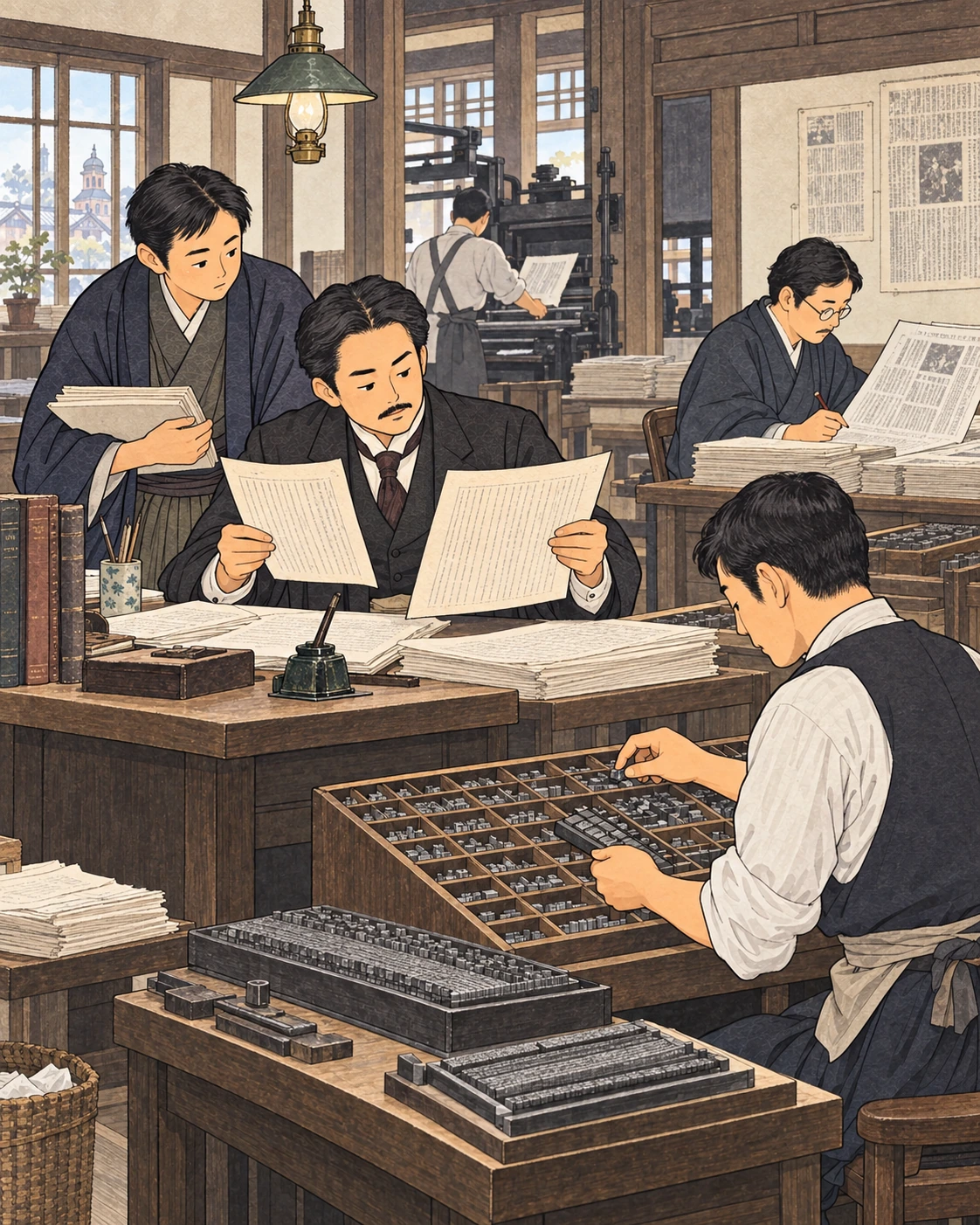
Masaoka Shiki began publishing his arguments about haiku in Nippon in June 1892. He joined the newspaper’s staff that December, then left university in March 1893. Paid newspaper work and a recurring place in print gave his literary criticism a wider venue than a private poetry circle.
Masaoka Shiki was born in Matsuyama, on the island of Shikoku, on 14 October 1867 by the Gregorian calendar. His personal name was Tsunenori. His father served in the lower samurai ranks of Matsuyama domain, a lord’s territory under the Tokugawa government. That world changed during his childhood. The Meiji government abolished the domains in 1871, and hereditary samurai status ceased to guarantee a stipend or an occupation. His mother and, later, his sister Ritsu sustained the household in which he studied and wrote.
His father died in 1872, leaving Tsunenori to inherit the household while still a child. His mother, Yae, was the daughter of the Confucian scholar Ōhara Kanzan. Study with his grandfather gave him access to Chinese texts and composition. Matsuyama’s schools and friends supplied further opportunities. Tokyo would later widen his audience, but his literary education had begun in the provincial city where his family lived.
As a child he studied Chinese texts with Ōhara Kanzan; after his grandfather’s death, a local teacher continued his instruction. Shiki began composing Chinese poetry and circulating writing among friends. He entered Matsuyama Middle School in 1880. Classical composition and the new school system belonged to the same youth, rather than to separate lives divided by the Restoration.
He left for Tokyo in 1883, carrying preparation acquired in Matsuyama. Advanced schools and publishers were concentrated in the capital, while letters and friendships kept him connected to home. The move offered an ambitious student a larger setting in which to test his writing; it did not erase the region that had trained him.
In 1894 he became responsible for editing Shō Nippon, a related newspaper. Selection, arrangement and publication now accompanied his own writing. The newspaper medium allowed a literary argument to continue through successive installments rather than depend on a single treatise.
His 1898 Uta Yomi ni Atauru Sho, or Letters to a Tanka Poet, attacked uncritical reverence for Ki no Tsurayuki and the Kokinshū anthology. He contrasted inherited formulas with poems from the Man’yōshū and by Minamoto no Sanetomo, examining rhythm, imagery and individual wording. He also urged comparison with haiku, Chinese verse and Western poetry instead of assuming that tanka necessarily surpassed other forms.
The letters answered objections by discussing particular poems. In their final discussion of diction, Shiki argued that familiar words could convey a perceived scene more clearly than conventional poetic synonyms. His reform was therefore worked out through examples and disputable judgments in public print. The judgments were his critical positions, not proof that an entire earlier poetic tradition had been objectively worthless.
In Tokyo Shiki studied at Kyōritsu School, then entered the university preparatory school in 1884 and the Imperial University’s College of Letters in 1890. These schools brought him into contact with students who shared his literary interests, including Natsume Sōseki. He did not finish a university degree. Newspaper writing increasingly claimed his attention, and he formally withdrew in 1893 after joining Nippon the previous December.
Newspapers offered a public different from the university classroom. Their recurring columns brought literary judgments into the same daily print as political affairs. Shiki and Sōseki were still students testing their abilities, not the paired monuments of later literary history. Writing increasingly became a possible occupation, though maintaining a life in Tokyo still required support from the relationships through which they had arrived.
A postcard from Sōseki in June 1892 urged him to seek permission for another examination opportunity. Shiki did not take the supplementary examination and failed the year’s assessment. He later recalled in A Drop of Ink that preparing for examinations made haiku arise so insistently that study was neglected. The later recollection gives the episode a literary voice; the postcard shows a friend trying to keep the student’s options open.
Shiki encountered baseball while studying in Tokyo and became an enthusiastic player. The game had reached Japan through earlier teachers and students. Its novelty brought him into a practice learned through rules and repeated play. He also used his familiar childhood name Noboru in a written pun on ‘base ball.’ That personal usage belongs to his literary aliases, rather than explaining the origin of the sport’s modern Japanese name.
In 1889 he took a bat and ball back to Matsuyama and taught students there. The equipment made his enthusiasm shareable in a particular place. Playing gave the young writer companionship and bodily experience that would later contrast with confinement. At the time it was an active interest alongside study and composition, not merely a scene of future loss.
In 1896 he explained baseball’s rules and equipment in Shōra Gyokueki, a series in Nippon. Readers could encounter the game beyond the students who played it. He also made baseball a subject for short verse, giving a new imported pastime a place in established forms of composition. Playing, explanation and poetry were distinct ways in which his enthusiasm reached other people.
Shiki made close observation and critical selection practical tools for modern haiku and tanka. A poem joining a persimmon to the sound of Hōryū-ji’s bell shows ordinary experience entering a named historical place. His newspaper essays and teaching gave writers ways to test such particulars against inherited poetic formulas, rather than treating revered models as beyond judgment.
Illness confined him physically while print and visitors enlarged his reach. Pupils developed his methods into competing schools rather than one fixed doctrine, and later institutions made him a founder of modern short verse. His significance lies in the arguments and networks he set in motion, not in a final judgment that earlier poetry had failed.
A serious episode of coughing blood in 1889 became associated with his adoption of the name Shiki. The name refers to the lesser cuckoo, whose cry was linked with blood in Chinese and Japanese literary tradition. He gave frightening bodily experience a form familiar to educated readers. Lung disease and later spinal tuberculosis increasingly restricted his movement, while his mother and Ritsu helped sustain daily life and writing.