Skip to content
Chronicle

Search History Omakase

Start typing to search.

    Illustration for Seiwa Delegates Government to Fujiwara no Yoshifusa

    866 | Heian period

    Seiwa Delegates Government to Fujiwara no Yoshifusa

    清和天皇と藤原良房の摂政政治

    Choose a reading depth

    Overview

    Yoshifusa had guided Emperor Seiwa since the child sovereign's accession in 858 and held the highest ministerial rank. Seiwa completed his coming-of-age ceremony in 864. The explicit authorization of 866 therefore marked a new delegation to a subject serving an emperor no longer treated simply as a child.

    The decision came amid crisis. The palace's Ōten Gate burned, accusations spread among senior officials, and the inquiry eventually destroyed the position of Tomo no Yoshio. Later narratives supplied a dramatic arson plot, but the contemporary record does not securely preserve every step of that familiar story.

    The authorization became an important precedent for government by a maternal relative of the emperor. It did not create the fully hereditary regency system in one day, and the common description of Yoshifusa as the first non-royal regent depends on how the office and its beginning are defined.

    Read Seiwa Delegates Government to Fujiwara no Yoshifusa

    Read the article below. Interactive reading tools are available when scripts load.

    Quick

    Seiwa Delegates Government to Fujiwara no Yoshifusa

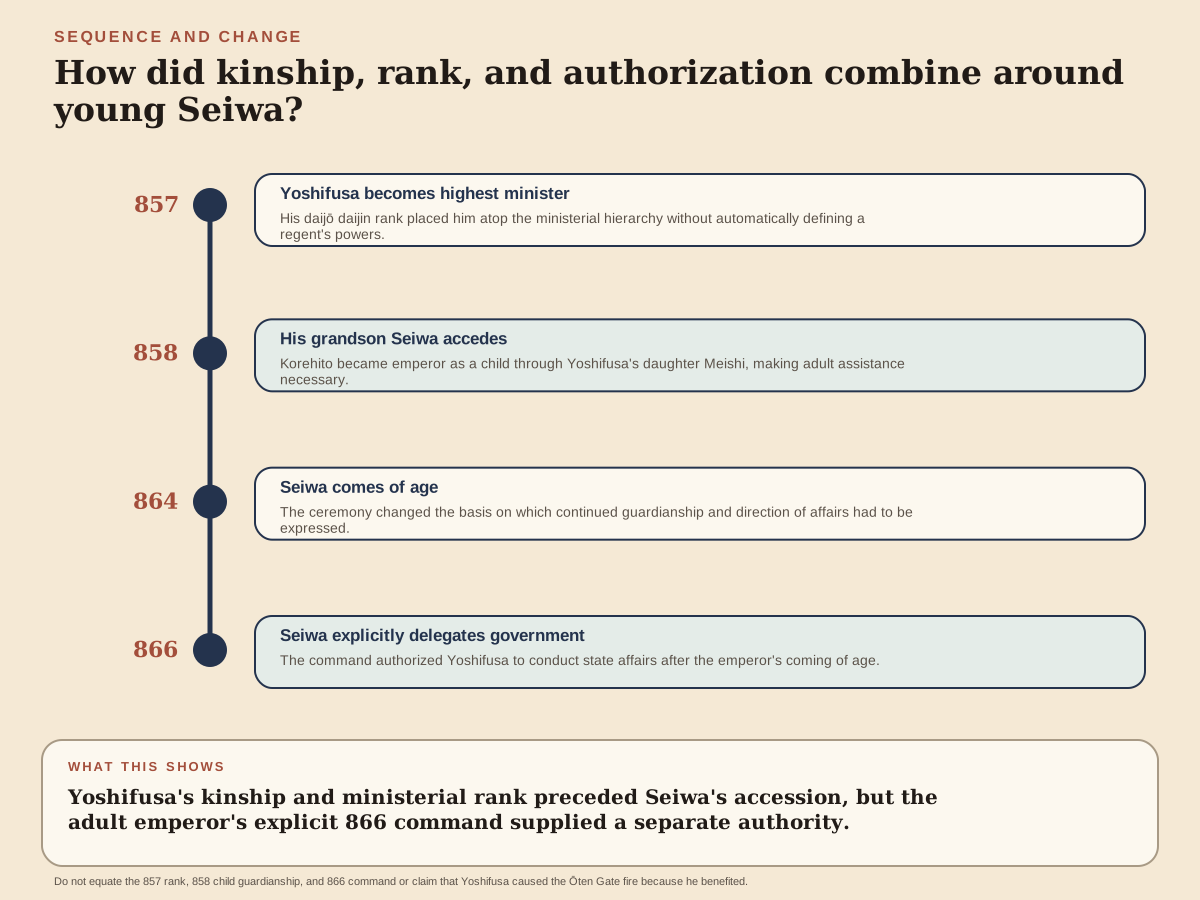
    Seiwa came to the throne in 858 as a child. Yoshifusa was his maternal grandfather, already daijō daijin, the highest minister, and the leading adult of the maternal household. These positions allowed him to guide government. They did not settle the later legal language of regency: guardianship at accession and an explicit authorization to conduct government are different kinds of evidence.

    Seiwa underwent his coming-of-age ceremony in 864. When an imperial command in 866 authorized Yoshifusa to conduct the affairs of government, it could not be explained only as the practical care of an infant ruler. The delegation established how a senior subject might exercise governing authority beside a sovereign who had crossed a recognized threshold of adulthood.

    The Ōten Gate burned in 866. Conflict followed among senior courtiers, including an accusation against Minamoto no Makoto and a later report against Tomo no Yoshio. Questioning and punishment removed Yoshio. The twelfth-century Ban Dainagon Emaki turned the affair into a vivid sequence of fire, accusation and exposure, but that artwork is a later narrative rather than an eyewitness record.

    Within the crisis, Seiwa directed Yoshifusa to handle the affairs of the realm. Some accounts treat Yoshifusa's effective regency as beginning in 858 and the 866 command as confirmation; other interpretations give the explicit command greater weight. Both dates belong in the story. The event uses 866 because that is where the surviving delegation is clearest.

    Yoshifusa's adopted heir Mototsune advanced after the affair and later received authorizations of his own. That continuity made the 866 arrangement a precedent for Fujiwara government through maternal connection and delegated authority. Yet each later settlement still involved an emperor, offices and a new command. A powerful household had found a durable route to government, not acquired an unchanging private title to rule.

    Classic

    Kinship, rank and the young Seiwa

    Yoshifusa's route to 866 began with office and marriage across two generations. His sister Junshi was mother of Emperor Montoku, and his daughter Meishi was Montoku's consort and mother of Prince Korehito. When Korehito became Emperor Seiwa in 858, Yoshifusa stood beside him as maternal grandfather and highest minister.

    Yoshifusa had become daijō daijin in 857. The rank placed a subject at the top of the ministerial hierarchy, but it was not a modern executive office with a fixed list of powers. Guardianship, ministerial rank and permission to conduct government overlapped without being identical.

    Seiwa's accession as a child made adult assistance necessary. By 864, however, he had undergone his coming-of-age ceremony. The relationship between sovereign and guardian now required a new political expression if Yoshifusa was to continue handling state affairs with explicit authority.

    The Ōten Gate crisis and an imperial command

    The Ōten Gate burned in 866. A palace fire was a material disaster and a political event: it damaged a ceremonial threshold, demanded ritual response and created a setting in which accusations among senior officials became dangerous. The court ordered religious observances while also confronting claims against Minamoto no Makoto and, later, Tomo no Yoshio.

    Later sources tell a polished arson story in which Yoshio accused Makoto and Yoshifusa intervened. The contemporary sequence is less complete. It supports intervention around the threat to Makoto, a later report against Yoshio, questioning and punishment. It does not securely supply every private conversation or prove that Yoshifusa designed the crisis.

    Within this unsettled court, Seiwa explicitly authorized Yoshifusa to conduct the affairs of government. The wording later became associated with sesshō, or regency. It was a grant of action by the sovereign, not merely a new rank automatically attached to Yoshifusa's household.

    The decision can be read in two time frames. Yoshifusa had already guided the government since Seiwa's child accession in 858. The 866 command either confirmed and reformulated that arrangement or marked a further delegation after the emperor came of age. The evidence supports the distinction more firmly than one uncontested start date.

    Yoshifusa governs with express authority

    The authorization strengthened Yoshifusa's ability to act at the center of government. Yoshio's punishment removed a senior rival, while the emperor's command supplied a public basis for Yoshifusa's continuing direction of affairs. Benefit does not prove that he secretly caused the fire or fabricated every accusation.

    Yoshifusa's adopted nephew Mototsune advanced in office after the affair. Adoption prepared household succession; promotion gave the heir a place within government. Neither step transferred every authority automatically. Mototsune later required political settlements and authorizations suited to different emperors.

    Yoshifusa continued to serve until his death in 872 and participated in official historical compilation. He left a powerful household and a remembered precedent. Seiwa remained the sovereign who granted authority and later abdicated in 876; delegation did not erase imperial action.

    A precedent for regency, with definitions attached

    The 866 command became a key precedent for Fujiwara rule beside the emperor. Maternal kinship could place a minister close to a young ruler, while office and explicit authorization converted proximity into governmental action. Later households repeated and enlarged this combination.

    Calling Yoshifusa the first non-royal regent is convenient but definition-dependent. Some narratives date his regency to Seiwa's accession in 858; others emphasize the express command of 866, and later terminology was not yet fixed in exactly the form familiar from subsequent centuries. The Event title therefore states the documented delegation rather than claiming a universally agreed first.

    The Ōten Gate affair also acquired a separate afterlife. The twelfth-century Ban Dainagon Emaki made fire, accusation and exposure visible through narrative painting. That work preserves how a later court imagined the crisis, while source criticism keeps its scenes separate from the ninth-century administrative record.

    Sources and notes

    1. 藤原良房 · Mezaki Tokue and Satō Sōjun, signed reference entries
    2. 承和の変と応天門の変:平安初期の王権形成 · Kamiya Masayoshi
    3. Fujiwara no Yoshifusa (804–872) · Iwao Seiichi and the Dictionnaire historique du Japon editorial team
    4. 伴大納言絵巻 · Idemitsu Museum of Arts
    5. 清和天皇 · Mezaki Tokue and Morita Tei, signed World Encyclopedia and Nipponica entries

    About these sources

    Reading preferences

    Text size
    Glossary intensity

    Choose how much explanation appears as you read.

    Saved on this device. All terms remain available in the glossary.

    Browse the glossary →
    History Omakase

    Opening reading…