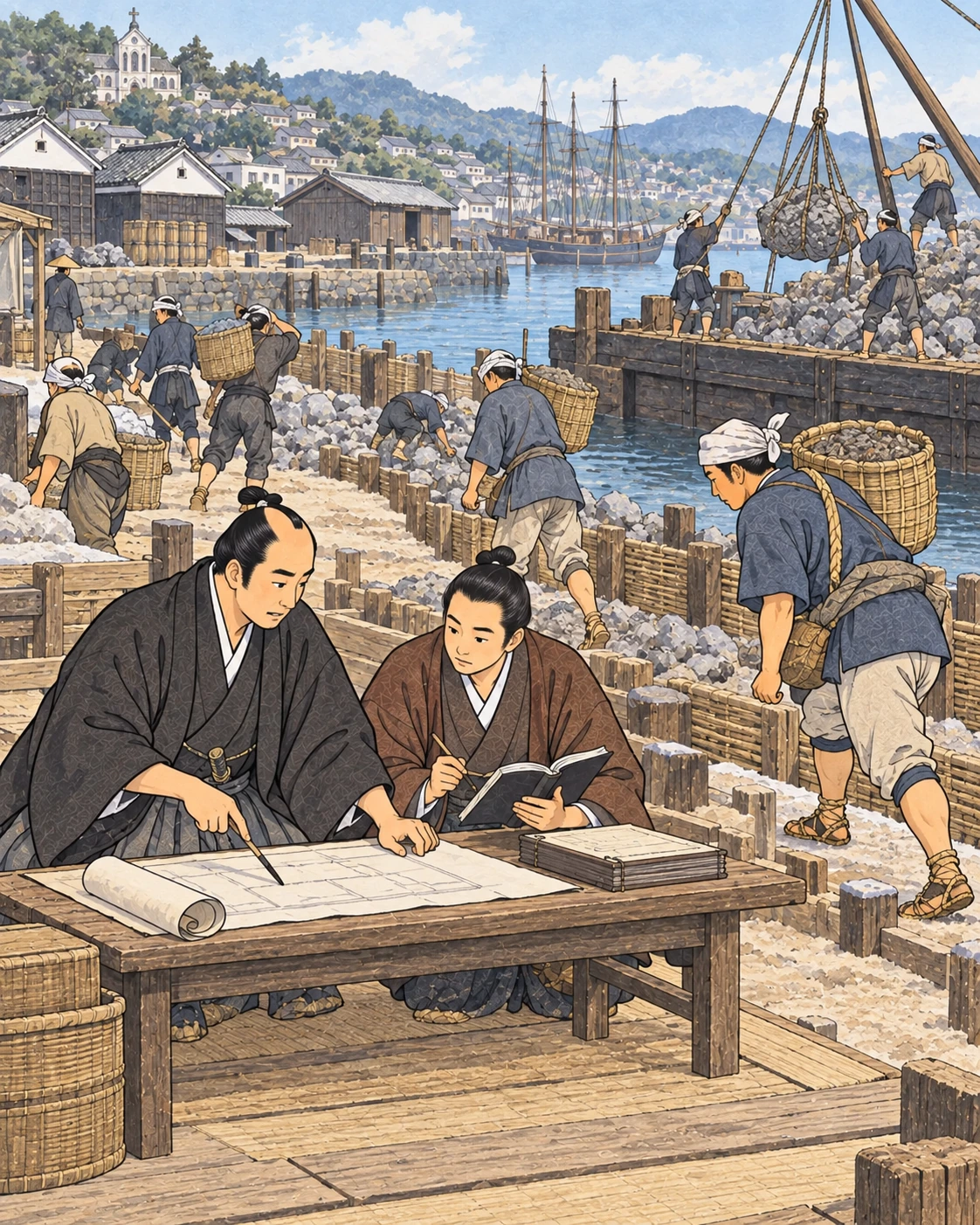
Nagasaki opened to treaty commerce in 1859, after the previous year’s agreements. The port already had Japanese, Chinese and Dutch trading connections. The new framework added foreign merchants’ residence, direct commercial transactions and consular legal arrangements, rather than creating trade at an empty waterfront.
Thomas Blake Glover was born in 1838 in Fraserburgh, a fishing port in northeastern Scotland. His father worked in the coastguard. The family later moved toward Aberdeen, where Glover attended school before leaving Britain for East Asia in the later 1850s. The ports around him belonged to a widening commercial world: Scottish ships and manufactured goods traveled far beyond the North Sea, and established trading houses offered young employees routes into Asian business.
Britain's industrial economy supplied the ships and manufactured goods carried through these networks. Empire shaped access to their destinations: naval coercion and unequal treaties opened markets on terms favorable to British subjects. Glover entered this world as a young employee, not as a representative empowered to make British foreign policy.
Before reaching Japan, Glover worked within British commerce in East Asia and passed through Shanghai. Jardine, Matheson & Co., a major British trading house, connected Asian ports with overseas markets and suppliers. Its agents had to arrange transactions across distance: a cargo might be sold in one port while payment, shipping and insurance depended on correspondents elsewhere. This was the network through which Glover gained his first Japanese assignment.
An agent depended on correspondents to arrange shipment and payment. Interpreters and local brokers made unfamiliar customers and regulations intelligible, while letters took time to arrive. Treaty privileges offered protection without guaranteeing that a cargo would sell or a customer would pay. In 1859 an assignment at Nagasaki brought Glover closer to Japanese buyers seeking foreign equipment. He still answered to the trading relationships that had given him his opening.
Providing residence and warehouses required land. Magistrate Okabe Nagatsune pursued reclamation along Ōura. When the trade office’s funds proved insufficient, he sought private contractors, with repayment planned through rents from foreign residents. Work proceeded in stages, involving contractors such as Kitano Oribe and Ozone Rokuzāemon. The settlement consequently took shape over several years.
Glover arrived on September 19, 1859. He assisted Kenneth Ross Mackenzie, an agent of Jardine, Matheson, and took over the local work when Mackenzie left for business in China. His early position was therefore a transferred commercial responsibility within the changing port. Later arms and ship sales grew from that business environment, rather than constituting the whole meaning of Nagasaki’s opening.
Nagasaki had long mediated foreign exchange through regulated Dutch and Chinese connections. Glover arrived from Shanghai on 19 September 1859, aged twenty-one, according to Glover Garden's chronology. He initially assisted Kenneth Ross Mackenzie, Jardine, Matheson's agent in the port. When Mackenzie left for expanding business in China, Glover assumed the agency's responsibilities. He inherited work and contacts rather than starting on an empty waterfront.
The new treaties changed residence and jurisdiction. Foreign merchants occupied a designated settlement and obtained protections under consular law. Their warehouses and homes nevertheless depended on Japanese construction and local supplies. Interpreters remained important as English-speaking business expanded alongside Nagasaki's older commercial communities.
Japanese domains—territories governed by hereditary lords under the Tokugawa shogunate, Japan's warrior government—sent agents to procure foreign equipment. They came with their own military and commercial purposes. Glover needed these customers, but a procurement agent also needed to compare prices, arrange finance and find equipment that the domain could operate.
Chinese merchants continued to participate in trade, and exported goods reached the harbor through Japanese growers and local dealers. Glover's agency had to establish relationships within the city while maintaining connections with principals abroad. Mackenzie's departure gave him a larger responsibility; it did not remove his dependence on the port's existing people and institutions.
Glover began trading independently in Nagasaki in the early 1860s. Kirin's historical account gives 1861 for the founding of Glover & Co.; Glover Garden gives 1862. These are different published chronologies, and the difference has not been established as two separate stages of incorporation. His firm exported tea and silk-related goods while importing ordinary merchandise, weapons and second-hand steamships.
Thomas Glover was an important commercial intermediary in arms, ships, mining and industrial ventures during Japan’s treaty-port transition. His connections could link foreign equipment and credit with domains, officials, students and Japanese entrepreneurs who were seeking technical capacity outside existing channels.
The failure of his own firm shows that influence did not require permanent ownership. Mitsubishi and other successors used people and knowledge developed around earlier ventures, while Japanese partners and workers made the enterprises function. Glover’s significance is therefore brokerage and transfer, not the legend of a foreign man single-handedly modernizing Japan.
A concrete purchase places that business in view. A 2018 article by Mint Museum curator Sawazaki Hitomi recounts that Glover and Godai Tomoatsu, a Satsuma domain official, traveled to Shanghai in 1862 and bought a steamship. Godai was seeking overseas equipment for a Japanese domain; Glover helped connect that demand with foreign supply.
Expensive vessels required more than a buyer willing to sign. Their condition mattered, and crews needed fuel and repairs after delivery. Credit could make a purchase possible before the customer had paid in full, leaving the merchant exposed if payment was delayed. Ordinary export trade and exceptional military purchases therefore sat within the same firm's finances.