

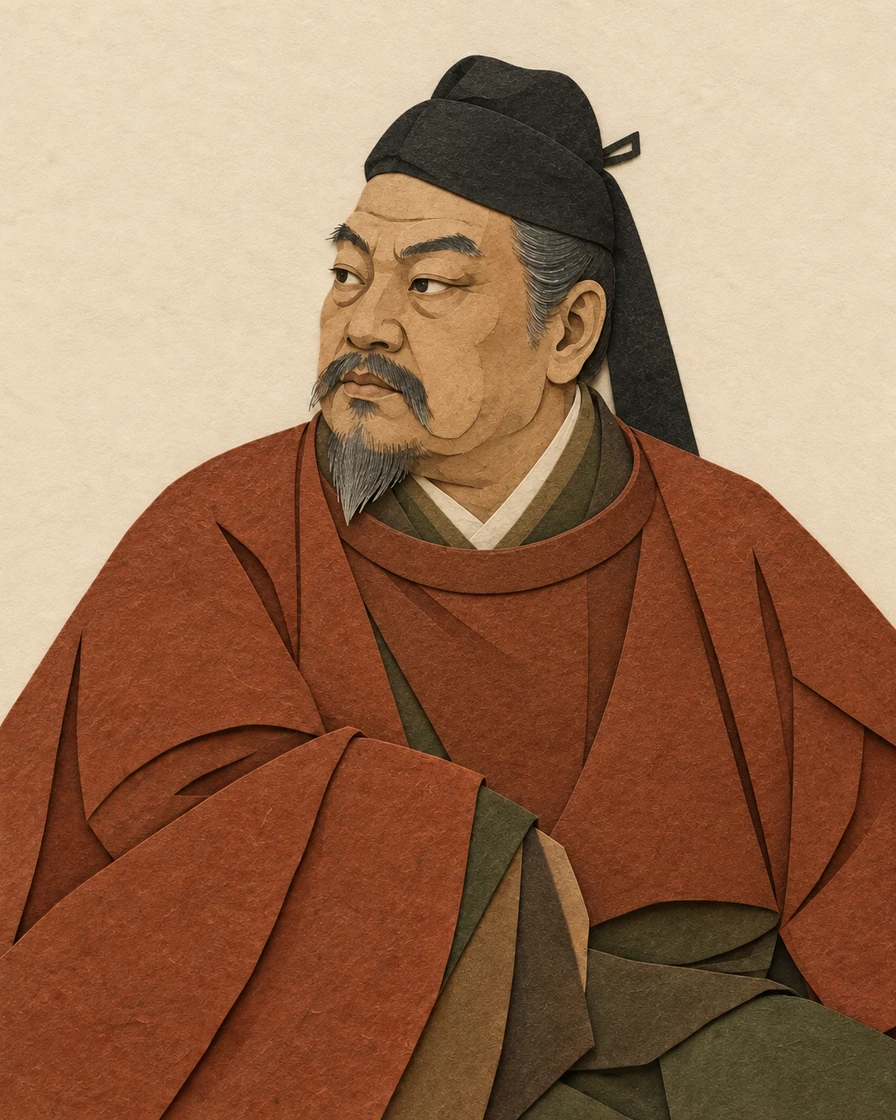
Asuka period
Soga no Iname
蘇我稲目
Overview
Soga no Iname was a leading minister at the sixth-century Yamato court, in the region of present-day Nara. The Nihon shoki, a royal chronicle completed in 720, names him as ōomi, a senior minister, under Emperor Kinmei. Two of his daughters became Kinmei's consorts; their children included the later rulers Yōmei, Suiko and Sushun. Iname's family therefore belonged within the royal succession as well as the government. [S01]
The chronicle credits Iname with supporting the worship of a Buddhist image sent by King Seong of Baekje, a Korean kingdom. Kinmei permitted him to try the new worship, and Iname established a temple in one of his residences. After an epidemic, opponents persuaded the ruler to have the image discarded and the temple burned. This account is placed in 552; other traditions date the royal transmission to 538. Its speeches and explanations of divine anger are later narration. [S01, S02]
Iname also appears in the chronicle's account of administration: in 553, he commissioned the recording of a shipping tax under royal orders. He died in 570. His son, Soga no Umako, held the senior ministry under the next ruler, Bidatsu. Religious patronage, official service and royal kinship supplied connected resources for the family's continuing influence. [S01, S03]
Sources and notes ViewHide
- [1]
日本書紀 Book XIX / William George Aston, trans., Nihongi: Chronicles of Japan from the Earliest Times to A.D. 697. London: Kegan Paul, Trench, Trübner & Co., 1896.Nihon shoki compilers; translation William George Aston
- [2]
万葉百科:仏教伝来Nara Prefectural Man'yo Culture Hall
- [3]
日本書紀 Book XX / William George Aston, trans., Nihongi: Chronicles of Japan from the Earliest Times to A.D. 697. London: Kegan Paul, Trench, Trübner & Co., 1896.Nihon shoki compilers; translation William George Aston
This account is placed in 552; other traditions date the royal transmission
Iname also appears in the chronicle's account of administration: in 553, he
The Nihon shoki, a royal chronicle completed in 720, names him as
Connections
Places
No linked places yet.
Events
No linked events yet.
Relationships
Topics
No related topics yet.