

Nara period
Prince Shiki
志貴皇子
Overview
Prince Shiki was a son of Emperor Tenji and Koshi no Michi no Kimi Iratsume. He lived through the change from Tenji's Ōmi court to the government of Tenmu and Jitō. In 679, he was one of six princes who took a pledge at Yoshino in the royal chronicle's account. In 689, Jitō appointed him to the office for selecting exemplary sayings. His later duties included responsibility for Jitō's cremation arrangements and attendance at Monmu's mortuary palace. These were royal and ceremonial responsibilities, rather than a reign of his own. [S01, S02, S03]
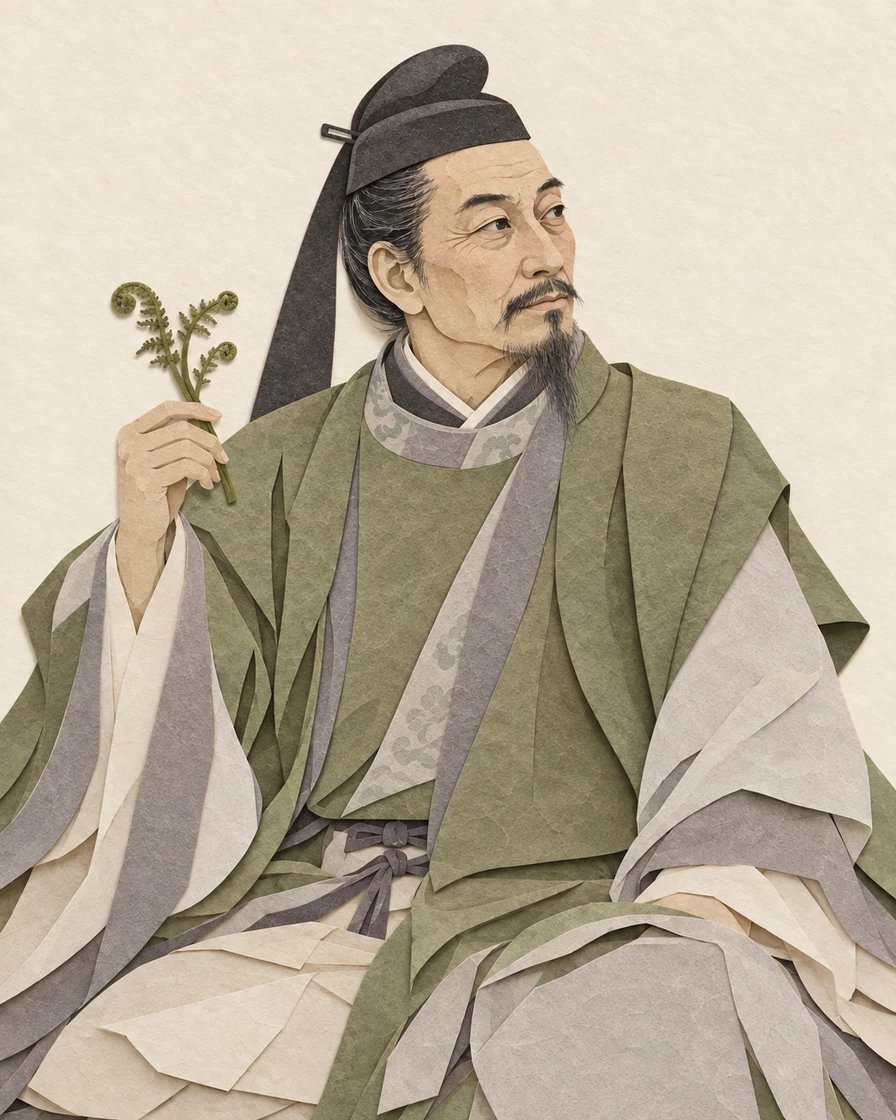
The eighth-century Man'yōshū preserves six short poems attributed to Shiki. One celebrates spring through young bracken above rushing water; others show a more delicate or playful register. These works survive from a career chiefly associated with the Fujiwara capital period. The anthology also contains Kasa no Kanamura's elegies for him. Their heading gives his death as 715, while the Shoku Nihongi gives 716. The difference remains unresolved here. Neither his verse nor descriptions of his limited offices establish his private feelings about the succession. [S01]
His son Shirakabe became Emperor Kōnin in 770. Shirakabe's mother was Ki no Tochihime; another of Shiki's sons, Prince Kasuga, had Princess Taki as his mother. After Kōnin's accession, Shiki received a posthumous imperial designation associated with his Kasuga Palace. That later honor recognized him as an emperor's father within royal commemoration; it does not show that Shiki had occupied the throne during his lifetime. [S01, S04]
Sources and notes ViewHide
- [1]
志貴皇子 / 改訂新版 世界大百科事典; 日本大百科全書; ブリタニカ国際大百科事典 小項目事典橋本達雄 (Hashimoto Tatsuo), Heibonsha and Shogakukan; Britannica
- [2]
日本書紀 Book XXIX / William George Aston, trans., Nihongi: Chronicles of Japan from the Earliest Times to A.D. 697. London: Kegan Paul, Trench, Trübner & Co., 1896.Nihon shoki compilers; translation William George Aston
- [3]
日本書紀 Book XXX / William George Aston, trans., Nihongi: Chronicles of Japan from the Earliest Times to A.D. 697. London: Kegan Paul, Trench, Trübner & Co., 1896.Nihon shoki compilers; translation William George Aston
- [4]
春日王と春日宮 / はじめての万葉集vol.116 / 県民だより奈良竹内亮 (Takeuchi Ryō), Nara Prefectural Man’yo Culture Hall
was one of six princes who took a pledge at Yoshino in
Jitō appointed him to the office for selecting exemplary sayings
Their heading gives his death as 715, while the Shoku Nihongi gives
His son Shirakabe became Emperor Kōnin in 770
Connections
Places
Events
No linked events yet.
Relationships
Topics
No related topics yet.