Read the article below. Interactive reading tools are available when scripts load.
Quick
Nagaya was Tenmu's grandson and Prince Takechi's son. His birth remains uncertain: 676 and 684 both appear in authoritative accounts. Kibi, his wife, was a daughter of Genmei and Prince Kusakabe, and a sister of Monmu and Genshō. Another marriage joined him to Fuhito's family. Imperial and Fujiwara kinship therefore already overlapped within his own relations. [1][2]
In 709 he became minister of the Imperial Household and in 710 moved to the Ministry of Ceremonial. These dated appointments begin the outline of his administrative career. His family's prominence did not preserve a complete account of his childhood or education; his later authority can be followed more securely through offices and the operations of his residence. [1]
At Heijō-kyō, Nagaya's household office received documents requesting people and recording supplies. A wooden communication from the court's music administration asks that a dancer be sent. Other records concern rice issues, deliveries and the work of lower officials and artisans. The residence depended on organized service as well as its prince. [3][9]
Kibi's commands also appear in the documents, alongside evidence of her own household administration. Her work should remain visible within the shared family setting. The records reveal early-century household operations; they do not preserve a continuous account of every private relationship, and they do not identify the later 729 plot's author. Nagaya's advancement would soon bring this imperial household's head into the leading ministry. [3][9][1]
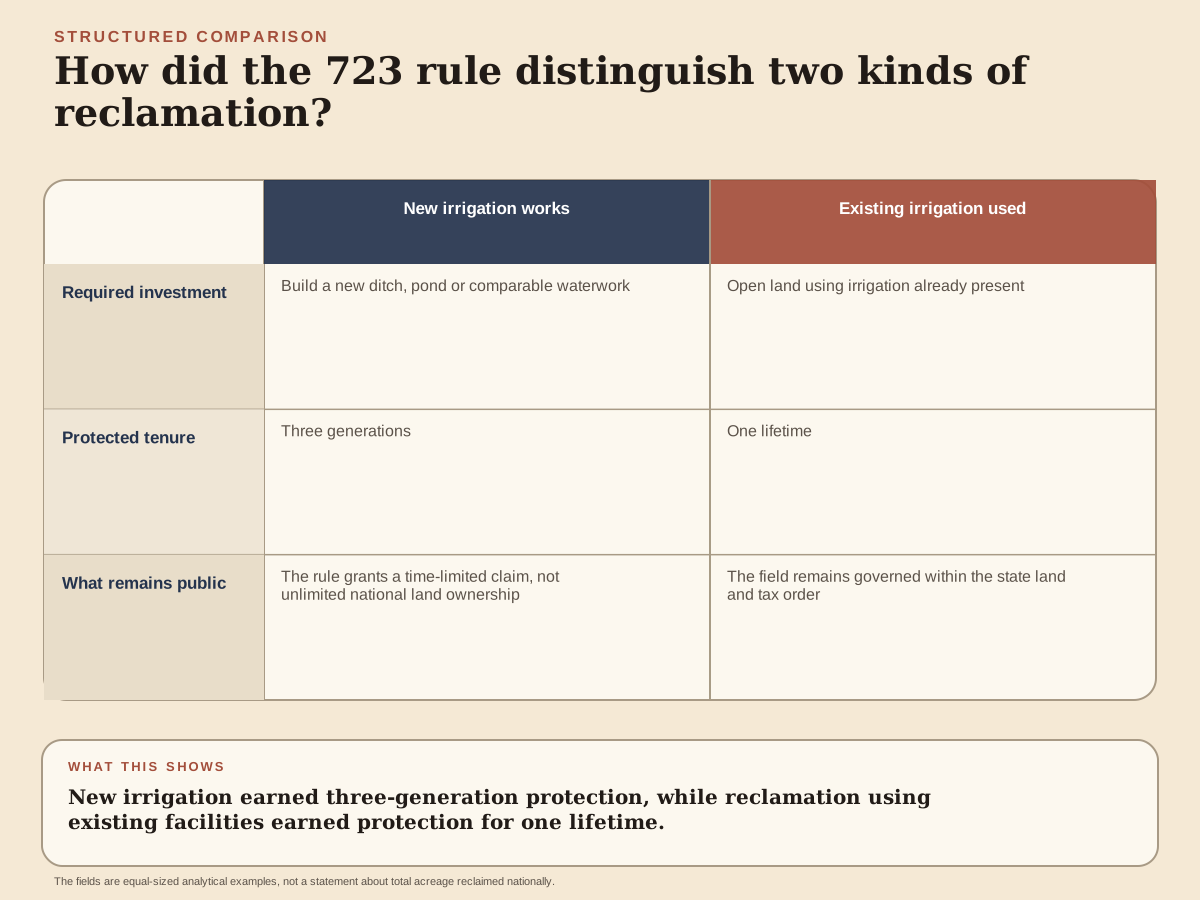
Nagaya became senior counsellor in 718 and right minister in 721, following Fuhito's 720 death. Other imperial princes held important governing and guard responsibilities. A 722 reclamation plan prescribed publicly supplied tools and limited labor service; its geographical scope is disputed. In 723, during Nagaya's leadership, the court encouraged reclamation: new irrigation works brought a three-generation period of possession, while use of existing irrigation brought possession for the cultivator's lifetime. This was a limited protection against confiscation, not perpetual ownership. [1][4][13]
Shōmu's accession in 724 brought Nagaya the left ministry. When Emperor Shōmu gave his mother, Fujiwara no Miyako, a title different from that prescribed in the code, Nagaya and his colleagues asked which designation to follow. The resulting adjustment shows a minister using statutory language within imperial government. It does not, by itself, prove a complete personal program against every Fujiwara relative. [1]
Nagaya's literary gatherings received Silla guests as well as court writers. The poetry preserved in the 751 Kaifūsō records participants whose service and learning crossed family and continental connections. Satō Makoto identifies Fujiwara participants among them. These cultural relations complicate later descriptions of mutually exclusive political camps. [5]
Religious patronage also produced specific work. In 712 Nagaya commissioned scripture copying for the deceased Monmu, Kibi's brother. A 728 commission sought merit for his deceased parents, Shōmu and earlier sovereigns. A later biography of Ganjin also remembered his gift of robes to monks in China. These acts belonged to his court relationships and Buddhist practice; they should not be transformed into evidence of clandestine wrongdoing. The final accusation would use a very different description of his conduct. [7][6][5][10]
In 729 two informants alleged that Nagaya was secretly studying illicit practices to overturn the state. The court sent troops led by Fujiwara no Umakai and guard officers to surround his residence, then a delegation questioned him. He was ordered to take his own life; Kibi and their four sons also died. These are the crisis's recorded acts, distinct from proof that the allegation was true. [10][12]
Other family members survived, including Fuhito's daughter and her children. Many people caught in the household's detention or family liability were soon released. Kōmyō became empress later that year. Scholars connect the crisis with succession and court power, but differ over who planned it and how the Fujiwara brothers acted together. Nagaya's household records cannot settle that question by themselves. [1][12][10]
The court ordered burial on Mount Ikoma. It explicitly treated Kibi as without guilt and required that Nagaya's burial not be made degrading. That differentiated treatment matters alongside the deaths and detentions; the whole household did not receive one uniform fate. [11]
The Nihon Ryōiki offered another account, linking Nagaya's fall to his striking a novice and describing disaster caused by his displaced bones. This is a religious explanation, not verification of supernatural harm. A tomb tradition near Arida drew on that story; the associated mound was found in 1908 but belonged to a much earlier burial period. Competing burial narratives preserve the prince's memory while keeping the circumstances of his death open to historical investigation. [11]
Classic
In 709 Nagaya became minister of the Imperial Household; in 710 he moved to the Ministry of Ceremonial. Yokota Ken'ichi's biography supplies these dated appointments before the leading ministries of the 720s. They put an imperial relative inside the court's administrative system. They do not provide an uninterrupted narrative of his earlier formation. His childhood and education remain less securely described than his offices. [1]
Historical disagreement · Family tradition and birth dates
Nagaya was Prince Takechi's son and Tenmu's grandson. His mother is traditionally identified as Princess Minabe, Tenji's daughter and Genmei's sister. The maternal identification has a different evidential footing from a dated office: Yokota points to the Kugyō Bunin, while Sakaehara Towao marks it as reported tradition. His birth, too, should remain qualified. 684 is common in biographies, but the cultural-properties institute uses 676 with a question mark.
The wooden household records date activities; they do not supply a conclusive birth certificate. [1][2]
Kibi, his wife, was Genmei and Kusakabe's daughter, a sister of Monmu and Genshō. Another wife was a daughter of Fuhito. Those relationships placed Nagaya within more than one prominent household. They also distinguish imperial descent from the particular path through which Monmu and later Shōmu inherited the throne. Nagaya's ancestry made him a significant imperial relative without proving a declared attempt to replace the reigning ruler. [1][3]
The appointments, family ties and uncertain early chronology belong together because they describe different parts of his standing. A later crisis would encourage readers to view every connection as an alliance or rivalry already settled from birth. The documents of his Heijō residence instead show a prince whose authority had to be supplied, administered and written into daily work before it became the subject of a treason accusation. [1][3][9]
A document from the court's music administration addresses Nagaya's household office and requests the dispatch of a dancer. The institutional description of the wooden records treats this communication as decisive evidence identifying the residence. The dated household records largely belong to the years 710–716; the institute's wider account places the group through about 717. These years locate the documents near the beginning of the new capital, well before the final accusation. [3][2]
The residence encompassed administrative work and production. Nara City's account identifies subdivisions concerned with the main residence, drink and sewing, together with women potters, sewing workers and chair makers. Materials and finished objects did not become household furnishings without labor. Such offices and occupations give the scale of Nagaya's life a practical meaning: it rested on people assigned distinct tasks, rather than only on the prince's place in an imperial genealogy. [14]
Evidence boundary · Reading the household records
Terasaki Yasuhiro follows rice issues through a recurring documentary form: destination, quantity, recipient, date and responsible issuer. Abbreviated names and small quantities, together with successive days, led him to interpret many records as daily distribution within a relatively close setting. That is a reasoned reading of the slips, not a complete surviving menu for every resident. The forms show how a supply could be requested, authorized and recorded without a long written account of the occasion. [9]
Kibi appears as more than a person receiving rice. Terasaki identifies communications issued under her command and evidence of a household administration of her own, exchanging documents with Nagaya's. The relationship between the two administrations, and the exact residential arrangement, required further interpretation. A shared family setting did not erase the princess's capacity to command personnel. Conversely, documentary exchange does not prove that every household office belonged to her or that a later sovereign lived in a particular room. [9]
Some records call Nagaya shinnō, an imperial-prince designation that raises questions when compared with statutory categories. Terasaki expressly registers titles and personnel that do not fit the expected regulations. The differences are evidence for examining actual administration, rather than a warrant to invent an otherwise unrecorded accession or settle Nagaya's birth year.
Written rules and household usage did not always supply identical categories. This organized residence would support a man advancing into the central government. [9][1]
Nagaya became senior counsellor in 718. After Fuhito died in 720, he rose to right minister in 721. During Genmei’s final illness that year, she entrusted affairs to Nagaya and Fujiwara no Fusasaki. The change placed him at the head of the ministers, but not alone at the summit of imperial administration. Yokota notes that Prince Toneri had received responsibility for overseeing the Council of State and Prince Niitabe for guards. Senior authority was distributed among people with different titles and responsibilities. The phrase “Nagaya's government” should therefore locate leadership within that arrangement rather than erase the other princes. [1]
In 722 the government set a target of reclaiming a million chō of good land. Yoshida Takashi describes provincial and district officers supplying food to recruited laborers, with service limited to ten days and tools lent from public stores. Officers who neglected the work faced removal.
Historical disagreement · What land did the million-chō plan target?
The target's reach is disputed: scholars differ over a national project or one centered on the northeastern frontier, and over wet-rice fields or upland cultivation.
The announced scale should not be mistaken for an achieved increase of a million chō. Its relationship to the following year's law also remains debated. [13]
Historical disagreement · How were three generations counted?
The court's cultivation policy addressed a material problem. In 723, during his leadership, it defined periods in which newly reclaimed fields would not be confiscated. Yoshida Takashi explains the distinction: where cultivators created new ditches or ponds, possession could last three generations; where they used existing irrigation, it lasted for the cultivator's lifetime. The exact way of counting the three generations is itself given in more than one form. The decisive distinction linked the protection's duration to the work put into irrigation. [4]
The difference concerns whether the cultivator counts as the first generation. Yoshida lists both the cultivator, child and grandchild, and the child, grandchild and great-grandchild.
These readings change the endpoint of protection; neither makes the 723 grant permanent private ownership. [4]
This was a change within the land regime, not a simple declaration of unrestricted private ownership. Yoshida emphasizes that reclaimed fields had lacked clear treatment and that the new periods protected cultivators against arbitrary provincial or district confiscation. The same terms also stated when possession would end. The rule therefore supplied an incentive and a limit together. Its later replacement in 743 with perpetual possession belongs to a subsequent court; Nagaya's 723 leadership should not be credited with that later outcome. [4]
In 724 Shōmu's accession brought Nagaya the left ministry. A command concerning the ruler's mother Miyako then gave him and his colleagues a question of administrative interpretation. The ruler had ordered the title daibunin, while the code prescribed kōtaibunin. They asked which should govern: obeying the command or following the statutory designation. Yokota records the resolution as adjustment to the prescribed title and withdrawal of the earlier command. A legal distinction had produced an actual change in official naming. [1]
Historical interpretation · A legal objection and an assumed clan rivalry
The episode matters because a minister raised the contradiction from within government.
It does not preserve a declaration that all Fujiwara advancement must be stopped. Biographies have connected it with anticipated opposition to Kōmyō's later appointment, but that connection is a historical explanation, not the entire surviving content of Nagaya's question. His own Fujiwara marriage and the prince-led commemoration of Fuhito at Kōfuku-ji in 721 are further reasons to keep particular acts distinct from an assumed permanent clan division. [1][8]
Evidence boundary · Poetry and political relationships
Nagaya's residence also hosted literary gatherings. Satō Makoto reads the Kaifūsō, compiled in 751, as evidence for a cultural circle receiving Silla guests and exchanging Chinese poetry. Its lists of poems and participants connect Nagaya with learned officials, people from immigrant-descended families and writers who had studied on the continent. The collection is a later literary witness to those occasions, not a transcript made by an observer at each gathering. [5]
Among the participants Satō lists Fujiwara no Fusasaki and Fujiwara no Umakai.
Their presence is a specific relationship within cultural activity, not proof of permanent political agreement. It makes an account of wholly separated “imperial” and “Fujiwara” worlds harder to sustain. Satō describes the distribution of characters to establish rhymes and interprets the poems as evidence of music, dance, food and drink. The literary forms preserve how learning could organize a reception; they do not license reconstruction of a particular evening's private conversation. [5]
Buddhist patronage produced another kind of written work. In 712 Nagaya commissioned the Great Perfection of Wisdom Sutra for Monmu's memorial. The Imperial Household Agency's description identifies a surviving volume and the relationship: the dead ruler was Kibi's brother, making Nagaya his brother-in-law. It also distinguishes an original scroll format from later folding-book form. A commissioning act, a family memorial and a transmitted object belong to the same project without being identical things. [7]
Evidence boundary · A dedication and private intentions
In 728 another six-hundred-volume commission sought merit for Nagaya's deceased parents, for the reigning Shōmu and for earlier sovereigns. The museum description of a fragment from volume 465 identifies the dedication's “Buddhist disciple, Prince Naga” with Nagaya.
This supplies a declared religious purpose that can be stated without guessing his complete private motives. A scholar may ask what favor or security he sought, but the surviving dedication should not become proof that his practice was aimed at overthrowing the state. [6]
Historical tradition · The robes sent to China
Another continental connection survives in the biography of Ganjin compiled in 779. Satō cites its tradition that Nagaya sent a thousand robes for monks in China, with verse on their collars joining separate lands through a shared sky and a hoped-for Buddhist connection. The account says Ganjin knew that message while still in China.
It gives the prince's religious patronage a later continental witness, without preserving the delivery of every robe or a personal meeting between the two men. This tradition, scripture dedications and the later charge of illicit practice belong to different kinds of evidence. [5][6][7][10]
Evidence boundary · An accusation is not proof
Two informants alleged in 729 that Nagaya secretly studied illicit practices and intended to overturn the state. Kimoto Yoshinobu reproduces the Shoku Nihongi account: on the night of the accusation, the court secured the three strategic barriers and sent troops to surround the residence. Fujiwara no Umakai and guard officers led the operation. The distinction between allegation and action is essential.
The record establishes what was reported and what the court ordered; its report of the charge is not independent proof that the alleged conspiracy occurred. [10]
A delegation then questioned Nagaya. Kimoto's quoted list includes Princes Toneri and Niitabe, together with senior officials including Fujiwara no Muchimaro. Their participation shows why the crisis cannot be explained by imperial genealogy alone. Princes from Nagaya's own extended imperial family took part in the court's inquiry. The leading minister was already inside a residence held under armed control, while questioning proceeded through a delegation carrying authority from the court. [10]
The court ordered Nagaya to take his own life. Kibi and their four sons—Kashiwade, Kuwata, Katsuragi and Kagitori—also died. The household's people were seized and detained in guard offices. Other branches had a different fate: Fuhito's daughter and her children survived, and many relatives and dependants were subsequently released. The distinction is necessary both to count the human loss and to avoid making the whole household disappear under one indiscriminate sentence. [1][12][10]
Kōmyō became empress later that year.
Historical disagreement · Who planned Nagaya’s destruction?
Several accounts connect Nagaya's destruction with anticipated opposition to her appointment and the succession difficulties following an infant heir's death. Those interpretations organize the political circumstances; they do not establish one uncontested planner. Kimoto records a debate between Nakagawa Osamu's account of the Fujiwara brothers' cooperation and Takinami Sadako's separation of Muchimaro from Fusasaki, supporting the latter while acknowledging that the Muchimaro-instigator explanation is not settled consensus.
Fusasaki's absence from the named operation is a piece of the argument, not conclusive proof of his innocence. [12][10]
The household records answer questions about administration and identity that the crisis narrative leaves aside. They cannot, by identifying Nagaya's residence, identify the author of the accusation. Nor does the rapid enclosure and death establish every private intention assigned to Shōmu, Kōmyō or the four brothers. The firm sequence is accusation, military containment, inquiry and ordered death, followed by differentiated treatment of survivors. It removed a leading minister and devastated a particular imperial household. [3][10][12]
Historical disagreement · Burial, retribution and a remembered tomb
The court ordered Nagaya and Kibi buried on Mount Ikoma. Yamamoto Takashi points out a distinction within the Shoku Nihongi account: Kibi was declared without guilt and was to receive ordinary burial observances; Nagaya's burial was not to be made degrading, despite the court's treatment of him as a guilty person. The command is evidence for official treatment after death. It does not retroactively prove the accusation or cancel the family's loss. [11]
The Nihon Ryōiki offered a different causal sequence. Its story begins with Nagaya striking a novice with an ivory tablet and reads the subsequent charge as retribution. It describes the family's bodies being burned and dispersed, with the prince's bones carried to Tosa and later moved to an island off Kii after people attributed deaths to his harmful presence. Those details belong to a religious tale whose explanation conflicts with the chronicle's burial account. The tale is important evidence of meaning attached to his fall, not proof of supernatural causation. [11]
A tomb tradition near Arida in Kii drew on that account. Its associated mound was found in 1908, but the mound's construction belonged to an earlier burial period.
The existence of a revered place therefore does not establish it as Nagaya's 729 grave. The difference between recorded burial, a tale of wandering bones and a later local association closes his life with several kinds of memory still distinguishable. His ministerial acts, literary relationships and household's destruction can be read without requiring those different witnesses to agree on one explanation. [11][1][5]