

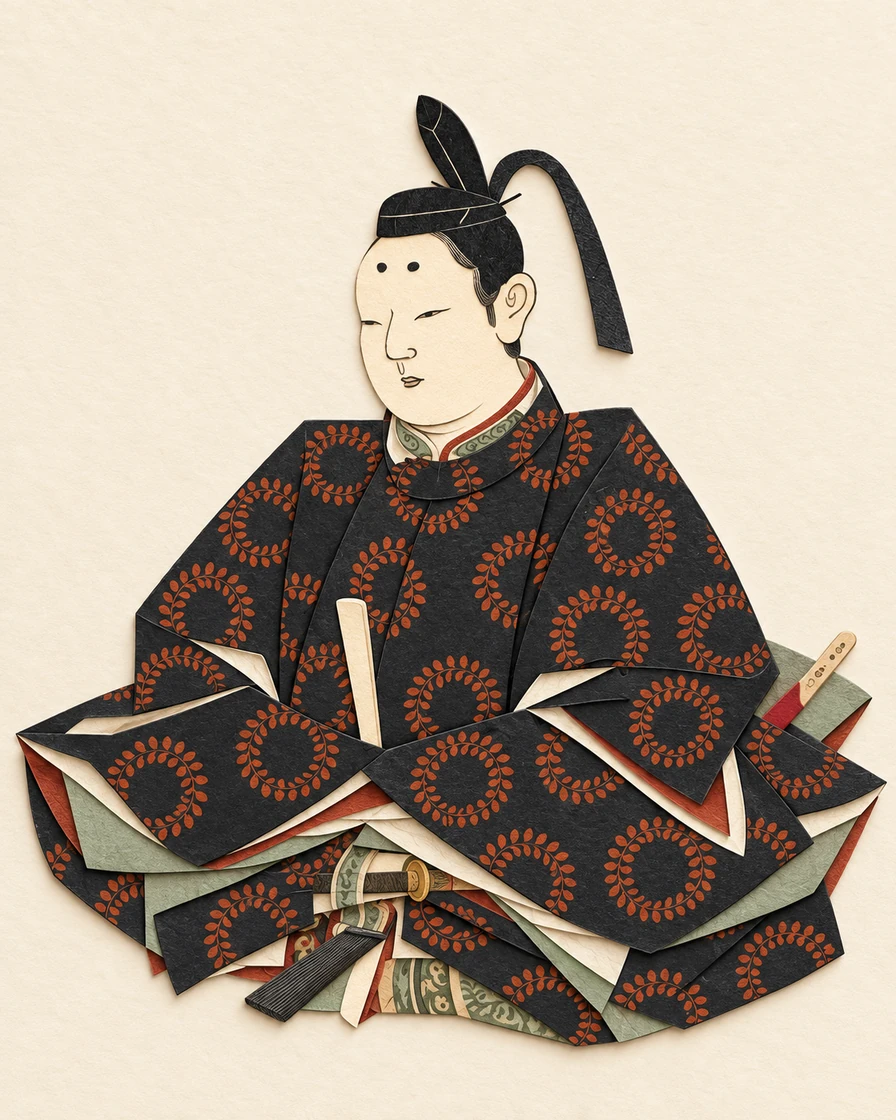
Kamakura period
Kujō Yoritsune
九条頼経
Overview
Kujō Yoritsune (1218–1256), also called Fujiwara no Yoritsune, became Kamakura’s fourth shogun. He was a son of the Kyoto aristocrat Kujō Michie and a distant relative of Yoritomo. After Sanetomo’s assassination in 1219, he was brought east as the infant Mitora. His formal appointment as shogun came in 1226. Kamakura had secured a new household around which loyalty could gather while the Hōjō regents continued to conduct government. [S01, S02]
In 1230 he married Take no Gosho, a daughter of the former shogun Yoriie. Court descent and marriage thus connected the new ruler to the displaced Minamoto household. His office also had practical weight: a surviving charter bearing his authorization recognized the Irobe family’s control of the Koizumi estate. Such authorization gave a regional household official recognition of its control, even while the regents conducted government. [S01, S03]
In 1244 the shogunal position passed to his son Yoritsugu under Hōjō Tsunetoki. Yoritsune remained in Kamakura as a retired lord whose ties to followers still mattered. Two years later, Hōjō Tokiyori sent him back to Kyoto amid suspicion of opposition to Hōjō rule. He died there in 1256. Removal from office had not immediately dissolved his political connections; those connections helped make his continued presence difficult for the men who controlled the government. [S01, S02]
Sources and notes ViewHide
- [1]
九条頼経 — 日本大百科全書新田英治 (Nitta Eiji)
- [2]
九条頼経 — ブリタニカ小項目事典 / 日本人名大辞典+Plusブリタニカ・ジャパン (Britannica Japan); 講談社 (Kodansha)
- [3]
九条頼経袖判下文新潟県立歴史博物館 (Niigata Prefectural Museum of History)
Kujō Yoritsune (1218–1256), also called Fujiwara no Yoritsune, became Kamakura’s fourth shogun
After Sanetomo’s assassination in 1219, he was brought east as the infant
His formal appointment as shogun came in 1226
married Take no Gosho, a daughter of the former shogun Yoriie
Connections
Places
No linked places yet.
Events
No linked events yet.
Relationships
Topics
Japan's Nesting Dolls of Power
Explore why leaving office did not always mean giving up power, and why powerful people still needed someone else’s title.
Read