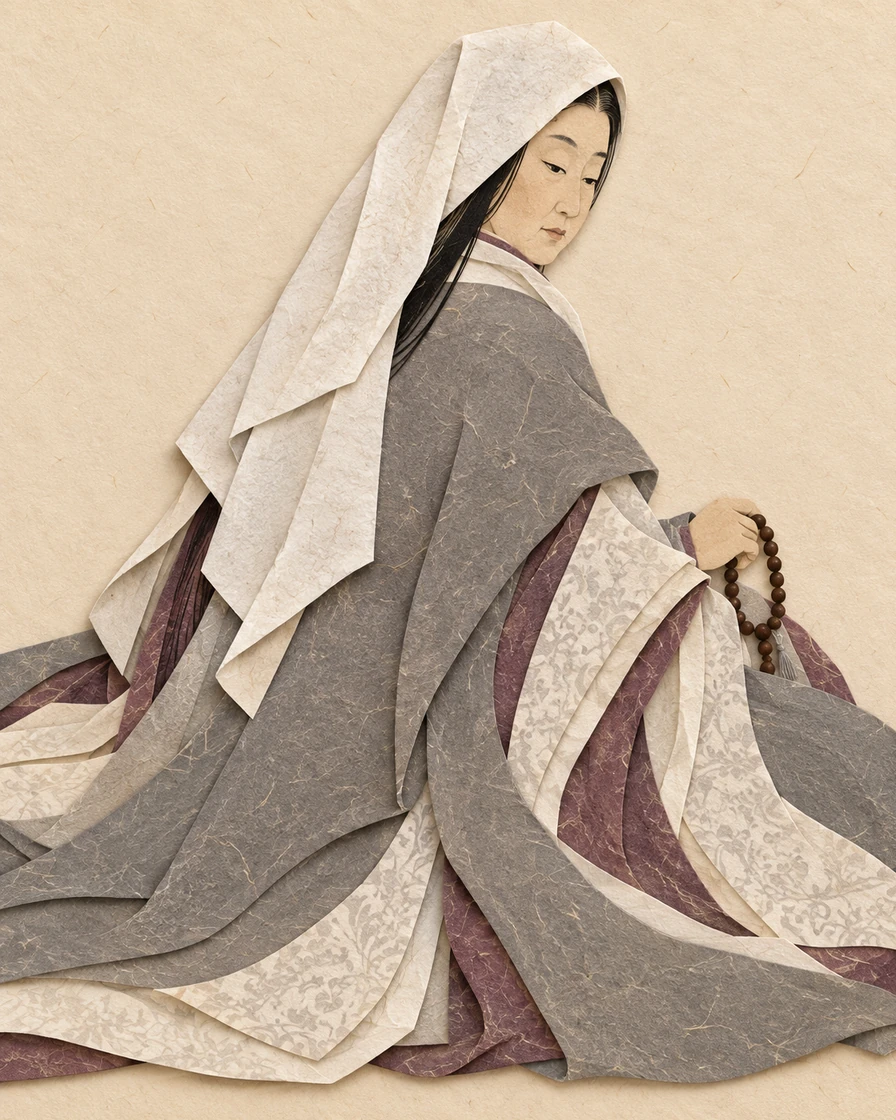
The woman later known as Kakusan-ni was born in 1252 into the Adachi family. Her father, Yoshikage, belonged to a household established within the Kamakura warrior regime, while her mother was a daughter of Hōjō Tokifusa. Her elder brother Yasumori became Adachi household head in 1253 and later served in the governing council and judicial administration. Kakusan was also recognized as his adopted daughter. This relationship explains why accounts can describe her connection to Yasumori as that of either sister or daughter, although Yoshikage is identified as her biological father. [1][9][7][8]
In 1261 she married Tokimune, son of Hōjō Tokiyori and heir to the main family line directing Kamakura government. She was known as Horiuchi-dono before her Buddhist name became prominent in accounts of Tōkei-ji. The marriage gave Yasumori a close connection to the next generation of Hōjō leadership. The Adachi supplied experienced officials and followers, while the Hōjō main line controlled the regency and important family resources. The union operated within this unequal but mutually consequential relationship between warrior households. [1][7][9]
Tokimune entered the regency in 1268 as envoys of the Mongol ruler pressed Japan for submission and relations. The regent, or shikken, directed decisions beneath the shogun, whose formal title remained separate from the Hōjō family’s leadership. Kakusan bore Sadatoki in 1271, providing an heir to the couple’s household. The boy’s maternal connection also linked him with Yasumori’s political network. The surviving biographical outline places Kakusan through marriage, maternity and subsequent religious affiliation; it supplies little detail about her childhood or domestic decision-making. As military danger and Zen patronage grew around the household, those family relationships remained part of the setting in which she would take religious vows. [7][8][9][1][2]
The invasions of 1274 and 1281 confronted Tokimune’s government with the mobilization of coastal defenses and warrior service. Officials including Yasumori participated in the governing network around him. Chinese Zen teachers also entered this circle of patronage. Tokimune invited Mugaku Sogen from China in 1279 and established Engaku-ji with him as opening teacher in 1282. The monk’s Chinese name was Wuxue Zuyuan; the name Mugaku Sogen reflects its Japanese reading. Kakusan’s later vows placed her directly within this religious relationship. [7][9][2][1]
In 1284 the husband and wife took Buddhist vows under Mugaku Sogen. Tōkei-ji’s account places the ceremony shortly before Tokimune’s death and gives the wife the religious name Kakusan Shidō. Taking vows established a recognized affiliation with a teacher and religious community. Tokimune’s death closed his personal direction of government, but it left a son within the main Hōjō line. Sadatoki succeeded to the regency while still young, assisted at first by senior figures whose connections ran through both the Adachi and the Hōjō’s own household servants. Kakusan survived as the new regent’s mother as well as a woman who had entered religious life. [1][2][7][8]
In 1285 competition between Yasumori and the powerful household servant Taira no Yoritsuna ended in the destruction of Yasumori’s faction. The fighting is known as the Shimotsuki Incident, after its occurrence in the traditional eleventh month. Charges that Yasumori’s son sought the shogunate through Minamoto descent formed part of the justification transmitted for the purge. Yasumori, relatives and supporters were killed, and Yoritsuna’s position around Sadatoki strengthened. For Kakusan, the defeated household was her own natal family, while the regent in whose government the purge occurred was her son. The record establishes that difficult conjunction of relationships without preserving a secure account of her intervention or personal response. Tōkei-ji’s remembered foundation belongs to the same year, within a governing world that could support religious institutions while destroying leading households. [8][9][1][2][3]
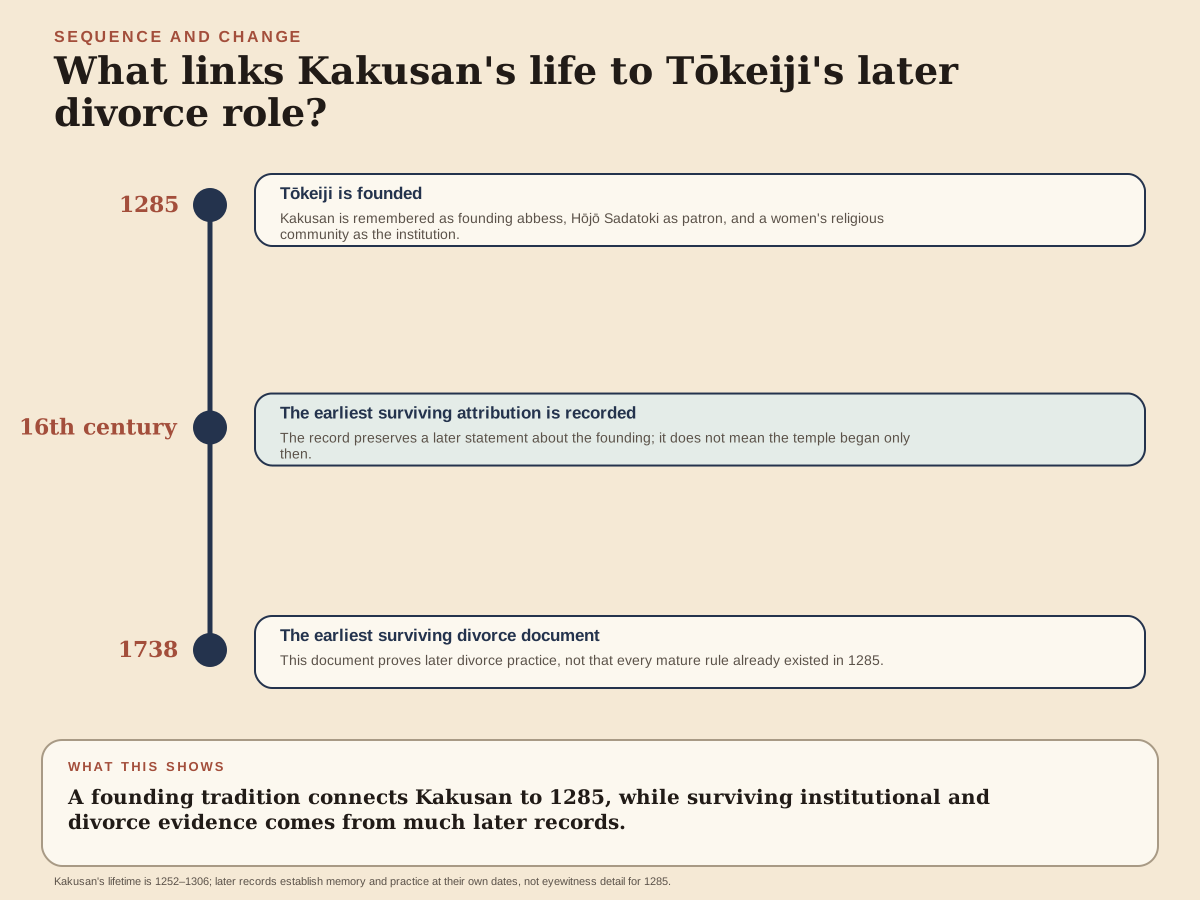
Tōkei-ji dates its foundation to 1285, the year after Tokimune died. Its history distinguishes Kakusan Shidō as kaisan, the spiritual founder, from Sadatoki as kaiki, the founding patron. The two designations separate religious authority from the support associated with a governing household. Kakusan gave the community a founding religious identity; Sadatoki connected it to the Hōjō main line after inheriting his father’s position. That arrangement made room for a woman’s religious standing within the patronage world of Kamakura’s warrior rulers. [2][3][6][8]
Kakusan’s teacher Mugaku Sogen had been opening abbot at Engaku-ji, placing her religious affiliation within Kamakura’s network of Zen teachers and patrons. At Tōkei-ji, successive women held the abbacy and maintained the religious community. A bell made under the fourth abbess, Ryōdō, in 1332 belongs to this later development, after Kakusan’s lifetime. The temple eventually drew abbesses from prominent aristocratic and warrior families and acquired a recognized place among Kamakura’s nunneries. Its continuity was achieved through these later appointments and acts of support, extending the institution beyond the founder’s own relationships. [2][6][7][3]
Kakusan died in 1306, leaving the nunnery associated with her to later generations. The account of its earliest years survives largely through records written much later. Koo JeeHoe’s study identifies the sixteenth-century Gozanki kōi, a work on Zen temples, as the earliest surviving text naming her as Tōkei-ji’s founder. The temple regulations compiled in 1745 preserve a fuller account of the foundation and succession of abbesses. [1][3][4]
Founding tradition and surviving divorce records
Tōkei-ji’s later accounts describe Kakusan as concerned for women bound to harmful husbands. The temple’s extract from an older record attributes to her the establishment of a period of residence through which women could obtain separation. It also connects authorization to her son Sadatoki and assigns a subsequent adjustment of the residence term to another abbess.
The passage speaks in an attributed first-person voice, but it is a transmitted temple account, rather than a contemporary transcript of Kakusan’s words. It gave the refuge institution a compassionate founding figure within the governing family. [2][4]
The oldest surviving Tōkei-ji divorce certificate dates from 1738, and many surviving certificates cluster in the later Edo period. The distance from 1285 to these documents limits what they establish about the first founder’s regulations. [2][4]
They preserve an institution to which women, chiefly from Musashi around Edo and neighboring Sagami around Kamakura, could turn when seeking to end marriages. The prescribed period of residence gave temple procedures a means of securing separation even where agreement was difficult. Most entrants, however, did not remain for the full three years. The possibility of temple protection could begin negotiations that settled a dispute sooner. [2][5][4][6]
The practical refuge depended on women entering the temple, people handling their cases and abbesses maintaining the institution’s recognized standing. Later patrons and governing authorities also affected the temple’s ability to sustain its distinctive functions. Kakusan’s place in this history is the remembered establishment of a women’s religious community, while the better-documented procedures belong to its later life. The divorce regulations ended under the Meiji government, long after her death. Her religious name continued to anchor the story of a temple that had outlasted the Hōjō regime and acquired uses beyond its original household connections. The legacy includes both an elite woman’s foundation and the efforts of later women to obtain help through a religious community. [4][5][3]