Read the article below. Interactive reading tools are available when scripts load.
Quick
Fujiwara no Teishi was born in 976 or 977 to Fujiwara no Michitaka and Takashina no Takako. Michitaka belonged to the family that supplied the emperor's leading regents. Takako was remembered in Ōkagami, a later historical narrative, for her Chinese compositions. Teishi's early education is less securely documented than the learned household she later maintained. [2] [13]
In 990 she entered Emperor Ichijō's court in Kyoto and became chūgū, a consort of empress rank. Her father's leading position supported the new household. Residence, attendants and imperial access connected the marriage to court government. These advantages were substantial, but their security depended on particular relatives remaining alive and influential. Teishi began her court career within that powerful family network. [1]
Sei Shōnagon entered Teishi's service around 993. The Pillow Book recalls a hesitant new attendant behind a screen, whom Teishi approached with pictures and summoned again the next day. The episode presents the empress taking an active part in bringing a woman into her community. It is also a memory shaped by Sei's admiration. [3]
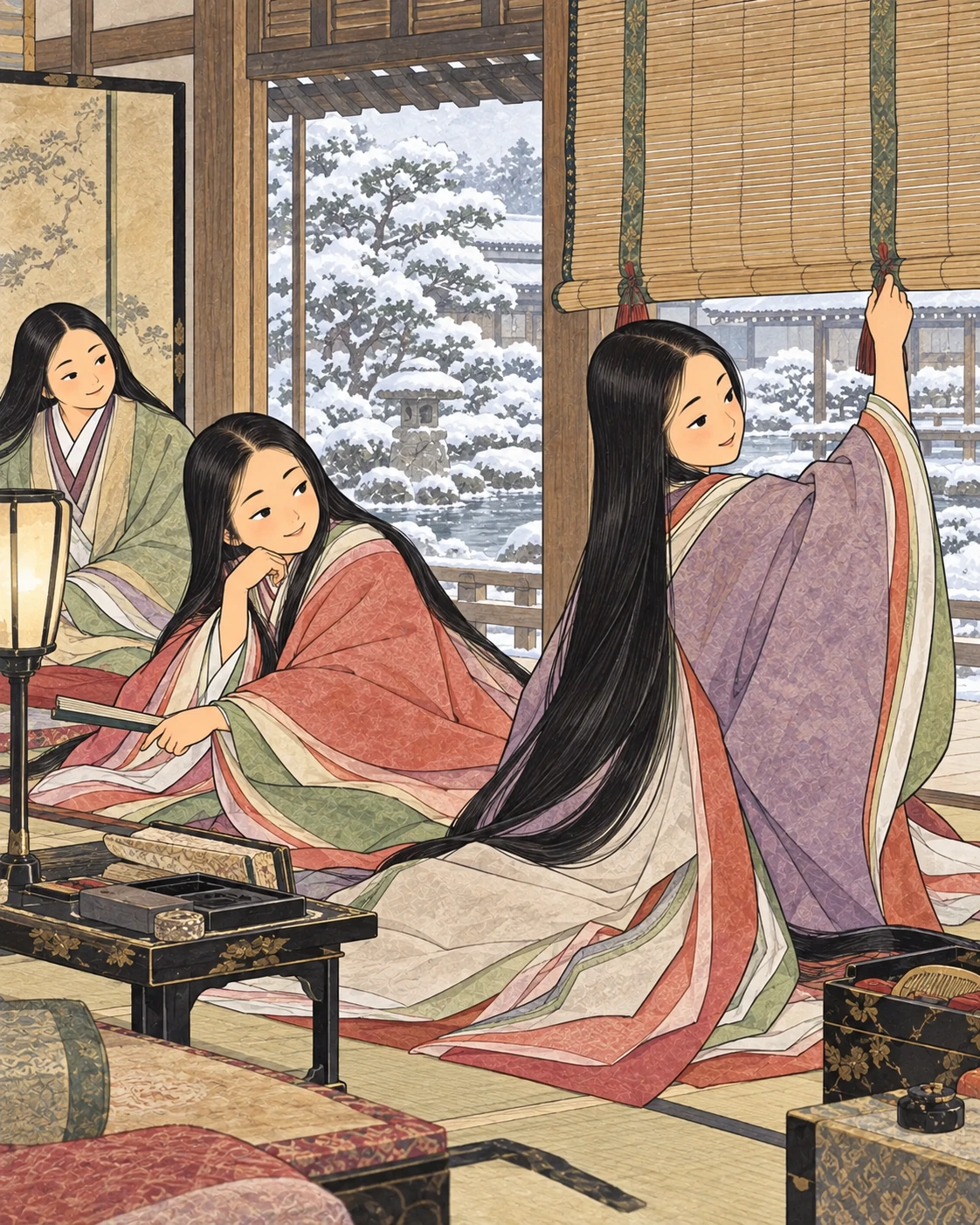
Other passages make literary exchange a shared practice. In the famous snow episode, Teishi alludes to the Chinese poet Bai Juyi's Incense Burner Peak; Sei raises the blind. Scholars differ over the episode's date and whether to read it as a test or as a playful request understood through familiar poetry. The book's postscript also links Sei's writing to paper supplied through Teishi's brother Korechika. The postscript offers a story of the work's beginnings through those household resources. Teishi's participation and resources helped sustain the setting in which Sei wrote. [2] [4]
Michitaka died in 995. In 996 Teishi's brothers Korechika and Takaie lost office and were sent away after a confrontation involving retired Emperor Kazan. Teishi left the palace and cut her own hair, expressing an intention to enter religious life. Her Nijō residence subsequently burned, and her mother died later in the year. She bore her first child, Princess Shūshi, near the end of that Japanese calendar year. [1] [5]
Her community was also unsettled. Sei withdrew amid suspicions that she was aligned with Michinaga, Teishi's uncle and the new leading minister. The Pillow Book remembers Teishi sending fine paper, a message to return and later a flower carrying a poetic phrase. Sei eventually resumed service. The gifts give a concrete view of Teishi maintaining contact; their precise timing and the length of Sei's absence remain disputed. Religious tonsure had not permanently ended the empress's court relationships. [6] [7] [14]
Teishi resumed visits to Ichijō and bore Prince Atsuyasu in 999. Shōshi, the daughter of her uncle Michinaga, entered the emperor's household that year. In 1000 Shōshi became chūgū, while Teishi held kōgō, the other empress title. The arrangement allowed one emperor two empresses. It preserved Teishi's rank while accommodating a household with much stronger support from the leading minister. [1]
Sei's writing follows Teishi into less imposing accommodation. At Taira no Narimasa's residence, the attendants mock their host, while Teishi checks their laughter. Another, undated episode records her giving a departing wet nurse a fan with a landscape and a poem in her own hand. Such passages describe a woman managing relations within a household whose members could leave. They preserve gestures and exchanges; they do not reveal everything Teishi thought about her changed position. [8] [9]
Teishi's last appearance in The Pillow Book belongs to the fifth month of 1000. Historical accounts place a further palace visit later that year. She died after giving birth to Princess Bishi near its end—1001 in Western calendar reckoning. The Pillow Book does not narrate her death. Other court records and Eiga Monogatari, a historical tale, preserve accounts of the birth, death and funeral. [10] [13]
Poems attributed to Teishi survived separately. Two open the lament section of the imperial anthology Go-Shūi Wakashū; its preface says they were among three verses found attached to a curtain cord after her death. A third, preserved in Eiga, has been interpreted as a request for burial without cremation. These are transmitted words and accounts, not access to every private intention. Her brief life ended, but the empress remembered by her attendant remained a participant in one of Japan's major works of prose. [11] [12]
Classic
Historical disagreement · Dating Teishi’s birth
Fujiwara no Teishi was born in 976 or 977 into a family close to the imperial household in Kyoto. Her father, Fujiwara no Michitaka, would become the leading regent in 990; her mother was Takashina no Takako.
Reference works and reconstructions of Teishi's traditional age differ by a year. Her earliest experiences are less clearly preserved than the public position into which she entered as a young woman. [1] [3] [13]
Her mother's reputation matters to the household's cultural history. Ōkagami, a later historical narrative, remembers Takako composing Chinese verse and receiving requests for compositions from the court. Literary historian Akama Etsuko connects this background to the ease with which Chinese learning appears around Teishi. The account gives the family a learned maternal figure, while the details of her daughter's early education remain unclear. Teishi's own exchanges at court provide firmer evidence of how she used such learning. [2]
In 990 Teishi entered Emperor Ichijō's court and received the title chūgū, an empress rank. Her marriage joined Michitaka's family to the reigning emperor. A consort's household brought attendants and relatives into a continuing relationship with imperial life. It offered a setting for visits, ceremony and the birth of possible heirs. Michitaka's position made those arrangements easier to sustain: family access and the leading offices reinforced one another. [1]
The titles themselves were adaptable. When Teishi became chūgū, the senior consort Junshi, associated with the earlier Emperor En'yū, held the title kōgō. That was an arrangement for women connected to different emperors. The innovation made in 1000 would be different: two empresses attached to Ichijō himself. The same pair of titles thus served different household arrangements a decade apart. [13]
In 990 the household had the support of a living, powerful father. Its later insecurity was not built into Teishi's title. It emerged when the people sustaining that position died or lost authority. The women's community developed during these favorable early years, before those changes transformed its surroundings. [1]
Around 993 Sei Shōnagon entered Teishi's service. The Pillow Book describes her initial reluctance to appear by daylight and her position behind a small screen. Teishi brought out pictures for her and summoned her again the following day. Through this recollection, the new attendant first becomes visible in an exchange initiated by the empress. Sei's account draws the reader close to that encounter, but its affectionate portrayal remains the attendant's work. [3]
The community shared more than polite appreciation. Chinese poems furnished phrases that could be turned into conversation, letters and action. In the snow episode, Teishi refers to the Chinese poet Bai Juyi's Incense Burner Peak, and Sei has a lattice raised before lifting the blind herself. The response allows the garden snow to enter an exchange already shaped by a Chinese poem. Other women recognize the verse, making Chinese literary knowledge part of the group’s shared conversation. [4]
Historical disagreement · Was Teishi’s snow question a test?
Its interpretation is contested. One familiar reading makes Teishi's question a test and Sei's gesture a brilliant answer. Nakajima Wakako argues that the other attendants' knowledge works against a simple examination: Teishi makes a playful request, and Sei understands its practical intent. Nakajima also discusses both an early palace setting and a possible later setting outside it.
The passage does not securely fix the day or place. Its clear historical value lies in the empress's participation in a woman-to-woman exchange through Chinese literary language. [4]
Material support appears in the book's account of its beginnings. Its postscript says that Korechika, Teishi's brother, provided paper to Ichijō and the empress. The emperor had Chinese history copied; Teishi asked what should be written on her portion, and Sei's response led to her taking up the writing. The meaning of the title's “pillow” remains unsettled. The origin story assigns a role to family resources and the empress's question, while Sei takes up the writing herself. [2]
The setting also included religious ceremony and imported objects. Nakajima notes the book's descriptions of Chinese silk and music at Teishi's arrival for a temple dedication. Such details locate literary exchange within the household's ceremonial life and its access to prestigious goods. Within this court environment, she could provide occasions and materials; Sei could make those encounters into prose with a shape of its own. [4] [12]
In 995 Teishi, an empress of Ichijō, lost her father Michitaka, and the leadership of the Fujiwara family became contested. His son Korechika still held high rank and the advantage of being Teishi's brother. But Michinaga, Michitaka's younger brother, obtained leading authority. In 996 Korechika and Takaie were punished after their party's nighttime confrontation involving retired Emperor Kazan. Teishi's closest male supporters lost their positions and were ordered away from Kyoto. [1]
Teishi left the palace for the Nijō residence. During the crisis she took scissors to her own hair, signaling an intention to enter religious life. The gesture belongs to a specific sequence of familial and political losses, rather than proving a permanent decision to sever every court relationship. The residence burned in the following month. Her mother Takako died later in the year, and Princess Shūshi was born near its end. This sequence follows the Japanese calendar year 996. [5]
Evidence boundary · A literary scene of departure
Eiga Monogatari, a later historical tale, gives a dramatic account of the removal of the brothers. It depicts Teishi and her mother holding on to Korechika as officials demand his departure. Akama quotes the scene when reconstructing the crisis.
Its narrative gives the family a language of distress, but the episode's speeches and gestures are transmitted literary representation. [5]
Inside the women's community, suspicion also had consequences. Sei stayed away amid accusations that she favored Michinaga's side. The Pillow Book records Teishi sending twenty sheets of fine paper with a message urging her return. A mat followed. These gifts referred to preferences Sei had previously expressed before the empress. The messenger brought objects that Sei could use, carrying an invitation shaped by conversations within the household. [6] [14]
Historical disagreement · When did Sei return to service?
The book also recalls a flower bearing a phrase from a poem, after which Sei returned. Akama places the flower in spring 997 and reconstructs a long absence beginning in 996; other readings explain the flower as a second autumn bloom or an artificial one.
The precise interval remains unsettled. What survives clearly is Sei's account of a mistress maintaining contact and drawing her back into service. Teishi's household resumed activity after the losses of 996, and the empress herself would again visit Ichijō. [7] [1]
Teishi's tonsure did not prevent renewed relations with Ichijō. In 999 she bore Prince Atsuyasu, the emperor's first son. That year Michinaga brought his daughter Shōshi into the imperial household. In 1000 Shōshi became chūgū, while Teishi held kōgō. Both were empress titles. The court accommodated two empresses attached to the same emperor, preserving Teishi's status while opening a senior position for Michinaga's daughter. [1]
The arrangement did not restore Michitaka's leadership or place the two households on an equal resource footing. A son made Teishi central to questions of succession, while the leading offices remained outside her immediate family's control. Nor did Shōshi's elevation automatically determine which child would inherit: her sons had not yet been born. Teishi's remaining career unfolded within an altered political environment, rather than after a completed victory by Shōshi's line. [1]
Changes of residence gave the women's work a different setting.
Historical disagreement · Why does The Pillow Book ridicule Narimasa?
The Pillow Book follows the empress into Taira no Narimasa's house. Its attendants mock the host's manner and language, while Teishi restrains their laughter and smiles. Akama reads the repeated contrast as a means of keeping the empress at the center of the episode. Other explanations connect the ridicule to Narimasa's alleged role in informing on Korechika.
These competing interpretations address how Sei constructed the episode. [8]
The host's efforts also matter. In the episode he seeks to provide clothes, meals and other necessities for the young Princess Shūshi and her attendants. His awkwardness makes him a target in Sei's prose, but the household still requires the accommodation and supplies he can offer. Teishi's intervention distinguishes her portrayal from that of the women laughing around her. The empress remains engaged in the management of relationships even when the setting no longer displays her father's former power. [8]
Another episode, without a secure date, concerns a long-serving wet nurse called Taifu no Myōbu, who leaves for Hyūga in southern Kyushu. Teishi gives her a fan: one side shows a sunny country scene, the other a rain-covered palace with a poem written in the empress's hand. The gift provides a farewell through an object and verse. Sei's accompanying sadness is her own response. The departure changed the empress's community even as the gift maintained a relationship across distance. These continuing exchanges sit beside the empress's visits, motherhood and changing formal status. [9]
Teishi's last appearance in The Pillow Book occurs in the fifth month of 1000, at the Sanjō residence with her children. Historical accounts record another return to the palace in the eighth month, followed by departure about twenty days later. Near the end of the Japanese year, she gave birth to Princess Bishi and died from the complications following the birth. The traditional date falls at the turn of 1000–1001 in Western reckoning. [10] [13]
Evidence boundary · Portents in the record of a death
The birth and death are known through accounts beyond Sei's book. Akama cites Gonki, the diary of Fujiwara no Yukinari, for news reaching the palace that the afterbirth had not come normally and that the empress had died. The same diary reports portentous clouds and a subsequent episode of spirit possession in another senior woman's household. Such reports describe ways court contemporaries interpreted a crisis.
They do not explain the medical cause or establish supernatural intervention. [10]
The Pillow Book leaves the death unnarrated. Eiga Monogatari instead devotes substantial attention to the death and funeral, including Korechika's grief. Its treatment gives a woman from the defeated family an important place within a narrative associated with Michinaga's prosperity. The works preserve different pictures of the same court world: continued exchange around a living mistress in one, a narrated loss in another. [10]
Her attributed poems traveled through another channel. The lament section of Go-Shūi Wakashū, an imperial anthology, opens with two verses under her name. Its prefatory account says that three poems were found attached to a curtain cord after her death and appeared intended for Ichijō to see. The verses address separation and remembrance. Their transmission preserves both a poetic voice and a story of its discovery. [11]
Historical interpretation · Reading the burial poem
A third poem, included in Eiga, asks that dew on grass be seen as the speaker's body, even without its becoming smoke or cloud. Akama interprets it as a request for inhumation, consistent with the account of burial without cremation.
Her further suggestion that Teishi wished to remain near her children is an interpretation, not a separately documented intention. [11]
Teishi died before her son's future was settled. Her own activities survive most fully through the people who wrote around her—an affectionate attendant, court diarists and later compilers—each preserving something different. [11] [1]