Read the article below. Interactive reading tools are available when scripts load.
Quick
In 884 the future Emperor Uda received the Minamoto surname and became an imperial subject. His father had just taken the throne as Emperor Kōkō; the change removed Sadami, as Uda was then known, from princely status. Born in 867 to Kōkō and Princess Hanshi, he belonged to the imperial family, but that connection did not itself fix the succession. [1]
Three years later, his father’s final illness brought a reversal. Sadami was restored as a prince, selected as heir, and succeeded Kōkō in 887. Fujiwara no Mototsune, the court’s highest minister, supported the choice. Uda therefore entered the reign with an indispensable senior partner already in place. The next question concerned the governing authority he would give that partner. [1][2]
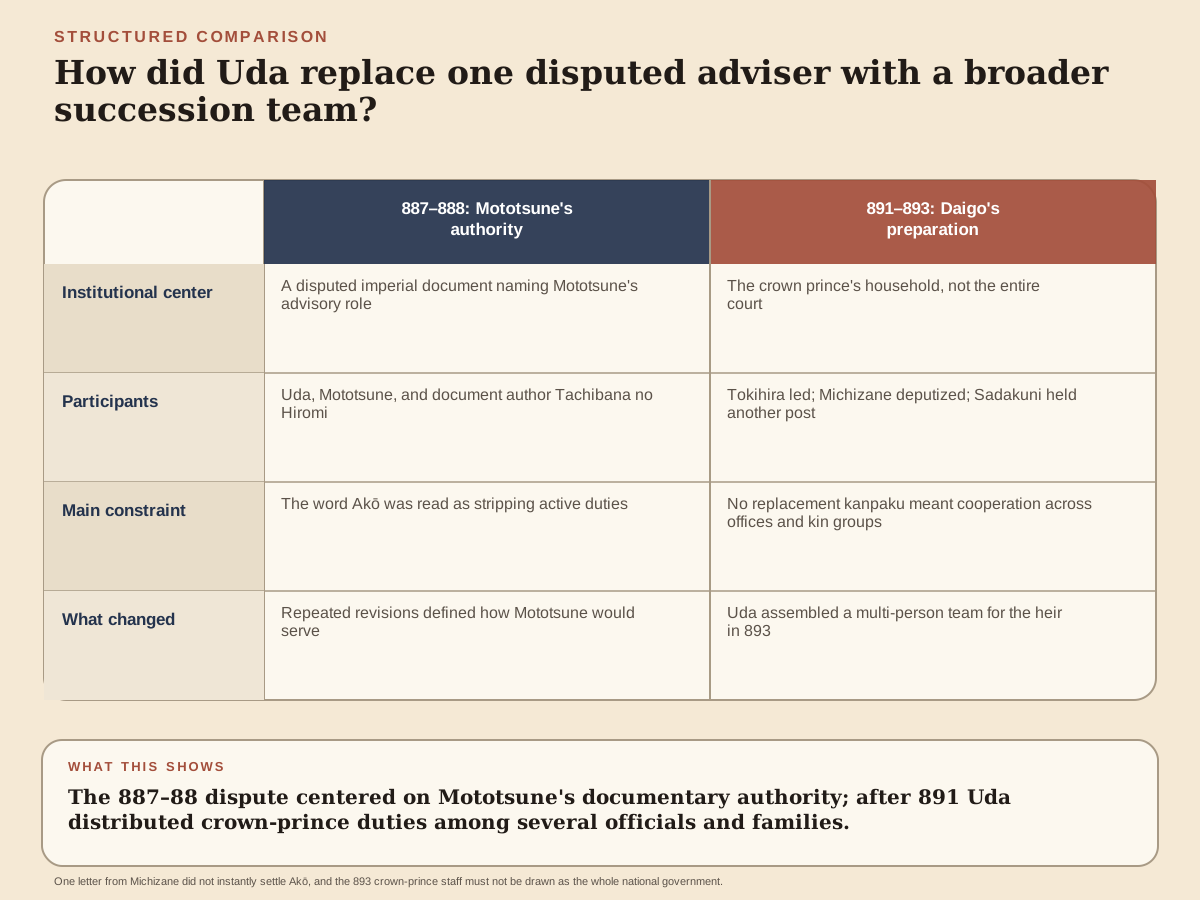
Uda asked Mototsune to assist in government. A later imperial reply described his position with Akō, an expression drawn from ancient China. Opponents interpreted it as a distinguished title without governing duties. Mototsune would not proceed until the disputed wording was resolved, and Uda had to revise the reply. The document’s author, Tachibana no Hiromi, also faced demands for punishment. [2]
Another project continued during this difficult opening. Kōkō had initiated a temple in 886; Uda dedicated it in 888, marking his father’s first death anniversary as well. It became Ninna-ji. In 890 the temple obtained two annual ordination places following its administrator’s petition. Political dependence and religious patronage developed together. Mototsune’s death in 891 finally gave Uda greater freedom to choose his governing arrangements. [3][1]
After Mototsune died, Uda appointed no replacement regent or kanpaku, the chief adviser to an adult emperor. He relied on Sugawara no Michizane and other capable officials. Fujiwara participation continued: when Atsuhito became crown prince in 893, Fujiwara no Tokihira headed his household, Michizane was deputy, and Fujiwara no Sadakuni also served there. [1][4]
In 894 a planned mission to Tang China did not sail. Michizane’s submission questioned whether it should proceed; the suspension became lasting, while merchants continued to connect Japan with the continent. Uda’s reign did not end those exchanges. In 897 he handed the throne to Atsuhito, Emperor Daigo. His parting instructions urged trust in Michizane, carrying an advisory relationship into the next reign. [7][6][1]
Uda took the tonsure at Ninna-ji in 899 and received precepts from Yakushin at Tō-ji later that year. In 904 he moved into Ninna-ji’s Omuro residence. His retirement acquired a settled religious home. The temple had also gained an annual ordination place for Buddhist chanting studies at its round hall in 900. [3]
His advice to Daigo had limits. In 901 Michizane was removed and sent to Dazaifu, despite Uda’s earlier recommendation. This failure does not settle how much influence Uda retained: scholarly accounts describe its extent differently, and some emphasize later cooperation with Daigo and Fujiwara no Tadahira. Uda outlived his son, dying at Ninna-ji in 931. The retired emperor’s religious life lasted far longer than his reign. [1]
Uda’s diary was once a ten-volume work. Today its entries survive as extracts quoted in other writings. A late Edo collection assembled such fragments; the result offers selected portions of an imperial record, with gaps between them. [9]
His instructions to Daigo likewise reached later readers through copies. Two manuscripts listed by the Kyoto Museum of Culture are eighteenth-century copies written by Konoe Iehiro, rather than Uda’s own sheets. Ninna-ji preserved his institutional association through a different history of loss and renewal: its precinct burned in 1468, rebuilding was completed in 1646, and the Omuro palace burned in 1887. The temple and transmitted writings retain different parts of Uda’s life; neither provides an untouched ninth-century setting. [8][3]
Classic
In 887 Sadami returned to princely status and became emperor within the same succession crisis. For the preceding three years he had held the status of an imperial subject under the name Minamoto no Sadami. His father, Kōkō, was nearing death, and the court needed an heir. Fujiwara no Mototsune supported Sadami’s selection. The man known afterward as Uda reached the throne through a reversal of his recent position, with the highest minister’s backing. [1]
Sadami had been born in 867, before his father became emperor. His mother, Princess Hanshi, also belonged to the imperial family. In 884, when Kōkō took the throne following Yōzei’s removal, Sadami received the Minamoto surname along with other children of the new sovereign. Imperial ancestry remained, but princely status did not. In studying preparations for Daigo’s later reign, Arai Hiroki emphasizes how late and hurriedly Uda’s succession was settled in 887. The outcome should not be projected back into the surname change of 884 as a known plan. [1][4]
Mototsune’s support connected the restored prince to the court’s existing leadership. Uda did not begin by seeking a government without that minister. Kotō Shinpei’s study of the Akō controversy identifies the essential duty involved: receiving consultation on matters submitted to the sovereign and on instructions issued in his name. Uda wanted Mototsune’s assistance in this arrangement. Selection of a sovereign had solved one problem; agreeing on the minister’s participation in the sovereign’s decisions created another. [2]
The opening of Uda’s reign thus turned on two connected acts. The court restored a subject as a prince and ruler, then had to specify the senior minister’s governing function. Both depended on documents and on cooperation between men who already held very different positions. The wording of the next imperial reply would test how far their understanding extended. [1][2]
The first document entrusted government to Mototsune using the expression kanpaku, the chief adviser to an adult emperor. An imperial reply to his resignation then called the position Akō, drawing on an ancient Chinese office. This was intended to describe his role, yet critics interpreted it as depriving him of active governing duties. Mototsune’s refusal to proceed made the disputed expression consequential. Uda’s need for advice was now joined to a minister’s demand that the documentary basis of his authority be settled. [2]
Tachibana no Hiromi had drafted the reply. He was also the maternal grandfather of two of Uda’s princes. The controversy therefore affected a learned official with a place in the imperial family’s network, as well as the ruler and highest minister. Demands to punish Hiromi gave the dispute a second object: the author of the document might bear the cost of its rejected wording. Kinship and scholarship met inside the same administrative act. [2]
Kotō reconstructs the sequence from eight extracts of Uda’s diary preserved in the Akō section of Seiji Yōryaku, a later compilation of government precedents. His published abstract describes an inconclusive scholarly discussion before Uda in the sixth month of 888. Uda then asked Mototsune to act under the original document of 887. Mototsune insisted that the Akō issue must first be resolved, leading to a revised imperial reply. An earlier document’s existence did not suffice while the later reply remained disputed. [2]
Historical disagreement · Dating the Akō negotiations
The dispute extended into the question of Hiromi’s punishment and a concession concerning Mototsune’s daughter, Onshi, entering Uda’s household. Kotō distinguishes these later stages and reconsiders a diary entry traditionally misdated to the sixth month rather than the eleventh. That changes how the diary entry relates to a letter from Sugawara no Michizane, a scholar and court official, to Mototsune.
The familiar story of a scholar’s intervention belongs within a sequence of revisions and negotiations; the evidence does not make one letter an independently proven, instant settlement. Onshi subsequently became Uda’s consort. [2][1]
During these years Uda also completed a project inherited from Kōkō. His father had initiated a temple at the foot of Ōuchiyama in 886. Uda dedicated it in 888, together with rites for Kōkō’s first death anniversary. Ninna-ji’s chronology records two annual ordination places obtained in 890 through a petition by its administrator. A building project had gained both commemorative purpose and provision for admitting monks. The temple’s development continued while Uda’s governing relationship with Mototsune remained in place, until the minister’s death in 891. [3][1]
Mototsune’s death in 891 allowed Uda to govern without installing a replacement regent or kanpaku. The absence of that senior intermediary increased the importance of officials whom the emperor could consult and promote. Michizane became especially prominent. Scholarly biographies also identify Fujiwara no Yasunori among the capable officials he employed and associate this phase with attempts to improve provincial government and reaffirm the principles of the legal administration. Later writers called it the “government of Kanpyō,” after the era name. The name summarizes an assessment; it does not establish that every provincial problem was solved. [1]
Uda’s arrangements for his heir show how personnel could serve both current business and the next reign. When Atsuhito became crown prince in 893, Tokihira held the leading office in the prince’s household, Michizane the deputyship, and Sadakuni another household post. Tokihira was Mototsune’s son. Sadakuni belonged to the family of Fujiwara no Takafuji, father of Atsuhito’s mother, Taneko. A scholar’s growing place at court coexisted with positions for the preceding minister’s family and the heir’s maternal relatives. [4]
Arai reads these connections as evidence of a projected leadership joining Tokihira and Michizane with Takafuji’s family. This is his reconstruction of the relationships and appointments. Uda’s instructions to Daigo supply a more specific example: for difficult business in the rear palace, they recommended one or two suitable women from Sadakuni’s sisters or close relatives. Ability was a stated condition, and family defined where candidates should be sought. The instruction describes a proposed arrangement, rather than proving the appointment of every woman envisaged. [4]
Historical interpretation · Reconsidering the Tang mission
The year 894 supplied another test of consultation. Michizane was designated to lead a planned mission to Tang China, but submitted a document asking senior courtiers to reconsider whether it should proceed. Furuse Natsuko’s study distinguishes that submission from an intention to abolish missions permanently and discusses doubts about treating a single recorded date as a complete decision. The planned embassy never sailed, and no further Tang mission was appointed.
This durable outcome arose from a process of reconsideration; Uda’s part should not absorb the adviser’s argument and the court’s deliberation into a solitary decree. [7][6]
Cultural exchange continued through merchants from the continent. There was no abrupt end to access to Chinese writings and practices. Uda’s own patronage joined these worlds: Arai discusses his commission in 888 for palace panels portraying Chinese men of learning, with court officials including Tokihira involved and Kose no Kanaoka providing the painting. His poetry and poetry gatherings also formed part of the court culture that preceded the Kokin Wakashū. That anthology was presented in 905, in Daigo’s reign. Uda contributed poems and patronage; he was not its reigning commissioning sovereign. [6][4][1][3]
In 897 Uda abdicated to Atsuhito. His instructions, conventionally called Kanpyō Goyuikai, urged Daigo to rely on Michizane. The prince’s household had already brought several leading men into related offices; the written advice sought to carry one especially valued relationship across the accession. Uda’s control over that relationship would now depend on a reigning son’s government. [1][4]
In 899 Uda took the tonsure at Ninna-ji. Its chronology places the act in the tenth traditional month and his reception of precepts from Yakushin at Tō-ji in the following month. Abdication in 897 and entry into monastic life in 899 were separate changes. The retired sovereign first handed over the throne, then adopted a religious status through ceremonies involving two temples. [3]
Ninna-ji supplied an institutional setting for this life. A round, eight-sided hall was built in 899. In 900, on its administrator Kangen’s petition, the hall received an annual ordination place for the study of Buddhist chanting. The allocation was a specific provision for training, distinct from the two places obtained for Ninna-ji in 890. In 904 Uda built the Omuro residence and moved there. His attachment to the temple involved space for living, ritual activity, and continuing instruction. Its working arrangements depended on monastic administrators’ petitions as well as imperial patronage. [3]
Evidence boundary · An accusation of changing the succession
Between his tonsure and his move, the recommended partnership at court failed a severe test. Michizane and Tokihira had become right and left ministers respectively in 899. In 901 Michizane was accused of plotting a succession change against Daigo and was sent to Dazaifu. Uda’s earlier instructions did not prevent his removal. Keio University’s account of a Tenjin scroll describes the succession accusation as slander.
The accusation is evidence of the attack on Michizane, rather than proof that Uda had actually planned to replace Daigo. [5][10][1]
Historical disagreement · How much influence did Uda retain?
Scholarly accounts assess the political consequence for Uda differently. Fujiki Kunihiko’s biography says his voice remained important during Daigo’s reign. The Sekai Daihyakka Jiten account describes a loss of power at Michizane’s fall, followed by a more cooperative relationship among Uda, Daigo, and Tadahira after Tokihira’s death in 909. Morita Tei likewise notes subsequent cooperation and participation in government.
These accounts support a distinction between failing to preserve a particular adviser’s position and withdrawing permanently from every court relationship. They do not warrant calling Uda the unchallenged ruler behind his son. [1]
Uda’s religious association lasted to the end of his life. Daigo died in 930; Uda died at Ninna-ji in 931 and was buried at Ōuchiyama. His tenure as reigning emperor had lasted ten years, but his retirement spanned thirty-four. The longer period included a settled monastic residence and shifting relations with the court. Neither a wholly political nor a wholly secluded account is sufficient to explain those years. [1][3]
The surviving evidence preserves Uda unevenly. His diary was known as a ten-volume work, but no complete volume survives today. A reference account describes entries quoted in works including Seiji Yōryaku and Saikyūki. It also identifies a late Edo collection of fragments. Such compilations recovered passages already selected by earlier writers; they did not restore all the missing days between them. Kotō’s reconsideration of the Akō extracts shows why the placement of an entry can change the explanation of a political dispute. [9][2]
The instructions left for Daigo have a different material history. A 2018 exhibition list identifies two eighteenth-century manuscript copies written by Konoe Iehiro and held by the Yōmei Bunko. It dates the original text to 897 while separately dating the displayed copies. This distinction matters when reading advice as evidence of Uda’s choices: a transmitted instruction can preserve his words without being an autograph from his reign. The two manuscripts are particular witnesses to copying in the Edo period, rather than evidence that every proposed staffing arrangement was carried out. [8][4]
Ninna-ji’s buildings also passed through interruptions. The temple chronology records the destruction of its precinct in 1468, completion of rebuilding in 1646, and the burning of the Omuro palace in 1887. Uda’s association survived in an institution that repeatedly lost and replaced structures. Its history and the copied texts bring different parts of his life into view: a religious residence with later physical changes, and a ruler’s advice and diary passages with their own gaps and transmission. Together they preserve a sovereign whose choices depended on colleagues, an heir, and monastic institutions, rather than an isolated ideal of wise rule. [3][8][9]