Read the article below. Interactive reading tools are available when scripts load.
Quick
Prince Munehito was born in 1103 to Emperor Horikawa and Fujiwara no Ishi and designated crown prince in infancy. Horikawa died in 1107, leaving a small child to become Emperor Toba. Shirakawa, his retired grandfather, remained the senior ruler, and Fujiwara no Tadazane served as regent. These were separate sources of authority around the young emperor. Toba's coming-of-age ceremony in 1113 marked his entry into adult court life; it did not end his grandfather's government. The imperial title and the power to direct succession would remain distinct throughout his own career. [1][2][16]
Tamako entered Toba's court in late 1117 and became chūgū, an empress title, in 1118. Shirakawa had raised her, connecting the marriage closely to his own household. Their son Akihito was born in 1119. In 1123 Shirakawa directed Toba to abdicate to that child, Emperor Sutoku. Toba became a retired emperor while his grandfather continued to govern. Later rumors questioned Sutoku's paternity. They have also produced differing modern explanations, but they cannot establish either his biological father or Toba's private beliefs. The demonstrable decision was the transfer of the throne under Shirakawa's authority. [3][4][23]
Toba spent six years in retirement before Shirakawa died in 1129. He then became the senior retired ruler and renewed ties with Tadazane's family, which had lost political standing under Shirakawa. Tadazane's daughter Taishi entered his household in 1133 and became empress the following year. This relationship mattered even though Toba himself no longer occupied the throne. His government also promoted courtiers such as Fujiwara no Ienari through provincial appointments and court rank. Political access ran through the retired sovereign's household as well as the reigning emperor's offices. [1][6][16][18]
Religious activity had begun during the years beneath Shirakawa: Toba's first Kumano pilgrimage was in 1125. His later foundations brought religion into the operation of his government. Taira no Tadamori's construction of Tokuchōju-in in 1132 was associated with permission to attend the palace. Shōkōmyō-in, dedicated in 1136, required provincial supplies, royal materials and labor from royal estates. Toba inspected its construction. Governors and court supervisors had different responsibilities, and the completed temple needed continuing income for services. Patronage involved appointments, work and maintenance alongside worship. [9][11][12][14][15]
During the same period, Toba's court participated in reviewing estate rights. Between 1135 and 1141, documents concerning four Usa shrine estates passed through the Dazaifu administration and the court. Toba's client Fujiwara no Akiyori held a senior Dazaifu post. Such proceedings examined existing rights, while donations simultaneously enlarged royal and temple holdings. Local owners sought protection and could retain managerial responsibilities after donation. The resulting estates connected court patronage to provincial claims and revenues; royal protection could also sharpen disputes with institutions that already held rights in the land. [8][9]
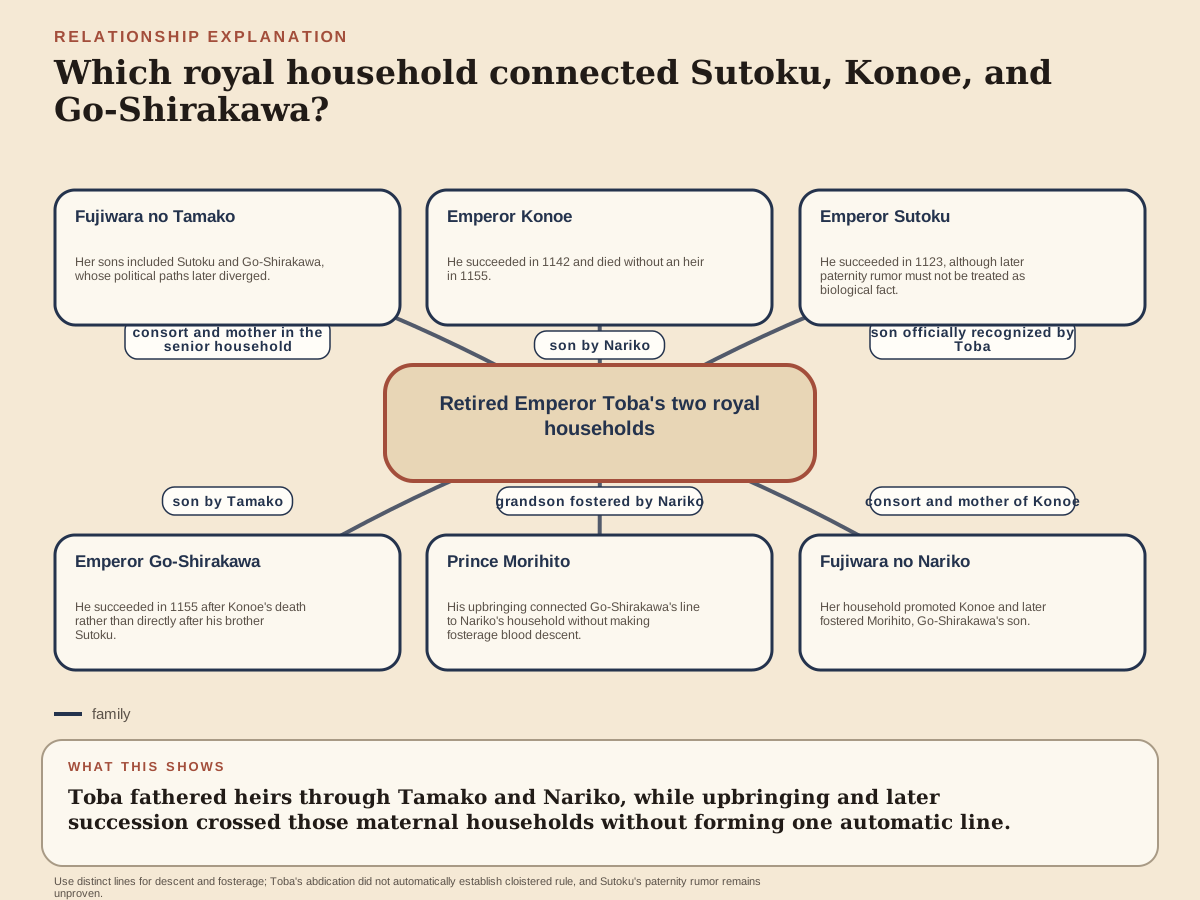
Toba founded Anrakuju-in in 1137 and prepared a tomb there in 1139. That year Nariko bore Narihito, the future Konoe, who became heir in infancy. Toba took Buddhist vows in 1141. At the close of that traditional year, corresponding to early 1142 in the Western calendar, Konoe replaced Sutoku. Nariko became empress and, in 1149, Bifukumon-in. Tamako, mother of Sutoku and Go-Shirakawa and a religious founder in her own right, died in 1145. Royal property also passed to Toba and Nariko’s daughter Princess Shōshi, later Hachijō-in, providing a foundation that continued beyond Toba's lifetime. [1][5][7][10][22][24]
Toba dedicated a hall for Amida Buddha at Anrakuju-in in 1147. Written prayers placed religious responsibility beside his position as the father of emperors. These texts were composed by scholars, whose different wording shaped the royal voice. In 1148, after a palace fire, Toba intervened in consultations about calendar prohibitions on rebuilding, citing Go-Sanjō's diary. His pilgrimage continued: a 1153 Kumano prayer accompanied an offering of a complete set of sutras written in gold. Kongōshin-in was dedicated in 1154, extending the palace-temple landscape in which he lived and exercised patronage. [10][12][13]
Tadazane favored his younger son Yorinaga, while the elder, Tadamichi, remained a powerful regent. Yorinaga became family head in 1150 and gained the right to inspect documents before they reached the emperor in 1151. That year his servants attacked Ienari's residence. Yet relations with Toba were still open to repair: Yorinaga arranged a healing ceremony for him in 1154. Konoe's death in 1155 brought accusations of sorcery and Yorinaga's loss of favor. Those accusations were political claims, not proof of supernatural harm. The imperial succession and the Fujiwara family dispute now converged. [12][17][18]
After Konoe died, Toba supported Masahito's accession as Go-Shirakawa, with Masahito's son Morihito placed in the succession. Nariko had taken Morihito as a ward, connecting this arrangement to her household. Sutoku and his son were excluded from the chosen line. Toba's health deteriorated, and he died at Anrakuju-in in 1156. Fighting in the Hōgen conflict followed his death, with Go-Shirakawa and Tadamichi facing Sutoku and Yorinaga. Toba's temples and donated estates endured through other custodians, but the ruler who had negotiated competing family interests was gone. [1][7][10][20][21][22]
Classic
Prince Munehito was born in 1103 to Emperor Horikawa and Fujiwara no Ishi, a daughter of Fujiwara no Sanesue. Designated crown prince in infancy, he became Emperor Toba after Horikawa died in 1107. The throne passed to a child within a court already accustomed to government by a retired sovereign. His grandfather Shirakawa had relinquished the imperial title decades earlier but remained the senior ruler. Toba's accession preserved that family's succession without bringing the child independent control of its politics. [1][2]
Fujiwara no Tadazane became regent for the young emperor in 1107. In 1113, he became kanpaku, the office associated with assisting an adult emperor, in the year of Toba's coming-of-age ceremony. The regent's office and Shirakawa's authority coexisted. Their presence matters because a reigning emperor, a retired emperor and a Fujiwara regent were different actors, even when court decisions linked their households. Calling the period simply Toba's reign would leave its governing relationships out of view. [1][16]
The distinction would acquire a second meaning after Toba's own abdication. He could become a retired emperor without becoming the senior retired ruler. Shirakawa was still alive and still able to direct the succession. The chronology therefore contains two separate changes: Toba surrendered the throne in 1123, then assumed senior retired authority in 1129. Between them lay six years in which his title had changed but his grandfather retained precedence. His adult marriage and the birth of a son took place before that second transfer of power. [1][3]
Tamako entered Toba's court in the twelfth month of 1117 and became chūgū, an empress title, in the following first month. She was Fujiwara no Kinzane's daughter, raised within Shirakawa's household. The marriage thus joined Toba to a woman whose upbringing connected her to the retired ruler as well as to her birth family. Their son Akihito was born in 1119. He would become Emperor Sutoku, while another of Tamako's sons, Masahito, would eventually become Go-Shirakawa. [3][4][5]
In 1123 Shirakawa directed Toba's abdication in favor of Akihito. The new emperor was still a small child. Toba's retirement did not terminate government by his grandfather; it added another retired sovereign beneath him. Succession was being arranged across three generations of the imperial family. Toba had borne the imperial title, but Shirakawa could determine when it passed to the next generation. The decision changed Toba's formal position while maintaining the senior ruler's command of the court. [1][3]
The unresolved question of Sutoku’s paternity
The family has subsequently attracted explanations centered on Sutoku's paternity. Rumors made Shirakawa his biological father, and modern scholars have differed over both the rumor's truth and the possibility that Toba believed it near the end of his life. Museum historian Enomura Hiroyuki explicitly leaves that question unsettled when examining Shirakawa's patronage of Sutoku's court.
Such conjectures cannot supply a documented emotional cause for every later succession decision. Tamako's upbringing, Akihito's birth and Shirakawa's direction of the 1123 abdication establish the immediate political relationships without settling the rumor. [4][23]
Looking beyond the abdication, Tamako’s own career also extended beyond this disputed paternity. She received the title Taikenmon-in, an honor for a high-ranking woman of the imperial court, in 1124 and founded Enshō-ji and Hōkongō-in. These titles and institutions gave her a place in the religious and political court that cannot be reduced to a question about her son's father. Toba's later marriages changed the distribution of access around him, but they did not erase the activities of the household formed during his reign. [4][5]
Shirakawa's death in 1129 made Toba the senior retired sovereign. He would exercise this position across the reigns of Sutoku, Konoe and Go-Shirakawa. The change was substantial, but it operated through court relationships and offices already available to retired rulers. A new senior household could select clients, renew ties and redistribute access. The throne remained occupied by another member of the imperial family. [1][2]
One important renewal concerned Tadazane. Political trouble under Shirakawa had removed him from the center of government in the early 1120s. After 1129 he recovered influence. His daughter Taishi became Toba's consort in 1133 and empress in 1134, although Toba was retired. The earlier marriage proposal had met Tadazane's refusal while Shirakawa was alive; acceptance under Toba belonged to a changed political setting. A consort's status could connect a Fujiwara household to the ruler directing affairs without requiring that ruler to occupy the throne. [6][16]
The Fujiwara family continued to supply major political actors. Tadazane's elder son Tadamichi held the regency, while his younger son Yorinaga would become a competing center of authority. Toba's restoration of relations with their father did not produce an enduring unity between the sons. Taishi, who later received the title Kayanoin, also possessed her own religious career and took vows in 1141. Her presence in Toba's household was more than a shorthand for her father's political recovery. [6][16][17]
Other courtiers rose through the retired government. Fujiwara no Ienari received provincial appointments, including posts in wealthy provinces, and attained third rank in 1136. He was Nariko's cousin, a relationship frequently used to explain his access to Toba. Appointments and rank, however, identify concrete channels of advancement; kinship alone cannot establish an unchanging alliance among everyone related to a consort. Later confrontations would involve Ienari's servants, the Fujiwara brothers and the retired sovereign's favor. [18]
Toba's religious activity began before he became the senior ruler. A prayer for his Kumano pilgrimage in 1125 supplies a dated starting point, and a later prayer in 1153 demonstrates its continuation. The intervening foundations expanded alongside his government after 1129. In 1132 Taira no Tadamori built Tokuchōju-in; the undertaking was associated with permission to attend the palace. Tadamori's provincial service and western anti-piracy activity placed him among the men through whom the retired court connected religious patronage to careers outside Kyoto. [12][14][15]
Shōkōmyō-in offers a more detailed view of a foundation's construction. Sculptor Ken'en, painter Ōgen and carpenter Suesada visited Byōdō-in in 1134 as preparations proceeded. Its famous hall devoted to Amida Buddha supplied a model. The new temple was dedicated in 1136 with both Toba and the reigning Emperor Sutoku present, and the Tendai monk Chūjin participated in the ceremony. An architectural model, specialist workmanship and the attendance of different imperial households met in one project. [10][11]
The supplies came through several channels. Maruyama Hitoshi's research summary distinguishes the governor of Iyo, Fujiwara no Tadataka, who provided important construction resources, from the court supervisor Minamoto no Morotoki. Provincial allocations supported work, while Toba supplied rare timber and labor drawn from his own estates. Officials were also involved in waterworks and other tasks. These details complicate an account in which a wealthy governor alone paid for a sovereign's temple: the project combined provincial responsibilities, court supervision and resources held by the royal household. [9]
Toba inspected the site and directed important points of the work. His role therefore extended beyond giving a foundation his name. The building then required an income that would continue after the dedication. Donated estates supplied ritual maintenance, and local donors could retain management responsibilities within the new arrangement. Patronage had a construction stage and a continuing administrative life. The temple depended on people who gathered materials, performed work, managed land and delivered revenue. [9]
These foundations also changed the palace landscape south of Kyoto. Maruyama treats the relationship between retired royal residences, temples and burial places as part of the period's urban transformation. That interpretation places Toba's worship within a material setting: buildings housed ceremonies, estates sustained them, and officeholders gained opportunities through their service. The temple's sacred purpose and its demands on government resources belonged to the same undertaking. [9][10]
Temple and household property grew while Toba's court also examined the validity of estate rights. The official history of Yukuhashi records proceedings concerning four Usa shrine estates between 1135 and 1141. Their documents moved through Dazaifu and the court. Fujiwara no Akiyori, a client close to Toba, held a senior post in the Dazaifu administration. Royal government could thus engage provincial claims through both formal documentary review and personnel linked to the retired household. [8]
The case prevents estate policy from being reduced to a single direction. Review could question privileges, but the same period saw donations enlarging the holdings of royal households and their temples. Existing public land and prior institutional rights did not disappear when a new protected estate was formed. The history of the Usa holdings records competition among such claims. Royal approval strengthened a donated estate's position while potentially placing pressure on another institution's revenues. [8]
Donation also involved bargains below the highest level of government. Maruyama's research identifies local donors and intermediaries who helped establish temple estates. For Kankikō-in, a foundation associated with Nariko’s vow, Toba ordered the submission of a donation deed for the Taki estate in Tanba province. A court woman known as Kaga and the donor Minamoto no Moroyuki mediated the arrangement. Moroyuki’s position as estate manager depended on supplying rents to fund Buddhist services. The court woman’s mediation, the donor’s undertaking and the royal foundation each supplied a necessary part of the relationship. Royal protection and local administrative responsibility were joined. An estate's place on a list of temple property therefore did not imply that the royal court directly performed every task on the land. [9]
The distinction among royal households remains essential. A later expansion affecting Usa property involved Seishō-ji, a vow temple of the retired Sutoku. That was not simply another estate personally acquired by Toba. Different members of the imperial family could hold institutions and property within the larger court. Toba's period of senior authority created opportunities for royal accumulation, but its beneficiaries and their claims must still be identified individually. The documentary court and the expanding household estate system overlapped without becoming one undifferentiated owner. [8]
Anrakuju-in was founded in 1137 within the Toba palace complex. In 1139 Toba prepared a tomb there, placing his future burial beside the religious establishment. The same period brought a new heir. Nariko bore Prince Narihito in 1139; he was designated crown prince in infancy. She became a titled consort that year and empress in 1141. Her son's position linked the future throne to a household different from Tamako's. [2][7][10]
Toba himself took Buddhist vows in 1141 and received the religious name Kūkaku. At the end of that traditional year, corresponding to early 1142 in the Western calendar, Narihito became Emperor Konoe, replacing Sutoku. Toba remained the senior retired ruler. The succession changed the occupant of the throne without giving the outgoing Sutoku the authority that Toba exercised. It also placed a son of Nariko, rather than another generation descending from Sutoku, at the center of the selected imperial line. [1][2][7]
Tamako's family and institutions continued alongside this change. She took vows in 1142 and died in 1145, after founding Enshō-ji and Hōkongō-in. Nariko received the female-in title Bifukumon-in in 1149. These women had different children, titles and foundations; their households supplied continuing religious activity and distinct connections to the throne. Describing them merely as an earlier and a later favorite would hide the institutions through which they acted. [5][7]
When did the first twelve estates pass to Hachijō-in?
Property arrangements reached royal daughters as well. Princess Shōshi, later known as Hachijō-in, received estates from her parents, Toba and Nariko.
Reference works differ over whether an initial transfer of twelve estates occurred in 1140 or at Toba's tonsure in 1141. Both place it before his death and connect it to Anrakuju-in property. The vast later Hachijō-in holdings accumulated through subsequent transfers and acquisitions; they should not be counted as a single donation made by Toba. [22][24]
The daughter who held this property would outlive her parents by decades. Religious maintenance and parental commemoration could therefore continue through a female royal custodian. Toba's foundations were bound to succession in two senses: a son occupied the throne, while other children and consorts received resources that sustained institutions beyond a particular reign. Their holdings were part of the family's future, even when their holders were not selected as emperors. [22][24]
Toba dedicated a nine-Amida hall at Anrakuju-in in 1147. The scholar Fujiwara no Naganori composed a prayer that connected the retired ruler's religious responsibility to his position as father of Sutoku and Konoe. Another writer, Fujiwara no Akinari, emphasized a quieter monastic life in a prayer for the same ceremony. Niki Natsumi compares these voices to show how a ruler's ceremonial identity could vary with the author. The first-person royal speaker was a literary construction prepared for a particular rite. [10][12]
Toba also used written precedent in government. After the Tsuchimikado-Karasuma palace burned in 1148, court deliberations considered whether calendar prohibitions prevented rebuilding. The regent Tadamichi, craftsmen and scholars participated in consultations concerning the status of the main residential hall. Toba cited Go-Sanjō's diary as support for postponing work. A record from an earlier emperor was being brought into a current decision about construction. [13]
Takuma Naoki identifies an error in that citation: Toba's statement confused the residential palace with the Daigokuden, whose main beam had actually been raised in a different year. The distinction changes the precedent's application. It also reveals the practical setting of royal learning. The question was which prohibition covered which building, and whether work should proceed. The consultation helped defer the project; later attempts at rebuilding met additional interruptions, and the palace was never restored. [13]
Ritual work continued alongside these administrative decisions. A 1153 Kumano prayer accompanied the offering of a complete set of sutras written in gold. Niki traces wording in Naganori's text to an earlier Kumano prayer composed by Fujiwara no Atsumitsu for Toba's 1125 journey. Scholars reused and adjusted a repertoire of ceremonial language across decades. Toba was the patron and participant, while the named writers supplied the texts through which his prayer was voiced. [12]
Kongōshin-in was dedicated in 1154. Archaeological research on the Toba complex identifies tiles made in several provinces and interprets waterways as likely transport routes for some supplies. Such material evidence complements the documentary picture of provincial contributions. It establishes the geographic reach of construction resources without showing that Toba personally arranged every shipment. His foundations continued to draw different regions into a religious landscape centered on the retired sovereign's residences. [10]
The renewed relationship with Tadazane's household had not settled authority within it. Yorinaga, the younger son favored by Tadazane, became head of the Fujiwara family in 1150. In 1151 he acquired nairan, the right to inspect documents before they reached the emperor. His elder brother Tadamichi retained the regency. These positions gave the brothers distinct forms of authority in the same court, and their rivalry concerned institutional access as well as their father's preference. [16][17]
In 1151 Yorinaga's servants attacked Ienari's residence. Hashimoto Yoshihiko notes that the later Gukanshō treated this conflict as one reason Toba grew distant from Yorinaga. That is a retrospective explanation of a documented confrontation, rather than a direct transcript of Toba's reaction. Ienari's position close to the retired sovereign made an attack on his household politically consequential, but the relationship between Yorinaga and Toba continued to change afterward. [12][18]
Yorinaga returned to a position in the retired administration in 1153. In 1154 he arranged a Medicine Buddha ceremony for Toba, who had fallen ill. He supplied the image and sutras, and Naganori wrote the prayer. Toba and Nariko attended. A man later grouped among Toba's opponents was, at this point, organizing religious work for the ruler's recovery. The chronology matters: a family connection or a later battlefield alignment cannot substitute for the changing relations of these years. [12]
Illness could also affect the preparation of ceremonial words. At a memorial rite arranged by Taishi in 1154, Naganori's prayer included language concerning Toba's health that another writer's text omitted. Niki suggests that the addition responded to his recent illness and may have sought renewed favor. The suggestion remains an interpretation of textual preparation and court circumstances. It does not prove that Toba dictated the addition or reveal his response on hearing it. [12]
Konoe's death in 1155 transformed the political setting. Accusations of sorcery helped discredit Yorinaga and accompanied his loss of favor. They were allegations about responsibility for a crisis, not evidence that supernatural harm had occurred. The Fujiwara dispute now met an imperial succession in which Sutoku's prospects and Nariko's household interests were also at stake. Toba had to select a line of succession amid divisions that had grown within the government he headed. [7][17]
After Konoe died in 1155, Toba supported Prince Masahito's accession as Emperor Go-Shirakawa. Masahito's son Morihito, the future Nijō, was positioned as successor. Nariko had taken Morihito as a ward, a yūshi relationship that brought him under her guardianship without changing his imperial parentage. The settlement connected the father who would immediately occupy the throne to the son favored for its future. [7][20][21]
Go-Shirakawa's accession therefore needs to be read with Morihito's designation. The choice excluded Sutoku and his son from the selected route to the throne. Toba, Nariko and Tadamichi supported the resulting arrangement. Scholarship summarized in the reference biographies emphasizes Morihito's intended succession when explaining why his father first became emperor. That gives the decision a concrete dynastic structure without requiring an invented account of Toba's private feelings toward every candidate. [20][21]
Toba's health deteriorated, and he died at Anrakuju-in in 1156. The site joined the foundation he had established in 1137 to the burial he had prepared during his lifetime. The Imperial Household Agency now designates Anrakujunomisasagi as his tomb. Its present designation identifies the commemorative site; the medieval chronology supplies the separate evidence for his foundation, burial preparations and death there. [1][10][19]
The Hōgen conflict followed his death. Go-Shirakawa and Tadamichi confronted Sutoku and Yorinaga, and military force decided the immediate contest. Toba's final settlement had favored one succession line, but it had not reconciled the excluded imperial household with its Fujiwara allies. The fighting belongs to the surviving actors' careers. Its timing nevertheless reveals what changed when the senior retired ruler who had mediated political access was removed. [17][21]
Other parts of his government lasted longer than that settlement's peace. Estates passed through Nariko and their daughter, and religious institutions continued to require custodians and revenues. Toba left buildings, documentary arrangements and family-held resources alongside a divided court. The continued life of these institutions depended on the people who inherited and maintained them. [22][24]