Read the article below. Interactive reading tools are available when scripts load.
Quick
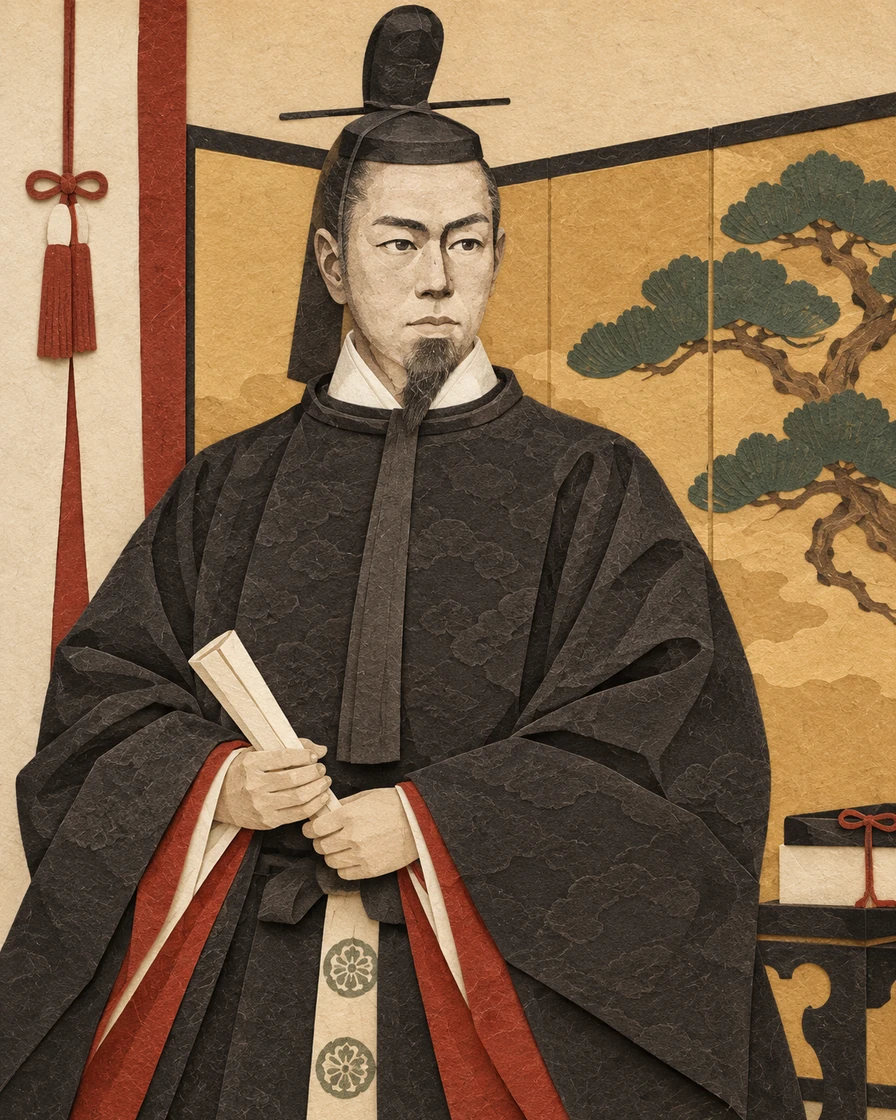
Born Prince Osahito in Kyoto in 1831, the future Emperor Kōmei was Emperor Ninkō’s fourth son. His mother was Fujiwara Naoko of the Ōgimachi family. He was designated heir in 1835, became crown prince in 1840 and succeeded his father in 1846; the enthronement ceremony followed in 1847. The imperial court conducted rites and conferred ranks, while the Tokugawa shogunate, Japan’s warrior government, held much of the country’s administrative and military power. Kōmei practiced poetry and court learning within this division of authority. In 1852 his son Mutsuhito, the future Emperor Meiji, was born to the court woman Nakayama Yoshiko. Court rites and the upbringing of an imperial heir formed part of his life alongside foreign-policy disputes. [1][2][3][4]
Soon after accession, Kōmei urged the shogunate to strengthen coastal defense. He accepted the limited agreement with the United States in 1854, but withheld approval for the commercial treaty sought in 1858. Opening trade and wider foreign residence raised different concerns from supplying visiting vessels. Senior councilor Hotta Masayoshi came to Kyoto seeking sanction and left without it. By asking, the shogunate had brought the emperor’s decision into a major foreign-policy procedure. Ii Naosuke’s government nevertheless authorized signature. Kōmei protested and expressed an intention to abdicate. The treaty remained in force, while its lack of prior sanction gave domestic opponents grounds to question the government’s obedience to the court. [1][2][3][5]
In the traditional eighth month of 1858 an imperial rescript criticizing treaty policy reached Mito, a Tokugawa domain in present-day Ibaraki, directly as well as the shogunate. It called for consultation with the three senior Tokugawa branches over the foreign challenge. Direct communication with a domain bypassed the usual shogunal hierarchy, giving the document political weight beyond its words. Naosuke’s own copy survives among the Ii family papers. His government investigated the people connected with the rescript, while the broader Ansei Purge punished opponents of its treaty and succession decisions. Kōmei’s command sought correction and cooperation; its route nevertheless opened a struggle over who could carry imperial instructions into action. [5][1][3]
After Naosuke’s assassination in 1860, the shogunate sought reconciliation through the marriage of Kōmei’s younger half-sister Kazunomiya to Shogun Tokugawa Iemochi. She was already betrothed to Prince Arisugawa Taruhito and initially resisted. Kōmei agreed with expectations that the shogunate would restore restrictions on foreign relations. In 1861 he formally declared her an imperial princess and gave her the name Chikako; his handwriting of the name survives. She traveled to Edo that year, and the wedding took place in the traditional second month of 1862. The marriage created a close family channel between the two institutions, while the foreign treaties and the unfulfilled promise remained. [1][3][6][7]
Kōmei sought shogunal reform and Iemochi’s presence in Kyoto. Tokugawa Yoshinobu, previously a defeated succession candidate, returned as guardian of the shogun, while Matsudaira Yoshinaga gained a senior reform role. Iemochi came in 1863 and accompanied the emperor to the Kamo shrines for expulsion prayers. Kōmei also visited Iwashimizu Hachiman; Iemochi was absent from that procession, with illness given as the reason. The shogunate promised action against foreign access, but the domains and Tokugawa officials did not carry out one unified policy. Personal attendance strengthened the emperor’s ability to demand an answer, while ceremonial agreement left the means of fulfilling it unresolved. [1][2][3][15]
In 1863 Kōmei supported the removal of Chōshū’s influence and activist nobles from Kyoto’s court politics. Prince Nakagawa, later known as Prince Asahiko, worked with court allies, Matsudaira Katamori, the shogunate’s Kyoto protector, and troops of Aizu and Satsuma. The action is known by the traditional date of the eighteenth day of the eighth month. Chōshū lost its palace-guard responsibility, and nobles including Sanjō Sanetomi fled to the domain. Kōmei still sought limits on foreign access, but opposed the activists’ direction of government. The exclusion did not end their political activity. Chōshū forces fought at the palace approaches in 1864, and campaigns against the domain followed. [1][2][8]
In 1865 a British, American, French and Dutch fleet pressed for imperial approval of the existing commercial treaties and early opening of Hyōgo, near present-day Kobe. Tokugawa Yoshinobu, Katamori and Matsudaira Sadaaki negotiated with senior courtiers. Kōmei finally sanctioned the treaties, but withheld approval for Hyōgo’s early opening. The two decisions were distinct, leaving a boundary to the concession. He continued to place trust in Yoshinobu. When Iemochi died during the second Chōshū campaign in 1866, Kōmei instructed the shogunate to stop the fighting. Yoshinobu became shogun, and the court–Tokugawa relationship continued under a new ruler while military and diplomatic constraints intensified. [9][10][1][2][3]
Kōmei died after contracting smallpox on 30 January 1867, the twenty-fifth day of the twelfth month of Keiō 2 in the traditional calendar. Later interpretations dispute whether disease alone explains his sudden ending; poisoning remains a debated claim rather than an established plot. His son Mutsuhito’s accession ceremony followed on 13 February, with the shogunate still in existence. Kōmei was buried at Nochi-no-Tsukinowa-no-Higashi-no-Misasagi in Kyoto. His poems, diaries and political records survived, later gathered in an official biography. The reign had enlarged the court’s practical role through refusals, appointments, family cooperation and qualified assent, while leaving the future arrangement of government to others. [1][2][3][4][11][12][13][14]
Classic
The future Kōmei was born Osahito in Kyoto in 1831, the fourth son of Emperor Ninkō. His mother, Fujiwara Naoko, was a daughter of Ōgimachi Sanemitsu and later received the title Shin-Taikenmonin. Recognition as heir in 1835, declaration as crown prince in 1840 and succession in 1846 marked different formal stages. The enthronement ceremony came in 1847. [1][2][3][4]
The imperial court conferred ranks, sanctioned important appointments and performed dynastic and religious rites. The Tokugawa shogunate, the warrior government based in Edo, now Tokyo, managed major military, territorial and foreign affairs through its own officials and the domain lords. Kōmei occupied a sovereign office of high standing without direct command of the domain armies. His instructions therefore required communication and cooperation with people who controlled administrative and armed resources. The boundary between the institutions would become harder to maintain when the shogunate sought imperial authorization for a treaty. [1][3][5][8][9]
Kōmei composed waka, the court’s short poetic form. His writings included responses to a flower gathering and to movement after the imperial palace burned in 1854. His handwritten poetry collection, titled 此花詠集, survives in thirteen volumes, alongside fragments of diaries and other royal writing. His son Mutsuhito was born in 1852 to the court woman Nakayama Yoshiko; Kōmei’s consort Kujō Asako became the child’s recognized mother. The surviving writings and family relationships give the reign a cultural and dynastic setting, while the government’s growing demands made the court’s position a matter of national dispute. [2][3][14][16]
In 1846 Kōmei sent the shogunate an instruction calling for stricter coastal defense. Foreign relations thus entered his reign before the 1858 controversy. The limited United States agreement of 1854 and the later commercial treaty were different arrangements. Acceptance of the former did not settle whether foreign trade and enlarged access should follow. The court viewed expanded contact through concerns over defense and the country’s sacred standing, as well as through the government’s practical negotiations. These considerations gave the emperor reasons to resist a proposal whose military consequences were being handled chiefly by Tokugawa officials. [1][2][3]
Senior councilor Hotta Masayoshi sought authorization for the American commercial treaty in 1858. Kōmei withheld it and called for discussion among the domain lords. Court nobles also opposed the proposal. The shogunate’s request had made an imperial decision part of a field largely managed through its own foreign officials. Refusal could therefore be understood as an obstacle to a legitimate domestic procedure, even though the court did not conduct the negotiations or control the force needed to resist foreign pressure. The dispute connected a treaty text to the distribution of authority within Japan. [1][3][5]
Ii Naosuke’s government proceeded with signature without prior imperial sanction. Kōmei protested and expressed a wish to abdicate. He subsequently accepted an explanation that presented the agreement as a temporary necessity while military preparedness improved. This accommodation after signature differed from the advance authorization Hotta had sought. The international undertaking and the domestic dispute could continue together: foreign representatives treated the treaty as an obligation, while opponents inside Japan challenged the procedure by which their government had accepted it. [1][3][5]
The Hikone Castle Museum preserves a copy in Ii Naosuke’s hand of the rescript dated the eighth day of the eighth traditional month of 1858. Known as the Bogo secret rescript, it criticized the shogunate’s treaty conduct and called for consultation with the three senior Tokugawa houses. The copy belongs to the Ii family documents, so the command survives within the records of the government leader it criticized. It gives the conflict a material form: an imperial instruction could be copied, retained and used by participants whose positions differed. [5]
The rescript went to Mito, a Tokugawa domain in present-day Ibaraki, as well as the shogunate. Domain governments ordinarily received political direction through the Tokugawa center; direct delivery from the court crossed that administrative principle. Mito’s recipients could carry imperial criticism into a setting already divided over treaty policy and the next shogun. Naosuke’s officials reacted by searching for the people involved. The instruction’s authority and its means of transmission became inseparable, because its route offered a way for a domain to claim a purpose received outside the normal chain of government. [5][1][3]
Kōmei’s criticism called for consultation and a better response to foreign pressure. His later support for cooperation with the shogunate is consistent with that demand for corrected government. The rescript was nevertheless drawn into investigations and the suppression of opponents associated with the Ansei Purge. After Naosuke’s assassination in 1860, the shogunate sought reconciliation with the court through a marriage alliance. [5][1][3]
Kazunomiya, Kōmei’s younger half-sister, had been betrothed to Prince Arisugawa Taruhito in 1851. The later proposal to marry her to Tokugawa Iemochi therefore required the release of an existing agreement as well as movement from Kyoto to Edo. She initially refused. Following Naosuke’s assassination, the shogunate wanted a visible connection that could repair its standing with the court. Kōmei accepted the marriage as part of cooperation between court and warrior government, with a condition concerning the reversal of foreign access. His roles as emperor and brother now involved a decision that changed his sister’s expected life. [1][3][6][7]
In the traditional fourth month of 1861 Kazunomiya received formal declaration as an imperial princess and the name Chikako. Kazunomiya’s imperial birth and her formal declaration as a princess were separate stages. Kōmei’s own written characters for the name survive in the Imperial Archives, associated with the official Hamuro Nagatoshi, who served in the arrangements for her journey. The documents connect the emperor’s authorization to the practical work of court personnel. Rank, name and attendants were part of the household the princess would carry into a warrior ruler’s residence. [6][7]
Kazunomiya reached Edo in 1861 and subsequently entered the castle. Her wedding to Iemochi occurred on the eleventh day of the second traditional month of 1862; a city notice afterward announced her title as the shogun’s principal wife. The wedding completed arrangements begun with court authorization and her departure from Kyoto. The foreign treaties remained operative. Kōmei had gained a close relationship with the ruling Tokugawa household, while retaining an expectation that it would implement a policy it had still not fulfilled. The family alliance therefore carried an unresolved obligation into subsequent audiences and negotiations. [7][1][3]
In 1862 Kōmei pressed for reform involving Tokugawa Yoshinobu and Matsudaira Yoshinaga, the former Echizen lord. Yoshinobu returned to office as guardian of the shogun; Yoshinaga received a senior responsibility for reform. These personnel changes placed men with significant Tokugawa and domain connections near Iemochi. Kōmei sought a government capable of carrying out the court’s purposes, including its demands over foreign relations. His instructions operated through appointments and cooperation with warrior leaders, whose influence and administrative experience were resources the court needed. [1][3]
Iemochi traveled to Kyoto in 1863 and accompanied Kōmei to the Kamo shrines for prayers associated with expulsion. Kōmei’s later journey to Iwashimizu Hachiman was a separate procession: the shogun did not accompany it, with illness given as the reason. The emperor’s movements brought ritual purpose outside the palace, while the shogun’s attendance acknowledged a court demand for his presence. The processions publicly affirmed the court’s demand for expulsion, while its execution remained a task for warrior officials and domain governments. [1][2][3][15]
The shogunate pledged to carry out expulsion while continuing to face its foreign treaty obligations. Domain governments controlled armed resources and interpreted the demand through their own circumstances. Kōmei could insist that the warrior government answer for the promise attached to the marriage, but its fulfillment required decisions by people beyond the audience. The gap between a declared purpose and coordinated action deepened contention in Kyoto. Activist nobles and Chōshū’s representatives pressed their own course, while the emperor grew resistant to their control of court politics. [1][2][3][8]
Activist nobles and Chōshū representatives had pushed for a journey to Yamato associated with an imperial expulsion campaign. Kōmei opposed their hold over court politics while continuing his own commitment to restricting foreign relations. He continued to favor cooperation with the shogunate, placing him at odds with activists seeking to direct the court’s next actions. Prince Nakagawa, later Prince Asahiko, and senior court allies worked with officials and domains supporting cooperation. The palace became a place where political access could determine which proposals reached the emperor. [1][2][8]
On the eighteenth day of the eighth traditional month in 1863, Aizu and Satsuma troops secured the palace while court allies altered its political arrangements. Matsudaira Katamori, lord of Aizu, held the shogunate’s Kyoto protectorate. Chōshū’s responsibility for guarding the Sakai-machi gate was removed, and activist nobles were barred from attendance. Kōmei approved the change. Sanjō Sanetomi and other nobles left with Chōshū’s men. Kōmei’s authorization was enforced at the palace gates by troops supplied by Aizu and Satsuma. [8][1][2]
Chōshū’s loss of court access did not abolish its domain government or the exiles’ political ambitions. Fighting reached the palace approaches in 1864, followed by punitive campaigns against Chōshū. Aizu’s role had made service to Kōmei and the shogunate compatible in the immediate coalition. Satsuma was then its partner, although later alliances would change. Kōmei continued to favor cooperation through Tokugawa and powerful domain leaders. Keeping the palace under that coalition’s control narrowed the activists’ means of action while helping turn their exclusion into another source of conflict. [1][2][3][8]
In 1865 representatives of Britain, the United States, France and the Netherlands brought a fleet to the Hyōgo area and demanded sanction of the 1858 commercial treaties along with early port opening. The shogunate could no longer treat domestic authorization as a matter separate from the foreign powers’ demands. Kyoto’s proximity made access through Hyōgo and Osaka particularly sensitive to the court. [9][10][3]
Tokugawa Yoshinobu, charged with palace defense, Matsudaira Katamori, the Kyoto protector, and Matsudaira Sadaaki, the shogunate’s Kyoto deputy, worked with the regent Nijō Nariyuki and other courtiers. Kōmei granted treaty sanction in 1865 while refusing the early opening of Hyōgo. The decision accepted the commercial agreements he had resisted in 1858 without conceding every demand now attached to them. Formal approval reduced one dispute over authorization. It left the port question to further negotiation, eventually resolved only after his death. [9][10][3]
The second campaign against Chōshū in 1866 brought military reverses to the shogunate. Iemochi died during the undertaking, and Kōmei instructed that fighting cease. Tokugawa Yoshinobu subsequently became shogun. The emperor had continued to seek correction through a cooperative Tokugawa government, but war and diplomatic demands narrowed its capacity. These changes gave his final period an unsettled setting: a recently conceded treaty relationship, an unopened port and a new shogun whose ability to restore authority remained untested. [1][2][3][9][10]
Historical disagreement · What caused Emperor Kōmei’s death?
Kōmei contracted smallpox and died on 30 January 1867. Some later historians argued for poisoning from the abrupt change in his condition. Other scholarship, notably Haraguchi Kiyoshi’s argument as described by the historian Machida Akihiro, explained the death through severe smallpox. Machida’s 2022 review judges the disease explanation predominant while acknowledging that the controversy has not been decisively closed.
The records attest his smallpox; the later debate has not established a particular poisoning plot. [2][3][11]
The Imperial Household Agency pairs the traditional date, Keiō 2’s twelfth month, twenty-fifth day, with 30 January 1867. The apparent difference between references ending the reign in 1866 and those using 1867 comes from the calendar boundary. The Seiryōden, a ceremonial hall of the imperial palace, was used for the late emperor’s funeral, and the Kogosho, another palace building, was temporarily arranged for Mutsuhito’s accession ceremony on 13 February. Existing furnishings and court offices supplied continuity while a new sovereign took his place. The dynasty’s succession proceeded before the later abolition of the shogunate and creation of the Restoration government. [12][3][4]
Kōmei’s burial place lies at the imperial tomb near Sennyū-ji in Kyoto. His poetry, diary fragments and other writings preserve parts of a life spent in court practice. The official Kōmei Tennō Ki was assembled decades later, through a project begun in 1891 and completed in the early twentieth century. It arranged events chronologically with cited source materials; later publication widened its use by historians. The compilation is a route to earlier evidence, with its own history of collection and arrangement. The biography brings together earlier records rather than supplying a single contemporary account of the reign. [4][3][13][14]
Kōmei’s reign made the emperor’s judgment increasingly consequential in treaty policy, appointments and Kyoto’s political alignments. His refusal in 1858, support for his sister’s marriage, approval of the 1863 exclusion and limited concession in 1865 were different decisions within an effort to preserve court authority through cooperation. The outcome after his death diverged from that arrangement. Kōmei could withhold assent or authorize appointments, but the enactment of his decisions continued to depend on the warrior leaders with whom he worked. [1][2][3][5][7][8][9]