Read the article below. Interactive reading tools are available when scripts load.
Quick
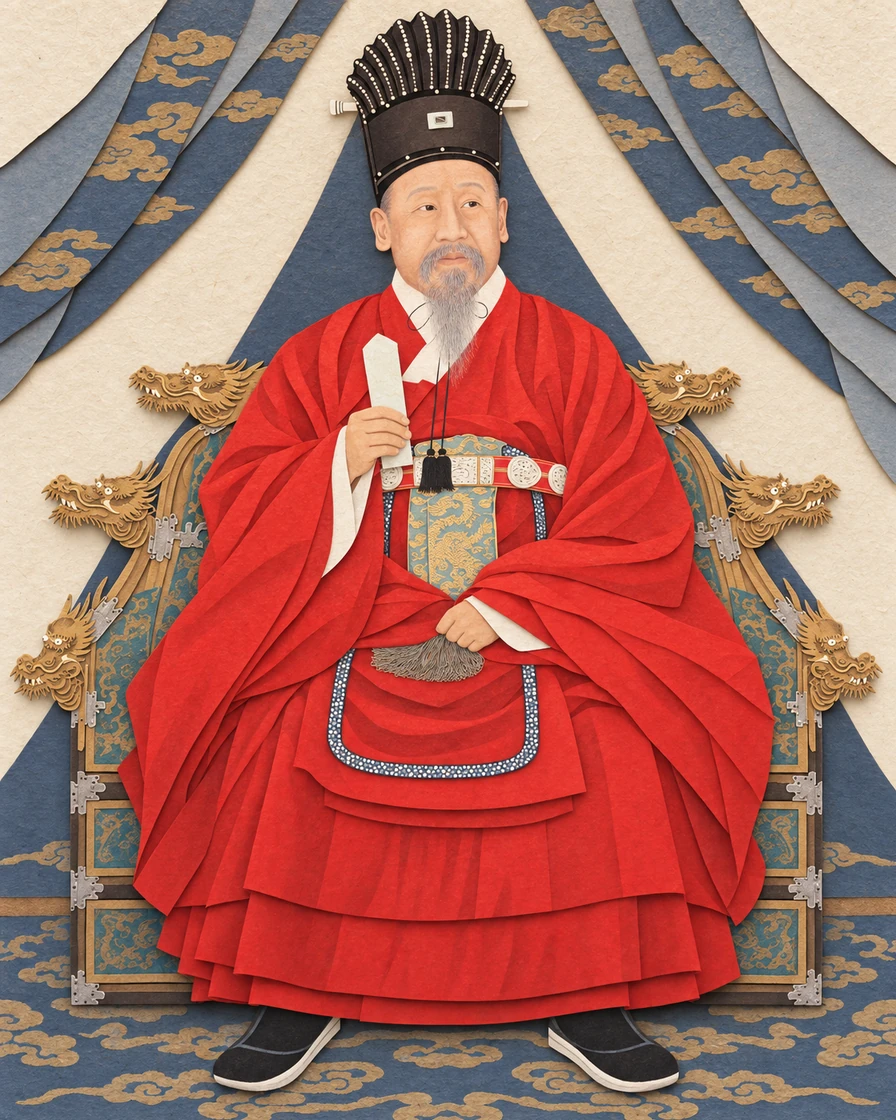
Gojong, a king of Korea’s Joseon dynasty, was born in Seoul in 1852, a younger son of Yi Ha-eung, the royal kinsman later known as the Heungseon Daewongun, a title for a king’s father who had not reigned. After King Cheoljong died without an heir, Dowager Queen Jo selected him to continue the line of her late husband, Ikjong. Korean traditional chronology places his accession in 1863. The child king’s authority initially rested with a senior dowager and his father. He married Queen Min in 1866. Although the dowager’s formal regency ended that year, the Daewongun retained political dominance until 1873, when Gojong and allies established more direct control. [1][2]
Gojong’s government moved toward foreign opening after his father’s loss of power. Japanese military pressure preceded the 1876 Ganghwa treaty, which established new relations and opened ports. Missions to Japan investigated its administration and imported knowledge of foreign institutions. The court created a coordinating office for new affairs and a modern military unit, the Byeolgigun. Officials also pursued weapons-manufacturing instruction through Qing China. These measures involved learning from different neighbors while attempting to strengthen Korea’s own government. They drew opposition from conservative scholars and left older soldiers facing worse treatment than the new force. [1][3]
In 1882 unpaid older soldiers and urban residents rebelled in Seoul. Soldiers had gone thirteen months without wages and received spoiled or adulterated rice when payment finally came. The revolt attacked officials and Japanese personnel and threatened the queen, who escaped. Gojong handed political control to his father to contain the crisis. Qing troops then intervened, seized the Daewongun and took him to China. The queen’s governing network returned, but Qing forces and advisers remained. Restoration of the court’s position came together with stronger foreign interference and new advantages for Qing merchants. [3][2]
In December 1884 Kim Ok-gyun and allied reformers staged the Gapsin coup with support from Japan’s representative. They sought to break Qing influence and construct a stronger modern state through rapid political change. Court rivals were attacked and a new administration announced reforms. Qing troops defeated the coup within three days; surviving leaders fled to Japan. Gojong’s court was preserved against another challenge, yet its dependence on Qing force deepened. Reform now carried competing political projects: some officials worked within the court’s existing alliances, while radicals tried to overthrow the network controlling it. [4][1]
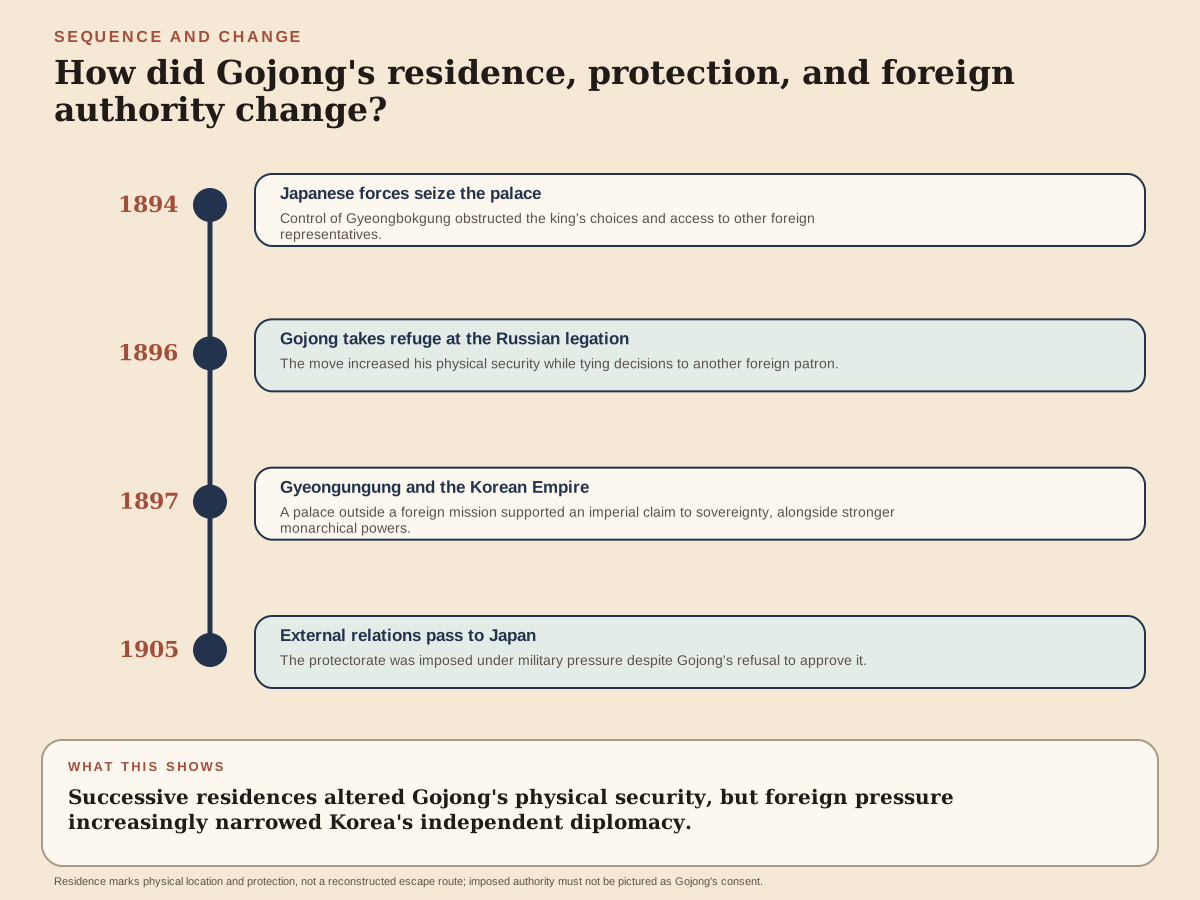
The Donghak peasant uprising in 1894 led the royal government to request Qing military help. Japan also sent troops and pressed for Korean reforms. On 23 July Japanese forces attacked Gyeongbok Palace, displacing the court’s control and bringing the Daewongun forward again. Gojong asked foreign representatives to visit him and seek their governments’ assistance. The appeals did not prevent war between Japan and Qing. Korean reforms proceeded under a changed distribution of power, with the king’s freedom restricted by soldiers and officials from outside the country. [1][5][6]
On 8 October 1895 a Japanese-led attack organized by Japan’s minister Miura Gorō killed Queen Min in the palace. Her body was burned. The loss removed Gojong’s wife and a political collaborator. In February 1896 he moved to the Russian legation, changing the court’s physical protection and its governing allies. Russian support countered Japanese pressure but increased opportunities for foreign concessions and influence. Public demands urged his return and stronger independence. He moved to Gyeongungung Palace in February 1897 and later that year founded the Korean Empire, granting the murdered queen a posthumous imperial title. [7][1][8]
In October 1897 Gojong proclaimed the Korean Empire and became its first emperor at Hwangudan, the altar for rites to Heaven. The Gwangmu reign name expressed a new sovereign position after the older relationship with Qing had ended. Reformers also demanded public deliberation and protection against foreign concessions. Gojong at times accepted reform demands, but in 1898 the court suppressed the Independence Club and popular assemblies. The 1899 state code declared the empire independent while assigning broad governing powers to its monarch. Imperial sovereignty and popular participation followed different paths. [8][9][10][1]
Gojong’s government pursued land surveys and official ownership documents during the Gwangmu period. A land-deed office established in 1901 administered new certificates and transactions; issuance expanded in 1902. The system sought more reliable holdings and tax records while restricting foreign land ownership outside treaty ports. Surviving 1903 deeds show the process reaching particular owners. Registration also gave officials power over recognized claims and exposed people without the required documents to penalties. These projects supply evidence of Korean institutional change before colonization, while their uneven implementation and fiscal demands remain part of the assessment. [11][8]
The Russo-Japanese War brought stronger Japanese military pressure and imposed agreements on Korea. In November 1905 Japan established a protectorate despite Gojong’s refusal to approve it. Korean foreign minister Pak Che-sun and Japanese envoy Hayashi Gonsuke signed the agreement; it transferred Korea’s external relations to Japan and created a Resident-General, a Japanese official supervising diplomatic affairs. Gojong sought help through secret diplomacy and sent Yi Sang-seol, Yi Jun and Yi Wi-jong to the 1907 Hague Peace Conference. They gained publicity but were denied official participation. Japanese pressure and Korean ministerial action then forced his abdication in July. His son Sunjong succeeded him. [1][12][13]
After abdication Gojong retained an imperial retirement title but no effective sovereignty. Japan’s 1910 annexation replaced the protectorate with colonial government and recast the royal family’s rank. He lived on in Seoul until his death in 1919. Rumors that Japanese agents had poisoned him heightened anger; they do not establish the cause of death. Mourning and the approaching royal funeral helped gather people amid the wider independence organizing that produced the March First Movement. His life ended after the empire he had founded had disappeared, while his memory entered a movement for a different political future. [1][14]
Classic
Born as Yi Myeong-bok in Seoul in 1852, Gojong belonged to a branch of the Yi house ruling Korea’s Joseon dynasty. His biological father, Yi Ha-eung, was not a reigning king. His mother came from the Yeoheung Min family. Selection after the childless Cheoljong’s death gave him a dynastic position beyond this household: he was recognized as continuing the line of Ikjong, the late husband of Dowager Queen Jo, through her decision. Birth and legally recognized royal succession performed different functions. [1]
The dowager governed formally on behalf of a minor, while Yi Ha-eung acquired the title Daewongun and substantial influence in government. Her withdrawal from the regency in 1866 did not immediately end his dominance. The title marked a king’s father who had not himself reigned. The difference between formal possession of kingship and effective decision-making would recur throughout Gojong’s life. [1][3]
His 1866 marriage brought another Min household into the center of court politics. Queen Min became a political collaborator, drawing on relatives and officials whose influence competed with the Daewongun. In 1873 criticism of royal kinsmen’s interference, including a memorial by scholar Choe Ik-hyeon, helped remove his father from dominant political control. Gojong’s more independent rule therefore grew through court alliances and conflict within his own family. A marriage later remembered through the queen’s violent death first supplied relationships through which the king could govern. [1][2]
Korea’s new treaty relations developed under force as well as negotiation. Japan used the 1875 Un’yō warship incident to press for the Ganghwa agreement in 1876. Gojong and Queen Min’s governing network accepted opening after the Daewongun’s earlier exclusionary policies. Officials and scholars disagreed over whether foreign contact offered necessary resources or threatened the political and moral order. Opening did not settle which institutions should change or who should control them. [3]
The missions sent to Japan in 1876, 1880 and 1881 gathered information about a neighboring government already reorganizing its offices and armed forces. The court’s Tongni Gimu Amun coordinated new military and diplomatic affairs. Sending observers required officials able to interpret what they saw and turn reports into appointments, training and expenditure. Korea also sought weapons-manufacturing knowledge from Qing China, so the flow of expertise was wider than imitation of Japan alone. [3]
The Byeolgigun, a new military unit, received Japanese-style training while older military formations were reduced. New institutions needed money, equipment and selected recruits. Older soldiers could lose work or find themselves receiving inferior treatment. The state’s effort to strengthen its army thus changed the livelihood of men who already served it. Military modernization created a division within the forces on which royal security depended; this consequence became urgent in 1882. [3]
The Imo mutiny in Seoul in 1882 grew from arrears, military restructuring and urban hardship. Older soldiers’ families depended on wages and small trades; many lived among the capital’s poorer residents. Payment after thirteen months arrived in rice of inadequate quantity and quality. Arrest of protest leaders intensified resistance. Anger against officials who administered pay expanded into attacks on politically influential households, commercial monopolies and Japanese personnel. [3]
The mutineers entered the palace and searched for Queen Min. She escaped while Gojong surrendered practical control to the Daewongun. His father reversed opening-era institutions and restored older military arrangements. The throne survived, but the king could not determine the immediate political settlement through ordinary command. The revolt joined men’s claims to subsistence to an older struggle over who governed around the monarch. [3][2]
Qing troops suppressed the revolt and carried the Daewongun to Tianjin. Their intervention restored the queen’s network while leaving troops and foreign advisers inside Korean government. New trade regulations strengthened Qing commercial access and asserted a subordinate relationship. Japan also demanded compensation and more favorable arrangements. A court recovered from domestic revolt now faced more intrusive claims by both neighbors. Dependence on assistance had consequences extending beyond the defeat of the mutineers. [3]
Reform officials in Korea divided after Qing’s 1882 intervention. Some accepted cooperation with the restored court and Qing advisers. A group led by reform official Kim Ok-gyun considered that framework an obstacle to Korean independence and rapid reform. Japanese support offered armed assistance against Qing’s stronger position in Seoul. Seeking such backing did not eliminate the reformers’ own project, but it made the attempt depend on a neighboring government with interests of its own. [4][3]
The coup began during a celebration at the postal administration in December 1884. The group attacked powerful court figures, formed a government and issued a reform program. Its control lasted only three days before Qing military action overturned it. Leaders were killed, punished or escaped to Japan. Gojong remained king, but the episode showed how rapidly control of the court could change when reform factions acted with foreign armed support. [4]
The program recorded in the Gapsin illok called for ending privileges based on family pedigree, reforming the land tax and concentrating state finances in the Board of Taxation. It also proposed combining four military commands and selecting men for a royal guard. Daily meetings of senior ministers were to turn deliberation into government orders. These measures would have changed recruitment, revenue and the forces surrounding Gojong, as well as Korea’s relations with Qing. The surviving fourteen articles describe a program announced during the coup, rather than reforms shown to have taken lasting effect in those few days. [4]
The failure narrowed the immediate space for radical reform and strengthened the court’s reliance on Qing protection. Neither opening nor royal survival resolved the rivalry between Japan and Qing over Korea. The king’s government had to work through officials whose visions of reform differed and foreign representatives able to back those differences with troops. Gojong’s later search for other diplomatic partners developed within this crowded political field. [4][1]
The Donghak peasant uprising in Korea in 1894 challenged a royal government already weakened by factional struggles and outside intervention. Qing troops entered at the court’s request; Japan deployed its own force and made reform demands. Japanese officials presented intervention through the language of Korean independence and administrative improvement. The Korean government nevertheless faced the immediate question of whether it could decide what foreign forces should do on its territory. [1][6]
US envoy John M. B. Sill reported on 24 July 1894 that Japanese forces had seized the palace the previous day and compelled the presence of the king’s father. Gojong called the foreign representatives to an audience. They passed Japanese guards and agreed to cable their governments for good offices. Sill’s dispatch also records refugees entering the American legation and his concerns about communications and neutrality. These practical details show how palace control and foreign access could obstruct the sovereign’s choices. [5]
Evidence boundary · What a foreign envoy could report
Sill wrote from the position of a foreign official protecting his mission and nationals; his account is not an unrestricted view of Korean politics. It does preserve a royal effort to seek an alternative to Japanese armed control. Japanese telegram descriptions separately connect the palace operation to military command and the envoy’s communication with Foreign Minister Mutsu Munemitsu. The king’s appeal, diplomatic reporting and army attack were different acts in the same crisis. The war altered Korea’s position before Japan and Qing settled their conflict by treaty. [5][6]
After Japan’s victory over Qing, Russian, French and German intervention required Japan to return Liaodong. The Korean court sought closer Russian support against Japanese pressure. Japan’s minister Miura Gorō organized the October 1895 palace attack that killed the queen. Her political influence and family relationships had helped Gojong govern; her assassination combined the destruction of a court actor with a direct loss inside his household. [7][2][1]
Evidence boundary · A court outcome and evidence of a killing
Jeong Gyo’s later chronicle reconstructed the attack with material from Japanese and Korean court proceedings. Its account was shaped by resistance to Japanese domination. Japanese defendants were released after proceedings found the evidence insufficient.
That legal outcome did not undo the palace killing, also described by foreign men present during the assault. Reconstruction of private planning and testimony by people inside the palace provide different kinds of evidence. [7]
The move to the Russian legation in February 1896 gave the king physical security outside his palace and removed a pro-Japanese governing arrangement. It also tied decisions to new patrons while foreign concessions accumulated. The Independence Club and other public voices pressed for a palace return and a more independent position. In February 1897 Gojong took up residence at Gyeongungung, the palace now called Deoksugung. A royal residence outside either foreign mission supplied a setting for his subsequent imperial proclamation. [1][8]
Proclaiming an empire in 1897 asserted a sovereign rank no longer subordinated to Qing’s emperor. The Hwangudan ceremony, Gwangmu reign name and new imperial titles placed that claim inside ritual and administrative life. Queen Min received the posthumous name Empress Myeongseong. The dynasty’s new standing accompanied projects that retained older foundations while adding institutions and techniques considered useful for a stronger state. [8][1]
The Independence Club’s meetings opposed Russian and Japanese concessions and discussed an assembly capable of reflecting public opinion. Petitions welcomed imperial reform decrees and sought wider deliberation, so the movement was not uniformly hostile to Gojong from its beginning. Court advisers proposed more limited consultation. After periods of negotiation the government suppressed the club and popular assemblies in 1898 with organized force. Defense of national independence did not settle whose voices would shape internal government. [10][1]
The nine articles of the 1899 state code announced an independent empire and hereditary autocratic government. They assigned the emperor military command, lawmaking, administrative organization, appointments and diplomacy. A prohibition on injuring imperial powers reinforced that distribution. References to international law presented these powers as attributes of recognized sovereignty. The document specified the ruler’s authority without a corresponding account of subjects’ constitutional rights. Its modern legal language therefore accompanied a concentration of monarchy rather than a representative constitutional settlement. [9]
An imperial government needed dependable revenue and a clearer account of land. The Gwangmu reforms under the Korean Empire included surveys and deeds that continued elements of earlier tax and administrative reform rather than returning wholesale to the order before 1894. Officials argued that ambiguous private documents permitted false sales, omissions and irregular records. Official certificates connected ownership, transfers and tax administration to a system supervised by the state. [11][8]
The 1901 land-registration office issued certificates whose halves were divided between the owner and local government. Transfers required further official documents. Rules restricted foreign ownership beyond treaty-port areas. They also threatened loss of recognized claims or confiscation when holders retained old documents without obtaining the new deed. The certificate could secure an owner’s position while making that security depend on completing official procedures. A landowner’s recognition did not itself guarantee a tenant’s livelihood or political rights. [11]
Historical interpretation · What do the land registers establish?
Descriptions of deeds issued in 1903 identify particular plots and owners, proving that the scheme operated in some places. They do not establish a complete national settlement. The historical discussion records problems of nominal owners and inaccurate entries. Historians have consequently assessed Gwangmu reform through both institutional projects and the monarchy’s expansion of authority and fiscal demands. Emphasizing only Gojong’s modernizing intention or only the eventual loss of independence would obscure the work and burdens that these records allow readers to examine. [11][8]
The land-registration essay identifies a narrower disagreement within the records. Critics point to nominal names, unfree dependants’ names and inaccurate entries as weaknesses in the survey. The essay counters that local communities could recognize the actual owner behind a recorded name, and that issuing the new deed was intended to provide further verification.
These arguments concern how to read the surviving registers, not proof that every holding was successfully registered. [11]
Japan’s victory over Russia reduced the court’s options for counterweight diplomacy. Itō Hirobumi arrived as a special envoy to press the protectorate while Japanese military power surrounded the negotiations. Gojong refused his approval. The surviving treaty catalogue identifies signatures by Pak Che-sun, Korea’s foreign minister, and Hayashi Gonsuke, Japan’s envoy. A group of Korean ministers accepted Japan’s demands under pressure, helping the foreign envoy impose the agreement despite the emperor’s refusal. [1][12][15]
Historical interpretation · Legal validity and imposed power
The text assigned external relations to Japan and prohibited independent Korean agreements. The Resident-General, Japan’s supervisory official for Korean diplomacy, was to reside in Seoul. Kyujanggak’s signed catalogue commentary treats Gojong’s refusal as grounds for denying the agreement’s legal validity.
That legal assessment must be distinguished from the power Japan actually exercised. The loss of diplomatic representation made it harder for a ruler rejecting the protectorate to pursue recognition and assistance abroad. [12][1]
Gojong commissioned three envoys to challenge the loss of sovereignty at The Hague in 1907. Denied places in the official conference, they distributed an appeal and spoke to journalists. Public visibility did not confer a diplomatic seat or force intervention by the powers. Japan and collaborating Korean ministers used the mission as grounds to remove Gojong; he abdicated on 20 July and Sunjong became emperor. A surviving monarchy now possessed less room to determine both external relations and its own succession. [13][1]
Gojong’s abdication did not end his life. His son Sunjong occupied the throne while the retired emperor remained in Seoul. Annexation in 1910 transferred governing authority to Japan and changed the family’s official rank within an imposed colonial order. Titles and maintenance could preserve a royal household without restoring its independent command. The years after 1907 belong to a former sovereign living under institutions he no longer controlled. [1][12]
Evidence boundary · Poisoning rumors after Gojong’s death
His death in 1919 gave mourning a national occasion.
Poisoning rumors intensified suspicion of Japanese rule, but a circulated accusation is different from established medical or documentary proof. Independence activists, religious organizations and students had already been preparing a national campaign. Organizers chose 1 March, before the royal funeral on 3 March, as people gathered in Seoul. Declarations and demonstrations extended beyond royal commemoration. [1][14]
Gojong’s record includes political alliance, opening, administrative projects, suppression and repeated attempts to secure outside support.
Historical disagreement · What did Gojong’s reforms strengthen?
A historiographical essay hosted by Korea’s National Institute of Korean History contrasts assessments of the Gwangmu reforms. A favorable reading points to administrative, property, commercial and military reforms as attempts to modernize while preserving sovereignty. A critical reading stresses the expansion of imperial authority and royal finances, burdens on taxpayers and limits on broader political participation.
These readings assess different relationships between royal power and national capacity. Modernizing projects do not by themselves demonstrate accountable government; criticism of their costs does not make Japan’s coercion or annexation an inevitable verdict on Korean self-rule. [8]
His life poses a concrete question about sovereignty: what resources and institutions allowed a monarch to act, and who bore the costs when royal survival and national independence ceased to coincide? [8][1][3][9][11][12]