Read the article below. Interactive reading tools are available when scripts load.
Quick
The future Go-Sanjō was born Takahito in 1034, the second son of Emperor Go-Suzaku. His mother, Princess Teishi, was Emperor Sanjō's daughter. Her imperial identity distinguished his maternal household from the direct relationship through which the leading Fujiwara regents supported recent emperors. She nevertheless had Fujiwara ancestry: her mother was Michinaga's daughter Kenshi. [1] [2] [15]
In 1045 Go-Suzaku died and Takahito's older half-brother became Emperor Go-Reizei. Takahito was designated crown prince. Fujiwara no Yorimichi, the leading regent, opposed that succession position. It endured while Go-Reizei's household sought an heir. Takahito's future throne depended on an arrangement maintained over time. [1] [3]
Takahito remained crown prince for more than twenty years. In 1046 Fujiwara no Shigeko became his consort; their children included Sadahito, the future Shirakawa, and four daughters. Shigeko died in 1062. Princess Kaoruko, another consort, had joined him in 1051 and later received empress rank. These relationships formed a royal household before his accession. [1] [12] [14]
Learning also established enduring connections. Ōe no Masafusa became his crown-prince scholar in 1067 and entered the emperor's chamberlain service after the accession. In 1068 Go-Reizei died without a child to succeed him. Takahito took the throne as Go-Sanjō, bringing years of household and scholarly relationships into a new position. [3] [6]
Go-Sanjō retained Fujiwara no Norimichi as kanpaku, a leading minister serving with an adult emperor, while giving greater direction to policy himself. In 1069 he issued an estate regulation and established a record office to examine land claims. Its work concerned shōen, estates held under privileges by aristocratic and religious institutions, and the land administered by provincial governments. [1] [2] [4]
Estate holders and provincial officials had to submit documents. Officials in the central office examined the evidence and decisions determined which estates could continue. The policy challenged recent foundations and poorly documented or obstructive claims; it could also confirm established privileges. Review clarified rights without ending the estate system or all the conflicts around it. [4] [5]
Alongside estate review, Go-Sanjō's government examined the supplies needed by court offices. Reports of annual requirements supported more permanent allocations from designated provinces for important expenses. A standard measure associated with his reign was prescribed in 1072. These measures concerned the material quantities through which administration worked. [2] [4] [16]
Palace construction followed its own schedule. Much of the old imperial complex had remained unreconstructed after fires. Go-Sanjō began with the Daigokuden, the great ceremonial hall. The emperor's residence was completed in 1071, and the hall in 1072. Calendar prohibitions affected when major structural work could occur. The reconstruction restored spaces for residence and ceremony during the same years as financial reform. [7]
The reign's initiatives extended to northern military action. In 1069 Go-Sanjō visited Iwashimizu Hachiman Shrine and offered prayers associated with campaigning against the north. Minamoto no Yoritoshi, governor of Mutsu, received imperial authorization to lead a campaign in 1070. The forces and precise routes remain imperfectly known. [9] [10]
The operation was interrupted by conflict inside the provincial government. Fujiwara no Motomichi took the governor's seals and keys and fled to Minamoto no Yoshiie. The court recalled Yoritoshi from his campaign command. Later documents asserted Yoritoshi's military achievements, but do not establish a complete conquest of the northern region. Authorization from Kyoto could be disrupted by the people and institutions responsible for carrying it out. [10]
Religious patronage developed alongside the other policies. Go-Sanjō founded Ensō-ji near Ninna-ji in Kyoto in 1070. In 1072 he attended its Saishō and Hokke assemblies. These rites joined prayer for the patron and protection of the state to a new institutional setting. [1] [8]
The assemblies also became opportunities for Tendai monks' advancement. Imperial patronage thus affected the religious community through recurring ceremonies, as well as through construction. Ensō-ji belonged to a group of four royal foundations near Ninna-ji and preceded Shirakawa's later Hōsshō-ji. Its buildings eventually disappeared, leaving its exact extent and location questions for historical and archaeological study. [8]
Near the end of the Japanese year 1072, Go-Sanjō abdicated to his eldest son, Sadahito, who became Emperor Shirakawa. He simultaneously made Jitsuhito crown prince. Jitsuhito's mother was Minamoto no Motoko, another consort, who also bore Sukehito in 1073. Recognizing the half-brother as heir constrained the assumption that Shirakawa's own child would follow him. [19] [3] [13]
Go-Sanjō became ill, took Buddhist vows and died in 1073, only months after the transfer. Historians have connected the abdication to succession planning and to an intention to rule in retirement; the latter remains unsettled. His son inherited estate review, religious and administrative relationships, and a succession whose later outcome was still open. Go-Sanjō's own political decisions ended before retired-sovereign government acquired its later form. [1] [3] [4]
Classic
Prince Takahito, the future Emperor Go-Sanjō, was born in 1034 as the second son of Emperor Go-Suzaku. His mother was Princess Teishi, a daughter of Emperor Sanjō. Recent emperors had close maternal relationships to the leading Fujiwara regent household. Takahito's mother belonged to the imperial family, giving him a different relationship to that household and its ministers. [1] [2]
The difference did not remove Fujiwara kinship from his background. Teishi's mother was Kenshi, a daughter of Fujiwara no Michinaga. The maternal family therefore crossed the supposed division between imperial and Fujiwara interests. What was weaker was the immediate relationship that could make a reigning emperor's maternal grandfather or uncle the head of his supporting political household. This distinction helps explain room for later imperial initiative without turning royal ancestry into isolation. [1] [15]
Go-Suzaku's death in 1045 placed Takahito's older half-brother on the throne as Go-Reizei and made Takahito crown prince. The designation is associated with his father's provision for the succession. Fujiwara no Yorimichi opposed it. His own daughter, and the daughter of his brother Norimichi, entered Go-Reizei's household, where the birth of a successor might have changed the future of the throne. [1] [3]
Takahito maintained his position while that possibility remained open. The crown-prince title gave his household recognized standing, but the eventual accession lay more than two decades ahead. Sources establish the designation and the ministerial relationships more clearly than they establish the child's response to them. The long interval matters: Go-Sanjō's accession emerged from a succession that endured through family and institutional changes. [1] [3]
During his years as crown prince, Takahito formed relationships that would outlast the wait for the throne. Fujiwara no Shigeko became his consort in 1046. She was a daughter of Kinnari and an adopted daughter of Yoshinobu, a Fujiwara noble outside Yorimichi's immediate leadership. Their children included Sadahito, born in 1053 and later Emperor Shirakawa, and four daughters. Family life preceded the policies for which Go-Sanjō became known. [18] [12] [1]
Shigeko died in 1062, before her husband's accession. Princess Kaoruko, daughter of Emperor Go-Ichijō, had become another consort in 1051. She received the title chūgū, an empress rank, in 1069. Takahito's household thus included Fujiwara and imperial relationships with different courses and futures. His maternal position outside the leading regent line did not make his marriages free of aristocratic connections. [12] [14]
Learning also supplied people and practices for government. Ōe no Masafusa became the crown prince's scholar in 1067. A recent edition of Minamoto no Toshifusa's diary identifies that office and his entry into chamberlain service after Go-Sanjō's accession. The transition connected scholarly work to direct service near the emperor. It gives a specific institutional course to the broader description of Go-Sanjō as a ruler who valued learning. [6]
Evidence boundary · What the surviving diary omits
The same diary's survival imposes limits. Its entries are known through selected copies and excerpts, and the edition notes that detailed accounts of Go-Reizei's death and Go-Sanjō's accession are absent from the surviving section.
A record may establish relationships and administrative routines without giving a full scene of the transfer. Go-Reizei died childless in 1068, and Takahito acceded. Existing advisers and household ties now operated around a reigning sovereign. [3] [6]
Go-Sanjō continued to use Fujiwara ministers, including Norimichi as kanpaku, the leading minister governing with an adult emperor. He also relied on Minamoto no Morofusa and Masafusa. Imperial initiative grew through selecting and directing people within the court, where the regent family retained office and resources. The next year's estate review would make that initiative visible in a new procedure. [1]
In 1069 Go-Sanjō directed a policy toward disputes over estates and provincial public land. The earlier decades had already seen repeated regulations and boundary investigations. Provincial governments needed revenue and asserted claims against privileged estates; estate holders appealed for exemptions and recognition. The emperor entered a field of contested rights that one new order could not simply erase. [4]
The regulation is commonly reconstructed through four criteria: estates newly established after 1045; public fields absorbed into estates; estates lacking a fixed account of their parcels; and older holdings whose documents were unclear or whose privileges obstructed provincial administration. These criteria brought age, boundaries, proof and public obligations into the review. An estate's powerful patron was not, by itself, the whole legal question. [5]
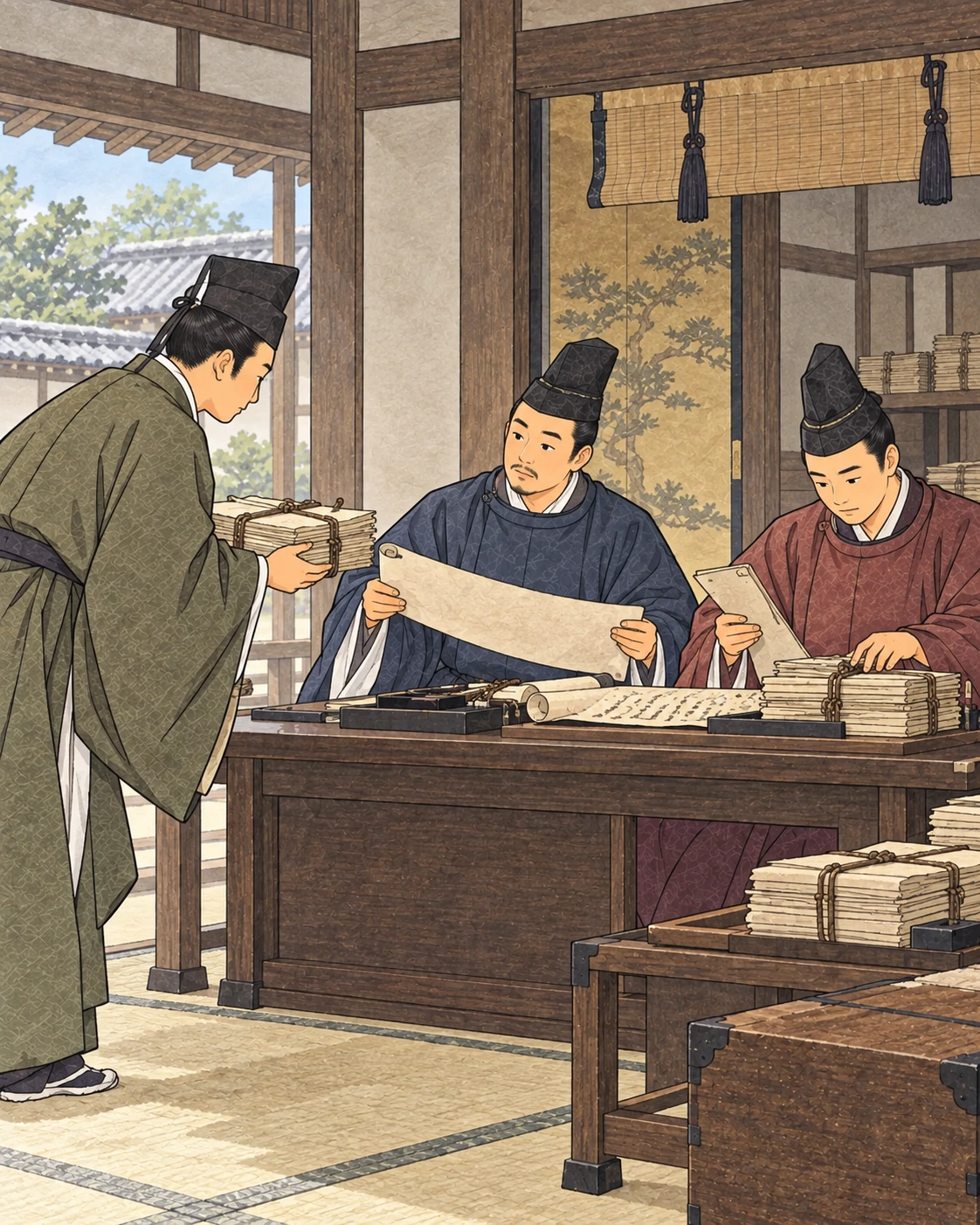
Later in 1069 a central record office, the Kiroku Shōen Kenkeijo, was established. Estate holders and provincial governments had to submit evidence to it. Officials examined the documents, and central decisions determined whether individual estates would continue or be stopped. Provincial government became a party whose claims could be judged alongside those of a temple or aristocratic holder. The procedure changed who could decide a dispute, as well as what documents were needed. [4]
Historical disagreement · Did the Fujiwara comply with estate scrutiny?
A policy of scrutiny could confirm privileges. Holders whose evidence supported their claims acquired recognized standing, while other claims were rejected. Accounts that describe the leading Fujiwara household refusing to submit documents coexist with scholarly judgments that it ultimately followed the policy. Kuroita Nobuo's reference biography regards the measure as substantially effective.
The evidence does not support making every estate a confiscated possession. [1] [5]
Historical interpretation · How effective was estate review?
Effectiveness also has more than one scale. Shimomukai Tatsuhiko emphasizes the authority acquired by the decisions while noting that subsequent disputes reopened questions they were meant to fix.
From the record office's operation one can establish a stronger central procedure; from continuing conflict one sees its limits. The reign helped shape the distinction between estates and public land through judgment and documentation, while leaving a contested system for successors. [4] [5]
Go-Sanjō's administration also addressed the flow of provisions to court offices. In the sixth month of Japan’s traditional calendar in 1069, the government required reports of annual needs. Important expenses that had been supplied through orders issued as occasions arose were assigned more permanent provincial sources. Shimomukai describes this as a wider application of an existing allocation mechanism. The policy gave recurring needs an identified claim on supply, connecting reform to the requirements of operating institutions. [4]
Historical disagreement · The capacity of the prescribed measure
Measures mattered when obligations were expressed in quantities. A standard masu, a container used to measure volume, is associated with Go-Sanjō's prescription in 1072.
Historical accounts of its capacity differ, and the surviving references do not justify converting it into one uncontested modern volume. Its authority as a prescribed measure nevertheless gave a common reference among the different containers in use. Kawashima Shigehiro also connects the reign's land records and levies to the developing estate and public-land order. [2] [16]
Government required buildings as well as quantities. On Go-Sanjō's accession, important parts of the imperial palace remained unreconstructed after earlier fires. He first began work on the Daigokuden, its great ceremonial hall. Since his accession ceremony used the Council of State's compound, the hall's completion became less urgent than it might have been. The emperor's residence was finished in 1071; the Daigokuden and its ceremonial precinct were completed in 1072. [7]
The timing involved calendrical prohibitions interpreted through Onmyōdō, practices of divination and calendar judgment. In 1069 advisers considered whether the year allowed the major work of erecting pillars and raising beams. The decision avoided that year's construction of the principal residence. Work began in 1070, but its pillars and beams were raised in 1071. Other buildings did not necessarily fall under the same prohibition. Different parts of the reconstruction could proceed on different schedules. [7]
Historical interpretation · Why did construction wait?
Takuma Naoki suggests that delay also allowed preparation and the assignment of construction obligations to provinces, drawing a comparison with Go-Sanjō's father's rebuilding.
That logistical connection is the historian's interpretation of the course of work. The documented sequence itself shows an emperor operating through advisers, provincial resources and construction stages. During the same short reign, policy changed the means of supply and restored the spaces where residence and ceremony took place. [4] [7]
Historical interpretation · A possible copying error
Go-Sanjō's initiatives also included military authority directed toward the north. In 1069 he visited Iwashimizu Hachiman Shrine and offered the Great Perfection of Wisdom scripture in connection with prayers for campaigning. The surviving shrine account, known through a later copy, associates the prayer with Minamoto no Yoriyoshi. The official Hirosaki history considers whether the name may instead refer to Yoritoshi and the approaching northern operation.
Its proposed correction is an interpretation of the transmitted record. [9]
Minamoto no Yoritoshi, governor of Mutsu in northern Honshū, held imperial authorization to lead the campaign of 1070. Central authority required a provincial commander and locally assembled forces. The exact size, composition and routes of that army remain uncertain. The Hirosaki history reconstructs possible operations through the surviving reports, while distinguishing those possibilities from a complete account of movements on the ground. [9] [10]
Conflict in the provincial headquarters interrupted command. Fujiwara no Motomichi took the governor's seals and keys, then fled to Minamoto no Yoshiie, governor of neighboring Shimotsuke. Seals and keys represented the tools of provincial authority and access to its stores. The court accepted the request to recall Yoritoshi and withdrew his campaign command. The emperor's authorized operation had become entangled with an internal administrative crisis and another military noble's intervention. [10]
Evidence boundary · Victory claims and a conjectured plot
The surviving evidence includes an official response in 1071 to Yoritoshi's campaign report and his own petition of 1086 seeking a new governorship. The later petition stresses earlier military achievement. It is also a document written to obtain an appointment. The history compares its claims with the earlier report, which describes captives and casualties without securely naming all conquered places. Assertions of victory do not settle the geographical extent of control. [10]
The official history discusses the possibility of a plot by Yoshiie against his rival, while acknowledging that it rests on circumstances. The administrative seizure and Yoritoshi's removal are stronger points than that explanation of hidden responsibility. Go-Sanjō's government could authorize and recall, but its initiative depended on institutions and people far from Kyoto.
Neither the campaign's recorded claims nor its later retelling establishes a completed conquest of the whole northern region. [10]
Go-Sanjō founded Ensō-ji near Ninna-ji in western Kyoto in 1070. The foundation belonged to a group of four royal temples whose names began with the character for “en,” or circle. It was the last of those four and formed part of a religious landscape tied closely to Ninna-ji. Temple construction gave the sovereign's patronage a setting for recurring rites, amid the other building and fiscal projects of his reign. [8]
In 1072 he attended the Saishō and Hokke assemblies at the temple. The foundation combined prayer for the patron and commemorative purposes with protection of the state. The Japanese Historical Society's account connects that character to Michinaga's earlier Hōjō-ji and to Shirakawa's later Hōsshō-ji. It situates Go-Sanjō's patronage within a sequence of aristocratic and royal religious institutions. [1] [8]
The assemblies did more than represent imperial devotion. They supplied new opportunities for Tendai monks to advance. Participation in a recurring royal rite could affect standing within the religious community. Buildings, ceremonies and clerical careers therefore joined in the foundation's operation. This is a specific religious consequence of Go-Sanjō's initiative, separate from claims about the private depth of his faith. [8]
Evidence boundary · Recovering a lost foundation
Later historians have also considered the four temples as connected to royal residences within Ninna-ji's institutional sphere. Their scale and layout remain under reconsideration. Ensō-ji collapsed in 1369 and disappeared, making the exact location and extent difficult to recover.
Records and archaeological traces give partial access to a large foundation whose fabric does not survive intact. [8]
Its later loss belongs to communities after the founder's life. During Go-Sanjō's reign, the temple was a functioning addition to royal religious patronage and the organization of clerical advancement. The connection to later Hōsshō-ji helps trace an institutional development, while retaining Ensō-ji's own place and rites. It leaves a religious legacy alongside the land and financial procedures inherited by the next reign. [8]
Near the end of the Japanese year 1072, Go-Sanjō transferred the throne to Sadahito, who became Emperor Shirakawa. At the same time, he made another son, Jitsuhito, crown prince. Jitsuhito was a son of Minamoto no Motoko, who also bore Sukehito in 1073. Shirakawa's mother, Shigeko, had died ten years earlier. Different maternal households stood around the emperor's children, and the recognized heir came from Motoko's household. [19] [3] [12] [13]
The designation had force beyond a transfer of titles. Shirakawa received the reigning office while his half-brother occupied the recognized succession position. His own children could not simply be presumed to inherit the throne next. Later accounts connect the intended sequence with Sukehito as well, though paternal expectation and the enforceability of a future sequence are different questions. Go-Sanjō's arrangement shaped options that survivors would have to confront. [18] [3] [13]
Historical disagreement · Why did Go-Sanjō abdicate?
His purpose in abdicating has long been debated. The Yamakawa reference account emphasizes making Jitsuhito heir and sees a tendency toward retired-sovereign government. Kuroita and Kawashima retain uncertainty over whether Go-Sanjō intended to govern in retirement.
The formal transfer and designation are clearer than a complete plan for the later institution of insei. These interpretations concern what abdication was meant to permit, not disagreement over the existence of the succession. [1] [2] [3]
Go-Sanjō became ill, took Buddhist vows and died in 1073, only months after abdication. Illness and the short interval ended his opportunity to develop a sustained course of retired rule. His own diary survives in fragments, and later reference to it does not restore a continuous account of his decisions. [1] [3]
Shirakawa inherited practices and problems: central examination of estates, the material administration of court, religious patronage and a succession that constrained his direct line. Later insei, government by a retired sovereign, developed through further choices and conditions. Go-Sanjō's brief reign provided important procedures and relationships, while his death left their continuation to people whose careers would take a different course. [1] [3] [4] [8]