

Muromachi period
Emperor Go-Murakami
後村上天皇
Overview
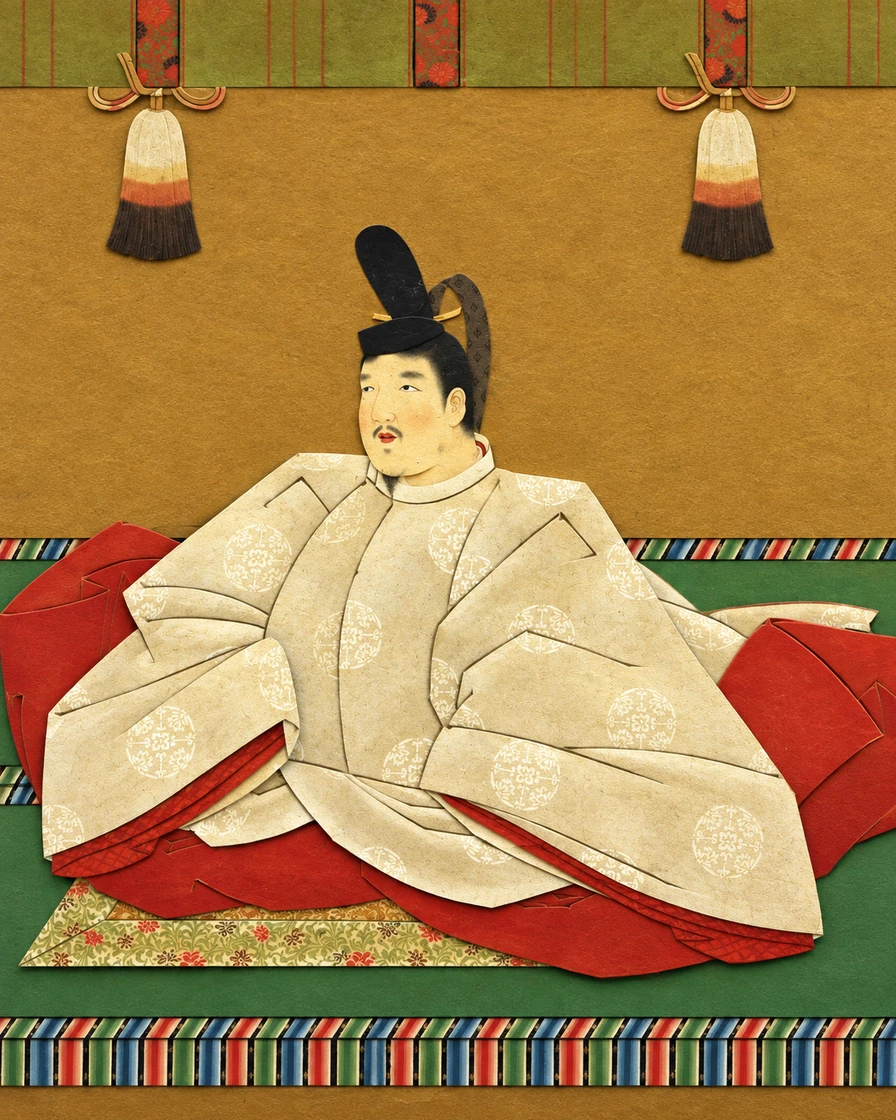
Emperor Go-Murakami (1328–1368), the son of Go-Daigo and Anō Renshi, spent part of his childhood far from the capital. In 1333 he traveled to Mutsu in northeastern Japan with Kitabatake Akiie, whose provincial government supported the new imperial regime. Their position depended on local warriors as well as recognition from court. An attempted voyage east in 1338 was disrupted by a storm, and the prince returned without reaching the intended base. [S01]
He succeeded his father at Yoshino in 1339 as ruler of the Southern Court, which contested the Kyoto court supported by the Ashikaga. Fighting repeatedly forced his household to move, including to Anō and places in Kawachi, south of Osaka. Courtiers, religious houses and warrior supporters enabled government to continue from changing residences. Efforts to recover Kyoto produced no durable return. The court’s survival required maintaining those connections while its military fortunes shifted. [S01]
Surviving letters, dated by their contents to about 1361–1362, show the emperor discussing arms, appointments and the movements of Ashikaga commanders. They also preserve concerns about illness and music, placing ordinary court relationships beside military business. Go-Murakami died at Sumiyoshi in 1368. Some of his letters were later joined and reused for memorial scripture. These remains connect a reign remembered through war and displacement with a ruler still attending to people, equipment and court culture. [S02, S01]
Sources and notes ViewHide
- [1]
後村上天皇 — 日本大百科全書 / 世界大百科事典黒田弘子 (Kuroda Hiroko); 飯倉晴武 (Iikura Harutake)
- [2]
後村上天皇宸翰書状Agency for Cultural Affairs
Emperor Go-Murakami (1328–1368), the son of Go-Daigo and Anō Renshi, spent part
traveled to Mutsu in northeastern Japan with Kitabatake Akiie, whose provincial government
An attempted voyage east in 1338 was disrupted by a storm, and
succeeded his father at Yoshino in 1339 as ruler of the Southern
Connections
Places
No linked places yet.
Events
Go-Daigo Establishes a Rival Court at Yoshino
吉野の南朝成立
In 1336, Go-Daigo left Ashikaga-controlled Kyoto for Yoshino and upheld his imperial claim against Kōmyō’s court, beginning the sustained division between the Southern and Northern Courts.
Relationships
Topics
Yoshino: When the Temples Became a Court
A displaced imperial household found a home in a religious landscape. Its hosts later gave that household's absence an enduring form.
Read