Read the article below. Interactive reading tools are available when scripts load.
Quick
Yoshiaki was born in 1537, a son of Ashikaga Yoshiharu, the twelfth Muromachi shogun. As a child he entered Ichijō-in, an aristocratic monastic house within Kōfuku-ji in Nara. Known as Kakukei, he became its head in 1562. His elder brother Yoshiteru held the shogunate, the Kyoto-centered military government. Yoshiteru’s killing in 1565 made the monk a potential successor and placed him under confinement. Retainers including Hosokawa Fujitaka helped him escape to Ōmi, in present-day Shiga Prefecture. In 1566 he left religious life and began using the name Yoshiaki, first written 義秋. He now needed allies who could support a claim to his brother’s office. [1][2][13][14][3]
Yoshiaki sought support for his claim while a rival member of the Ashikaga family, Yoshihide, competed for the shogunate. He moved through Wakasa to Echizen, in present-day Fukui, where Asakura Yoshikage sheltered him. Followers gathered around him, and records of his stay show a household already arranged into offices. He appealed to powerful regional lords for help reaching Kyoto. In 1568 he adopted the written form 義昭 and found a military partner in Oda Nobunaga. Nobunaga defeated resistance along the route through Ōmi and pushed Miyoshi forces from the capital region. Yoshiaki entered Kyoto and received the imperial appointment as shogun that year. The return joined his family authority and officials to Nobunaga’s army. [2][1][3][4][8][6]
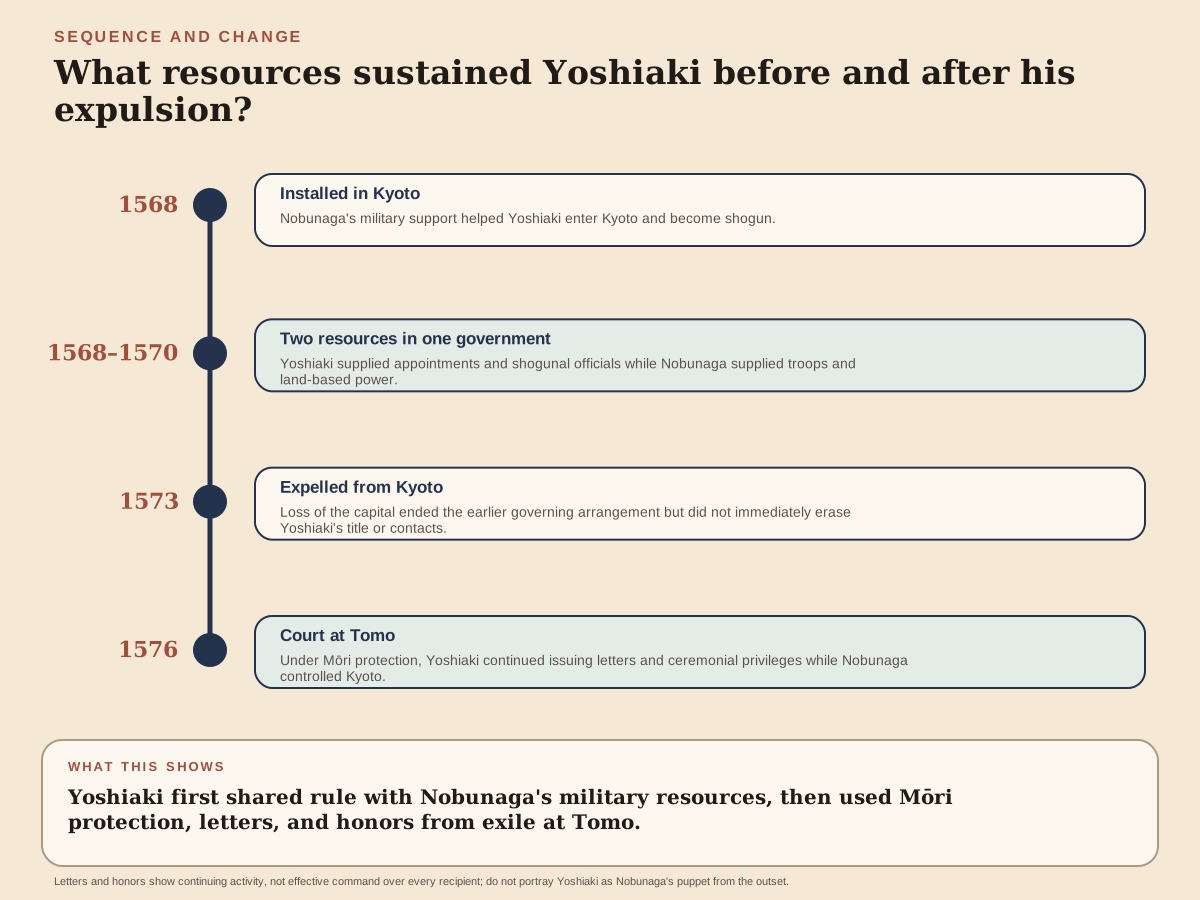
Yoshiaki’s government drew on Ashikaga retainers and Oda commanders. His court appointment and family connections gave the return a recognized political form, while Nobunaga supplied military support. Officials handled access to the shogun, petitions and correspondence. Regulations issued in 1569 required disputes to pass through designated officials and prohibited unauthorized seizures of temple and estate property. An agreement of 1570 required provincial shogunal letters to be discussed with Nobunaga. It also envisaged rewards drawn from Nobunaga’s lands when the shogun lacked resources of his own. Cooperation therefore touched ordinary governing work as well as the protection of Kyoto. [3][4][6][5]
The partnership became harder to sustain as Nobunaga fought regional and religious opponents. Yoshiaki’s advisers were divided over their relationship with him. A letter dated by researchers to 1572 shows Nobunaga maintaining contact with Hosokawa Fujitaka and asking him to recruit local lords. Yoshiaki meanwhile sought Takeda Shingen’s help in mediating the conflict with Honganji, a powerful Buddhist institution. Attempts to manage the wider fighting drew more rulers into the struggle. Nobunaga presented the shogun with a severe remonstrance criticizing his correspondence, rewards and finances. Those complaints expressed the patron’s position, while the eventual break reflected a struggle involving the shogun and his advisers. In early 1573 Yoshiaki moved into armed opposition. [4][6][5][7]
Nobunaga brought military pressure against Yoshiaki in 1573, burning areas around Kyoto and part of the city. Imperial envoys helped arrange a temporary reconciliation. Yoshiaki later renewed resistance from Makishima, south of Kyoto near the Uji River. Oda forces crossed the river and attacked his position. He surrendered his young son as a hostage and left for Wakae in Kawachi, in present-day Osaka Prefecture. Nobunaga retained control of Kyoto, ending Yoshiaki’s government in the capital. The expulsion conventionally marks the Muromachi shogunate’s end, although Yoshiaki continued political efforts from outside the city. [7][8][2][1][12]
Yoshiaki moved by sea from Yura to Tomo in 1576. The port lay in Bingo, in present-day Hiroshima Prefecture, under the protection of Mōri Terumoto. From there he sent public letters in the shogun’s name and sought help recovering his Kyoto position. A surviving letter promoted peace among the Hōjō, Takeda and Uesugi families. Other documents granted ceremonial privileges in gratitude for local support. When Akechi Mitsuhide killed Nobunaga at Honnō-ji in 1582, Yoshiaki again appealed for a return. The death of his opponent did not produce the Mōri commitment or wider political settlement needed to restore him. His next accommodation would be with Hideyoshi, who had become the stronger contender for power. [12][9][10][11]
Yoshiaki eventually made an accommodation with Toyotomi Hideyoshi. He met Hideyoshi in Bingo during the latter’s Kyushu campaign in 1587 and helped with negotiations. His return to the capital region came during the transition of 1587–1588. In 1588 he took Buddhist vows and became known as Shōzan Dōkyū. Hideyoshi provided an income valued at ten thousand koku, the rice measure used to assess landed revenues. In 1592 Yoshiaki attended Hideyoshi’s headquarters at Nagoya in Hizen during the invasion of Korea. He died in Osaka in 1597. The former shogun’s final years preserved rank and material support within the order that had replaced his own. [2][12][1]
Classic
Born in 1537, Yoshiaki was a son of Shogun Ashikaga Yoshiharu and the younger brother of Yoshiteru, who would succeed to the shogunate. His mother belonged to the Konoe court family. In 1542 he entered Ichijō-in at Kōfuku-ji in Nara, taking the religious name Kakukei. Ichijō-in was an aristocratic monastic house closely connected with the Konoe. Its heads belonged to the elite world of court-linked temples and helped administer Kōfuku-ji alongside the rival house of Daijō-in. The institution held estates, subordinate houses and market privileges, giving its headship material as well as religious importance. [1][2][13][14]
Kakukei became the head of Ichijō-in in 1562. He had spent much of his early life within that institution rather than in command of a territorial army. In 1565 his elder brother, Shogun Yoshiteru, was killed in an attack by Miyoshi forces. Kakukei was confined in Nara but survived. The killing left former shogunal retainers seeking a successor from the Ashikaga house. His position as Yoshiteru’s brother made him a possible center for their efforts. [2][13][1][14][3]
Hosokawa Fujitaka and other retainers helped Kakukei escape, and he reached Wada Koremasa’s base in Ōmi. His subsequent letters thanked Fujitaka and Isshiki Fujinaga for their service. The men who had served his brother now helped him move and communicate. In 1566 he returned to lay life and took the name Yoshiaki, initially written 義秋. His claim to become shogun put those existing connections to a new purpose, while the route to Kyoto remained in the hands of other powers. [1][2][3][4]
Yoshiaki’s move into secular politics did not bring immediate access to Kyoto. Ashikaga Yoshihide was a competing claimant supported by the Miyoshi side. After leaving Ōmi, Yoshiaki traveled through Wakasa to Echizen and placed himself under Asakura Yoshikage’s protection. His requests for support reached several regional rulers, including Uesugi Kenshin, Takeda Shingen and Mōri Motonari. The household could issue appeals from refuge, but its return depended on someone willing and able to make a military intervention. [1][2][3][4]
A record of Yoshiaki’s formal visit to Asakura Yoshikage in 1568 lists attendants, intermediaries, guards and scribal personnel. These were organized responsibilities within an Ashikaga household seeking political recovery. Yamada’s study relates that arrangement to the offices later used in Yoshiaki’s Kyoto government. It also distinguishes direct evidence of followers’ service from the fuller lists supplied by later war narratives. The people accompanying a ruler in ceremony and those conveying his political decisions did not necessarily perform the same work. [3]
Yoshiaki changed the written form of his name to 義昭 in 1568 and moved into Nobunaga’s protection. Nobunaga’s base in Mino gave his army a route toward Kyoto through Ōmi. His forces defeated the Rokkaku and then Miyoshi positions around the capital. Yoshiaki entered Kyoto and was appointed shogun by the imperial court. The men who had attended him in refuge could now take part in government with a military patron whose forces had made the return possible. [1][2][4][8][3][6]
The government established in 1568 joined Yoshiaki’s court appointment, Ashikaga household and provincial connections with Nobunaga’s military strength. Both shogunal retainers and Oda men participated in governing the capital region. Hosokawa Fujitaka and Akechi Mitsuhide worked alongside men such as Murai Sadakatsu and Kinoshita Tōkichirō, later Toyotomi Hideyoshi. Ōta Gyūichi’s account describes Yoshiaki thanking Nobunaga and permitting him to use prestigious crests after the return. It also records a Noh theatrical performance celebrating the campaign’s participants, placing political service within a courtly ceremonial setting. [3][4][6][8]
In 1569 Nobunaga had a residence built for Yoshiaki at Nijō in Kyoto. Murai Sadakatsu and another Oda official, Shimada, supervised construction, with craftspeople summoned from the city and timber brought from surrounding areas. The fortified residence gave the shogunal household a physical seat that required another ruler’s resources to construct. Mitsuhide and Murai also became involved in Kyoto’s civilian administration. Their joint-letter and rice-trade-regulation copies survive among documents connected with Manjūyamachi, a city neighborhood. The local records place governing work among town institutions as well as in the shogun’s residence. [8][15]
The 1569 palace regulations prescribed attendance and the use of designated intermediaries to present business. They prohibited private approaches in litigation and directed complainants through the officials responsible for handling cases. Additional clauses prohibited unjustified occupation of temple and estate owners’ current holdings. These prescriptions addressed access to the ruler, property disputes and the conduct of men attached to government. They asserted procedures by which the shogunal household should hear business; enforcement depended on the officials and holders involved. [5]
Historical disagreement · Was Yoshiaki merely Nobunaga’s puppet?
The 1570 articles required Yoshiaki to inform Nobunaga when issuing provincial letters, so that Nobunaga could add a letter of his own. They also provided for rewards from Oda-controlled land if Yoshiaki wished to reward service but lacked holdings to assign. The same arrangement gave Nobunaga broad discretion over restoring order. Recent research has increasingly treated the two men’s government as a working partnership, with complementary sources of authority, rather than reducing Yoshiaki to a passive figure. [5][3][6]
The regulations of 1570 connected Yoshiaki’s decisions to a military partner fighting opponents in several regions. Regional lords of the Azai and Asakura houses, along with followers of Honganji, a powerful Buddhist institution, resisted Nobunaga, with interests and commitments of their own. The shogun’s household also contained men whose relationships with Nobunaga differed. A newly identified letter assigned to 1572 shows Nobunaga thanking Hosokawa Fujitaka for continued gifts and communication when contact with other shogunal retainers had broken down. Nobunaga asked Fujitaka to bring local lords in the provinces south of Kyoto into his following. The request put a man close to Yoshiaki to work strengthening Nobunaga’s regional connections. [4][5][6]
Historical disagreement · Who built the opposition to Nobunaga?
The familiar encirclement interpretation makes Yoshiaki the coordinator of a common anti-Nobunaga front. Inaba Tsuguharu’s 2024 Kumamoto research report instead reconstructs an alliance that changed through negotiation and successive conflicts. Yoshiaki asked Takeda Shingen to mediate between Nobunaga and Honganji in 1572; Shingen’s later campaigning helped turn that attempted mediation into armed opposition.
The disagreement concerns the sequence and purpose of the contacts. The report’s revised dating of letters and Nobunaga’s seventeen-article remonstrance weakens the picture of a single plan directed by Yoshiaki from the outset; it does not erase his eventual choice of armed resistance. [6]
Nobunaga’s seventeen-article remonstrance, placed late in 1572 by that report, criticized unauthorized letters, inadequate rewards, income handling and the sale of stored rice. The charges reveal what Nobunaga wanted to challenge; they do not establish every allegation of misconduct as fact. [6][5]
In early 1573 Yoshiaki chose armed opposition and sought support beyond Nobunaga’s camp. Nobunaga’s letters blamed hostile advisers for the shogun’s change of course while preserving Fujitaka as an intermediary. He still described reconciliation with Yoshiaki as a means of restoring government. That language expressed Nobunaga’s view and kept negotiation available even as military preparations developed. The choices of the shogun, his advisers and provincial lords now determined whether another settlement could survive. [6][7]
Nobunaga’s army advanced against Yoshiaki in 1573 and used burning to pressure him. Destruction reached areas outside Kyoto and then the upper city, while the shogun’s residence was placed under military threat. The University of Tokyo’s source summary describes lower Kyoto submitting and escaping the same destruction. Residents faced the consequences of competing authorities seeking to control the capital. Imperial envoys were sent to the opposing sides, and a reconciliation was reached in the fourth traditional month. Pledges followed, temporarily preserving the possibility of continued cooperation. [7][8]
Yoshiaki again resisted Nobunaga and moved his principal position to Makishima by the Uji River. In the seventh traditional month, Oda forces approached and crossed the river from two directions. Their attack broke the outer defenses, leaving the shogun unable to hold the position. He surrendered, and his young son was kept as a hostage. Ōta Gyūichi’s account describes Hideyoshi escorting him to Wakae Castle in Kawachi. The loss of his capital seat and the surrender of his child made defeat a change in his household’s condition as well as in the government. [2][8]
Nobunaga controlled Kyoto after Yoshiaki’s departure and placed Murai Sadakatsu in charge of affairs there. The shogun’s offices and provincial connections could no longer operate from the capital as they had since 1568. The year 1573 therefore remains the conventional endpoint of the Muromachi shogunate. Yoshiaki himself survived with followers and a claim to return. After moving through other places, he established himself at Kōkoku-ji in Yura, in present-day Wakayama. Correspondence could now reach potential supporters from a place of refuge, with recovery dependent on another provincial alliance. [8][3][7][1][2][10][12]
In 1576 Yoshiaki traveled by sea from Yura to Tomo, a port in Bingo on the Inland Sea. Mōri Terumoto protected him, and followers accompanied the household. Its location gave appeals for a return to Kyoto a provincial base with access to maritime routes. His officials and supporters remained part of the work of issuing and carrying letters. The title “Tomo shogunate,” sometimes used for this activity, describes a government operating away from its former capital, whose recovery depended on provincial support. [12][10][11][13]
Evidence boundary · Identifying an unnamed recipient
A document displayed by Hiroshima’s historical museum grants the right to use a white umbrella bag and a cloth saddle cover in thanks for support at Tomo. These were visible privileges restricted to recognized holders.
The recipient’s name is no longer present; museum scholars suggest a member of the local Murakami family from the document’s wording and parallels. A comparable grant names a local Murakami lord connected with the port. Yoshiaki could reward a host by authorizing an honor drawn from the shogunal order. The grant addressed a practical dependency of exile while retaining the forms of a ruler who recognized service. [10][12]
A letter conventionally assigned to 1576 and addressed to Hōjō Ujinori promoted peace among the Hōjō, Takeda and Uesugi. These eastern families were potential participants in a wider political alignment. The letter was a gonaisho: a direct shogunal letter conveying public business in the form of personal correspondence. Ujinori handled diplomacy toward western Japan within the Hōjō house, providing a route into its decisions. The appeal records an effort to bring the families together, while their actual willingness to cooperate remained their own. Yonezawa’s collection also preserves a 1576 shogunal letter alongside a supplementary letter signed by Makishima Akimitsu and Isshiki Akihide, showing officials supporting the correspondence. [9][2][12][13]
Evidence boundary · Claiming Nobunaga’s defeat
Nobunaga’s death at Honnō-ji in 1582 led Yoshiaki to renew appeals for a return to Kyoto. A letter to the Mōri naval commander Nomi Munekatsu claimed Nobunaga’s defeat and called for further service from Terumoto and Kobayakawa Takakage.
Its wording appropriated the event for Yoshiaki’s political claim; it does not establish that he had directed Mitsuhide’s attack. The proposed return again required forces and cooperation that his household could not supply alone. The appeal did not bring the Mōri into action on his behalf, and the wider struggle turned toward Hideyoshi. [11][12]
Historical disagreement · Dating the return from exile
Yoshiaki’s efforts after Nobunaga’s death had not restored his Kyoto government. By 1587 Hideyoshi’s military and political position supplied a different route out of provincial refuge. Yoshiaki met him in Bingo as the Kyushu campaign proceeded and cooperated in negotiations connected with the Shimazu.
He returned to the capital region during 1587–1588; accounts differ in how they date that transition. His return took place within Hideyoshi’s order rather than as the recovery of his former independent government. [2][12]
In 1588 Yoshiaki took Buddhist vows and used the name Shōzan Dōkyū. He received high court honor and an income assessed at ten thousand koku of rice, a measure used to value landed revenues. He had spent years seeking restoration while continuing to use a shogunal identity outside Kyoto. Religious retirement and accommodation with Hideyoshi gave the surviving man a place after the capital government’s conventional end in 1573. [2][12][10][11]
In 1592 Yoshiaki joined Hideyoshi’s headquarters at Nagoya in Hizen during the invasion of Korea. The headquarters stood in what is now Saga Prefecture, on the Japanese side of the campaign. He died in Osaka in 1597, still receiving the status and support arranged after his return. Twenty-four years had passed since the military defeat that ended his Kyoto government. Those years included continued attempts to recover power and finally a life sustained within another ruler’s settlement. [1][2][12]